

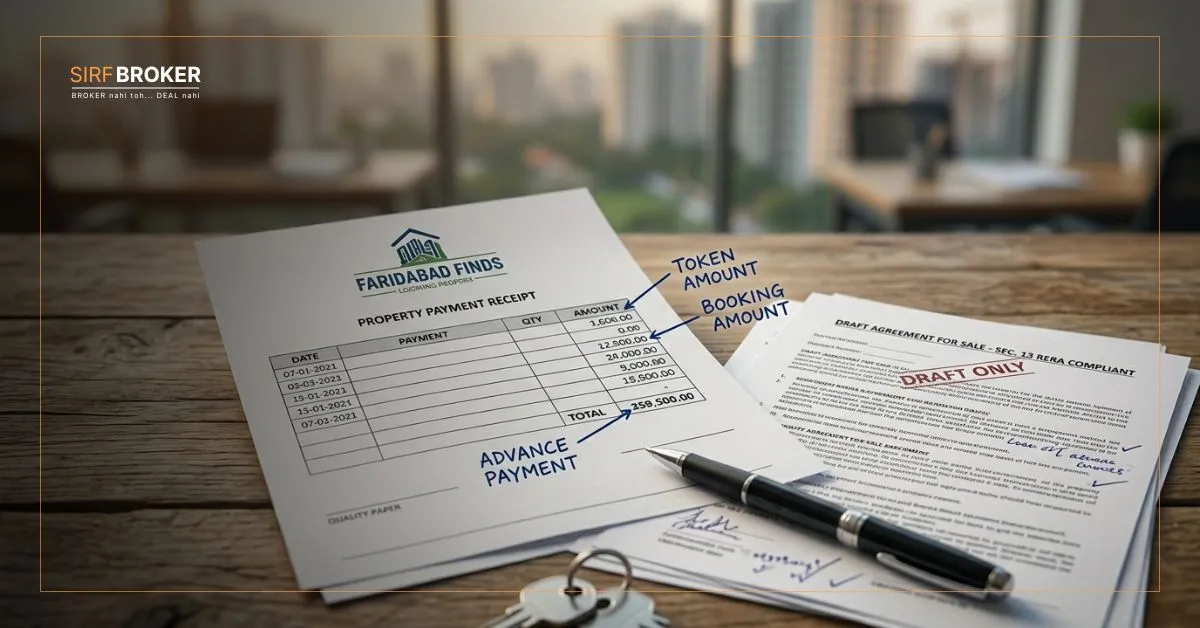
In property conversations, three payment terms get mixed up all the time:
- booking amount
- advance payment
- token amount
Many people use them as if they mean the same thing.
They do not.
Sometimes the difference is practical. Sometimes it is legal. Sometimes it is just market language being used loosely. And that is exactly why buyers, sellers, and brokers get confused at the wrong stage of the deal.
One person says, “Pay token to block it.”
Another says, “This is just booking amount.”
Someone else calls it advance payment.
Then later, when the transaction slows down or the deal changes, people realise they were never fully clear on what that money was supposed to mean in the first place.
That is risky.
Because once money moves in a property transaction, expectations harden very quickly. The emotional seriousness of the deal increases even if the legal transfer has not happened yet. And under Indian property law, that distinction matters a lot: a contract for sale does not by itself create any interest in or charge on the property. In other words, paying an early amount is not the same as becoming the owner.
That is why these three terms should be understood properly.
Not as loose market slang.
As transaction stages.
First, the most important point: these terms are often used differently in different deals
Before defining each one, one thing should be clear.
There is no single universal market rule that makes every booking amount, token amount, and advance payment identical across all property transactions in India. In practice, different builders, brokers, sellers, and local markets may use these words differently. That is exactly why the written document and the stage of the transaction matter more than the label alone. Housing.com notes this explicitly in the context of token money and similar early-stage payments, pointing out that market practice varies and there are no fixed written rules for token amount in all real-estate transactions.
So the right way to understand these terms is not by asking, “What do people call it?”
The better question is:
At what stage is the payment being made, and what is that payment supposed to do?
That is the real distinction.
A simple way to understand the difference
Before going into the details, here is the cleanest summary:
| Term | What it usually means | Where it commonly appears |
| Token amount | A smaller early amount paid to show serious intent and move the deal beyond a verbal discussion | Resale deals, broker-led deals, early negotiations |
| Booking amount | Amount paid to reserve or apply for a specific unit, often in builder or project-led sales | Under-construction or builder-led transactions |
| Advance payment | A broader term for any money paid before final completion of the sale, often as part of the total consideration | Can include booking amount, token, or later-stage pre-completion payment |
This table is useful, but it still needs context.
Because in real life, the difference is not only about the amount. It is about the purpose and stage of the money.
What is token amount in real estate?
In common Indian real-estate practice, token money is usually the early amount a buyer pays to show genuine intent and take the discussion beyond a verbal understanding. ICICI Bank describes token money as an advance amount or part of the sale consideration paid as assurance for the transaction, while Housing.com describes it as the advance amount paid after a verbal agreement to buy the property. Housing.com also notes that people may refer to it by names like earnest money, bayana, goodwill amount, or even booking amount in some markets.
That is exactly why confusion begins.
In many resale-property conversations, token money is the first serious monetary signal in the deal. It is often paid before the full agreement and before registration. Its job is usually to show seriousness and hold the conversation in place while the transaction moves to the next stage.
What token amount usually does
- shows the buyer is serious,
- signals the seller not to treat the property as completely open,
- and pushes the deal toward documentation or the next formal step.
What token amount does not do
It does not transfer ownership.
That distinction is not just practical — it is legal. Under Section 54 of the Transfer of Property Act, a contract for sale does not by itself create any interest in or charge on the property.
So token money may make the deal more serious. It does not make the buyer the owner.
That is the first major thing people need to understand.
What is booking amount in real estate?
The term booking amount is most commonly used in builder-led or project sales, where the buyer is trying to reserve or apply for a particular unit.
This is different from the typical resale-style “token” conversation, where the early amount is often linked to a direct negotiation between buyer and seller. In builder sales, the booking amount is usually connected to:
- reservation of a specific unit,
- application for allotment,
- or the beginning of the allotment process.
This is also where the legal framework becomes more visible.
Under Section 13 of the Real Estate (Regulation and Development) Act, 2016, a promoter cannot accept more than 10% of the cost of the apartment, plot, or building as an advance payment or application fee without first entering into a written agreement for sale. The RERA FAQ also reflects this rule directly.
That matters because builder-side booking payments are not supposed to float around as vague early money forever. Once the promoter crosses that threshold, the law expects the next documented stage — the written agreement for sale.
In simple terms
A booking amount is usually a unit-reservation-stage payment in project or builder transactions.
It may function like an early commitment amount, but it is more closely linked to booking a specific unit than the looser resale-style token practice.
What is advance payment in real estate?
This is the broadest of the three terms.
Advance payment is not always one specific market-stage word. It is a wider expression that can refer to any money paid before the final completion of the sale. In legal and registration language, the concept is broad enough to include earnest money, part purchase money, or other amounts paid before completion.
The Registration Act is helpful here. It makes clear that a document operating as a contract for sale does not require registration merely because it contains a recital of the payment of earnest money or the whole or any part of the purchase money. That tells you something important: Indian property law recognises that money may be paid in advance of final transfer in different forms and stages.
Under RERA Section 13, the law also uses the phrase advance payment or application fee in connection with what a promoter can take before executing an agreement for sale.
So “advance payment” is usually the umbrella term.
In practice, advance payment may include:
- token amount,
- booking amount,
- part payment before agreement,
- or an early stage payment that forms part of the total sale consideration.
That is why “advance payment” often overlaps with the other two terms.
It is broader, not always more precise.
So what is the real difference?
This is the cleanest way to separate them:
1. Token amount
Usually an early seriousness payment, often seen in resale or broker-led direct deals.
2. Booking amount
Usually a reservation-stage payment for a specific unit, more common in builder / project-led deals.
3. Advance payment
A broader expression covering money paid before final transfer, and it may include either of the above depending on how the deal is structured.
So if someone asks:
Is booking amount the same as token amount?
The honest answer is:
Not always. Sometimes people use them loosely, but in practice booking amount usually sounds more project / allotment linked, while token amount usually sounds more early-negotiation linked.
And if someone asks:
Is token amount an advance payment?
Then yes — in a broad transaction sense, it usually is.
That is why these terms overlap but should not be treated as identical.
Why people get confused between these terms
The confusion usually comes from three places.
1. Market language is loose
Different cities, brokers, builders, and sellers use different words for similar early-stage payments. Housing.com notes that token money can be referred to by several names in practice, including earnest money and booking amount.
2. The amount may come early, before full documentation
Since all three can appear before final registration, people assume they are the same thing.
3. The written paper is often weaker than the spoken conversation
Instead of carefully documenting the payment purpose, people say:
- “This is just booking.”
- “This is token.”
- “This is advance.”
Then later, when the transaction changes, nobody agrees on what that payment was supposed to do.
That is where problems begin.
Which one comes first in a typical property transaction?
There is no single national template, but in common market practice:
In many resale deals
The token amount may come first, followed by:
- document comfort,
- a written agreement,
- and then later sale deed / registration stages.
In many builder-led transactions
The booking amount or application-stage amount may come first, followed by:
- allotment process,
- agreement for sale,
- and later stage-wise payments.
In both cases
All of this still falls under the wider category of advance money paid before final transfer.
That is why the correct question is not “What word was used?”
It is “What stage are we in, and what written condition is attached to this payment?”
A payment label is weaker than the written terms
This is one of the most important practical lessons in the whole topic.
A lot of people argue later about whether something was:
- token,
- booking,
- earnest,
- advance,
- goodwill,
- or bayana.
That argument matters less than they think.
What matters more is:
- was it written down,
- what did the writing say,
- what was the next stage,
- what was the cancellation position,
- and what were both sides actually committing to?
ICICI Bank recommends recording the token-money stage properly through a receipt, MOU, notarised understanding, or sale agreement, including the parties, property details, amount, timelines, and termination / refund conditions.
That principle applies more broadly to all early-stage money.
If the paper is weak, the label will not save you later.
Does any of these payments create ownership?
This needs to be stated very clearly.
No. Not by themselves.
Under Section 54 of the Transfer of Property Act, even a contract for sale does not by itself create any interest in or charge on the property.
That means:
- token amount does not create ownership,
- booking amount does not create ownership,
- advance payment does not create ownership.
These payments can create seriousness, rights under contract, obligations, and stronger expectations. But they are not the same thing as final transfer.
This is exactly why buyers should be careful not to become emotionally overcommitted just because “money has been paid.”
Money may move before ownership does.
And that difference matters.
When does the 10% RERA rule matter?
This is especially relevant in builder/project transactions.
Under Section 13 of RERA, a promoter cannot accept more than 10% of the cost of the apartment, plot, or building as an advance payment or application fee without first entering into a written agreement for sale. The RERA FAQ repeats this point in simpler language, and MahaRERA’s FAQ also states that taking more than 10% without a written agreement for sale is not allowed.
So if the transaction is with a promoter or builder, this is not just a market-practice question. It has a legal ceiling built into the stage before the agreement for sale.
That makes the builder-side “booking amount” conversation much more structured than many buyers assume.
What buyers should check before paying any of these
This is where discipline matters more than vocabulary.
Before paying any booking amount, token amount, or advance payment, the buyer should ideally be clear on:
At minimum:
- who is receiving the money,
- what stage of the deal the payment belongs to,
- what document or written acknowledgment exists,
- what happens next,
- what the cancellation / refund condition is,
- and whether the basic document comfort already exists.
Buyers should avoid:
- cash payments,
- vague oral commitments,
- “just pay now, paperwork later” pressure,
- unclear refund terms,
- and amounts that move faster than the buyer’s actual readiness.
Housing.com advises buyers not to make the token payment in cash and notes that buyers should keep the amount limited and documented properly because market practice is not uniformly regulated.
That is sensible advice.
Because early payment is not dangerous only because of the amount.
It becomes dangerous when the purpose is unclear.
What brokers should understand about these terms
This topic matters for brokers too.
A broker who casually uses “token,” “booking,” and “advance” as interchangeable words creates confusion early in the deal. That confusion later becomes mistrust, especially when:
- the client thought the payment was refundable,
- the seller thought the deal was locked,
- the builder thought the agreement stage had already begun,
- or the buyer assumed the property was effectively secured.
A better broker does something else.
They explain:
- what stage the payment belongs to,
- whether it is resale-style token or builder-style booking,
- whether the amount is part of the broader advance-payment flow,
- what the next document stage is,
- and why the written terms matter more than the label.
That makes the broker look more professional immediately.
Because strong brokerage is not only about finding the property.
It is also about making the money stages clearer.
A simple final comparison
If you want the cleanest summary, this is it:
| Payment Term | Best simple meaning | Typical context | Biggest risk if misunderstood |
| Token amount | Early seriousness payment | Resale / broker-led negotiation | Buyer assumes it means ownership or guaranteed hold |
| Booking amount | Reservation or allotment-stage payment | Builder / project purchase | Buyer pays before understanding builder-side agreement stage |
| Advance payment | Broad term for money paid before final transfer | Can include both of the above | People assume the word itself tells them the legal effect |
That is why the smartest people in a transaction do not depend only on the label.
They depend on the written structure behind the label.
What this really comes down to
Booking amount, advance payment, and token amount are connected — but they are not always the same thing.
The difference is not only in the amount.
It is in the stage, the purpose, and the written commitment behind it.
That is what buyers and brokers should remember.
A payment is not safer because it has a softer name.
A payment is safer because:
- the purpose is clear,
- the next step is defined,
- the writing is proper,
- and the property-side comfort is already in place.
That is the real standard.
Because in real estate, confusion does not begin when people disagree at the end.
It usually begins much earlier — when everyone thought they understood the first payment, but nobody had actually defined it properly.