

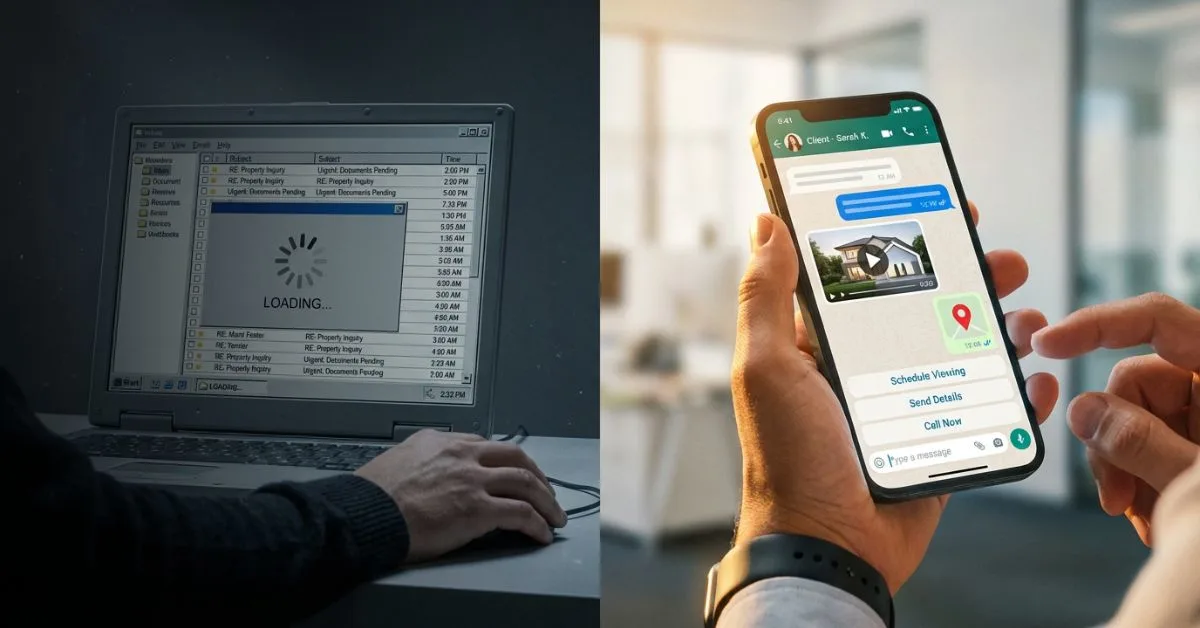
It’s a familiar story. A broker spends hours crafting the perfect email. It has detailed property descriptions, high-resolution photos attached, and a polite, professional closing. He hits “send” and then… he waits. And waits. He checks his outbox. He wonders, “Mera email mila ya spam mein chala gaya?” (Did they get my email, or did it go to spam?). Hours turn into days, and the initial excitement of the deal fades into frustrating silence.
Now, picture this alternative: The broker sends a quick WhatsApp message. “Hi [Client Name], just sent you a 1-minute video of that sea-facing flat we discussed. Let me know what you think!” Within seconds, two blue ticks appear. A minute later, the reply comes: “Wow, looks amazing! Can we visit this weekend?”
This isn’t a glimpse into the distant future. This is the reality of real estate communication, and it’s happening now. The slow, formal, and often inefficient world of email is being rapidly replaced by the instant, interactive, and media-rich environment of WhatsApp.
By 2026, proficiency in professional WhatsApp communication will no longer be a “nice-to-have” skill for a real estate broker; it will be a fundamental requirement for survival. Brokers who master this conversational approach will close deals faster, build stronger client relationships, and leave their email-bound competitors waiting for a reply that may never come.
Why Email is Losing its Place in the Real Estate Deal Flow
For a long time, email was the digital equivalent of a formal letterhead. It was the standard for all professional communication. But in the context of a fast-paced, visually-driven property market, its weaknesses have become glaring.
- The Black Hole of the Inbox: The average person receives dozens, if not hundreds, of emails per day. Your carefully crafted message is competing with promotional offers, newsletters, work updates, and spam. The chances of it being opened promptly are slim. Open rates for emails in the real estate sector hover around 20-25%, which means 3 out of 4 of your emails might not even be seen.
- Painfully Slow Response Times: Email culture does not demand an instant reply. It’s acceptable to respond in a few hours or even the next day. In a competitive property market where a good deal can be gone in minutes, this delay is a deal-killer.
- Clunky for Media Sharing: Attaching multiple high-resolution photos or videos to an email is cumbersome. It leads to large file sizes, potential delivery failures, and a poor user experience for the client who has to download each file individually.
- Too Formal and Impersonal: The structure of an email—salutation, body, closing—creates a formal distance. It’s hard to build genuine rapport or have a quick, flowing conversation. It feels like a transaction, not a relationship.
Email still has its place for sending final, formal documents or contracts, but for the day-to-day communication that moves a deal forward, it has become a bottleneck.
The Unstoppable Rise of WhatsApp in Real Estate
WhatsApp, on the other hand, seems almost perfectly designed for the needs of the modern broker and client. Its power lies in its unique combination of immediacy, interactivity, and simplicity.
- Incredible Open and Response Rates: The numbers speak for themselves. WhatsApp messages have an open rate of over 98%, and over 90% of messages are read within the first three minutes. When you send a message, you can be almost certain it will be seen, and seen quickly. The “blue ticks” create a social contract of acknowledged receipt.
- Seamless Rich Media Integration: This is a game-changer. Within a single chat, you can instantly share:
- High-quality photos and videos of a property.
- A Google Maps pin for a precise location.
- PDFs of floor plans or brochures.
- Quick voice notes to explain a complex point personally and quickly.
- Direct, Personal, and Conversational: WhatsApp is inherently a conversational platform. It breaks down formal barriers and helps you build a personal connection with your client. It feels less like a pitch and more like a helpful chat with a trusted advisor.
- The Power of Group Chats: The “Deal Room” group chat is an incredibly efficient tool. You can create a group with the buyer, seller, and even their legal advisors to ensure everyone is on the same page. Updates, questions, and scheduling can be managed in one central, transparent place.
A client discovering a broker through a modern platform like Sirfbroker is already in a digital-first mindset. They expect communication to be just as fast and efficient. A quick introductory WhatsApp message from a verified broker is far more likely to get a positive response than a cold, formal email.
Email vs. WhatsApp: A Head-to-Head Comparison
| Feature | ||
| Typical Open Rate | 20-25% | >98% |
| Response Time | Hours to Days | Minutes to Hours |
| Relationship Tone | Formal, Transactional | Personal, Conversational |
| Media Sharing | Clunky, Attachments, Size Limits | Seamless, Integrated, Instant |
| Best For | Final contracts, formal offers, legal documents. | Quick updates, sharing listings, scheduling, building rapport. |
| Client Perception | “Another email in my inbox.” | “A personal message from my advisor.” |
The Professional WhatsApp Blueprint: A 5-Step Guide for Brokers
Using WhatsApp for business is not the same as chatting with friends. It requires a professional approach to build trust and avoid common pitfalls. Here is your guide to becoming a WhatsApp pro.
Step 1: Get WhatsApp Business (It’s Free!)
If you are still using your personal WhatsApp, switch to the WhatsApp Business app immediately. It’s a simple change that unlocks powerful professional features:
- Business Profile: Set up a profile with your photo, business name, address, and a link to your professional profile (like your Sirfbroker page).
- Automated Greetings: Create a welcome message that automatically sends to new inquiries. Example: “Hello! Thank you for your interest. This is [Your Name], a verified real estate advisor. How can I help you today? You can view my professional profile here: [Link]”
- Quick Replies: Save frequently used messages (like your bank details for token payments or answers to common questions) to send with a single tap.
Step 2: The First Contact – Permission is Key
Never add a client to a broadcast list or group without their permission. The first message is crucial.
- Always introduce yourself clearly. “Hello [Client Name], my name is [Your Name] from [Your Company]. You recently enquired about a property on [Platform Name].”
- State the purpose of your message. “I have a few properties that match your requirement. Would you be open to me sharing some details and videos with you here on WhatsApp?”
- This permission-based approach respects the client’s privacy and sets a professional tone from the start.
Step 3: Master “Snackable” Communication
WhatsApp is designed for short, easy-to-digest messages. Avoid sending long, dense paragraphs.
- Break up your points into multiple short messages.
- Use emojis professionally to add tone and warmth. A simple thumbs-up 👍 or smiley face 😊 can make your communication more friendly.
- Leverage voice notes. For a point that needs a bit more explanation, a 30-second voice note can be much faster and more personal than typing a long message. It allows the client to hear the sincerity in your voice.
Step 4: Create a “Deal Room” Group Chat for Transparency
Once a deal progresses, create a dedicated group.
- Title the group clearly: e.g., “Deal for Flat 501, Sunshine Apartments.”
- Add all key stakeholders: Buyer, seller, yourself. You can add lawyers or family members later if needed.
- Set ground rules: Start with a welcome message establishing the purpose of the group. “Welcome everyone. We will use this group to coordinate all next steps for the deal…”
- This keeps everyone in the loop, reduces miscommunication, and creates a transparent record of the deal’s progress.
Step 5: Know When to Go Formal
While WhatsApp is great for 90% of communication, it doesn’t replace the need for a formal paper trail for critical milestones.
- Use WhatsApp for: Speed, scheduling, sharing initial visuals, quick Q&A.
- Switch to Email for: Sending the final official offer letter, sharing the draft Sale Agreement, and any communication that needs to be formally recorded for legal purposes.
- A smart broker uses both channels for their respective strengths, often confirming a formal email with a quick WhatsApp: “Hi [Client Name], just sent you the draft agreement on email. Please check when you have a moment.”
The Future of Real Estate is Conversational
The shift from email to WhatsApp is more than just a change in technology; it’s a change in mindset. It’s a move away from slow, impersonal, transactional communication towards a fast, personal, and relationship-focused approach.
By meeting your clients on the platform they use and love, you are showing that you respect their time and are in tune with the modern world. You are positioning yourself as an accessible, efficient, and tech-savvy advisor. This aligns perfectly with the ethos of platforms like Sirfbroker, which aim to connect clients with forward-thinking, verified professionals.
The brokers who master this new conversational commerce will not only survive but thrive, building stronger relationships and closing deals while their competition is still stuck staring at an empty inbox.
Ready to upgrade your communication strategy and connect with clients in real-time? Create your broker profile on Sirfbroker and show clients you are a modern, responsive professional.