

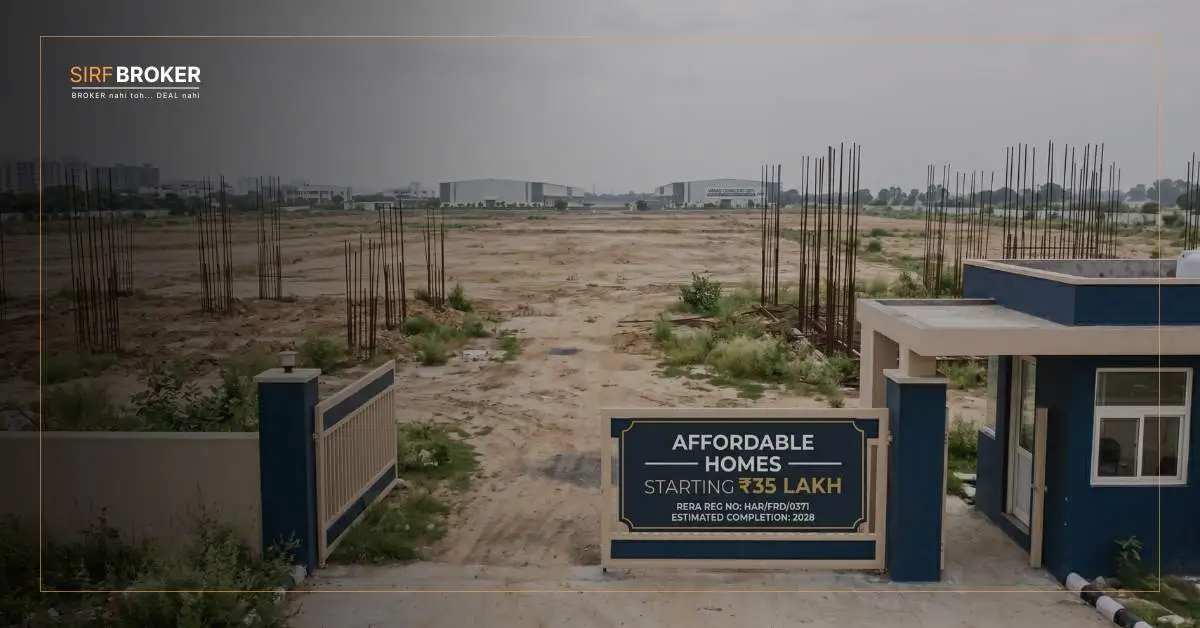
A buyer in Delhi NCR with a ₹60 lakh budget sits down with a broker in 2026. The broker pulls up the options. There are fewer than in 2022. They are mostly resale. The new launches in that range are at the periphery of the periphery — 45 minutes from any employment centre, with infrastructure that is promised rather than built. The premium and luxury projects, meanwhile, are abundant, active, and selling well.
This is not an anomaly. It is a structural shift — and it has been happening quietly for three years.
India’s affordable housing segment, defined broadly as units priced below ₹45 lakh in major cities, has been exited by the developer community at scale. The economics stopped working for them. Margins in affordable are thin; input costs — steel, cement, labour — have risen sharply; land in well-located urban zones has repriced beyond what an affordable project can absorb. Premium and luxury segments offer developers four to six times the per-unit margin. The decision to move upmarket was rational. The consequences for the mid-budget buyer are real.
| India sold 14% fewer homes by volume in 2025 than 2024 — but the total value rose 6%, crossing ₹6 lakh crore, according to ANAROCK Research. That is what a structural shift from affordable to premium looks like in the data: fewer transactions, higher average ticket sizes, concentrated in the top of the market. The ₹40–80 lakh buyer is not competing in a declining market. They are competing in a market that has reorganised around someone else. |
What Happened to Affordable Housing — the Data Behind the Decline
The share of affordable housing in India’s total new residential launches has fallen sharply over the past four years. Knight Frank India’s market research confirms that developers have been redirecting capital toward mid-premium and luxury segments, where per-unit margins are significantly higher and buyer profiles are less sensitive to interest rate movements.
The numbers from ANAROCK Research tell the story clearly: India’s top seven cities recorded approximately 3.95 lakh unit sales in 2025 — down from 4.59 lakh in 2024, a 14% decline in volume. Yet total sales value rose 6% to over ₹6 lakh crore. That arithmetic only works if the average transaction value is rising — which it is, because the mix has shifted toward more expensive units.
| Segment | What Happened to New Launch Supply | Why |
|---|---|---|
| Below ₹45 lakh (affordable) | Significant decline in new launches | Input cost inflation made margins unviable; land repriced above affordable-project thresholds in urban zones |
| ₹45–80 lakh (mid-segment) | Limited, location-constrained supply | Available primarily in peripheral micro-markets; well-located mid-segment options are scarce |
| ₹80 lakh–1.5 crore (mid-premium) | Stable — developer interest maintained | Acceptable margins; buyer profile with credit access and lower rate sensitivity |
| Above ₹1.5 crore (premium/luxury) | Significant increase in new launches | High per-unit margins; strong NRI demand; wealthier buyers less sensitive to the rate environment |
Knight Frank India’s India Real Estate Outlook attributes softer mid-segment performance to sharp price escalation, limited availability in well-located micro-markets, and investor-led activity concentrating in the premium end of the market.
Why Developers Won’t Come Back to Affordable — and Why That Matters for Buyers
The economics that pushed developers out of affordable housing have not reversed. They have worsened.
Steel and cement prices remain elevated relative to 2020 levels. Skilled construction labour costs have risen. Urban land in well-located catchments has appreciated to the point where an affordable project — defined by its capped sale price — cannot absorb the land cost and still generate a viable developer margin. The developer who wants to build in Gurugram, Bengaluru, or Pune and price units below ₹45 lakh is being asked to accept a loss, not a thin margin.
| The absence of fiscal incentives makes it economically unviable for developers to build affordable housing in well-located urban zones. Without a tax benefit, interest subvention, or FAR incentive that offsets the compressed margin, developers will continue to allocate capital to premium projects where the return is four to six times higher. Buyer demand at the affordable end of the market is not in question — the problem is that the supply-side economics have permanently shifted. This is structural, not cyclical. |
What SWAMIH and PMAY Are Actually Delivering — and What They’re Not
The government’s response to the affordable housing supply problem has two components: completing stalled existing projects, and supporting new affordable supply through subsidies.
The completion side is moving. The government allocated ₹15,000 crore through the second tranche of SWAMIH (Special Window for Affordable and Mid-Income Housing) fund specifically to complete stalled projects — targeting delivery of approximately 1 lakh additional units from projects that had already been sold to buyers but not built. This is meaningful for buyers stuck in stalled projects. It is not new supply.
PMAY-Urban has delivered substantially — over 9.63 million homes completed under the cumulative programme as of December 2025, according to the Ministry of Housing and Urban Affairs (MoHUA). PMAY-Urban 2.0 provides interest subsidies for eligible homebuyers borrowing for affordable homes. But PMAY subsidies do not create new supply — they make existing affordable supply more accessible to buy. If the supply itself is shrinking, the subsidy helps a smaller pool of buyers.
| The PMAY subsidy is real. The SWAMIH completion funding is real. Neither creates new affordable housing supply in the cities where mid-budget buyers actually want to live. PMAY projects are concentrated in peripheral zones and Tier 2 cities. SWAMIH is completing units that already exist. The buyer who assumes that “the government is building affordable homes” and therefore supply will increase in their preferred city is reasoning from the wrong premise. |
For a detailed breakdown of what PMAY-Urban 2.0 actually guarantees — and the eligibility conditions that brokers sometimes misrepresent — the guide on what PMAY-Urban 2.0 actually covers is essential reading before signing any agreement where a subsidy has been promised.
The Mid-Budget Buyer’s Real Options in 2026
If new affordable supply in well-located urban markets is structurally constrained, the mid-budget buyer’s options in 2026 are more specific than they were in 2018.
| THE MID-BUDGET BUYER’S FRAMEWORK FOR 2026 Option 1: Quality resale → Well-maintained resale flats in established urban micro-markets often represent genuine value. The premium inventory is new launches; resale provides access to locations that new affordable launches cannot reach. Verify title clearly — use the mutation and circle rate guides before transacting. Option 2: Peripheral new launches with confirmed infrastructure → Mid-budget new launches exist — mostly 40–60 km from city centres. The critical filter is confirmed, funded infrastructure with visible construction. “Proposed” infrastructure at the periphery is a price story without a delivery story. Option 3: SWAMIH-completed projects → Buyers stuck in stalled projects are receiving possession under SWAMIH. Some completed units come to resale in 2026 — completed, titled stock at mid-budget prices, often in locations no new project would build at today’s land prices. Option 4: Tier 2 city primary purchase → Cities like Pune, Ahmedabad, Nagpur, and Lucknow offer mid-budget options with better location quality than equivalent budget in a Tier 1 city periphery. For buyers with employment flexibility, Tier 2 is the strongest value proposition in 2026. |
What to Verify Before Buying in the Mid-Budget Segment
| Check | Why It Matters More in This Segment | Red Flag |
|---|---|---|
| RERA registration and filings | Affordable projects are more financially stressed — developer fund management is more precarious | Filing gaps of 2+ quarters on state RERA portal |
| Developer’s delivery track record | Developers without margins for delays have fewer financial buffers when costs overrun | Multiple RERA complaints or delayed possessions in prior projects |
| Infrastructure timeline | Peripheral affordable projects are entirely dependent on infrastructure arriving to deliver livability | Infrastructure described as “planned” or “upcoming” with no confirmed project number or visible construction |
| Circle rate vs deal price | Stamp duty is calculated on whichever is higher — in new peripheral zones, circle rates can produce unexpected additional cost | Developer cannot provide clarity on the applicable circle rate before you commit |
| PMAY subsidy eligibility — verified | Brokers in the affordable segment routinely promise PMAY subsidies that buyers don’t qualify for | Broker cannot provide written confirmation of eligibility criteria against your specific profile |
| Bank loan approval on the project | Banks assess developer and title risk — absence from approved lists signals compliance or title issues | No major bank has approved home loans against the project |
Understanding what circle rate means — and how it can add materially to your total purchase cost — is covered in the guide to what circle rate is and why it matters in property deals. And before committing any funds, the guide on the difference between booking amount, advance payment, and token amount covers exactly what you are and aren’t committing to at each stage.
Sirf Broker POV
The affordable housing story in 2026 is not a story about government schemes failing or developers being irresponsible. It is a story about basic economics producing a predictable outcome — and the buyer community not having been told the outcome clearly enough.
When you remove the margin incentive for a developer to build a certain product, they stop building it. The fiscal incentives that made affordable housing viable for developers in the 2015–2020 period have expired or weakened. Land costs have risen. Input costs have risen. The developer who would have built ₹40 lakh units in Bengaluru’s periphery in 2018 is building ₹1.2 crore units in Bengaluru’s mid-zone in 2026. Both decisions are rational. Both are responses to the same economic signal.
The buyer with a ₹50–70 lakh budget who walks into a broker meeting in 2026 expecting the same volume of new-launch options that existed five years ago is going to be surprised. They should not be — the supply-side shift has been visible in the data for three years. The broker who tells them the truth about this — that new affordable supply in well-located zones is structurally constrained and isn’t coming back without significant fiscal intervention — is doing their job. The broker who says “prices will come down” or “more affordable options are launching soon” is deferring the disappointment, not solving it.
The mid-budget buyer in 2026 has real options: quality resale, SWAMIH-completed units, and Tier 2 city purchases. What they don’t have is a large pool of new, well-located, affordably priced primary supply in Tier 1 cities. The sooner that is understood clearly, the better the decision they will make.
Conclusion
India’s affordable housing market has not collapsed — it has reorganised. New supply in the affordable segment is concentrated in peripheral zones and Tier 2 cities. Premium supply dominates new launches in Tier 1 urban markets. The mid-budget buyer who understands this clearly can make a good decision. The buyer who keeps waiting for a new affordable launch in a well-located Gurugram or Bengaluru micro-market is waiting for something that isn’t coming.
Frequently Asked Questions
1. Why is affordable housing disappearing from India’s major cities?
Developers have exited the affordable segment because the economics no longer support it. Land costs in well-located urban zones have risen beyond what affordable unit prices can absorb. Input costs — steel, cement, labour — have increased sharply since 2020. Premium and luxury segments offer developers four to six times the per-unit margin. Without fiscal incentives to offset these economics, new affordable supply in well-located Tier 1 markets is structurally constrained.
2. What is SWAMIH and how does it help mid-budget buyers?
SWAMIH (Special Window for Affordable and Mid-Income Housing) is a government fund providing last-mile construction financing to complete stalled residential projects. The Union Budget FY26 allocated ₹15,000 crore in a second tranche, targeting delivery of approximately 1 lakh additional units from previously stalled projects. SWAMIH helps buyers stuck in delayed projects receive possession — but it does not fund new affordable supply in high-cost urban markets.
3. Does PMAY-Urban 2.0 create new affordable housing supply?
No. PMAY-Urban 2.0 provides interest subsidies to eligible homebuyers to make existing affordable housing more financially accessible. It does not incentivise developers to launch new affordable projects in high-cost urban markets. The programme has delivered over 9.63 million completions under its cumulative phases per MoHUA data — primarily in peripheral zones and Tier 2 and 3 cities.
4. What are the real options for a ₹40–80 lakh buyer in India’s major cities in 2026?
Four realistic options: quality resale flats in established urban micro-markets (which provide location access that new affordable launches cannot match); new peripheral launches with confirmed and funded infrastructure; SWAMIH-completed units entering resale (completed, titled, at prices no new project would reach at today’s land costs); and Tier 2 city primary purchases, which offer the strongest value proposition for buyers with location flexibility.
5. How has India’s housing sales data reflected the shift away from affordable housing?
According to ANAROCK Research, India’s top seven cities recorded a 14% decline in housing sales volume in 2025 — from approximately 4.59 lakh units in 2024 to 3.95 lakh units — while total sales value rose 6%, crossing ₹6 lakh crore. Fewer transactions at higher average values is the statistical signature of a market shifting up-segment, with premium and luxury driving value while affordable and mid-segment volume declines.
6. What should a mid-budget buyer verify before purchasing in 2026?
Six checks: RERA registration and current quarterly filings on the state portal; developer’s track record delivering affordable-segment projects on time; confirmed and funded infrastructure near peripheral projects with visible construction (not just “proposed”); the applicable circle rate and total all-in purchase cost; whether any PMAY subsidy claim is verified against your actual eligibility profile; and whether at least two major banks have approved home loans against the project.
7. Will affordable housing supply recover in India’s Tier 1 cities?
Without new fiscal incentives — tax breaks, FAR bonuses, or interest subvention structures that restore developer margin viability — a meaningful recovery in new affordable supply in well-located Tier 1 micro-markets is unlikely in the near term. The economic drivers pushing developers toward premium are structural, not cyclical. Tier 2 city affordable supply is more likely to grow, supported by lower land costs and expanding employment. The government’s SWAMIH and PMAY allocations are real — but neither instrument directly incentivises new Tier 1 affordable launches.
Sources and References
- ANAROCK Research — India Residential Market 2025 Annual Data — 14% volume decline (3.95 lakh units vs 4.59 lakh); total sales value +6% to ₹6+ lakh crore. anarock.com/research
- Knight Frank India — India Real Estate Outlook — Developer migration to premium segments; limited mid-segment availability; price escalation impact. knightfrank.co.in
- Ministry of Housing and Urban Affairs (MoHUA) — PMAY-Urban cumulative completions 9.63 million homes as of December 2025; SWAMIH fund structure. mohua.gov.in
- Union Budget FY2025-26 — SWAMIH 2.0 allocation ₹15,000 crore; interest subsidy scheme allocation ₹35 billion. indiabudget.gov.in
- Colliers India — India Real Estate 2026 Outlook — Tier 2 city residential growth; decentralised housing demand. colliers.com/en-in
Disclaimer
| This article is published by Sirf Broker for educational and informational purposes only. It is not investment, financial, or legal advice. Affordable housing availability, PMAY eligibility, SWAMIH project status, and government scheme terms vary by city, project, and individual profile and are subject to change. All data points are sourced from publicly available reports cited above. Buyers should verify PMAY eligibility directly with their lending institution, check RERA status on state portals, and consult qualified legal and financial professionals before any purchase decision. |