

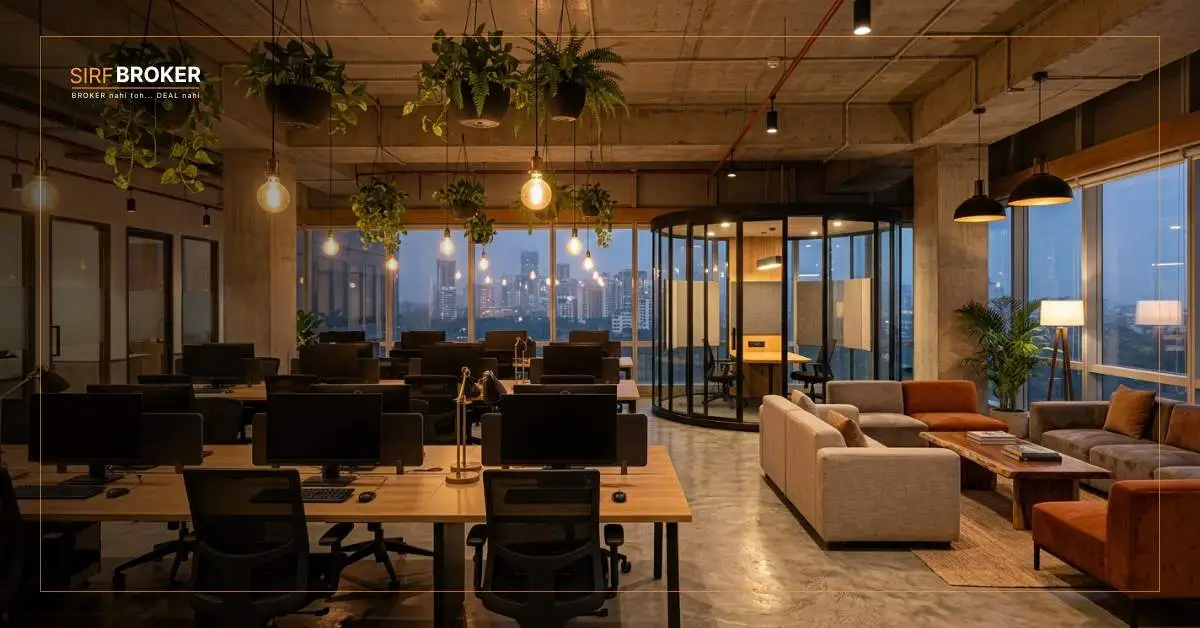
A number crossed quietly in FY2026 that deserves far more attention than it received. India’s total flexible office stock — co-working spaces, managed offices, business centres, and enterprise flex solutions across the country — crossed 100 million square feet, according to Business Standard’s reporting on sector data. That makes India’s flex office ecosystem larger than the entire Grade A office stock of most individual countries in the Asia-Pacific region. It is a milestone that marks a permanent shift in how Indian businesses think about office space — and a structural change in how brokers need to position their commercial office advisory services.
The growth of flex office in India is not a post-pandemic trend that is normalising back toward traditional leasing. It is a fundamental reorganisation of how companies — from two-person startups to 10,000-employee multinationals — consume office space in a market that offers them unprecedented flexibility, operational efficiency, and capital efficiency relative to direct leasing. The data from Q2 CY2026 confirms this: flexible workspace operators accounted for 27% of all office leasing demand, making them the single largest demand category ahead of IT/ITeS (31% combined) and well ahead of BFSI (10%). This is a market that has matured from a niche to a structural feature of Indian real estate.
For brokers facilitating commercial office transactions, the 100 million sq ft milestone creates a specific set of opportunities and a specific set of challenges. The opportunity: flex office is a transaction type that generates recurring revenue rather than one-time commissions, for brokers who understand how to position managed office solutions. The challenge: flex office operators have their own sales teams, and brokers who do not actively partner with these operators will find themselves disintermediated from a growing segment of the market.
| India Flex Office Market — Key Numbers 2026 Total flex office stock, FY26 100+ million sq ft Flex share of Q2 CY’26 office demand 27% Flexible workspaces driving total office demand 73% (hybrid work adoption) India flex office market value, 2026 USD 4.53 billion Projected market value by 2031 USD 8.7 billion (CAGR ~14%) India’s registered startups outside metros 50% of 1,15,000 startups |
How India’s Flex Office Market Got Here: A Ten-Year Structural Shift
The story of flex office in India is a story of supply creating demand, and demand maturing into enterprise adoption. The early co-working operators of 2012–2016 — WeWork, Awfis, 91springboard, CoWrks — targeted startups and freelancers. The pitch was simple: community, coffee, and a professional address without a lease commitment. The spaces were modest, the economics were uncertain, and the target customer was largely pre-revenue.
What changed the trajectory was enterprise adoption. By 2019, large technology companies, BFSI firms, and consulting organisations began using managed office solutions not as a temporary measure but as a deliberate strategy for specific use cases: overflow capacity, project-specific teams, satellite locations in new cities, and the growing cohort of remote-first employees who needed a third place between home and headquarters. The pandemic accelerated this adoption by three to five years: companies that had never considered flex office suddenly had to configure distributed work environments, and the managed office solution was the fastest path to doing that without the capital commitment of a direct lease.
By FY26, the market has matured into a genuinely enterprise-grade product category. India’s leading flex operators — Awfis, IndiQube, Table Space, WeWork India, Smartworks, and others — are publicly listed or have raised significant institutional capital. They operate large, professionally managed centres with SLA-backed services, enterprise-grade IT infrastructure, and the ability to accommodate multi-city portfolios for large occupiers. The 100 million sq ft milestone reflects not just volume growth but a fundamental maturation of the product from co-working lifestyle choice to strategic enterprise real estate solution.
The Enterprise Shift: Why Large Companies Are Choosing Flex Over Direct Leasing
The single most important trend in Indian flex office in 2026 is the acceleration of enterprise adoption — large companies signing managed office agreements rather than direct leases for meaningful portions of their portfolio. According to sector reporting, 73% of office occupiers in India cite rapid enterprise adoption of hybrid work as a sustaining driver of flex demand. This is not a small or marginal cohort — it represents the mainstream of India’s commercial office occupier base.
The financial logic of managed office for enterprises is compelling and has become clearer as the market has matured. A direct lease for 50,000 sq ft in a Grade A Bengaluru building carries: a security deposit of 6–10 months’ rent (₹2–3 crore), stamp duty and registration costs, fit-out capital expenditure of ₹800–1,500 per sq ft (₹4–7.5 crore), and a lock-in period of 36–60 months that limits flexibility if the team contracts. The total initial outflow before the first employee walks in is typically ₹8–12 crore for a 50,000 sq ft space at mid-market Bengaluru rents.
A managed office solution for the same 50,000 sq ft — from a mature operator with enterprise-grade infrastructure — carries none of these upfront costs. The occupier pays a monthly per-seat fee that typically ranges from ₹8,000 to ₹18,000 per seat depending on location and quality, on a 12–24 month agreement. The fit-out is the operator’s asset, not the occupier’s. The security deposit is typically 3 months rather than 10. The flexibility to scale up, scale down, or exit after the lock-in period is built into the structure. For companies that are uncertain about their headcount trajectory — which, in 2026, includes almost all technology and BFSI companies — this flexibility has enormous value that the per-sq-ft comparison does not capture.
Geography: Bengaluru Dominates, But Tier-2 Cities Are the Growth Story
Bengaluru remains the dominant flex office market in India by stock and by new supply addition — driven by the concentration of technology companies, startups, and the large global delivery centres that anchor demand in the Outer Ring Road and Whitefield corridors. However, the most significant geographic story in India’s flex office market in 2026 is the rapid expansion into Tier-2 cities.
The driver of this expansion is demographic: 50% of India’s 1,15,000 registered startups are based outside the top metros, according to sector data. These startups need professional, well-equipped work environments, but they cannot absorb the capital commitment or the minimum-space requirements of direct Grade A leases. Flex office fills this gap exactly — a 10-person startup in Indore or Coimbatore can take 10 to 20 seats in a managed centre and scale from there. The flex operators who have identified this opportunity are expanding into markets like Ahmedabad, Jaipur, Indore, Kochi, and Chandigarh — cities that have the demand density to support viable centres but were previously underserved.
For brokers in Tier-2 markets, the emergence of professional flex office operators is creating a new transaction type that was not previously available to them: the enterprise occupier who wants a Tier-2 satellite office in a managed format. This is a growing and underserved segment in most Tier-2 markets, and brokers who build relationships with the major flex operators’ expansion teams can access a pipeline of transactions that they would not otherwise see.
The Flex Office Operators: Who Are They and How Do Brokers Work With Them
India’s flex office market is dominated by a small number of scaled operators who have professional channel partner programs for brokers. Understanding these programs and how to access them is a prerequisite for any commercial broker who wants to participate in the flex office segment.
The major Indian flex operators — Awfis (publicly listed on NSE), IndiQube, Table Space, Smartworks, and Skootr — all have formal broker empanelment programs. Brokers bring corporate occupier requirements to the operator, who matches them with available inventory in the relevant city and format, and pays a commission on the completed transaction. Commission structures vary: most operators pay 1 month’s rent per seat contracted as a flat fee, or a percentage of the total contract value. Some pay annual commissions on renewals. The broker’s leverage is the quality of the occupier requirement they bring — a 200-seat enterprise requirement from a well-known company is worth significantly more than 10 individual seat enquiries.
The brokers who are most successful in the flex office segment operate as portfolio advisors rather than transaction facilitators: they help occupiers understand which combination of direct lease, managed office, and co-working seats makes most sense for their specific portfolio needs, then they facilitate the execution of each element. This advisory positioning is harder to replicate than a listing database — and it commands a relationship that generates repeat business at every portfolio review cycle.
Sirf Broker POV: The Broker Who Ignores Flex Office Is Ignoring 27% of the Market
We will state this plainly: any commercial broker who does not have a working knowledge of India’s flex office market and an active relationship with at least two or three major flex operators is ignoring 27% of the available office leasing demand in their city. That number is too large to dismiss as a niche, too structural to treat as a temporary trend, and too valuable — in terms of recurring occupier relationships — to leave to operators’ in-house sales teams.
The common reason brokers give for not engaging with flex office is that the commissions are lower per transaction than direct lease commissions. This is partially true on a per-transaction basis. It ignores two things. First, flex office transactions close faster — a managed office deal for 50 seats closes in weeks, not months. The time-value of a faster transaction is real. Second, flex office creates a repeating client relationship: an occupier who takes 50 seats today may expand to 100 seats in 18 months, or need a second city, or decide to transition to a direct lease as they scale. The broker who placed them in the flex solution is the first call for each of these decisions — if they served the occupier well the first time.
The 100 million sq ft milestone is not the end of this story. With the market growing at nearly 14% annually and enterprise adoption accelerating, India’s flex office stock will likely double again in the next five to six years. The brokers building flex expertise and operator relationships today are positioning for a market that will be twice as large in 2031. That is worth the investment.
Conclusion
India’s flex office market crossing 100 million sq ft is not just a volume milestone. It is confirmation that flexible workspace has become a permanent structural feature of how Indian businesses consume office space. For brokers, the question is no longer whether to engage with flex office — it is how quickly to build the knowledge and relationships required to serve it effectively.
For a full breakdown of the cost difference between flex office and direct leasing, read our guide to office fit-out costs and the true cost of leasing in India and our coverage of common mistakes in commercial property leasing.
Frequently Asked Questions
How big is India’s flex office market in 2026?
India’s total flexible office stock crossed 100 million square feet in FY2026, according to Business Standard’s reporting on sector data. The market is valued at USD 4.53 billion in 2026 and is projected to reach USD 8.7 billion by 2031 at a compound annual growth rate of approximately 14%. Flex office accounted for 27% of total office leasing demand in Q2 CY2026, making it the single largest demand category in India’s commercial office market.
What is driving the growth of flex office space in India?
The primary driver is enterprise adoption of hybrid work — 73% of Indian office occupiers cite hybrid work as a sustained driver of flex demand. Companies are choosing managed offices over direct leases for the financial and operational flexibility they offer: no large upfront security deposits, no fit-out capital expenditure, shorter commitment periods, and the ability to scale seats up or down. The startup ecosystem — with 1,15,000 registered startups, 50% of which are outside metros — is a secondary structural driver.
Who are the major flex office operators in India?
India’s leading flex office operators include Awfis (publicly listed on NSE), IndiQube, Table Space, Smartworks, WeWork India, and Skootr, among others. These operators run professional managed office centres across India’s major cities and have formal broker empanelment and commission programs. The market is consolidating around a small number of scaled operators who can offer enterprise-grade infrastructure and multi-city portfolio solutions.
How is co-working different from a managed office in India?
Traditional co-working involves shared open-plan desks in a community environment — typically used by freelancers, startups, and small teams who value community interaction and flexible day or month commitments. Managed office (also called enterprise flex) involves a dedicated, customised space within a professionally managed building — with private meeting rooms, dedicated desks, branded reception, and enterprise-grade IT — typically taken on 12–36 month agreements by larger companies. The managed office product is what is driving enterprise adoption and the majority of India’s 100 million sq ft flex stock.
How can brokers earn commission on flex office transactions?
Most major flex office operators in India have formal broker channel partner programs. Brokers bring corporate occupier requirements to the operator, who matches them with available inventory. Commissions vary by operator but typically range from 1 month’s rent per seat contracted as a flat fee to a percentage of total contract value. Some operators pay annual renewal commissions. Brokers with large enterprise requirements — 100 seats or more — are particularly valued as channel partners and may negotiate enhanced commission structures.
Is flex office a temporary trend or a permanent shift in Indian real estate?
The evidence strongly suggests a permanent structural shift. India’s flex stock has grown continuously for a decade, crossing the 100 million sq ft threshold in FY2026 despite multiple economic disruptions. Enterprise adoption — large companies using managed office as a deliberate portfolio strategy rather than a temporary solution — is now the dominant demand driver. The market is growing at nearly 14% annually and is projected to reach USD 8.7 billion by 2031. The underlying drivers (hybrid work, startup density, capital efficiency of managed office vs. direct lease) are structural rather than cyclical.