

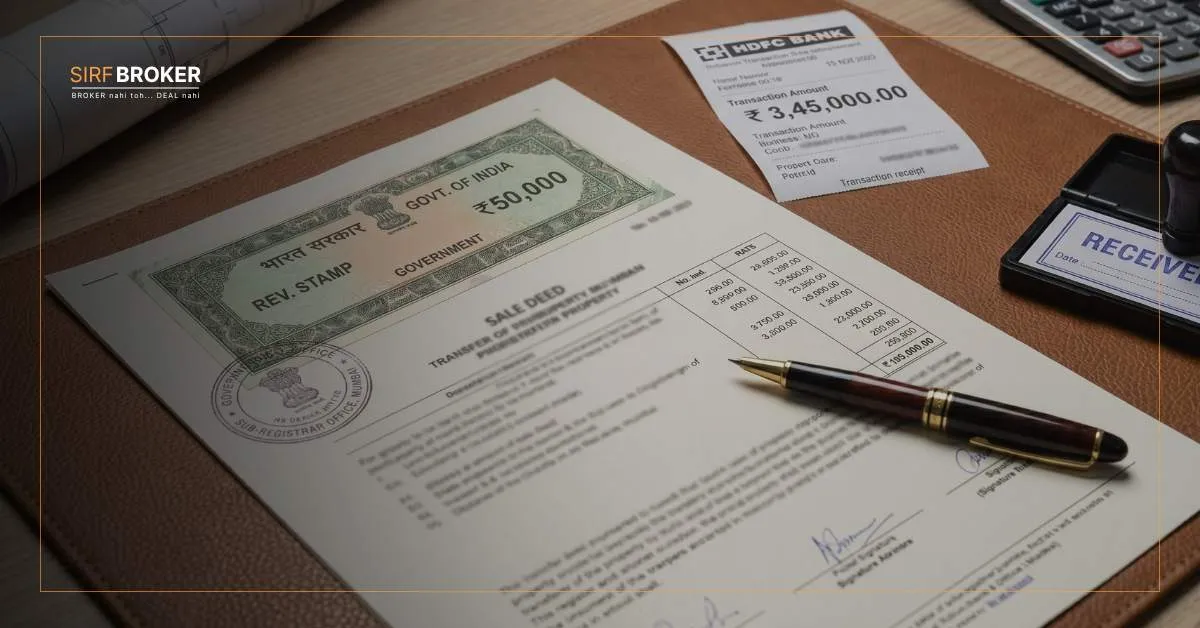
A buyer in Mumbai agrees a deal at ₹1.5 crore for a 2BHK. They have the down payment arranged, the home loan sanctioned, the moving date in mind. Three days before registration, they find out the stamp duty is ₹9 lakh and registration is ₹30,000. Neither was in their budget. The bank won’t lend for these costs — stamp duty and registration are not included in most home loan sanctions. The money has to come from savings.
This is one of the most common financial surprises in Indian property transactions. Stamp duty and registration are not optional. They cannot be negotiated. They are determined by the state government and must be paid before the property is legally registered in your name. Without registration, you do not own the property — you have paid for it, but you don’t own it.
| Stamp duty and registration charges add between 5% and 9% to the total purchase cost in most Indian states. On a ₹80 lakh property, that is ₹4–7.2 lakh in government fees — paid upfront, in full, from your own funds. This is not a minor line item. In many cases it is larger than the broker’s commission, the GST on an under-construction property, and the maintenance deposit combined. Budget for it before you start looking, not after you have committed. |
How Stamp Duty Is Calculated — The Basics Every Buyer Must Know
Stamp duty is a state government tax levied on the legal document that transfers property ownership. It is calculated as a percentage of the property’s registered value — and here is the critical point: it is calculated on whichever is higher, the actual deal price or the circle rate (government-set minimum value for the area).
This means if you negotiate a deal at ₹60 lakh in an area where the circle rate values the property at ₹70 lakh, you will pay stamp duty on ₹70 lakh — not ₹60 lakh. The registration charges are calculated on the same basis. Buyers who don’t know the circle rate for their target area before agreeing a deal can find their actual transaction cost significantly higher than expected.
The guide to what circle rate is and why it matters in property deals explains this mechanism in full — including how to check the applicable circle rate before you agree a purchase price.
State-Wise Stamp Duty Rates in India 2026
| State / City | Stamp Duty (Male Buyer) | Stamp Duty (Female Buyer) | Registration Charges |
|---|---|---|---|
| Maharashtra (Mumbai) | 5% (+ 1% Metro Cess) | 5% (+ 1% Metro Cess) | 1% (capped at ₹30,000) |
| Delhi | 6% | 4% | 1% |
| Haryana (Gurugram / Faridabad) | 7% | 5% | ₹15,000–50,000 (slab-based) |
| Uttar Pradesh (Noida / Lucknow) | 7% | 7% (1% rebate in some areas) | 1% |
| Karnataka (Bengaluru) | 3–5% (value-slab based) | 3–5% | 1% |
| Telangana (Hyderabad) | 4% | 4% | 0.5% + ₹25,000 transfer duty |
| Tamil Nadu (Chennai) | 7% | 7% | 4% (one of highest in India) |
| Rajasthan (Jaipur) | 6% | 5% | 1% |
Note: Rates are indicative for 2026 based on state government structures. Always verify the exact applicable rate with your state’s sub-registrar office or official stamp duty portal before budgeting — rates are subject to state budget amendments.
| Chennai is the most expensive state for registration in India: Tamil Nadu levies 7% stamp duty plus 4% registration — a combined 11% on the property value. A ₹1 crore flat in Chennai costs ₹11 lakh in government fees alone, before GST (if under construction), broker commission, or any other cost. Budget accordingly — and check before you fall in love with a property. |
The Women Buyer Concession — What It Means in Practice
Many Indian states offer a stamp duty concession of 1–2% when the property is registered solely in a woman’s name or jointly with a woman as the first owner. In Delhi, this means a male buyer pays 6% while a female buyer pays 4% — a 2% saving. On a ₹1 crore property, that is ₹2 lakh in real money.
The concession applies when the woman is the primary or sole registrant. In a joint purchase by a husband and wife where the wife is listed first, most states apply the female rate. Confirm this with your state’s sub-registrar office before registration — the rules on joint ownership and concession eligibility vary by state.
GST on Under-Construction Properties — The Cost Most New Buyers Miss
| If you are buying an under-construction property, GST applies — and most buyers don’t know the rate. As of 2026, GST on under-construction residential properties is 5% of the property value (1% for affordable housing units under ₹45 lakh). This is in addition to stamp duty and registration. Ready-to-move properties with an Occupancy Certificate (OC) do not attract GST. A ₹80 lakh under-construction flat in Delhi therefore carries: 6% stamp duty (₹4.8L) + 1% registration (₹80K) + 5% GST (₹4L) = approximately ₹9.6 lakh in government and tax costs before you pay the broker or take possession. |
How to Calculate Your True All-In Property Cost
| YOUR TRUE PROPERTY COST: THE FULL CALCULATION Step 1 → Start with the agreed deal price or the circle rate — whichever is higher. This is your stamp duty base. Step 2 → Add stamp duty at your state’s applicable rate (from the table above). Use the female rate if applicable. Step 3 → Add registration charges — typically 1% of the stamp duty base, subject to any state cap. Step 4 → If under construction: add 5% GST (1% for affordable category). If ready-to-move with OC: no GST. Step 5 → Add maintenance deposit (typically 1–3 months’ maintenance advance, paid at possession). Step 6 → Add any broker commission or facilitation fee agreed. This is the only negotiable cost in the list. This is your real purchase cost. Compare it to what you have available — not just the headline property price. |
Understanding the difference between what you commit at each stage — from token to booking to agreement to registration — is covered in the guide to booking amount, advance payment, and token amount in Indian property transactions. Know which stage triggers which financial commitment before you sign anything.
Red Flags Around Stamp Duty That Buyers Should Watch For
- Developer or broker quoting total cost without specifying whether stamp duty and registration are included
- Any suggestion that stamp duty can be reduced by understating the deal price in the sale agreement — this is tax evasion and creates serious legal risk for the buyer
- A property being registered at circle rate with a separate “cash component” — structurally the same problem as above, and the buyer bears the legal exposure
- Broker promising a specific stamp duty amount without checking the current circle rate for that specific address
- Developer including GST in the headline price for a ready-to-move property — no GST is payable if the property has an OC
Sirf Broker POV
Stamp duty is the most predictable cost in a property transaction and the one most consistently excluded from buyer budgets. This is not accidental — headline price is what sells property. The 6–8% in government fees that follows is disclosed later, when the buyer is emotionally committed to the deal and less likely to reconsider.
The professional broker who builds stamp duty into the conversation from the first budget discussion is serving their client. The broker who lets the client discover it at registration is setting up a difficult conversation — and sometimes a deal that falls apart because the buyer genuinely doesn’t have the funds.
One specific point worth knowing in 2026: the Model Tenancy Act and various state registration reforms are moving India toward greater documentation of property transactions. This makes undervaluation of registered sale price — a common stamp duty avoidance practice — increasingly risky. Revenue authorities have access to the same circle rate data buyers can access online, and the gap between a registered value and market value is the kind of discrepancy that triggers scrutiny. The buyer who registers at true market value, pays the correct stamp duty, and maintains a clean paper trail is building a property asset that is genuinely theirs. The buyer who cuts corners is building a dispute.
Conclusion
Stamp duty and registration are not optional, not negotiable, and not included in your home loan. Budget them before you start looking, calculate them on the circle rate basis rather than just the deal price, and factor in GST if the property is under construction. The total government and tax cost on most Indian property transactions in 2026 runs between 5% and 11% of the property value. Plan for it.
Frequently Asked Questions
1. What is stamp duty on property in India and who pays it?
Stamp duty is a state government tax levied on the legal document that transfers property ownership — the sale deed. It is paid by the buyer. It is calculated as a percentage of the property’s registered value (or circle rate, whichever is higher) and must be paid before or at the time of property registration at the sub-registrar’s office. Without paying stamp duty, the sale deed cannot be registered — and an unregistered sale deed is not legally enforceable.
2. What are the stamp duty rates in India’s major cities in 2026?
Key rates in 2026: Mumbai/Maharashtra 5% (plus 1% Metro Cess) + registration capped at ₹30,000; Delhi 6% (male) / 4% (female) + 1% registration; Gurugram/Haryana 7% (male) / 5% (female); Noida/UP 7% + 1% registration; Bengaluru/Karnataka 3–5% slab-based + 1% registration; Hyderabad/Telangana 4% + 0.5% + ₹25,000 transfer duty; Chennai/Tamil Nadu 7% + 4% registration (highest combined rate in India). Always verify current rates with the state’s sub-registrar portal before budgeting.
3. Is stamp duty charged on the deal price or the circle rate?
Stamp duty is charged on whichever is higher — the actual deal price or the government-set circle rate for the area. If you agree a deal at ₹60 lakh in an area where the circle rate values the property at ₹70 lakh, stamp duty is calculated on ₹70 lakh. This can significantly affect your total cost in areas where circle rates are set higher than market transaction prices — check the circle rate for your specific address before finalising any purchase price.
4. Do women get a discount on stamp duty in India?
Yes, in many states. Delhi offers a 2% concession (6% for male buyers, 4% for female buyers). Haryana offers a 2% concession (7% male, 5% female). Rajasthan offers 1% concession. Uttar Pradesh offers a rebate in some areas. The concession typically applies when the property is registered solely in a woman’s name or with a woman as the primary registrant in a joint purchase. Verify the current rules with your state’s sub-registrar office before planning the registration.
5. Does GST apply to property purchases in India in 2026?
GST applies only to under-construction residential properties — at 5% of the property value (1% for affordable housing under ₹45 lakh). Ready-to-move properties that have received an Occupancy Certificate (OC) are exempt from GST. This distinction significantly affects the total cost of a purchase — a ₹1 crore under-construction flat in Delhi carries approximately ₹9.8 lakh in stamp duty, registration, and GST combined, versus approximately ₹6.8 lakh for an equivalent ready-to-move property.
6. Can stamp duty be included in a home loan?
No. Stamp duty and registration charges are not part of the property’s loan value under most Indian home loan products — they must be paid from the buyer’s own funds at the time of registration. A few lenders offer a top-up loan for registration expenses, but this is separate from the home loan sanction and not universally available. Budget stamp duty and registration as cash requirements independent of your home loan arrangement.
7. What happens if I don’t register my property after buying it?
An unregistered sale deed is not legally enforceable under the Registration Act, 1908. It cannot be admitted as evidence in a court dispute over ownership. In practice, an unregistered property transaction means the buyer has paid the purchase price but does not have legal title — the seller can technically transact with the same property again, and the buyer has limited legal recourse. Property registration is not optional: it is the step that makes you the legal owner.
Sources and References
- State Stamp Duty Portals — Maharashtra IGR (igrmaharashtra.gov.in), DORIS Delhi, HRERA Haryana, IGRS UP, Karnataka Kaveri portal, Telangana Registration, Tamil Nadu IGRS — current stamp duty and registration rates for 2026.
- Economic Survey of India — FY2025-26 — Property transaction cost data; registration reform overview. indiabudget.gov.in
- Ministry of Housing and Urban Affairs (MoHUA) — Model Tenancy Act framework; registration documentation requirements. mohua.gov.in
Disclaimer
| This article is published by Sirf Broker for educational purposes only. Stamp duty rates, registration charges, and GST applicability vary by state, property type, buyer profile, and transaction structure, and are subject to change through state budget amendments. The rates in this article are indicative for 2026 and should be verified directly with the relevant state’s sub-registrar office or official portal before budgeting. This article does not constitute legal or financial advice. |