

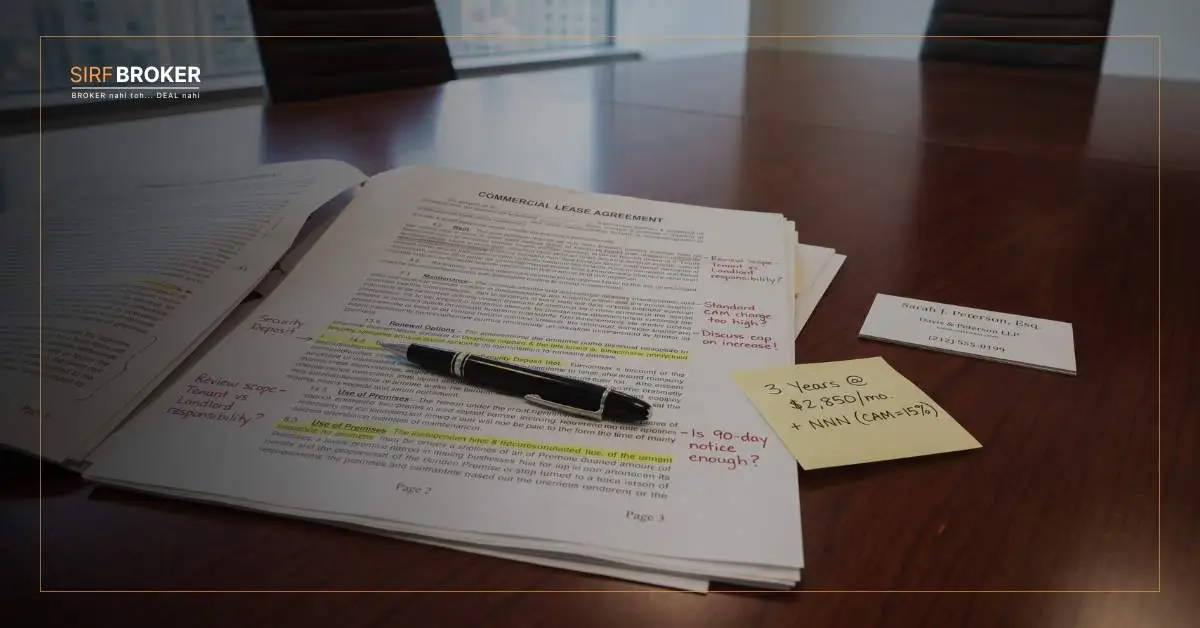
A broker facilitates an office lease in Bengaluru. The landlord’s draft agreement has a 15% annual rent escalation, a 12-month security deposit, no break clause, and a lock-in period of five years with no exit option. The broker presents it to the tenant and says “this is standard.”
None of it is standard. All of it is negotiable. And a broker who does not know that is not protecting their client — they are protecting the path of least resistance to closing a deal.
India’s commercial leasing market is in the middle of a significant regulatory and market-practice shift in 2026. The New Rent Rules implementing the Model Tenancy Act framework are being rolled out across states, establishing new standards for written agreements, security deposits, dispute resolution, and registration. And the market dynamics — with tenants gaining power in certain segments as large deals concentrate demand — have changed what a well-represented tenant can actually achieve in a lease negotiation.
| The New Rent Rules 2026 — implementing the Model Tenancy Act framework across Indian states — establish mandatory written agreements, cap security deposits at 6 months for commercial tenancies, and create a formal digital dispute resolution structure. Understanding what is now the legal framework, what is market standard, and what is still negotiable is the difference between a broker who adds value and one who just moves paperwork. |
What the New Rent Rules 2026 Actually Change
The New Rent Rules 2026, implementing the Union government’s Model Tenancy Act (MTA) framework at the state level, represent the most significant update to India’s tenancy regulatory structure in decades. For commercial leases, the key changes are these.
| Provision | What the New Framework Says | What Changed |
|---|---|---|
| Written agreement mandatory | Every commercial tenancy must be documented in a written agreement filed with the designated Rent Authority | Verbal or informal arrangements no longer have legal standing for protection under the MTA framework |
| Security deposit cap | Maximum 6 months’ rent for commercial tenancies | Landlords demanding 10–12 months security (common previously) are now in excess of the recommended framework |
| Dispute resolution structure | Three-tier structure: Rent Authority → Rent Court → Rent Tribunal | Faster resolution pathway than civil courts for disputes on deposit returns, repairs, and eviction |
| Overstay penalties | Digital tracking of tenancy status; penalties for landlords delaying deposit returns | Provides tenant recourse for withheld deposits — previously very difficult to recover |
| Registration requirement | Leases exceeding 11 months must be registered to be legally enforceable | Unregistered leases remain unenforceable as evidence in court — increasingly enforced |
The Five Clauses Every Commercial Broker Should Negotiate
| THE FIVE CLAUSES TO NEGOTIATE IN EVERY COMMERCIAL LEASE 1. Rent Escalation → The market standard in India is 5% compounded annual increase. Many landlord drafts propose 10–15%. Push for 5% compounded or a market review mechanism at Year 3 and Year 6. On a ₹2 lakh/month lease, the difference between 5% and 10% annual escalation adds ₹48 lakh in additional rent cost over a 5-year term. 2. Security Deposit → MTA framework caps at 6 months. Many landlords request 10–12 months. A well-located tenant with a strong covenant (listed company, established MNC) should negotiate to 3–6 months. Get the refund timeline written into the agreement — 30 days from vacating, with interest on late return. 3. Fit-Out Period → A grace period before rent commences while the tenant fits out. For large spaces (10,000 sq ft+), 2–3 months rent-free fit-out period is standard in good buildings. First-time negotiators often sign without asking. This single item can be worth ₹6–9 lakh on a mid-size deal. 4. Break Clause → The right to exit the lease mid-term with notice (typically 3–6 months). Landlords resist. Tenants need it. A break clause at Year 3 of a 5-year lease is a critical protection for companies whose space needs may change. Without it, an exit before lease end requires either landlord consent or paying out the remaining term. 5. Maintenance Obligations → Clearly define what the landlord maintains (structure, common areas, facade, lifts) versus what the tenant maintains (fit-out, internal M&E, air-con within leased area). Ambiguous clauses become expensive disputes. Get a clear schedule of maintenance obligations as an exhibit to the agreement. |
What “Market Standard” Actually Means in Different Property Types
The negotiation leverage and market norms vary significantly by property type, building quality, and tenant profile. A broker who quotes “market standard” without contextualising it to the specific deal is providing information that may be inaccurate.
| Property Type | Typical Escalation | Typical Lock-In | Tenant Leverage |
|---|---|---|---|
| Grade A+ office (GCC / MNC) | 5% compounded annually | 5 years (sometimes 7–10) | Limited — developer has queue of GCC tenants |
| Grade A office (standard) | 5–7.5% annually | 3–5 years | Moderate — negotiate fit-out period and break clause |
| Retail / high street commercial | 15% every 3 years (common) | 3 years | Location-dependent — prime locations, limited leverage |
| Industrial / warehouse | 5% annually or 15% every 3 years | 5–10 years (Grade A) | Good on security deposit and fit-out — tight on escalation |
| Older Grade B office | Variable — 5–10% | 1–3 years | High — landlord needs tenant, negotiate everything |
Registration — Why Unregistered Leases Are a Broker Liability
Under Indian law, a lease for immovable property exceeding 11 months must be registered to be legally enforceable. An unregistered lease cannot be admitted as evidence in court if a dispute arises over rent, possession, or deposit.
| In practice, many commercial leases in India — particularly smaller premises and Tier 2 city offices — are executed on 11-month leave-and-licence agreements that are perpetually renewed, specifically to avoid registration cost. This saves the landlord ₹20,000–50,000 in registration fees but leaves the tenant with an agreement that provides far weaker legal protection. A broker whose client is a tenant should always recommend a registered lease for any tenancy expected to last more than a year — and should be able to explain why, not just present the landlord’s preferred format. |
The most common mistakes in commercial property leasing deals — including documentation gaps that create disputes post-occupancy — are covered in detail in the guide on common mistakes in commercial property leasing deals. Understanding what goes wrong is the fastest way to ensure it doesn’t happen in your deals.
What Tenant-Side Brokers Are Getting Wrong in 2026
- Presenting landlord-drafted terms as “standard” without checking whether any term is negotiable for the specific deal profile
- Not raising the fit-out rent-free period — the single most commonly missed negotiation point in mid-size deals
- Accepting security deposits above 6 months without pushing back, even where the MTA framework provides a clear reference
- Not insisting on a registered agreement for leases that the tenant expects to continue beyond 11 months
- Missing the maintenance obligations schedule — leaving the tenant exposed to landlord claims for repairs that are genuinely structural
- Not documenting the condition of the premises at handover with a signed inventory — creating disputes at exit
- Failing to confirm whether the property’s occupancy certificate has been issued before the lease begins
The commission protection guide explains how to structure your engagement so that tenant-side advisory work — including lease negotiation — is reflected in your brokerage terms, not assumed to be included in a standard facilitation fee.
Sirf Broker POV
The commercial lease is the document that governs a business’s single largest fixed cost for 3 to 10 years. A broker who treats lease facilitation as paperwork processing is not serving their client — they are co-signing a document they haven’t read on behalf of someone who trusted them.
The brokers who are genuinely valuable in commercial leasing know three things most don’t: what is actually standard in the market for this property type and this tenant profile, what the regulatory framework now says (and how to use it as a negotiation reference), and which specific clauses matter most for the client’s business situation. A startup with uncertain headcount needs a break clause. A manufacturer needs a clear maintenance schedule. A retailer in a new development needs a revenue-share rent cap for the ramp-up period. These are not generic lease points — they are specific protections that only a broker who understood the client’s situation would know to negotiate for.
The New Rent Rules 2026 are a genuine opportunity for well-informed brokers. The MTA framework gives tenant-side brokers a legislative reference for pushing back on above-market security deposits and demanding written registered agreements. Use it. Most landlords are aware of the framework but are accustomed to tenants and their brokers not pushing back. A broker who knows the rules changes the negotiation.
For brokers who want to build the kind of commercial reputation that generates referrals, the guide on building a personal brand as a broker covers why expertise in a specific asset class — like commercial leasing — is now the clearest path to differentiation in a market where generalists are competing against online platforms.
Conclusion
India’s commercial leasing market in 2026 has a clearer regulatory framework than at any point in the past decade. The Model Tenancy Act implementation gives brokers a legitimate basis to push back on above-market deposit demands, insist on written registered agreements, and set expectations for dispute resolution. Whether brokers use that framework depends entirely on whether they know it exists.
The five clauses — escalation, security deposit, fit-out period, break clause, and maintenance obligations — cover the majority of disputes that arise in Indian commercial leases. Knowing them, and knowing which to push on for a specific deal profile, is the minimum standard for a broker advising a commercial tenant in 2026.
Frequently Asked Questions
1. What does the Model Tenancy Act change for commercial leases in India?
The Model Tenancy Act (MTA), being implemented across Indian states through New Rent Rules 2026, establishes mandatory written agreements for all commercial tenancies filed with a Rent Authority, caps security deposits at 6 months for commercial properties, and creates a three-tier dispute resolution structure (Rent Authority → Rent Court → Rent Tribunal) that provides a faster pathway than civil courts. Verbal tenancy arrangements no longer have legal standing for protection under this framework.
2. What is the standard rent escalation clause in Indian commercial leases?
The market standard for Grade A commercial office leases in India is 5% compounded annual escalation. Many landlord-drafted agreements propose 10–15% annual escalation — which is above market. On a ₹2 lakh/month lease, the difference between 5% and 10% compounded annual escalation adds approximately ₹48 lakh in additional rent cost over a 5-year term. Retail commercial leases commonly use a 15% escalation every 3 years instead of annual compounding.
3. What is a fit-out period and how should brokers negotiate it?
A fit-out period is a rent-free grace period at the start of a lease during which the tenant installs their interior fit-out before operations begin. For office spaces of 10,000 sq ft and above in Grade A buildings, 2 to 3 months rent-free fit-out period is market standard. This is one of the most commonly missed negotiation points in mid-size commercial deals. On a ₹3 lakh/month office, a 2-month fit-out period represents ₹6 lakh in direct savings at the deal stage.
4. What is a break clause in a commercial lease and why does it matter?
A break clause is the tenant’s right to exit the lease mid-term with a specified notice period — typically 3 to 6 months — without financial penalty. In a 5-year lease, a break clause at Year 3 means the tenant can exit at that point by giving notice. Landlords routinely omit break clauses from draft agreements. For any tenant whose space requirements may change — startups, scaling businesses, companies undergoing reorganisation — a break clause is a critical protection. Without one, mid-term exit requires landlord consent or paying out the remaining lease term.
5. What is the maximum security deposit a landlord can charge for a commercial lease under the new rules?
Under the Model Tenancy Act framework being implemented through New Rent Rules 2026, the maximum security deposit for commercial tenancies is 6 months’ rent. Many landlords continue to request 10 to 12 months — which exceeds the MTA’s recommended cap. Tenants and their brokers can use the MTA framework as a reference to negotiate deposits to 3 to 6 months. The refund timeline should also be written into the agreement — typically 30 days from vacating the premises, with interest on late return.
6. Does a commercial lease need to be registered in India?
Yes. Under the Registration Act 1908, any lease for immovable property for a term exceeding 11 months must be registered to be legally enforceable. An unregistered lease cannot be submitted as evidence in court in the event of a dispute. Many commercial leases — particularly for smaller premises — are structured as 11-month leave-and-licence agreements perpetually renewed to avoid registration costs. While this saves ₹20,000–50,000 in registration fees, it significantly weakens the tenant’s legal protection. Brokers should recommend registered leases for any tenancy expected to last more than 12 months.
7. How should a broker document the condition of premises at commercial lease handover?
At the start of a commercial tenancy, both landlord and tenant should sign a Premises Condition Report — a written and photographic inventory of the condition of walls, floors, ceilings, electrical fixtures, plumbing, HVAC, and any existing fit-out. This document is the baseline against which end-of-tenancy condition is assessed. Without it, landlords can claim damage that existed before the tenancy began, and tenants have no documentary proof of the original condition. This is one of the most common sources of security deposit withholding disputes in commercial leasing.
Sources and References
- Ministry of Housing and Urban Affairs (MoHUA) — Model Tenancy Act 2021 / New Rent Rules 2026 — Security deposit caps, mandatory written agreement requirements, dispute resolution structure. mohua.gov.in
- JLL India — India Office Market Quarterly Reports 2025/2026 — Market standard lease terms, escalation benchmarks, Grade A lease data. jll.co.in
- CBRE India — India Real Estate Market Outlook 2026 — Commercial lease market dynamics, GCC leasing behaviour, tenant demand drivers. cbre.co.in
- Registration Act 1908 — Lease registration requirements above 11 months. indiacode.nic.in
Disclaimer
| This article is published by Sirf Broker for educational and informational purposes only. It is not legal advice. Lease negotiation outcomes depend on specific property, market conditions, landlord profile, and deal structure. Model Tenancy Act implementation varies by state and is ongoing. Brokers and tenants should consult a qualified property lawyer before executing any commercial lease agreement. |