

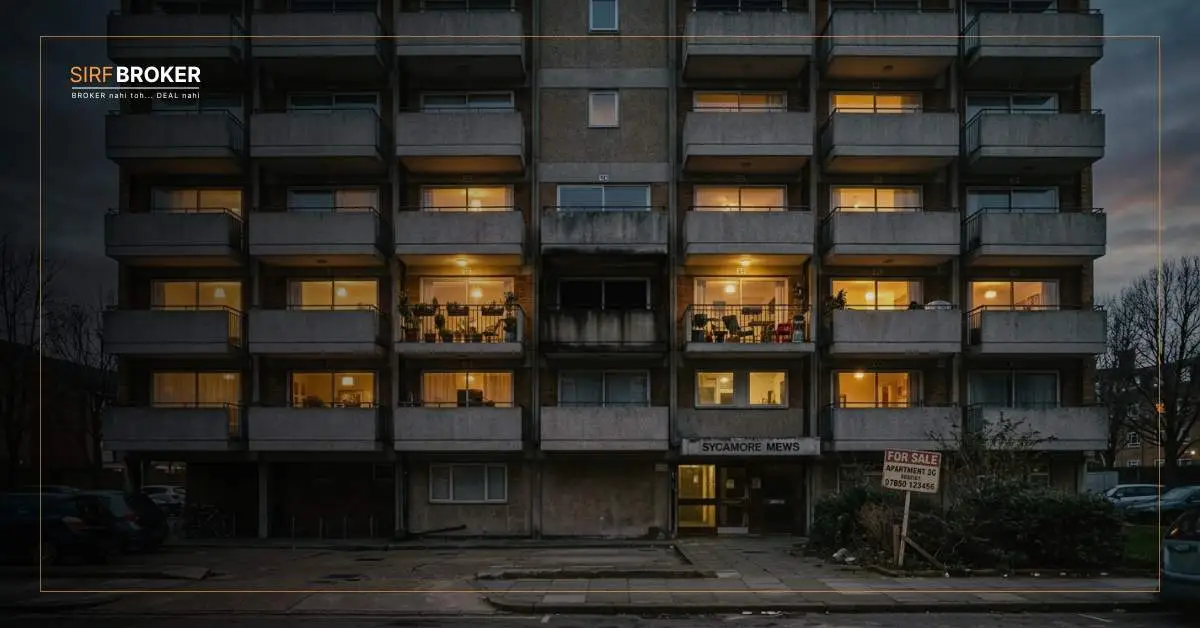
The Knight Frank India Q1 2026 residential report contained a data point largely overshadowed by the premium market headlines: sales of homes priced below ₹50 lakh fell 23% year-on-year across India’s top eight cities in Q1 2026, to 16,273 units.
A 23% sales decline in a market segment is a significant number. But what it means — and what it does not mean — requires unpacking. A sales decline does not automatically mean demand collapsed. It could mean supply shrank and buyers had less to choose from. It could mean buyers are priced out and have stopped searching in the primary market. It could mean they have moved to resale, shifted geography, or delayed purchase entirely.
In the case of India’s affordable housing segment in Q1 2026, the answer involves all of the above.
| Sales of homes under ₹50 lakh fell 23% YoY to 16,273 units in Q1 2026 across India’s top eight cities per Knight Frank India. This is not a demand collapse — it is a supply withdrawal removing affordable buyers from the primary market and pushing them into resale, peripheral corridors, and Tier 2 cities. |
Why Supply Withdrawal Produces a Sales Decline
| WHY DEVELOPERS EXITED AFFORDABLE HOUSING Land cost has risen past affordable thresholds → In major cities, land cost per sq ft has risen to levels where it is impossible to build and sell at sub-₹50 lakh with viable margins. The land cost alone in key corridors approaches what the entire affordable unit would sell for five years ago. Construction cost inflation → Steel, cement, and labour costs have risen 20–35% since 2021. An affordable project viable at ₹2,200/sq ft construction cost is not viable at ₹3,200/sq ft when the selling price is fixed by what the affordable buyer can pay. Premium margin advantage → A developer choosing between a ₹2 crore premium project with 28–32% gross margin and a ₹45 lakh affordable project with 10–14% gross margin — same land cost, same regulatory burden — makes a rational choice to build premium. PMAY complexity → PMAY-Urban 2.0 provides subsidy incentives but disbursement process, documentation requirements, and timeline uncertainty have dampened developer enthusiasm for building designated affordable stock at scale. |
What This Means for the Buyer Who Needs a Home Under ₹50 Lakh
| Buyer Situation | What the Market Offers in 2026 | Practical Action |
|---|---|---|
| 2BHK under ₹50L in a major city | New supply very limited in primary market. | Focus on resale market. Older stock in established localities often in this range. |
| Can stretch to ₹50–80L | Peripheral corridors 30–50 km from city centre have new supply in this range. | Evaluate metro/road connectivity honestly. Infrastructure improving but uneven. |
| Open to Tier 2 cities | Jaipur, Lucknow, Indore, Ahmedabad have strong new supply in ₹30–60L range. | Best affordability-quality combination in India right now. |
| PMAY eligible | PMAY-U 2.0 active with subsidy for eligible EWS/LIG buyers in designated projects. | Verify specific project’s PMAY registration before committing. Timelines vary. |
The Resale Market: Where Affordable Demand Is Actually Going
| The resale market for properties in the ₹30–70 lakh range in major cities is more active in 2026 than primary market data suggests. Older apartments in established localities — where the original owner bought at ₹20–35 lakh five to eight years ago — are selling at ₹45–70 lakh today. Stamp duty is lower (no GST), the location is established, and title is typically cleaner than under-construction risk. Buyers who understand the resale market are finding more choices than those focused only on new launches. |
Before transacting in the resale market, title and document verification is non-negotiable. The property verification checklist for buyers and brokers covers the specific documents to check before any resale transaction.
Will Government Policy Fix the Affordable Supply Problem?
| For PMAY to meaningfully increase affordable supply in major cities, it would need to either: subsidise land cost directly through dedicated government land banks; substantially increase construction cost subsidies; or provide FAR/FSI concessions that allow developers to cross-subsidise affordable units with premium development on the same plot. None of these are currently available at the scale required in major metropolitan markets. |
For buyers who want to understand PMAY eligibility accurately, the detailed guide on what brokers must explain about PMAY-U 2.0 before promising a subsidy covers eligibility conditions, income limits, and disbursement process.
Sirf Broker POV
India’s 23% decline in affordable housing sales is a policy failure dressed in market data. The market is functioning — it is efficiently delivering what developers find profitable. The problem is that what developers find profitable is no longer the housing that most Indian households can afford in the cities where they work.
This is not a moral observation — it is a structural one. The incentive structure for developers does not currently support affordable housing production at meaningful scale in major city markets. Changing that requires government intervention on the cost side of the developer equation — not on the demand side. Demand exists. The buyer who needs a ₹45 lakh home in Pune or Bengaluru exists. The new supply product that meets their budget does not.
For buyers in this segment, the practical advice is stark: expand your geography or engage the resale market. The new-launch affordable segment in major cities is not going to recover without policy changes not currently on the table. The resale market, peripheral corridors, and Tier 2 cities are where the inventory actually is.
Conclusion
Affordable home sales declined 23% in Q1 2026 because affordable supply declined — not because buyers disappeared. The demand is being redirected to resale markets, peripheral corridors, and Tier 2 cities. Buyers who limit their search to new primary-market launches in major cities are searching in the thinnest part of the market.
Before any transaction, understanding full purchase cost is essential. The guide to circle rates and why they matter in property deals is a useful starting point for calculating true purchase cost.
Frequently Asked Questions
1. Why did affordable housing sales fall 23% in India in Q1 2026?
Sales under ₹50 lakh fell 23% YoY to 16,273 units in Q1 2026 per Knight Frank India. The primary cause is supply withdrawal — developers have exited the affordable segment because construction costs, land prices, and margin requirements make it financially unviable relative to premium housing.
2. Is there a demand problem in India’s affordable housing market?
No. The decline is supply-driven, not demand-driven. The buyer who needs a ₹30–50 lakh home exists. What does not exist in adequate quantity is new-launch supply meeting that budget. Demand is being redirected to resale, peripheral corridors, and Tier 2 cities.
3. Where can affordable homebuyers find supply in India in 2026?
Three viable options: resale market in established localities (₹40–70 lakh range); peripheral corridors 30–50 km from major city centres; Tier 2 cities like Jaipur, Lucknow, Indore, and Ahmedabad with strong new supply in the ₹30–60 lakh range.
4. What is PMAY and does it help affordable homebuyers in 2026?
PMAY-Urban 2.0 provides interest subsidies for eligible EWS/LIG buyers and capital assistance for developers building designated affordable stock. It helps reduce total loan cost but has not been sufficient to reverse the structural developer economics driving exit from the affordable segment.
5. Is the resale market a good option for affordable homebuyers?
Yes — often better than the primary market for this segment. No GST, lower stamp duty, established locations. Older apartments bought at ₹20–30 lakh 5–8 years ago are available at ₹45–70 lakh today. Title verification is essential before any resale transaction.
6. What is the cheapest city to buy a home in India in 2026?
Among major metros, Hyderabad and Pune offer relatively better affordability. For best overall affordability: Ahmedabad, Jaipur, Lucknow, Indore, and Nagpur regularly offer 2BHK properties in the ₹30–55 lakh range in well-located projects.
7. Will affordable housing prices fall in India’s major cities?
Unlikely near-term. Land and construction costs have not reversed. Developers will not return to affordable housing at scale without policy intervention on the cost side. The sub-₹50 lakh share of new supply will likely continue shrinking through 2026 and 2027.
Sources
- Knight Frank India — Q1 2026 Residential Market Report — Affordable sales (under ₹50 lakh) fell 23% YoY to 16,273 units. knightfrank.co.in
- JLL India — Residential Dynamics Q1 2026 — Premium segment growth context. jll.co.in
- MoHUA / PMAY-Urban 2.0 — Policy framework. pmay-u.gov.in
| Disclaimer: Published by Sirf Broker for educational purposes only. Not financial or investment advice. Consult a qualified broker and financial advisor before any property transaction. |