

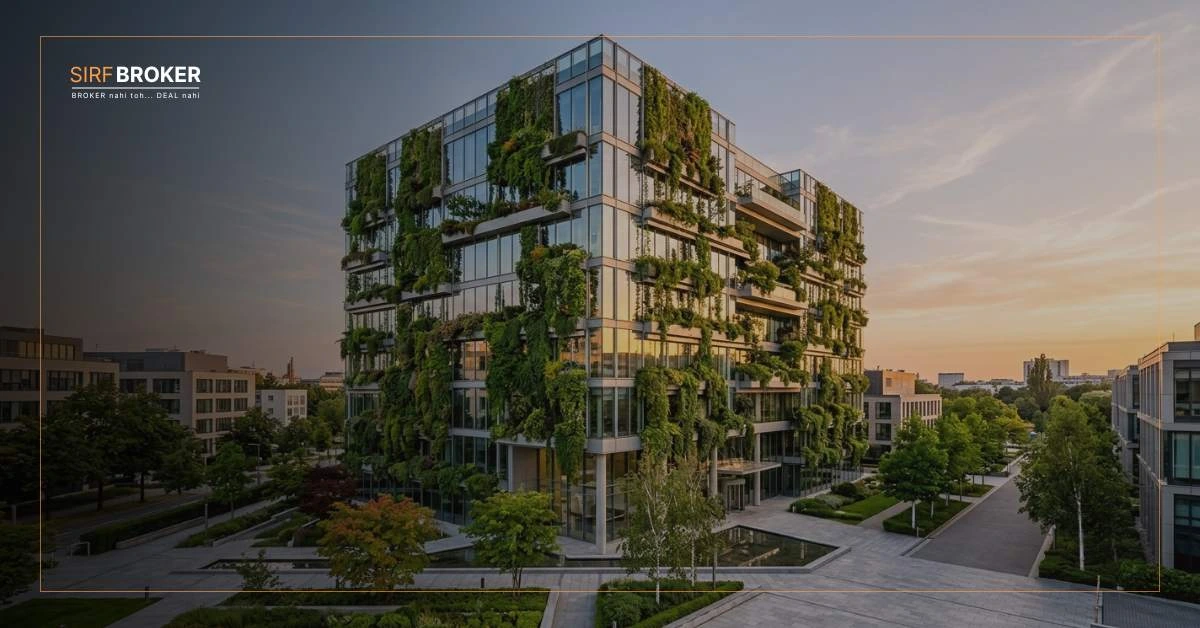
Green building certification in India’s commercial real estate market has crossed the threshold from competitive differentiator to baseline requirement. According to Colliers India’s 2026 Real Estate Outlook and Cushman & Wakefield India’s 2026 perspective, 80–90% of new commercial supply entering India’s top city markets in 2026 is expected to carry green certification — with overall green building penetration projected at 70–75% across India’s total Grade A commercial stock.
This is not a CSR metric or a branding exercise. It is a tenant procurement requirement. GCCs operating under global ESG mandates, multinational corporations with scope 3 emissions reporting obligations, and listed Indian companies with sustainability commitments built into board-level strategy — this tenant base requires green-certified buildings. A developer who does not build to certification standard is not competing for a meaningful share of institutional commercial leasing demand in 2026.
| 80–90% of new commercial supply in India in 2026 expected to be green-certified. Overall green penetration across Grade A commercial stock projected at 70–75%. GCCs, MNCs, and listed Indian enterprises now require green-certified buildings — not as a preference, but as a procurement standard. Developers building brown assets are being filtered out before shortlisting begins. |
The Three Certification Standards That Matter in India
| Certification | Issued By | Recognition | Tenant Requirement |
|---|---|---|---|
| LEED (Leadership in Energy and Environmental Design) | US Green Building Council (USGBC) | Global — recognised by all multinational GCC and MNC procurement teams | Required by virtually all US and European MNCs and GCCs |
| IGBC (Indian Green Building Council) | CII — Indian Green Building Council | National — widely recognised in India, accepted by domestic institutional tenants | Accepted by domestic enterprises and Indian-origin GCCs |
| GRIHA (Green Rating for Integrated Habitat Assessment) | TERI / MoHUA | National — government-aligned, relevant for PSU and government-leased assets | Required for government and PSU procurement in many states |
Why Tenants Require Green Buildings — The Business Case
| WHY GCCS AND MNCS REQUIRE GREEN BUILDINGS IN 2026 Scope 3 emissions reporting → Companies listed on US, UK, and European exchanges now report Scope 3 emissions — which include the carbon footprint of leased office space. A non-green-certified building in their portfolio creates a reportable emissions liability. Procurement teams are instructed to avoid this. ESG board mandates → Listed Indian companies with SEBI BRSR (Business Responsibility and Sustainability Report) obligations and multinational companies with global sustainability commitments have board-level ESG targets. Real estate is one of the highest-impact levers for achieving these targets. Operational cost advantage → Green-certified buildings typically deliver 20–30% lower energy costs compared to non-certified equivalents. For a GCC with 1,000+ seats, this is a material annual operating saving — not a soft benefit. Talent preference → Employee surveys consistently show preference for green, well-ventilated, naturally lit workspaces — particularly among the GCC professional cohort. Developers who can cite indoor air quality, biophilic design, and wellness certification attract tenants who use these features in talent retention arguments. |
The Cost of Green Certification — And Why It’s Worth It
| Green certification adds approximately 3–8% to construction cost depending on the target rating level. For a 3 lakh sq ft commercial building, that is ₹10–25 crore in additional upfront investment. The return on that investment: a rental premium of 8–15% over non-certified comparable buildings in the same micro-market, access to 80–90% of the active leasing demand, and institutional capital eligibility (REITs and PE funds apply green criteria in asset acquisition). The arithmetic strongly supports certification for any developer building institutional-grade commercial stock. |
What Brown Buildings Face in 2026
| Non-certified commercial buildings in India’s major markets are increasingly competing in a shrinking tenant pool. When 80–90% of new supply is green, the non-certified building defaults to the tenant who either cannot afford green-building rents or does not face ESG procurement requirements. In most major market segments, that is a contracting, price-sensitive tenant base. Vacancy risk is structurally higher for non-certified assets. |
Sirf Broker POV
Green certification has stopped being a differentiator and become a threshold in India’s Grade A commercial market. This transition happened faster than most developers who entered the market five to seven years ago anticipated — and it has meaningful consequences for existing non-certified assets as well as new development decisions.
For developers with existing non-certified commercial stock, the question is not whether to upgrade — it is whether the retrofit economics work for the specific asset. Energy efficiency upgrades, IGBC existing building certification, and operational improvement programmes can upgrade older assets to a certifiable standard, and the rental premium and vacancy benefit often justify the investment. The developer who treats their existing portfolio as a green upgrade project — rather than writing off non-certified assets to a declining tenant base — has a material asset management opportunity.
For developers planning new supply, there is no longer a legitimate cost-benefit argument against building to LEED or IGBC Gold standard. The rental premium, the tenant access, the capital eligibility, and the future resale positioning to a REIT or PE acquirer all point in the same direction. The 3–8% additional construction cost is not a question to debate in 2026. It is a cost of entry to the institutional commercial market.
Conclusion
80–90% of India’s new commercial supply in 2026 will be green-certified. That number makes green certification a prerequisite for competing in institutional commercial real estate, not a premium. Developers who build brown assets in 2026 are reducing their addressable tenant market, their rental premium potential, and their institutional capital eligibility simultaneously. The cost of certification is 3–8% of construction. The cost of not certifying is the other 80–90% of the market.
Frequently Asked Questions
1. What percentage of India’s commercial real estate will be green-certified in 2026?
80–90% of new commercial supply entering India’s top city markets in 2026 is expected to carry green certification. Overall green penetration across India’s total Grade A commercial stock is projected at 70–75%, per Colliers India 2026 and Cushman & Wakefield India 2026 outlook reports.
2. Which green building certifications matter most in India in 2026?
Three main certifications: LEED (USGBC) — required by US and European MNCs and GCCs; IGBC (CII) — widely accepted by domestic enterprises and Indian-origin GCCs; and GRIHA (TERI/MoHUA) — government-aligned, required for PSU and government leasing. LEED is the gold standard for international institutional tenants.
3. How much does green certification add to construction costs in India?
Approximately 3–8% premium on construction cost depending on target rating level. For a 3 lakh sq ft commercial building, approximately ₹10–25 crore additional upfront investment. Offset by 8–15% rental premium over non-certified comparable buildings and access to 80–90% of active leasing demand.
4. Why do GCCs require green-certified offices in India?
Scope 3 emissions reporting obligations on parent company exchanges; board-level ESG targets; 20–30% lower energy operating costs; and talent preference for green, well-ventilated workspaces. For GCCs reporting to US or European headquarters, non-green-certified leasing creates a reportable emissions liability.
5. What happens to non-green commercial buildings in India?
Structural vacancy risk increases as they compete in a shrinking, price-sensitive tenant pool. Rental premium is not achievable. Institutional capital (REITs, PE funds) applies green criteria in acquisition — limiting exit options. Developers with non-certified assets should evaluate IGBC existing building certification for retrofit.
6. Can existing buildings be retrofitted to green certification standard in India?
Yes — IGBC and LEED both have “existing buildings” certification pathways covering energy efficiency, water management, indoor air quality, and operational improvements. The retrofit investment is typically 40–60% lower than new-build certification cost, with 12–18 month payback through energy savings and rental improvement.
7. Do green buildings get higher rent than non-green buildings in India?
Yes — green-certified Grade A buildings command an 8–15% rental premium over non-certified comparable buildings in the same micro-market. The premium is highest in Bengaluru, Hyderabad, and Mumbai where institutional tenant demand is concentrated and certification is an effective screening criterion.
Sources
- Colliers India — Real Estate 2026 Outlook — 80–90% new supply green-certified, 70–75% overall green penetration. colliers.com/india
- Cushman & Wakefield India — 2026 Outlook — ESG requirements driving green building demand. cushmanwakefield.com/india
- Indian Green Building Council (IGBC) — IGBC certification standards. igbc.in
| Disclaimer: Published by Sirf Broker for educational purposes only. Not investment or construction advice. All data from publicly available reports cited above. |