

Total stock numbers in real estate are useful for context. What matters more is quality composition — and in India’s warehousing market in 2026, the quality story is the one that changes strategy.
India’s total industrial and warehousing stock across eight major cities reached 514 million sq ft in 2026, representing a 13% increase from 2024. Within that number, Grade A assets — modern, institutionally specified, high clear-height warehousing — grew 20% year-on-year to 293 million sq ft and now account for 57% of total inventory, according to CBRE’s India Logistics Market Outlook 2026. A decade ago, Grade A was well under 30% of India’s total warehousing stock. The market has structurally re-engineered itself toward quality, and that shift is not slowing.
The “flight to quality” that CBRE identifies is not just a headline trend — it is a market mechanism with specific consequences for developers building second-generation facilities, for occupiers deciding between upgrading and staying, and for brokers navigating a bifurcated vacancy landscape.
| 514 MSF total warehousing stock in 2026. 293 MSF is Grade A — up 20% YoY — now 57% of total inventory. Grade A rents rising. Grade B rents stagnant or softening. The quality bifurcation is the defining story of India’s logistics real estate market. |
What Grade A Warehousing Actually Means
The term “Grade A warehouse” is used loosely in Indian real estate conversations. It needs a precise definition to be useful for developers, occupiers, and brokers advising either side of a transaction.
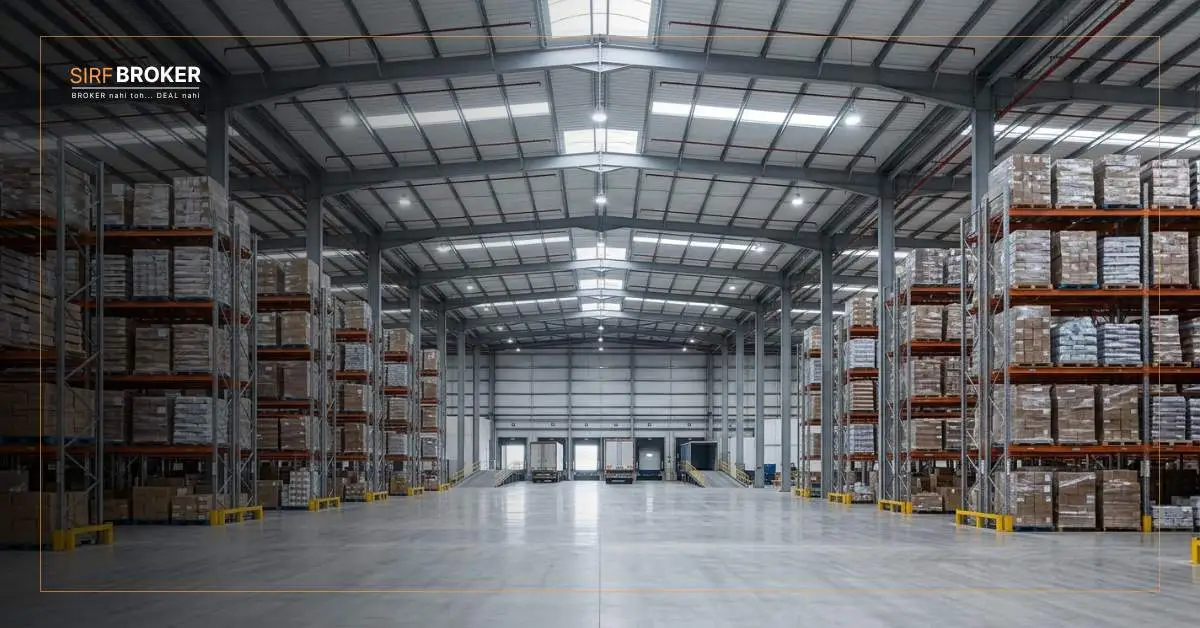
A Grade A warehouse in the Indian context typically meets these specifications: minimum clear height of 10-12 metres (enabling high-bay racking and automated storage); fire safety compliance to NBC and local codes with automatic sprinkler systems; dock levellers with covered loading bays; flatness tolerance (FM2 standard or better) for MHE (Material Handling Equipment) operations; power backup for temperature-sensitive or continuous operations; and institutional building management with documented maintenance standards.
Not every warehouse with a modern facade meets these specifications. India’s warehousing market has a significant layer of Grade B — buildings that look professional externally but lack the structural or mechanical specifications required by sophisticated logistics operators. This is the segment being left behind by the market’s flight to quality, and it will face sustained vacancy pressure as occupiers upgrade and Grade A options become more available in established corridors.
| Specification | Grade A | Grade B |
|---|---|---|
| Clear Height | 10-12 metres minimum | Often 6-8 metres |
| Fire Safety | NBC compliant, automatic sprinklers | Variable, often manual only |
| Floor Flatness | FM2 standard (MHE-ready) | Unspecified, limits automation |
| Loading Bays | Covered dock levellers | Often open-face or at-grade |
| Management | Institutional, documented SLAs | Typically owner-managed, informal |
According to CBRE’s India Logistics Market Outlook 2026, warehousing rentals are expected to maintain an upward trajectory, supported by this flight to quality and rising replacement costs. Grade A rents are rising; Grade B rents are stagnant or softening in markets where Grade A has been delivered at scale.
The Geographic Concentration in 2026
India’s warehousing demand is not evenly distributed, and the Q1 2026 data confirms the concentration sharply. Mumbai and Pune together drove 81% of warehousing leasing in Q1 2026. That concentration reflects the western gateway cluster’s infrastructure advantages: port connectivity via JNPT and Mundra, established FMCG, e-commerce, retail, and manufacturing demand density, and superior NH and expressway connectivity into the heartland.
| WAREHOUSING DEMAND GEOGRAPHY: WHAT DEVELOPERS MUST KNOW Mumbai + Pune (81% of Q1 2026 leasing) → Highest liquidity, shortest lease-up timeline, port-driven demand. Tightest land costs but strongest exit optionality. The default first market for institutional warehouse capital. Delhi NCR, Bengaluru, Hyderabad, Chennai → Viable secondary markets with genuine demand — but longer absorption timelines and narrower occupier base. Underwriting assumptions should reflect that secondary city exposure carries materially higher vacancy risk per CBRE 2026. Emerging corridors (Ludhiana belt, Rajasthan zones, NH-48) → Genuine medium-term demand rationale from manufacturing thesis. Near-term absorption requires patient capital — not the right market for short hold strategies. |
For brokers in the logistics leasing segment, geographic specialisation is the only defensible position. The broker who knows every Grade A park in Bhiwandi, Nhava Sheva, and Chakan — their vacancy positions, lease terms, developer track records, and connectivity — is operating in a fundamentally different business from the broker who handles opportunistic warehousing referrals. The former commands an advisory relationship. The latter is competing on rate against portals.
How Developers Are Responding to the Flight to Quality
CBRE’s India Logistics Market Outlook 2026 identifies three adaptation strategies developers are using to respond to the quality-premium opportunity while managing the land cost challenge that comes with it.
First, long-term land lease models — leasing land from landowners over 30-40 year terms rather than acquiring it outright — are reducing upfront capital requirements and improving return on equity. This is a structural shift in how warehousing development is financed in India, enabling more developers to enter Grade A development without the balance sheet weight of land ownership.
Second, decentralisation into multiple smaller parcels across emerging corridors rather than concentrating in single large campuses where land costs are prohibitive. A cluster of three 2-lakh sq ft facilities across different locations can achieve similar lease economics to a single 6-lakh sq ft campus with better geographic demand coverage and lower concentration risk.
Third, retrofitting second-generation urban warehouses — dated industrial structures from the 1980s and 1990s — with modern flooring, fire systems, and HVAC to meet Grade A specifications. In cities where serviced land near demand centres is scarce, retrofitting is often more economical than greenfield development further from the market.
What Institutional Capital Is Doing
The expected IPO of Blackstone’s Horizon Industrial Parks — flagged in CBRE’s 2026 logistics outlook — is a signal worth tracking. It would be India’s second major listed logistics REIT vehicle and would create a transparent public market benchmark for Grade A warehouse asset values in India.
| CBRE’s 2026 logistics outlook projects 15-18% growth in warehouse leasing overall, bolstered by investor confidence and the potential for large-scale portfolio transactions. The “portfolio transaction” language is significant — it signals that the institutional buyer base for Indian logistics real estate is large enough to absorb package deals, not just individual assets. That is a marker of a maturing market. |
For developers and investors sitting on Grade A logistics assets, a listed benchmark means a clearer exit option than the bilateral deal market. If Horizon’s assets trade at a 6-7% cap rate on their income, that benchmarks what other institutional-quality warehouse portfolios should command. To understand how India’s REIT framework shapes commercial real estate ownership and exit strategies, read: REITs Are Changing Real Estate Investing: What Brokers Must Learn.
Sirf Broker POV
India’s warehousing market is in a period of quality bifurcation — and that bifurcation is where the strategic opportunity sits for every participant in the market.
The flight to quality is not just about better specifications. It is about the kind of occupier that Grade A attracts, and what that occupier means for asset value over a 10-year horizon. Grade A warehouses in India’s established corridors are increasingly occupied by institutional tenants — listed 3PLs, global e-commerce operators, manufacturing companies with procurement governance requirements. These tenants sign longer leases, maintain facilities to standard, and provide predictable income. They are the kind of occupier that makes an asset financeable, insurable at market rates, and ultimately sellable to a PE fund or REIT.
Grade B assets attract a different occupier profile — smaller traders, informal logistics operators, cost-sensitive manufacturers — who sign shorter leases, negotiate aggressively on rent, and leave facilities in worse condition. The rent per sq ft difference between Grade A and Grade B in Mumbai’s corridors is not dramatic. The value difference over a 10-year horizon — because of occupier quality, lease term, and exit option — is very large.
This is what brokers and developers involved in logistics real estate need to communicate to clients with clarity: the decision to invest in Grade A specifications is not an aesthetic choice. It is a financial decision with a compounding long-term return differential over Grade B. The flight to quality is rational because the market has figured out that quality pays — not just in rent, but in total value. Developers who cut specifications to save ₹50 per sq ft on construction are giving up multiples of that in exit value.
Conclusion
India’s warehousing market has crossed 514 MSF and is structurally reorienting around Grade A assets that serve the institutional occupier base. CBRE’s 2026 outlook projects 15-18% leasing growth, a Blackstone IPO in the pipeline, and continued rental growth in Grade A-heavy markets. For developers: build Grade A, manage land cost through long-term leases and smaller parcels, and target the Mumbai-Pune cluster for near-term liquidity. For brokers: specialise in specific corridors and build occupier relationships — generic warehousing knowledge is commoditised and competing against search portals.
For context on how India’s commercial and industrial occupier ecosystem connects to the broader office demand picture, read: India’s GCC Boom and What It Means for Office Demand Through 2030.
Frequently Asked Questions
1. How large is India’s warehousing market in 2026?
India’s total industrial and warehousing stock across eight major cities reached 514 million sq ft in 2026 — a 13% increase from 2024. Of this, Grade A assets account for 293 million sq ft (57% of total inventory), having grown 20% year-on-year, per CBRE’s India Logistics Market Outlook 2026.
2. What is a Grade A warehouse in India?
A Grade A warehouse in India typically has a minimum clear height of 10-12 metres for high-bay racking, fire safety compliance (NBC standards with automatic sprinklers), FM2-standard floor flatness for material handling equipment, covered dock levellers, power backup, and institutional building management. Not every modern-looking warehouse meets these specifications.
3. Which cities have the most warehouse leasing demand in India?
Mumbai and Pune together drove 81% of warehousing leasing in Q1 2026, per CBRE data. This western gateway cluster dominates due to port connectivity, FMCG and e-commerce demand density, and road infrastructure. Delhi NCR, Bengaluru, Hyderabad, and Chennai are active secondary markets but with longer absorption timelines.
4. What is the flight to quality in India’s warehousing market?
Flight to quality refers to logistics and industrial occupiers consistently choosing Grade A specifications over lower-quality options, even at a rent premium. CBRE’s India Logistics Market Outlook 2026 confirms Grade A rents are on an upward trajectory while Grade B assets face vacancy pressure, driven by the operational requirements of e-commerce, 3PL, and manufacturing occupiers.
5. What is the warehousing leasing growth forecast for India in 2026?
CBRE’s India Logistics Market Outlook 2026 projects 15-18% growth in warehousing leasing in 2026, supported by investor confidence, large-scale portfolio transactions, and the expected IPO of Blackstone’s Horizon Industrial Parks. E-commerce, 3PL, and the China+1 manufacturing thesis remain the primary demand drivers.
6. How are developers managing high land costs in India’s warehousing market?
Three strategies are emerging: long-term land leases (30-40 year terms) instead of outright acquisition; decentralisation into multiple smaller parcels across emerging corridors to reduce per-unit land cost; and retrofitting second-generation urban warehouses with modern specifications to avoid expensive greenfield development further from demand centres.
Sources and References
- CBRE India — India Logistics Market Outlook 2026 — 514 MSF total stock +13% from 2024; Grade A 293 MSF +20% YoY; Grade A 57% of inventory; Mumbai/Pune 81% of Q1 leasing; 15-18% leasing growth forecast; Blackstone Horizon IPO expected. cbre.co.in
- JLL India — Warehousing Market Reports 2026 — Warehousing and logistics market overview; institutional demand trends. jll.co.in
Disclaimer
| This article is published by Sirf Broker for educational and informational purposes only. Warehousing stock figures, leasing data, and developer strategy commentary are sourced from publicly available third-party reports cited above and are subject to revision. This is not investment or transaction advice. |