

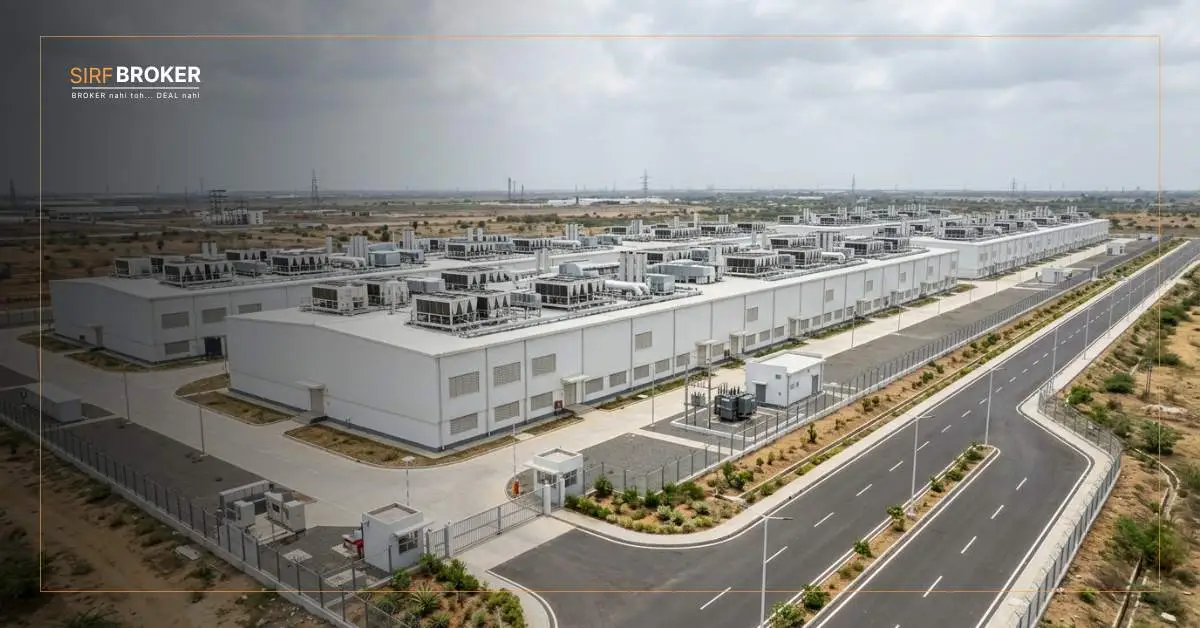
wFor three consecutive years, office was the uncontested winner of institutional capital in Indian real estate. Grade A, GCC-anchored, REIT-eligible office assets captured the majority of private equity inflows — the logic was straightforward: contracted income, institutional tenants, observable demand growth, and clear exit pathways through India’s growing REIT ecosystem.
In Q2 2026, that pattern broke.
Data centres captured 38% of all PE real estate inflows in India during Q2 2026 — against office’s 30% — marking the first quarter in which data centres overtook office as the leading PE real estate investment category in the country, per Savills India’s H1 2026 India Real Estate PE Investment Report. Total PE inflows into Indian real estate reached $3.2 billion in H1 2026, up 33% year-on-year. Q2 2026 alone attracted $2 billion — 25% higher than Q2 2025.
The reversal is not a one-quarter anomaly. It reflects a structural convergence of AI-driven global data infrastructure demand, India-specific policy tailwinds, and a capital composition shift bringing US and Canadian institutional money — responsible for 69% of all foreign PE into Indian real estate in H1 2026 — into a real estate category that most Indian brokers and developers have never transacted.
| H1 2026 India PE real estate: $3.2B total (+33% YoY). Q2 2026: $2B (+25% YoY). Data centres: 38% of Q2 inflows. Office: 30%. Residential: 16%. Domestic capital: 51% of H1 total. Foreign capital: 49% — 69% from USA & Canada, directed into data centres and hospitality. Source: Savills India H1 2026. |
What the Savills H1 2026 Data Actually Shows
Savills India’s H1 2026 report records $3.2 billion in total PE inflows into Indian real estate — a 33% year-on-year increase. Q2 2026 specifically attracted $2 billion, up 25% year-on-year. Domestic capital accounted for 51% of H1 inflows — a signal that Indian institutional capital (family offices, domestic PE funds) is stepping in with conviction alongside foreign flows.
| Q2 2026 INDIA PE REAL ESTATE: ASSET CLASS BREAKDOWN Data Centres → 38% — Hyperscale and co-location facilities. Largest single category for the first time. Driven by US and Canadian capital and AI infrastructure demand. Office → 30% — Grade A, GCC-anchored. Second-largest category but displaced from top position it held in H1 2025. Residential → 16% — Premium and luxury housing. Domestic capital primary driver. Limited foreign PE interest in development-stage residential. Alternatives → 16% — Hospitality, healthcare, student housing/co-living. Reflects diversification of investor base into maturing asset classes. |
A clarification on methodology matters here. Knight Frank India’s H1 2026 report recorded $1.13 billion in PE flows for the same period — significantly lower than Savills’ $3.2 billion. Both are accurate within their definitions. Savills captures a broader scope including equity commitments at development-stage and platform-level deals; Knight Frank tracks completed, transaction-level deployed capital. For the data centre story, the Savills methodology is the more relevant frame — AirTrunk’s $30 billion India commitment and the Reliance-Meta infrastructure partnership are commitment-level deals, not transaction-level deployments. Understanding this difference matters for anyone using market reports to make investment or leasing decisions.
Why Data Centres Are Winning Institutional Capital in India
Three forces are converging to make data centres the most actively targeted institutional real estate category in India in 2026. None of them are temporary.
| THREE FORCES DRIVING DATA CENTRE PE DOMINANCE 1. AI Infrastructure Is Non-Negotiable Capex The shift from general cloud computing to AI inference and training workloads requires significantly denser, more power-intensive server infrastructure. India’s scale, English-language technical workforce, and position as a consumption market for AI services makes it a mandatory destination for hyperscalers — not a preference. Microsoft, AWS, Google, and Meta are not choosing whether to build in India. They are choosing how fast. 2. India’s Policy Framework Is Exceptional by Global Standards Three provisions are driving capital confidence: a 15% safe harbour tax margin for domestic data centre operators (reducing transfer pricing risk), tax holidays to 2047 for foreign cloud service providers using India-based capacity, and 25–35% capital support for green technology investments. These provisions directly address the three risk factors historically deterring institutional capital in emerging market infrastructure: tax uncertainty, regulatory longevity, and capital recovery timeline. 3. Anchor Capital Has Confirmed India’s Tier-1 Status AirTrunk’s $30 billion India commitment and the Reliance-Meta partnership have signalled that the world’s most sophisticated infrastructure investors have processed India as a primary market, not an emerging experiment. Cumulative data centre investment commitments reached $126 billion by end-2025, per CBRE India, and are projected to exceed $180 billion in 2026. When capital of this quality and scale commits, the broader real estate ecosystem restructures around it. |
Where Data Centre Real Estate Is Being Built in India
Data centre investment in India concentrates in five geographies, each driven by different combinations of connectivity infrastructure, power grid access, and land availability.
Mumbai and Navi Mumbai remain the primary hub. Submarine cable landing stations provide low-latency connectivity to Southeast Asia, the Middle East, and Europe. MIDC industrial corridors in Airoli, Turbhe, and Taloja are the most active development zones. The established enterprise and financial services base generates co-location demand that supports economics at all facility scales.
Chennai is the second major hub, particularly preferred by US and Southeast Asian hyperscalers. The Tamil Nadu Data Centre Policy, combined with submarine cable access and lower land costs than Mumbai, has made Chennai the most active second-market for data centre development. Its submarine cable advantage is structural — it cannot be replicated in landlocked markets.
Hyderabad and Pune are the growth markets. Lower land costs, stable power infrastructure, and strong enterprise demand from GCC clusters are driving new development pipelines. Both cities are seeing land assembly activity in peripheral industrial zones directly connected to incoming data centre mandates.
NCR is the emerging market. Noida Expressway and Greater Noida corridors offer industrial-zoned land with improving fibre connectivity. The concentration of GCC and enterprise demand in Gurugram and Noida is beginning to attract operator interest. This market is 18–24 months behind Mumbai and Chennai in development readiness but is seeing active land-level attention.
What This Means for Developers — A New Build Typology
Power is the primary constraint, not space. A hyperscale data centre requires 50–200 megawatts (MW) of dedicated power — the consumption equivalent of powering a mid-size neighbourhood. The ability to secure high-tension power infrastructure (132 KV or 220 KV substations, dedicated grid connections) is more important than building design or location premium. A developer who controls a 20-acre industrial parcel with confirmed 100 MW power access is a more valuable counterparty to a hyperscaler than one with a central location and no power certainty. Data centre development begins with power access agreements, not architectural drawings.
Land zoning is industrial, not commercial. Data centres require industrial-zoned land, MIDC or state industrial authority compliance, and permitting processes entirely different from commercial real estate development. Developers whose expertise is in commercial office or residential will need new regulatory relationships and construction management capabilities — or must partner with developers who already have them.
Tenant covenants operate at a different level. When a hyperscaler leases a data centre, the specifications — TIER III or TIER IV Uptime Institute certification, specific power delivery and cooling redundancy requirements — are categorically different from a GCC leasing Grade A office. Developers engaging hyperscaler conversations without understanding these requirements are negotiating without the ability to evaluate what they are being asked to build. For the institutional investment context behind why structured, income-generating assets matter for capital access, read: REITs Are Changing Real Estate Investing: What Brokers Must Learn.
What This Means for Brokers — A New Specialist Category Is Opening
For most Indian commercial real estate brokers, data centres are entirely uncharted territory. The leasing conversation is different. The client qualification is different. The transaction structure is different. And the fee opportunity — driven by land parcels, development agreements, and hyperscaler-level deals — is different from standard office leasing. The number of Indian real estate brokers who currently have credible expertise in this category is very small. That is the opportunity.
Land advisory for data centre development is the most accessible entry point. The first phase of any data centre project is land assembly — identifying industrial-zoned parcels with power access and connectivity proximity in development corridors of Mumbai, Chennai, Hyderabad, Pune, and NCR. Brokers with strong land transaction experience in these peripheral zones can build entry relationships with project development teams of established data centre operators — NTT Data, STT GDC, Nxtra, Yotta Infrastructure, CtrlS Datacenters — who are actively expanding their India footprint.
Co-location brokerage sits within existing client relationships. Enterprise clients — GCCs, large Indian corporates, BFSI institutions — need co-location space for their own IT infrastructure. This is a corporate occupier transaction with technical specifications, and it sits within the broker’s existing enterprise and GCC client base. The question to ask every enterprise real estate client right now: “Who manages your co-location infrastructure decision, and who are they talking to?”
Build-to-suit advisory for hyperscalers is the highest-value entry point — advising a hyperscaler or development partner on site selection, power infrastructure access, and local regulatory navigation. This requires specialist knowledge that takes time to build. But a broker who can genuinely serve this need operates in a category where no credible Indian real estate professional currently competes at scale. The specialist advantage in an uncrowded category is exactly what brokers who built GCC expertise in 2019–2020 are benefiting from today. To understand how specialist positioning compounds into long-term brokerage advantage, read: From Listings to Personal Brands: The New Broker Reality.
Sirf Broker POV
The data centre overtaking office as India’s top PE real estate category in Q2 2026 is being read in most commentary as a technology infrastructure story. It is also, unambiguously, a real estate story — and one the Indian real estate industry is structurally unprepared for.
What Q2 2026 marks is not the beginning of this trend. The underlying demand — AI inference capacity requirements, enterprise cloud expansion, data sovereignty regulations — has been building for three years. What changed in Q2 is that committed capital became large enough to register unambiguously in aggregate PE data. The developers and brokers who recognised this pattern in 2023–24 are already in active conversations with hyperscalers and data centre operators. Everyone else is 18–24 months behind and doesn’t yet know it.
There is one structural difference between data centre investment and office investment that every real estate professional should internalise: data centre demand is not correlated with economic cycles the way office demand is. When companies reduce headcount and cut office space in a downturn, they do not cut AI inference capacity or enterprise cloud storage. The demand durability for data centre infrastructure may be higher than for any other real estate category in the current environment — which is precisely why US and Canadian institutional capital, managing against elevated interest rates and macro uncertainty, is placing 69% of its India real estate bets here and not in office or residential.
India — with its submarine cable infrastructure, improving power grid, AI talent base, and an incentive framework designed to attract exactly this category of capital for the next two decades — is positioned to become one of three or four tier-1 global data centre real estate markets by 2030. The Savills and CBRE data is confirming it. The real estate industry’s job is to develop the expertise and transactional capability that matches the scale of capital arriving. That window is open. It will not stay open indefinitely.
Conclusion
Data centres captured 38% of India’s PE real estate inflows in Q2 2026, overtaking office (30%) for the first time on record, per Savills India’s H1 2026 report. Total PE flows reached $3.2 billion in H1 2026 (+33% YoY). US and Canadian capital accounts for 69% of all foreign PE, directed primarily into data centres. CBRE India projects cumulative data centre investment commitments to exceed $180 billion in India in 2026, up from $126 billion at end-2025.
For developers: power access is the primary development constraint. Industrial zoning, TIER III/IV certification readiness, and hyperscaler-level tenant engagement are the new competencies. For brokers: land advisory, co-location mandates, and build-to-suit site selection are three viable entry points into a specialist category where credible expertise is rare and institutional demand is accelerating. The time to build that expertise is now — before it becomes crowded.
For a deeper understanding of how institutional investment structures shape what gets built and what brokers ultimately lease, read: REITs Are Changing Real Estate Investing: What Brokers Must Learn.
Frequently Asked Questions
Why did data centres overtake office in India’s PE real estate rankings in Q2 2026?
Data centres captured 38% of India’s PE real estate inflows in Q2 2026, versus office at 30%, per Savills India’s H1 2026 report — the first time data centres have led. Three forces drove the shift: AI and cloud infrastructure demand making India a mandatory hyperscaler destination, India’s exceptional policy framework (tax holidays to 2047, 15% safe harbour margin, green tech capital support), and large-scale anchor commitments from AirTrunk and the Reliance-Meta partnership confirming tier-1 market status.
How much PE investment did Indian real estate attract in H1 2026?
Savills India’s H1 2026 report records $3.2 billion in total PE inflows into Indian real estate — a 33% increase year-on-year. Q2 2026 alone attracted $2 billion, up 25% YoY. Domestic capital accounted for 51% of H1 inflows; foreign capital for 49%, with 69% of that originating from the USA and Canada, directed primarily into data centres and hospitality assets.
Where in India are data centres being developed, and what drives location selection?
India’s five primary data centre markets are Mumbai and Navi Mumbai (submarine cable connectivity, MIDC industrial zones in Airoli and Turbhe), Chennai (submarine cable access, Tamil Nadu policy support, lower land cost), Hyderabad (GCC cluster demand, stable power), Pune (growth market, strong enterprise base), and NCR (emerging — Noida Expressway and Greater Noida corridors). Location selection is driven by high-tension power access (100+ MW grid connectivity), connectivity infrastructure, and industrial-zoned land availability. Land cost is secondary to power and connectivity.
What makes data centre development different from office or residential for Indian developers?
Three fundamental differences: power is the primary constraint — hyperscale data centres require 50–200 MW of dedicated high-tension power, and development begins with power access agreements, not architectural drawings; land zoning is industrial, requiring MIDC or state industrial authority compliance and entirely different permitting processes; and tenant covenants are hyperscaler-level — TIER III or TIER IV Uptime Institute certification and specific cooling and power redundancy requirements that differ categorically from GCC office leases.
How can Indian commercial real estate brokers enter the data centre category?
Three viable entry points: (1) Land advisory — identifying industrial-zoned land with power access in development corridors of Mumbai, Chennai, Hyderabad, Pune, and NCR for operators like NTT, STT GDC, Nxtra, Yotta, and CtrlS actively expanding in India. (2) Co-location brokerage — enterprise GCC and BFSI clients need co-location space; this is a corporate occupier transaction within existing broker relationships. (3) Build-to-suit advisory — site selection and regulatory navigation for hyperscalers; highest value, requires specialist knowledge built over time.
What is the long-term investment outlook for data centre real estate in India?
CBRE India projects India’s data centre capacity to grow 30% year-on-year in 2026, with cumulative investment commitments expected to exceed $180 billion — up from $126 billion at end-2025. India’s policy framework (tax holidays to 2047, 15% safe harbour margin, green tech capital support), combined with AI-driven demand from US and Canadian institutional capital, positions India as one of three or four tier-1 global data centre real estate markets by 2030. Critically, data centre demand is structurally less correlated with economic cycles than office demand — giving the asset class above-average demand durability across market conditions.