

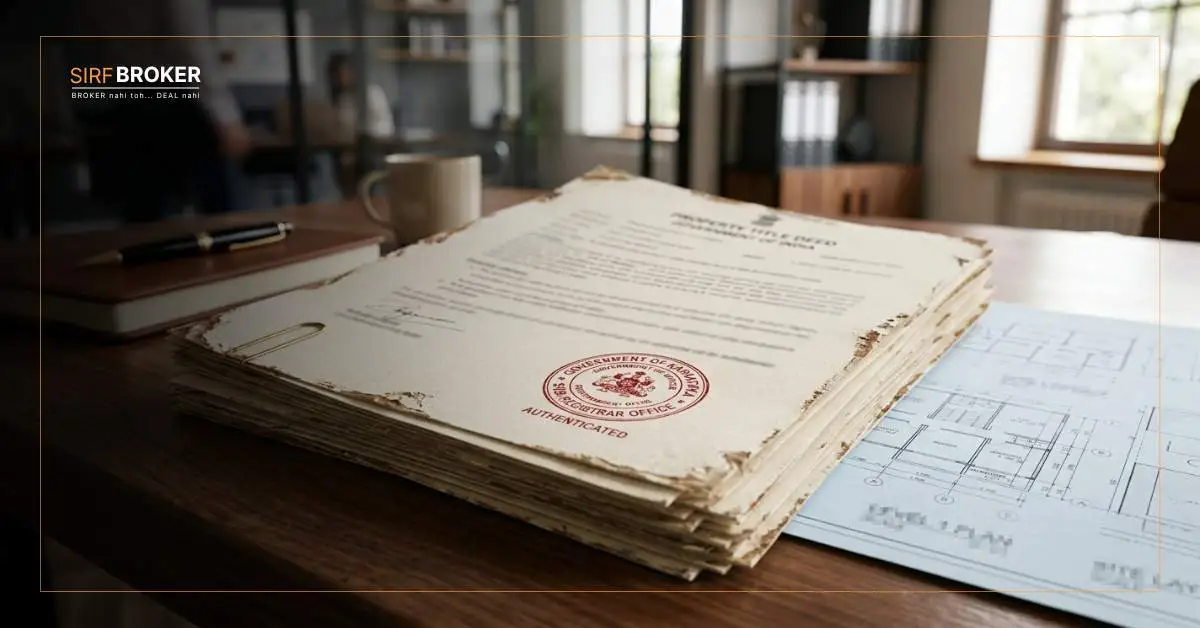
Thousands of property buyers and tenants move into buildings every year in India without an occupancy certificate. Some don’t know what it is. Some assume the developer handled it. Some are told by brokers it’s “being processed” and can be sorted after possession.
In most cases, by the time the problem surfaces — a bank refusing to disburse a loan, a municipal notice, an insurance claim that can’t be settled — it is already expensive to fix.
The occupancy certificate is not a formality. It is the document that makes a building legally habitable. Without it, you are occupying a building the law does not yet recognise as fit for use.
| Under RERA 2016, obtaining and handing over the occupancy certificate is the developer’s legal obligation — not the buyer’s problem to chase after possession. |
What Is an Occupancy Certificate in India?
An Occupancy Certificate — commonly abbreviated as OC — is an official document issued by the local municipal authority confirming that a building has been constructed in accordance with the approved building plan, complies with applicable bylaws and safety requirements, and is safe for occupation.
It is issued by the local body in whose jurisdiction the property falls — the Municipal Corporation, Development Authority, or in smaller towns, the relevant gram panchayat or tehsil office.
The OC is not issued automatically. The developer must apply for it after construction is complete. The local authority inspects the building, verifies compliance with the sanctioned plan, and issues the certificate if everything is in order. If the building deviates from the approved plan — an extra floor, a change in layout, an encroachment — the OC may be withheld or delayed.
What Is the Difference Between an Occupancy Certificate and a Completion Certificate?
These two documents are often confused, and in some states they are partially merged — but they are legally distinct.
A Completion Certificate (CC) certifies that a building’s construction has been completed and conforms to the approved plans. It is issued before the building is ready for occupation and does not confirm that utilities, safety systems, and civic connections are in place.
An Occupancy Certificate (OC) goes further. It confirms not just that the building is built, but that it is safe and legally ready to be occupied — with electrical connections, water supply, sewage systems, and fire safety measures in place and functional.
Think of it this way: a Completion Certificate says the building exists in the form it was approved for. An Occupancy Certificate says the building is fit for human use.
In some states, the two are combined into a single Completion Cum Occupancy Certificate (CC-OC). In others — including Maharashtra and Delhi — they remain separate. A broker advising a client must know which document applies in the relevant state.
Why Buying or Renting Without an Occupancy Certificate Is a Legal and Financial Risk
Home loan disbursement. Banks and housing finance companies will not disburse the final installment of a home loan — or approve a resale loan — for a property without an OC. If the developer does not obtain an OC on schedule, your loan disbursement can stall even after the physical possession date.
Utilities and services. Permanent water connections, electricity meters, and gas connections are typically provided only to buildings with an OC. Developers who hand over possession before obtaining OC often use temporary connections — which can be disconnected at any time.
Resale complications. Selling a property without an OC is possible in practice but significantly constrained. Buyers requiring home loans will be unable to complete the purchase, and the transaction may attract scrutiny from the registrar’s office.
Insurance. Property insurance claims can be denied if the insurer establishes that the building was occupied without a valid OC at the time of the policy or the incident.
Municipal action. A municipal authority can issue a notice, impose compounding charges, or in extreme cases issue demolition orders on buildings occupied without an OC. While large residential projects are rarely demolished, the uncertainty is a real liability.
What RERA Says About the Occupancy Certificate
Under the Real Estate (Regulation and Development) Act, 2016, the occupancy certificate is explicitly tied to the developer’s obligations to the buyer.
Section 11(4)(b) of RERA requires the developer (referred to as the “promoter”) to obtain the occupancy certificate and make it available to allottees at the time of handing over possession.
Critically, RERA makes it the developer’s responsibility to obtain the OC — not the buyer’s. A developer who hands over possession without an OC is in violation of the Act and can be complained against at the state RERA authority. Buyers have grounds to file a complaint and seek remedies including compensation or a refund with interest.
The RERA registration of a project also requires the developer to disclose the OC status on the RERA portal. Buyers can check the status of OC applications and issuances on state RERA portals — MahaRERA for Maharashtra, UP RERA for Uttar Pradesh — before signing any agreement.
How to Verify an Occupancy Certificate Before You Sign
Step 1: Ask for the original OC document, not a copy. A developer who cannot produce the original — or at minimum a certified copy from the local authority — does not have one. “It’s in process” is not an acceptable answer before possession.
Step 2: Check the RERA portal. For RERA-registered projects, the OC application status is disclosed on the state RERA portal. Compare what the developer says with what is filed on the portal.
Step 3: Cross-check with the local authority. The issuing authority maintains a record of issued OCs. An RTI (Right to Information) request can confirm whether the OC for a specific project has been issued.
Step 4: Check the OC for your specific wing or phase. An OC for one tower in a large project does not apply to another. Verify that the OC is specific to the building and unit you are occupying.
Step 5: Read the OC itself. The document specifies the building, the sanctioned plan reference, and any conditions. Conditions on an OC — such as “subject to installation of fire safety equipment” — are red flags that require resolution before possession.
Sirf Broker POV
The occupancy certificate conversation reveals a consistent pattern in Indian real estate: the documentation that protects buyers the most is also the documentation most commonly glossed over in the rush to close.
Here is what we see on the ground. Developers who do not have an OC at possession are often in one of three situations: the building was constructed with deviations from the sanctioned plan; the civic authorities are yet to complete infrastructure connections; or the developer’s compliance team is simply behind on documentation. In all three cases, the buyer who takes possession is absorbing a risk the developer should be carrying.
The broker’s role is not to pressure the client toward possession — it is to surface the OC status before the final documentation is signed. A client who signs the possession letter without an OC has far less leverage than a client who refuses to sign until the OC is produced. After possession, the developer’s incentive to chase the OC declines sharply. The leverage is entirely pre-possession.
Any broker advising a client in a new residential or commercial purchase should treat the OC check as a non-negotiable pre-possession step. The five minutes spent verifying an OC on the RERA portal can save a client months of legal exposure. That is the kind of advice that builds a referral practice.
Conclusion
The occupancy certificate is the document that separates a completed structure from a legally habitable one in India. Without it, a bank will not lend, a municipal authority will not service, and a court may not protect. Under RERA, obtaining it is the developer’s legal obligation — and the buyer’s right to demand before possession.
Before any possession ceremony, check the property verification checklist every broker should follow and confirm the OC status on the relevant state RERA portal. It takes minutes. It protects years.
Frequently Asked Questions
What is an occupancy certificate (OC) in India?
An Occupancy Certificate is an official document issued by the local municipal authority confirming that a building has been constructed in compliance with the approved plan and applicable bylaws, and is safe and ready for occupation. The developer must apply for it, and the local authority inspects the property before issuing it.
Is an occupancy certificate mandatory in India?
Yes. Under RERA 2016, the developer is legally required to obtain the occupancy certificate and provide it to buyers at the time of handing over possession. Occupying a building without an OC exposes the occupant to risks including denial of home loan disbursement, utility disconnection, municipal penalties, and resale complications.
What is the difference between an occupancy certificate and a completion certificate?
A Completion Certificate confirms a building’s construction is complete and conforms to the approved plan. An Occupancy Certificate goes further — it confirms the building is safe for occupation with utilities, fire safety, and civic connections in place. In some states they are one document; in Maharashtra and Delhi they are separate.
How do I check if a building has an occupancy certificate in India?
Check the project’s page on the relevant state RERA portal (MahaRERA for Maharashtra, UP RERA for Uttar Pradesh). You can also contact the local Municipal Corporation directly or file an RTI request to confirm whether an OC has been issued for the specific building.
Can I get a home loan if the building does not have an occupancy certificate?
No. Banks and housing finance companies will not disburse the final loan installment or approve a fresh home loan for a property without an occupancy certificate. This applies to both new purchases and resale transactions.
What should I do if my developer hands over possession without an occupancy certificate?
Do not sign the possession letter unless the OC is produced or independently verified. If you have already taken possession without an OC, you can file a complaint with the state RERA authority under Section 31 of the RERA Act, which gives buyers the right to demand the OC and seek compensation for delay.