

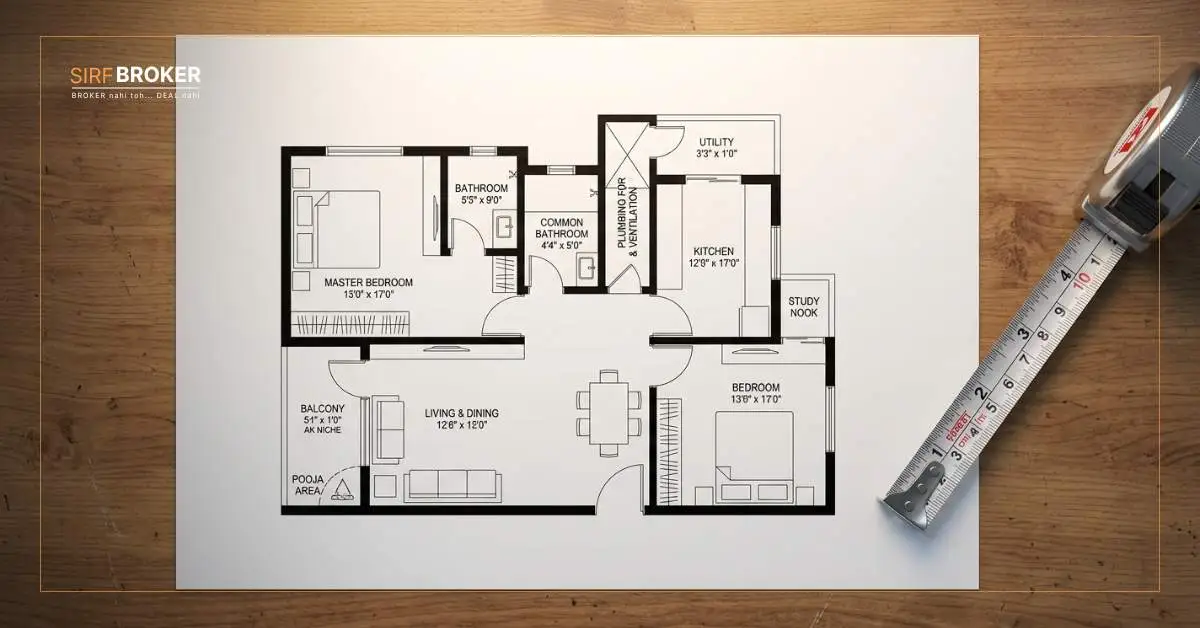
A developer quotes you 1,200 sq ft. You imagine 1,200 sq ft of space. What you may actually get is 780 sq ft of usable space — and a bill for 1,200.
This is not fraud. It is the result of three different area definitions that operate simultaneously in Indian real estate: carpet area, built-up area, and super built-up area. Each measures a different thing. Developers historically priced on super built-up area — the largest number — while buyers compared prices without understanding what that number included. The gap between what was quoted and what was liveable could be anywhere from 25% to 50%.
RERA changed some of this. But knowing the distinction between these three numbers remains one of the most practically important pieces of knowledge any buyer, tenant, or broker can have.
| Under RERA 2016, all registered projects must price apartments on carpet area. But secondary market resales, older buildings, and commercial leases still commonly use super built-up area — requiring buyers to do the translation themselves. |
What Is Carpet Area? The RERA Definition That Changed Everything
Carpet area is the net usable floor area within the four walls of an apartment or unit. It is the area you can actually walk on, place furniture on, and use. It excludes the area under the walls themselves.
The Real Estate (Regulation and Development) Act, 2016, provides a precise legal definition under Section 2(k):
“The net usable floor area of an apartment, excluding the area covered by the external walls, areas under services shafts, exclusive balcony or verandah area and exclusive open terrace area, but includes the area covered by the internal partition walls of the apartment.”
This definition includes the area under internal partition walls (the walls between rooms within your apartment) but excludes external walls. It also explicitly excludes balcony and terrace areas, which some developers had previously folded into carpet area calculations.
Under RERA, all real estate developers in states where the Act applies must sell apartments on the basis of carpet area. The agreement for sale must state the carpet area and the price per sq ft of carpet area.
What Is Built-Up Area and How Is It Different?
Built-up area — also called plinth area — is the carpet area plus the area covered by the external walls of the apartment and any exclusive-use areas like a private balcony, terrace, or utility area.
Formula: Built-Up Area = Carpet Area + Area under external walls + Exclusive balcony/terrace area
External walls of an apartment are typically 9 to 12 inches thick. In a typical 1,000 sq ft carpet area apartment, the built-up area would be approximately 1,100 to 1,150 sq ft — an increase of 10 to 15%.
Built-up area represents the physical footprint of your unit — the space the building allocates to you, including structure. It does not include any common area.
What Is Super Built-Up Area — and Why Developers Used It for Pricing
Super built-up area — sometimes called saleable area — is built-up area plus a proportionate share of all common areas in the building. Common areas include:
Lift lobbies and lift shafts, staircases, corridors and passages, generator rooms, security cabins, club facilities, gym, swimming pool (in some projects), and pump and maintenance rooms.
Formula: Super Built-Up Area = Built-Up Area + Proportionate share of common areas
In a building with significant amenities, the common area can be substantial. A unit with a carpet area of 800 sq ft might have a super built-up area of 1,100 to 1,250 sq ft — a loading factor of 35 to 56%.
Pre-RERA, developers priced on super built-up area because it produced the highest number — and therefore the lowest apparent per-square-foot rate. A developer pricing at ₹8,000 per sq ft on a super built-up area of 1,200 sq ft was effectively charging ₹12,000 per sq ft of actual carpet area. The headline looked competitive. The effective cost was not.
How to Calculate the Loading Factor — and What Is Reasonable
The loading factor is the percentage difference between the super built-up area and the carpet area. It tells you how much of what you are paying for is actually usable space.
Formula: Loading Factor (%) = [(Super Built-Up Area − Carpet Area) ÷ Carpet Area] × 100
Example: Carpet Area: 900 sq ft | Super Built-Up Area: 1,200 sq ft | Loading Factor: 33.3%
In Indian residential real estate, a loading factor of 25–35% is broadly considered market-standard for a well-designed mid-to-premium apartment building. A loading factor above 40% deserves scrutiny — it typically indicates either a project with very large common areas or a developer inflating the saleable area beyond actual common area proportions.
What RERA Changed — and What It Did Not
RERA’s mandated shift to carpet-area pricing was a significant reform. For RERA-registered projects, the agreement for sale must specify the carpet area, the price per sq ft of carpet area, and any separately stated charges for common areas.
This makes comparison shopping materially more honest. If two developers in the same location are both RERA-registered and pricing on carpet area, a buyer can compare ₹12,000 per sq ft across both projects without the distortion of different loading factors.
What RERA did not change: the practice of quoting super built-up area in marketing materials, developer sales conversations, and resale transactions — particularly for older projects that predate RERA registration. Commercial office leasing in India also continues to operate largely on built-up area or super built-up area. An occupier negotiating an office lease should always clarify what measurement standard is being used and calculate the effective per-sq-ft cost of carpet area before comparing buildings.
Sirf Broker POV
The carpet area conversation should happen at the very beginning of a client engagement, not after the developer has demonstrated a floor plan and the client has already pictured their furniture in it.
Here is what we consistently observe: brokers who explain carpet area, built-up area, and super built-up area at the first meeting are the ones who do not lose clients to a competitor who quoted a lower per-sq-ft rate. Because the moment a client understands that a ₹7,500/sq ft super built-up rate with 40% loading works out to ₹10,500/sq ft on carpet area — more expensive than the ₹9,800/sq ft carpet area rate they thought was “too expensive” — the broker who explained it first has a client for life.
The deeper issue is that RERA transparency has not eliminated confusion; it has created a two-speed market. RERA-registered projects price on carpet area. Resale transactions on older projects, builder floors, commercial deals, and projects in states with weaker RERA implementation still operate on super built-up area. Clients move between these categories constantly and rely on their broker to translate.
The broker who cannot explain the difference between carpet area, built-up area, super built-up area, and loading factor in a two-minute site visit conversation is leaving room for the client to doubt their expertise — and their value.
Conclusion
The three area measurements describe the same physical space from three different perspectives. The gap between the smallest (carpet) and the largest (super built-up) is where pricing distortions live. RERA has imposed more discipline on new projects, but the resale market and commercial sector still require buyers and tenants to do the translation themselves.
If you are evaluating a property deal, also check what circle rate is and why it matters in property deals — it is the other pricing variable that changes the effective cost of the same transaction.
Frequently Asked Questions
What is the difference between carpet area and super built-up area in India?
Carpet area is the net usable floor space inside your walls — the area you actually live or work in. Super built-up area includes your carpet area, the area under external walls, your exclusive balcony or terrace, plus a proportionate share of all common areas in the building such as lobbies and staircases. The gap between them — the loading factor — typically ranges from 25% to 40% in Indian residential projects.
How does RERA define carpet area?
Under Section 2(k) of RERA 2016, carpet area is “the net usable floor area of an apartment, excluding the area covered by the external walls, areas under services shafts, exclusive balcony or verandah area and exclusive open terrace area, but including the area covered by the internal partition walls of the apartment.” RERA-registered projects must price apartments on carpet area basis.
What is a loading factor in real estate and how is it calculated?
The loading factor is the percentage by which super built-up area exceeds carpet area. Formula: [(Super Built-Up Area − Carpet Area) ÷ Carpet Area] × 100. A loading factor of 25–35% is broadly market-standard for a mid-to-premium Indian apartment building. Above 40% warrants scrutiny.
Is pricing on super built-up area still legal in India after RERA?
For RERA-registered projects, agreements for sale must state carpet area and price per sq ft. However, super built-up area may still appear in marketing materials. For secondary market resales of older buildings and commercial projects, super built-up area pricing remains common. Always ask for the carpet area and calculate the loading factor before comparing.
What is the difference between built-up area and super built-up area?
Built-up area is carpet area plus external walls and exclusive balcony or terrace — your unit’s physical footprint only. Super built-up area adds a proportionate share of the building’s common areas (lobbies, staircases, amenities). Super built-up area is always the largest of the three measurements.
Do these area definitions apply to commercial property in India?
RERA’s carpet area mandate applies primarily to residential real estate. Commercial office leasing largely continues to use built-up area or super built-up area for pricing. Occupiers negotiating office leases should always clarify which measurement standard is being used and calculate their effective cost per sq ft of usable space before comparing buildings.