

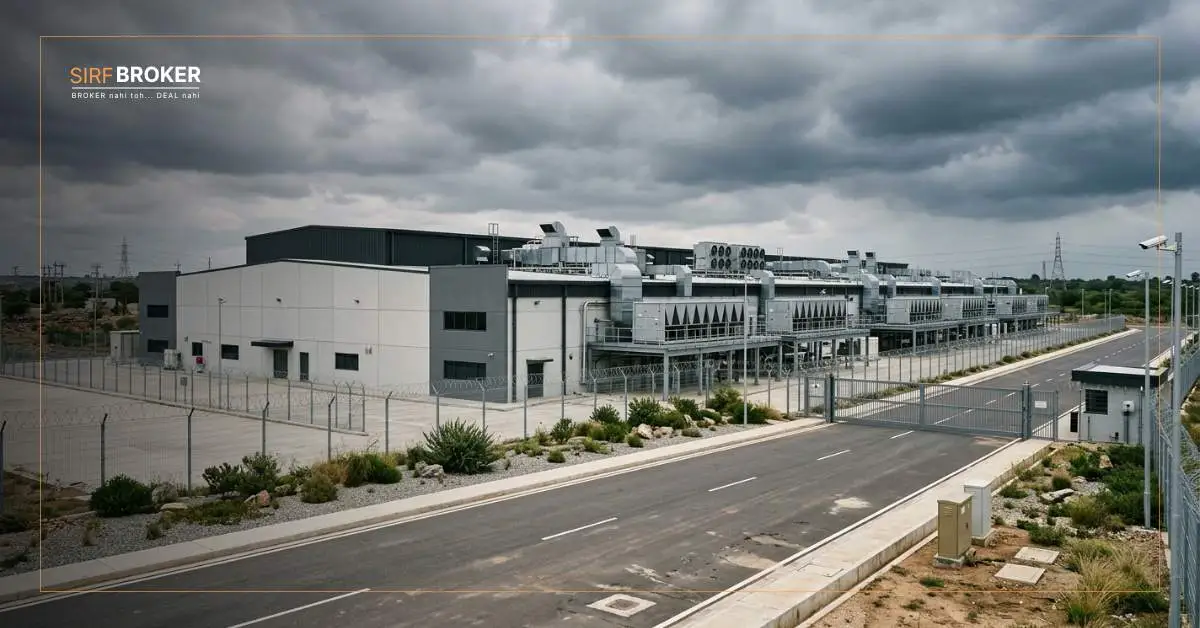
Private equity investment in India’s real estate sector reached $3.2 billion in the first half of 2026 — a 33% increase year-on-year over the $2.4 billion deployed in H1 2025, according to Savills India’s H1 2026 investment report. Total full-year 2026 PE investment is projected at $6.5–7.5 billion. Within that headline number lies a structural shift that few in the Indian real estate market have fully processed: data centres attracted 38% of Q2 2026 PE inflows — overtaking offices (30%) to become the single largest recipient of institutional real estate capital in India. Residential accounted for 16%.
The category that dominated India’s institutional real estate investment for fifteen years — the Grade A commercial office — has been overtaken by an asset class that barely existed as a real estate investment category in India five years ago. That shift is not a curiosity. It is the most direct signal of where global institutional capital believes the structural growth in Indian real estate will come from over the next decade — and it has immediate, actionable implications for developers, occupiers, and commercial brokers who have not yet built knowledge of this asset class.
| India Real Estate PE Investment — H1 2026 at a glance Total PE investment H1 2026: $3.2 billion — up 33% YoY (Savills India) · Full-year 2026 forecast: $6.5–7.5 billion · Data centres (Q2 share): 38% — largest segment · Office (Q2 share): 30% · Residential: 16% · Domestic investors: 51% of total H1 inflows · Foreign investors: 49% · US & Canada share of foreign capital: 69% Source: Savills India H1 2026 Investment Report; inkl.com; BW Businessworld; The Hans India. |
Why Data Centres Have Overtaken Offices in PE Investment
The shift of institutional capital toward data centres in Indian real estate is being driven by three compounding forces: the global artificial intelligence infrastructure build-out, India’s digital consumption growth, and the structural supply gap in Indian data centre capacity relative to projected demand.
Global hyperscalers — Microsoft, Google, Amazon Web Services, Meta — have announced over $20 billion in combined India data centre investment commitments since 2023. These commitments require physical real estate — land, power, connectivity infrastructure, and facilities — that must be sourced, developed, and leased. That translates directly into real estate transactions: land acquisition in power-rich corridors near fibre backbone infrastructure, build-to-suit development mandates, and long-term lease structures from creditworthy hyperscaler tenants. US and Canadian institutional capital — which accounted for 69% of all foreign PE investment in Indian real estate in H1 2026, per Savills — is following the hyperscaler investment pipeline because the risk-return profile of a fifteen-year lease to a global hyperscaler in a structurally undersupplied asset class is highly attractive relative to other emerging market real estate alternatives.
India’s data centre capacity — currently approximately 1,100 MW across the country — is projected to need to grow to 2,500–3,000 MW by 2027–28 to meet AI and cloud computing demand, per multiple industry projections. That supply gap is the fundamental investment thesis driving the PE capital flowing into Indian data centre real estate right now.
Domestic Capital at 51%: A Structural Shift in Who Owns Indian Real Estate
Domestic investors accounting for 51% of total PE investment in Indian real estate in H1 2026 is a milestone number. Historically, institutional real estate PE in India was dominated by foreign capital — Singapore sovereign wealth, US private equity, and Middle Eastern funds. The domestic majority in H1 2026 reflects the maturation of India’s institutional real estate capital ecosystem: listed REITs providing a benchmark for commercial real estate valuations, domestic insurance funds and pension capital beginning to allocate to real estate as an asset class, and Indian family offices and HNI capital accessing commercial real estate through structured vehicles.
This matters for developers because the diversification of the capital source base reduces dependence on global risk appetite cycles. When US or European investors pull back from emerging market allocations — as they did in 2022-2023 — Indian real estate investment previously experienced significant funding gaps. A domestic capital base at 51% provides a structural floor to investment activity that was absent in earlier cycles.
| Asset Class | Q2 2026 PE Share | Primary Capital Source |
|---|---|---|
| Data Centres | 38% — largest segment | US & Canadian PE; hyperscaler-linked infrastructure funds; domestic data centre operators |
| Office | 30% | REIT-linked capital; Singapore sovereign; domestic institutional funds |
| Residential | 16% | Domestic family offices; structured developer finance vehicles; NRI capital pools |
| Hospitality | Growing; Warburg Pincus, Blackstone active | Global PE; domestic operators seeking capital for expansion |
| Industrial / Warehousing | Steady; infrastructure fund interest | CDPQ, GIC, domestic logistics-focused REITs and platforms |
What the Data Centre Capital Shift Means for Developers
Data centre development is not conventional real estate development. The asset requires land with specific characteristics — proximity to high-voltage power substations (33KV or above), access to multiple fibre routes, water availability for cooling, proximity to the grid without excessive transmission losses — that are not the same criteria as commercial office or industrial park development. Data centre capital expenditure per sq ft is five to eight times higher than Grade A office development. The tenants — hyperscalers and co-location operators — sign fifteen to twenty-five year leases with creditworthy covenant. The yield profile is different from conventional commercial real estate.
Developers who want to participate in data centre real estate need either a genuine capability build — technical understanding of critical facility design, power infrastructure, and cooling systems — or a joint venture partnership with an experienced data centre operator who provides the technical capability while the developer provides the land and construction management. The developers who have moved fastest on data centre joint ventures — Hiranandani, CtrlS, Adani, NTT Data — are establishing land banks and power agreements that will be structurally difficult for new entrants to replicate in the next two to three years. For more on how REITs and institutional capital are reshaping commercial real estate ownership in India, read: REITs Are Changing Real Estate Investing: What Brokers Must Learn.
What This Means for Commercial Brokers
Data centre real estate transactions do not flow through the conventional commercial brokerage channel. Hyperscaler land acquisition, build-to-suit development, and co-location lease negotiations happen through a combination of in-house real estate teams, global infrastructure advisory firms, and specialist land acquisition consultants. The data centre sector does not use the residential or conventional office brokerage market.
What the data centre PE investment number tells commercial brokers is a different story: the capital that used to flow primarily into office real estate is diversifying. Office still gets 30% of PE flows — it is not disappearing. But the marginal capital at the frontier of institutional real estate investment in India is going to data centres. That means office-focused developers who are not diversifying their product mix are competing for a declining share of institutional capital. And for commercial brokers who advise developers on land acquisition, development strategy, and asset positioning — understanding the data centre capital thesis is table-stakes knowledge for a senior commercial real estate advisor in 2026.
Sirf Broker POV
Data centres attracting 38% of India’s real estate PE investment — more than offices — is the kind of data point that should force a re-examination of a lot of received wisdom about what Indian real estate is fundamentally about.
The received wisdom has been: India’s real estate story is an urbanisation story. More people moving to cities, more homes needed, more offices for the growing services economy. That story is still true. But layered on top of it is a second story that is moving faster: India’s real estate is also becoming a digital infrastructure story. The physical facilities that support cloud computing, AI inference, and data sovereignty for a $4 trillion economy are real estate assets. They require land, they require development, they require long-term leases, and they are attracting the same institutional capital that built India’s Grade A office market — but on a faster growth trajectory and with a more structurally locked-in demand base.
For brokers and developers who came up through the office or residential market: the data centre shift does not make your market smaller. Office will absorb record leasing volumes this year. Premium residential will absorb meaningfully more value than last year. But the frontier of institutional capital in Indian real estate has moved. The professionals who understand where that frontier is — and who is deploying capital there, on what terms, for what underlying demand — are going to be significantly better positioned as strategic advisors than those who treat $3.2 billion in PE investment as a background statistic.
Conclusion
India’s real estate attracted $3.2 billion in PE investment in H1 2026 — up 33% YoY per Savills India. Data centres attracted 38% of Q2 2026 PE flows, overtaking offices (30%). Domestic investors drove 51% of total flows — a first. US and Canadian capital drove 69% of foreign investment, primarily into data centres and hospitality. Full-year 2026 PE investment is forecast at $6.5–7.5 billion.
For developers: data centre real estate requires specific land characteristics, power infrastructure access, and technical capability that must be built or partnered now — not in 2028. For commercial brokers: the diversification of institutional capital away from office-dominated flows is the most important structural development in Indian real estate investment for a decade. Understanding it is not optional for anyone advising at the senior commercial level. For brokers looking to build the specialist knowledge that captures institutional-level mandates, read: From Listings to Personal Brands: The New Broker Reality.
Frequently Asked Questions
How much PE investment did India’s real estate attract in H1 2026?
India’s real estate sector attracted $3.2 billion in private equity investment in H1 2026 — a 33% increase year-on-year over $2.4 billion in H1 2025, per Savills India’s H1 2026 investment report. Full-year 2026 PE investment is projected at $6.5–7.5 billion.
Why are data centres attracting the most PE investment in India real estate?
Data centres attracted 38% of Q2 2026 real estate PE flows, overtaking offices. The AI infrastructure build-out by global hyperscalers (Microsoft, Google, AWS, Meta), India’s digital consumption growth, and a structural supply gap in data centre capacity (India needs to grow from ~1,100 MW to 2,500–3,000 MW by 2027–28) are creating a demand base that institutional capital is following. US and Canadian PE — 69% of foreign real estate investment in H1 2026 — is deploying into data centre real estate because hyperscaler lease covenants and 15–25 year lease terms offer attractive risk-adjusted returns.
What share of India’s real estate PE investment is from domestic investors?
Domestic investors accounted for 51% of total real estate PE investment in H1 2026 — a milestone majority, per Savills India. This reflects the maturation of India’s institutional capital ecosystem: listed REITs providing commercial real estate valuation benchmarks, domestic insurance and pension fund allocation to real estate, and family office and HNI access to commercial real estate through structured vehicles.
What does the data centre investment boom mean for real estate developers?
Data centre development requires specific site characteristics — proximity to high-voltage power substations, multiple fibre routes, water access for cooling — and capital expenditure five to eight times higher than Grade A office per sq ft. Developers must either build technical capability in-house or joint venture with experienced data centre operators. Early movers — Hiranandani, CtrlS, Adani, NTT Data — are establishing land banks and power agreements that will be difficult for new entrants to replicate quickly.
Is office real estate losing institutional investment interest in India?
No — office attracted 30% of Q2 2026 PE flows and office leasing hit a record 45.5 MSF in H1 2026. However, data centres attracted 38% — overtaking office for the first time. The marginal institutional capital at the frontier of Indian real estate investment is diversifying toward data centres, while office remains a core institutional asset class. Office-focused developers who are not diversifying their product mix are competing for a declining share of PE capital relative to those with data centre exposure.
Which foreign investors are leading India real estate PE investment in 2026?
US and Canadian investors accounted for 69% of all foreign PE capital deployed in Indian real estate in H1 2026, per Savills India — primarily directed toward data centres and the hospitality sector. Singapore sovereign wealth funds and Middle Eastern capital continue to participate in office and logistics assets, while European capital has been relatively less active in the H1 2026 cycle.