

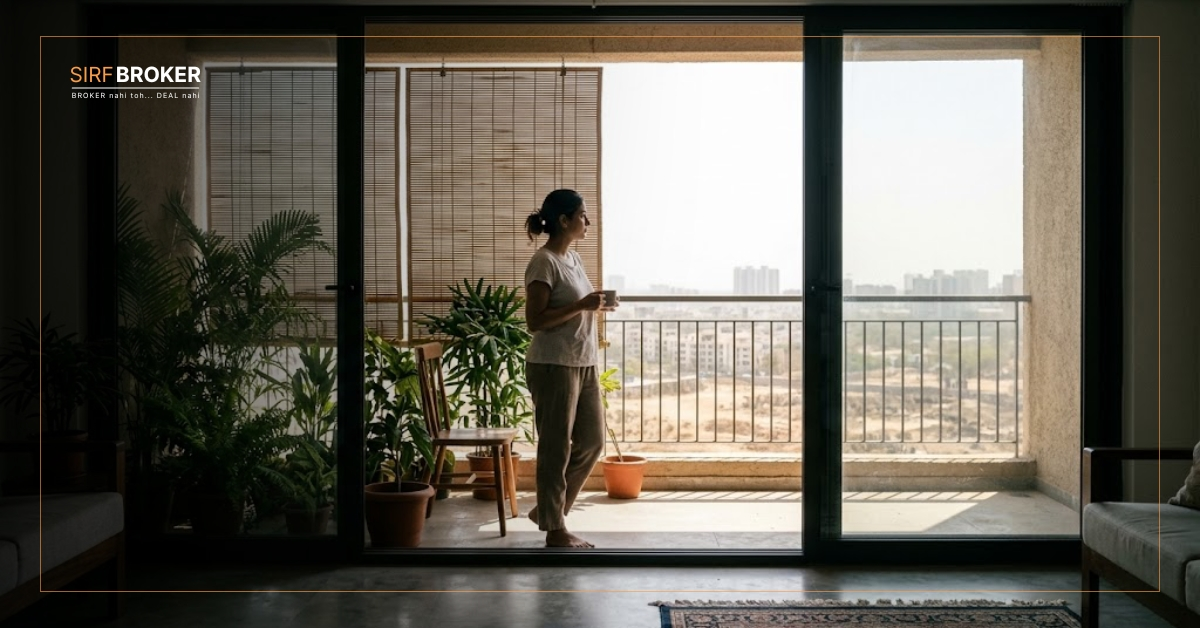
It is 2:30 PM in late May.
The AC has been running since morning. The balcony floor is too hot to stand on barefoot. The lift lobby feels like an oven. The kids have stopped going downstairs to play. The backup power has already kicked in twice. The water pressure is weaker than usual. The bedroom cools only after the AC runs for an hour.
This is the part of the home that the brochure never showed you.
The sample flat looked beautiful in October. The garden looked peaceful in the evening. The clubhouse felt impressive during the sales visit. But the real test of an Indian home is not how it looks in pleasant weather.
The real test is whether it remains liveable in peak summer.
| A home is not truly affordable if it becomes expensive to cool, uncomfortable to live in, and unsafe for children or elderly family members during peak summer. |
India’s heatwaves are no longer just weather news. They are becoming a real estate issue. Recent IMD-linked reports have shown severe heatwave conditions across parts of North India, with Banda in Uttar Pradesh reported around 48.2°C and Delhi under heatwave warnings during peak summer.
For homebuyers, this changes the buying question.
Earlier, buyers asked:
“Kitna area hai? Rate kya hai? Possession kab hai?”
Now, serious buyers also need to ask:
“Garmi mein ye ghar rehne layak hai ya nahi?”
The New Real Estate Question: Can This Home Survive May and June?
Most buyers judge a home through the usual checklist:
- Price
- Carpet area
- Location
- Builder name
- Amenities
- Possession date
- Loan eligibility
That checklist is still important. But it is incomplete.
In a heatwave-prone India, buyers must now judge a home through another lens: heat performance.
Heat performance means how the home behaves when outside temperatures cross 42°C, 45°C or more. Does the flat trap heat? Does the bedroom cool quickly? Does the balcony remain usable? Does the lift lobby become unbearable? Does the society have reliable power backup? Is water supply stable in peak summer? Are common spaces shaded or exposed?
| The next phase of Indian homebuying will not only be about location and price. It will also be about liveability under stress. |
This does not mean every buyer needs a luxury green-certified home. It means every buyer needs to check whether the home will be comfortable, affordable and safe during Indian summer.
The Summer Stress Test: How a Home Fails in Real Life
Instead of reading a brochure, imagine living inside the home for one full summer day.
This is the better way to judge a property.
1. Morning: The Flat Starts Heating Early
If a flat has poor orientation, weak ventilation or direct wall exposure, it may start heating early in the day. East-facing openings can bring morning heat. West-facing walls can become worse by afternoon. A flat with no cross ventilation may feel stuffy even before noon.
A good home does not need the AC from the first hour of the day. It should allow airflow, daylight and comfort without becoming a heat box.
2. Afternoon: The Real Heat Test Begins
The most honest site visit happens between 12 PM and 4 PM in April, May or June.
This is when weak design gets exposed.
Touch the west-facing wall. Stand on the balcony. Walk through the lift lobby. Check the common corridors. Visit the parking area. Walk from the tower to the gate. If every step feels like a punishment, the project has a heat-comfort problem.
3. Power Cut: Backup Becomes More Than a Luxury
During peak heat, power backup is not only about convenience. It affects lifts, fans, water pumps, security systems, common areas and sometimes AC points.
Many buyers hear “power backup available” and assume everything is covered. That is a mistake.
You need to ask what is covered:
- Only common areas?
- Only lights and fans?
- AC points included or excluded?
- Lift backup available?
- Backup charged separately?
- Diesel generator cost passed through maintenance?
4. Water Pressure: Summer Exposes Weak Supply
Heat increases water use. Families bathe more. Plants need more watering. Cooling systems consume more. Common areas need cleaning. If a society depends heavily on tankers, summer becomes expensive and uncertain.
A climate-ready home is not only about AC. It is also about dependable water.
5. Evening: Outdoor Amenities Become Unusable
A jogging track, kids’ play area or clubhouse lawn looks good in a brochure. But if the walking path has no shade, if the play area has heat-trapping flooring, or if the clubhouse is uncomfortable in summer, the amenity is not truly usable.
Buyers should not pay premium maintenance for amenities that become unusable for three months every year.
6. Night: The Sleep Test
Some flats release heat slowly at night. Roof slabs, exposed walls and glass-heavy designs can keep rooms warm long after sunset.
If the bedroom needs long AC hours just to become sleepable, the home is quietly adding to your electricity bill every summer.
The Premium Formula: Heat Resilience Score
| CLIMATE-READY HOME FRAMEWORK — Heat Resilience Score = Ventilation + Insulation + Shade + Power Backup + Water Security + Green Cover + Cooling Efficiency A home with a higher Heat Resilience Score is not just greener. It is easier to live in, easier to cool, safer for vulnerable family members, and more practical during peak summer. |
This framework is simple, but it changes how buyers judge homes.
A project with a swimming pool but poor ventilation is not climate-ready. A project with a garden but no shade on walking paths is not climate-ready. A project with “green” branding but tanker dependency is not climate-ready.
Heat resilience is not a brochure word. It is a daily living experience.
The Heat Comfort Checklist for Buyers
| Heat Factor | Why It Matters | What Buyer Should Check |
|---|---|---|
| Flat orientation | Direct sun exposure changes indoor temperature and AC usage. | Ask for actual facing on the master plan, not only sales explanation. |
| Cross ventilation | Air movement reduces stuffiness and improves comfort. | Check whether windows/openings allow airflow from more than one side. |
| Top-floor heat | Roof slabs absorb heat and radiate it into the flat. | Ask about cool-roof coating, terrace insulation or roof treatment. |
| West-facing exposure | Afternoon sun heats walls and windows aggressively. | Look for shaded balconies, fins, overhangs or wall protection. |
| Tree cover | Mature trees reduce heat around walkways and common spaces. | Check actual trees on site, not only landscape renders. |
| Power backup | Peak summer makes power reliability critical. | Ask what backup covers: lifts, AC points, pumps and common areas. |
| Water supply | Heat increases water demand and exposes weak supply systems. | Check source: municipal, borewell, tanker, rainwater harvesting, recycling. |
| Common-area shading | Unshaded pathways make daily movement uncomfortable. | Walk from tower to gate during afternoon and feel the difference. |
| Lift lobby ventilation | Closed lobbies can become heat traps. | Check air movement, fans, vents, windows or cooling provision. |
Why “Cheap” Homes Can Become Expensive in Summer
A cheaper property is not always cheaper to live in.
A poorly designed home can increase summer costs through:
- Higher AC usage because rooms trap heat.
- Higher maintenance because society backup and diesel costs increase.
- Higher water cost because the project depends on tankers.
- Lower amenity value because open areas are unusable during hot months.
- Lower rental comfort because tenants prefer cooler, better-managed flats.
| A flat with a lower price but higher cooling cost, poor water reliability and unusable amenities may be cheaper only on paper. |
This is the part most buyers ignore during negotiation.
They negotiate ₹500 per sq ft, but forget to calculate 20 years of summer discomfort.
The Greenwashing Trap: Garden Does Not Mean Climate-Ready
Many projects now use words like green, sustainable, eco-friendly, nature-inspired and climate-smart.
Some genuinely are. Many are not.
A few lawns, a small garden, rooftop solar for common lighting, or a green page in the brochure does not automatically make a project heat-resilient.
India’s green building movement is growing strongly. IGBC states that India now has over 19,330 registered projects and over 15.90 billion sq ft of green building footprint. That is a serious shift in the market.
But buyers still need to check whether the specific home they are buying performs well in heat.
Brochure Green vs Real Heat Comfort
| Brochure Claim | What It May Mean | What Buyer Should Verify |
|---|---|---|
| Green project | May refer to certification, landscaping or energy features. | Ask what exactly is green: materials, energy, water, design or certification. |
| Large open spaces | May still be exposed to harsh sun. | Check shade, tree maturity and usability during afternoon. |
| Glass elevation | May look premium but can increase heat gain. | Ask about glazing quality, shading and cooling design. |
| Solar panels | May cover only common-area lighting. | Ask what load is actually supported. |
| Water conservation | May be limited or symbolic. | Check rainwater harvesting, STP reuse and tanker dependency. |
| Green brochure and heat-resilient design are not the same thing. A buyer must verify how the home actually performs in summer. |
The 2 PM Site Visit Test
This is the most practical advice in the entire blog.
If you are serious about buying a home, visit the project at least once between 12 PM and 4 PM during the summer.
Not in the evening. Not on a pleasant day. Not only in the sample flat.
Go when the heat is uncomfortable.
During the visit, check:
- Lift lobby temperature: Stand for two minutes and feel the air.
- West-facing wall: Touch the wall and check heat build-up.
- Balcony usability: Can you stand there comfortably?
- Common pathways: Walk from tower to gate.
- Parking heat: Check open parking, basement ventilation and shaded parking.
- Power backup: Ask for written specifications.
- Water source: Ask whether the society depends on tankers in summer.
- Tree cover: Check actual grown trees, not render images.
- Amenity usability: See whether play areas, lawns and seating zones are usable.
- Resident feedback: If occupied, ask residents about electricity bills and summer comfort.
This single visit can reveal more than ten sales calls.
How Heat Affects Different Types of Property
Instead of city-wise analysis, this topic needs a performance-wise analysis. Different property types react differently to heat.
| Property Type | Heat Risk | What to Check |
|---|---|---|
| Top-floor apartment | High roof exposure can heat rooms for hours. | Cool roof, insulation, terrace treatment, AC load. |
| West-facing flat | Afternoon heat can be intense. | Shading, balcony depth, glass type, wall insulation. |
| Low-rise plotted home | More wall and roof exposure. | Roof insulation, tree cover, courtyard design, water source. |
| High-rise apartment | Depends on floor, facing, glass and airflow. | Mid-floor comfort, ventilation, lobby design, backup. |
| Senior living project | Critical because residents may be heat-vulnerable. | Medical access, shaded outdoors, indoor amenities, 100% backup. |
| Rental housing | Poor heat comfort can increase tenant turnover. | AC efficiency, water reliability, society maintenance, ventilation. |
| Commercial office | Cooling cost affects occupier expense. | HVAC efficiency, glazing, green certification, backup. |
| Warehouse or industrial shed | Heat affects workers, inventory and productivity. | Roof insulation, ventilation, fans, shaded loading bays. |
Why Heat-Ready Homes Matter More for Children and Senior Citizens
For a young working professional, heat discomfort is irritating.
For children, elderly parents, pregnant women and people with health conditions, it can be serious.
Heatwaves can affect sleep, hydration, mobility, outdoor activity and overall safety. A poorly ventilated flat, a hot lift lobby, an exposed parking deck or a long walk through unshaded common areas can become a daily risk for vulnerable family members.
This is why families should judge heat comfort as a safety issue, not just a lifestyle feature.
| If a senior citizen cannot comfortably walk from the lift to the garden in summer, the project’s open space is not truly usable for that family. |
The Investor Angle: Heat Comfort Can Protect Rental Demand
Investors usually think about price appreciation, rental yield and location.
They should now also think about heat comfort.
Tenants increasingly prefer homes that reduce daily friction. In heat-prone cities, tenants notice:
- How quickly rooms cool
- Whether water supply is stable
- Whether power backup is reliable
- Whether the society is comfortable for children
- Whether the common areas are usable
- Whether maintenance charges rise heavily in summer
A flat that is cheaper to rent but painful to live in may face higher tenant turnover. A better-designed home in the same micro-market can feel more valuable because it reduces daily discomfort.
For investors, heat resilience can support tenant stickiness.
What Developers Should Be Designing Now
Serious developers should stop treating climate features as marketing decoration.
Heat-resilient design needs to be built into planning, construction and maintenance.
Important design features include:
- Cool roofs or roof insulation for top-floor comfort.
- Shaded pathways from towers to gate, clubhouse, parking and amenities.
- Cross-ventilated unit plans instead of sealed heat boxes.
- Reduced west-facing heat exposure through fins, overhangs or balcony depth.
- Mature tree cover and not just decorative landscaping.
- Water recycling and rainwater harvesting.
- Solar support for common-area loads where feasible.
- Shaded or ventilated parking.
- Usable indoor community spaces for peak summer months.
These features are not just sustainability points. They directly affect daily living.
What Brokers Should Actually Tell Buyers
| Don’t say: “Sir project green hai, garden bhi hai.” Say instead: “Sir heat comfort check karna zaroori hai. Ventilation, insulation, west-facing exposure, power backup, water supply, tree cover aur common-area shading dekhni padegi. Green brochure aur heat-resilient design alag cheezein hain.” |
This is how brokers become advisors.
A buyer may forget a sales pitch. But they will remember the broker who told them to visit the site at 2 PM in May before paying the booking amount.
What Buyers Should Avoid
- Top-floor flats without roof treatment.
- West-facing flats without shading.
- Projects with no real tree cover.
- Closed lift lobbies with no ventilation.
- Weak or partial power backup.
- Water tanker dependency without clarity.
- Glass-heavy designs without cooling planning.
- Fake green amenities that look good only in renders.
- Amenities that are unusable in summer.
- Buying only after evening site visits.
The Final Sirf Broker View
Indian real estate has always been sold on location, price, area and amenities.
That is changing.
Heatwaves are forcing buyers to ask deeper questions. Can the home stay cool? Can children play? Can elderly parents move safely? Will water supply hold? Will the electricity bill become painful? Will the balcony be usable? Will common spaces work in May?
These are not small questions anymore.
They are real buying questions.
| The future of housing is not only location and price. It is liveability under stress. A good home should not only impress you during a site visit. It should protect your comfort when the city is burning outside. |
Do not buy only a brochure.
Buy a home that can handle Indian summer.
Frequently Asked Questions (FAQs)
1. Why is heatwave resilience important for Indian homebuyers?
Heatwave resilience matters because extreme heat affects comfort, health, electricity bills, water use, power backup, outdoor amenities and daily liveability. A home that performs poorly during summer can become expensive and uncomfortable to live in.
2. What is a climate-ready home?
A climate-ready home is designed to stay liveable during heat, water stress and power load. It usually has better ventilation, insulation, shade, backup, water security, green cover and cooling efficiency.
3. Are green-certified projects always heat-resilient?
Not always. Green certification can be a good signal, but buyers still need to check the specific unit’s orientation, ventilation, wall exposure, power backup, water source, tree cover and common-area shading.
4. Should buyers avoid top-floor flats?
Not always. But top-floor flats need roof treatment, insulation or cool-roof measures. Without these, they can become significantly hotter during peak summer.
5. What is the best time to visit a site for heat testing?
Visit between 12 PM and 4 PM during April, May or June. This is when heat performance becomes visible. Evening visits can hide major heat-comfort problems.
6. Can heat-resilient homes have better rental demand?
In heat-prone markets, yes. Tenants often prefer homes with reliable power backup, stable water supply, better ventilation and lower cooling discomfort. This can help reduce vacancy and improve tenant stickiness.
7. What should brokers explain about heat comfort?
Brokers should explain ventilation, insulation, orientation, west-facing exposure, power backup, water reliability, tree cover and common-area shading. They should not sell only on “green project” claims.
Sources and References
- India Meteorological Department (IMD): Heatwave warnings, seasonal outlooks and public weather advisories.
- Economic Times / Times of India / Hindustan Times: Recent North India heatwave reporting, including Banda and Delhi heatwave updates.
- National Disaster Management Authority (NDMA): Public health guidance for heatwave conditions.
- Indian Green Building Council (IGBC): India’s green building footprint, registered projects and certification ecosystem.
- Bureau of Energy Efficiency (BEE) / Energy Conservation Building Code (ECBC): Energy efficiency references for buildings.
- GRIHA / TERI: Green building and resource-efficient design references.
- CEEW, WRI India, UNEP, IEA and World Bank: Urban heat, cooling demand and climate-resilient building research.
- Knight Frank, JLL, CBRE, Anarock, Colliers and Cushman & Wakefield: Real estate market research, sustainability trends and buyer preference references.
Disclaimer
This blog is published by Sirf Broker for educational and informational purposes only. It is not investment advice, legal advice, financial advice, medical advice or a property buying or selling recommendation. Heatwave conditions, electricity costs, water supply, construction quality, project features and green certification standards may vary by location and project. Buyers should verify all project-specific claims independently and consult qualified professionals before making a real estate decision.