

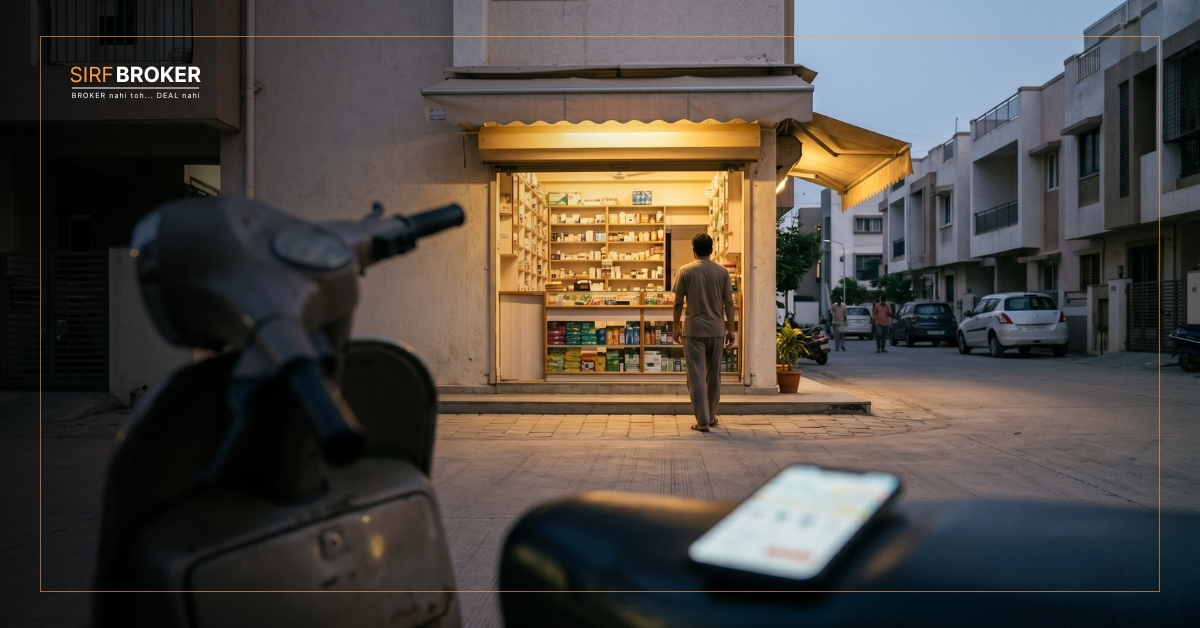
It is 10:30 PM. Someone at home needs medicine urgently. You open an app, search for the product, check the delivery time, compare alternatives, and then pause.
Do you wait for online delivery?
Or do you walk to the nearest trusted chemist who knows the neighbourhood, understands prescriptions, and can suggest what is available right now?
This simple moment explains the future of neighbourhood retail real estate better than most market reports.
India’s recent pharmacy strike against online medicine delivery platforms brought this debate into the spotlight. But this is not only a pharmacy issue. It is a retail real estate issue.
| Online delivery will not kill every local shop. It will kill weak, invisible and inconvenient shops. The shops that survive will be the ones that are trusted, accessible, urgent, visible and deeply connected to daily neighbourhood habits. |
For real estate brokers, this is an important shift.
Retail leasing can no longer be sold only with old lines like “main road shop,” “good footfall,” or “corner property.” The future of neighbourhood retail needs a sharper question:
What daily-life problem does this shop location solve?
The Pharmacy Strike Is Not Just a News Event. It Is a Retail Signal.
The nationwide pharmacy strike against e-pharmacies and online medicine delivery platforms showed the tension between two models of retail.
On one side, online platforms offer convenience, pricing, choice and doorstep delivery.
On the other side, local pharmacies offer immediacy, trust, human advice, prescription familiarity, emergency access and neighbourhood dependence.
The Times of India reported that around 40,000 retail pharmacies in Tamil Nadu, including about 2,500 in Madurai, were part of the strike. Reports also noted that authorities asked hospital-attached pharmacies, 24-hour stores, and essential medicine providers to remain available in different states. The Indian Express reported that AIOCD, representing nearly 12.4 lakh chemists, pharmacists,and drug distributors, announced the nationwide strike against e-pharmacies.
This tells us something important.
Even when online delivery grows, physical retail does not disappear from essential categories. It gets redefined.
| The future of neighbourhood retail is not offline versus online. It is urgent trust versus delayed convenience. |
That difference matters for commercial property brokers, shop owners, landlords, investors and business tenants.
The Real Retail Question: What Still Needs a Physical Shop?
Not every business needs a prime local shop anymore.
Some businesses can move online. Some can work from warehouses. Some can operate through dark stores, delivery hubs or appointment-based models.
But some categories still need physical presence because customers need them quickly, repeatedly or with trust.
These include:
- Pharmacies
- Clinics and diagnostics
- Grocery and daily essentials
- Salons and grooming
- Food and snacks
- Repair and service shops
- Stationery and school-related retail
- Pet care and veterinary support
- Optical stores
- Local banking, ATM and payment-service points
These shops survive not because they are old-fashioned, but because they solve immediate problems.
This is why retail real estate is not dying. Weak retail is dying.
The 3-Minute Convenience Rule
Neighbourhood retail works when it fits into daily life without friction.
A local shop becomes valuable when a customer can reach it quickly, park briefly, get the product or service, and return without wasting time.
This is the 3-Minute Convenience Rule.
| Neighbourhood Retail Strength = Convenience + Trust + Repeat Demand + Visibility + Access + Local Habit A shop location is strong when it becomes part of the neighbourhood’s routine, not just when it sits on a busy road. |
This formula is important for brokers.
A shop is not automatically good because it is on the main road. It is good when the right customer can use it easily and repeatedly.
Why Pharmacies Are Different From Normal Retail
A pharmacy is not the same as a fashion store or a mobile accessories shop.
Medicine purchase is often urgent, sensitive and trust-led. Customers are not only buying a product. They are buying assurance.
That is why local pharmacies have real neighbourhood value.
Pharmacies survive because they offer:
- Urgency: Customers may need medicines immediately.
- Trust: A known chemist can guide availability and alternatives.
- Prescription familiarity: Repeat patients often build pharmacy relationships.
- Neighbourhood memory: Local chemists understand nearby doctors, clinics and patient patterns.
- Emergency access: Late-night and hospital-adjacent pharmacies have strong practical value.
- Repeat demand: Chronic medicines create recurring purchase behaviour.
| For pharmacy real estate, the best location is not always the most glamorous. It is the one closest to illness, urgency, doctors, residential density and daily trust. |
This is why a small pharmacy beside a clinic can outperform a bigger shop in a weak retail strip.
What This Means for Retail Real Estate
Online delivery changes how local shops compete.
It does not remove the need for physical retail. It forces physical retail to become sharper.
For retail real estate, this means location must now be judged by use-case fit, not only visibility.
A strong neighbourhood shop location usually has:
- Residential density nearby
- Easy walking access
- Short-term parking or stopping space
- Visibility from daily movement routes
- Nearby clinics, schools, offices or apartment gates
- Ground-floor access
- Clear signage opportunity
- Low entry friction
- Repeat customer catchment
A weak shop may have frontage but no real habit loop. A strong shop sits where people already move daily.
Retail Location Is No Longer Just “Main Road”
Many brokers still describe shop locations using outdated language:
- Main road
- Wide frontage
- Good footfall
- Corner shop
- Market facing
These points matter, but they are not enough.
The better question is:
Which business category can actually make money from this shop?
A pharmacy needs a different location logic from a café. A diagnostic centre needs different access from a salon. A grocery store needs a different catchment from a premium showroom.
| Retail Category | What It Needs | Weak Location Risk |
|---|---|---|
| Pharmacy | Clinics, residential density, urgency access, trust catchment. | Low repeat demand if far from doctors and homes. |
| Grocery / convenience | Daily footfall, apartment gates, easy stopping access. | Online delivery competition if access is inconvenient. |
| Diagnostics | Doctor referrals, parking, lift access, clean approach. | Patients avoid difficult or poorly accessible locations. |
| Salon / grooming | Visible neighbourhood presence, repeat customers, comfort. | Weak loyalty if access and experience are poor. |
| Food outlet | Visibility, delivery rider access, kitchen feasibility, evening demand. | High rent without order density can destroy margins. |
| Premium showroom | Brand visibility, parking, affluent catchment, display frontage. | High rent becomes risky without matching customer profile. |
Broker POV: Stop Selling Shops, Start Selling Use-Cases
This is the main Sirf Broker point.
A retail broker who only says “shop available” is becoming replaceable.
A retail broker who understands business fit becomes valuable.
For example, instead of saying:
“Ground floor shop hai, good location hai.”
A sharper broker should say:
“This shop can work well for a pharmacy because there are three clinics within walking distance, two apartment societies nearby, easy two-wheeler stopping space, and evening medicine demand from residential catchment.”
That is advisory selling.
| Don’t say: “Sir shop main road pe hai, rent easily aa jayega.” Say instead: “Sir, retail tenant tab tikta hai jab shop ka use-case clear ho. Is location mein pharmacy, clinic-support retail, grocery ya salon chalega ya nahi, uske liye catchment, visibility, parking, habit demand aur nearby competition check karte hain.” |
This is how a broker stops sounding like a listing forwarder and starts sounding like a retail advisor.
The Retail Broker’s Location Fit Framework
Before recommending a shop to an investor, landlord or tenant, brokers should run a basic location-fit test.
| Shop Suitability Score = Catchment + Visibility + Access + Parking + Repeat Demand + Competition + Category Fit A good shop is not good for every business. The right shop is the one where the business category and local customer habits match. |
This one framework can change how brokers present retail property.
Which Retail Spaces Can Survive Online Disruption?
Online delivery is strong when the customer can wait.
Local retail is strong when the customer needs speed, trust or physical experience.
| Retail Space Type | Survival Strength | What Broker Should Check |
|---|---|---|
| Pharmacy near clinics | High because of urgency and prescription demand. | Doctor proximity, residential density, evening access. |
| Grocery near apartment gates | Strong if it solves daily convenience. | Walking catchment, quick parking, repeat household demand. |
| Clinic-linked retail | Strong because health categories need trust. | Doctor network, lift access, signage, hygiene perception. |
| Salon and personal care | Strong because service needs physical presence. | Neighbourhood profile, repeat clientele, comfort and visibility. |
| Repair and service shops | Strong because customers need local resolution. | Accessibility, trust catchment, service visibility. |
| Generic fashion shop | Weak unless experience or brand pull is strong. | Footfall quality, customer profile, competition from online platforms. |
Which Retail Spaces Are Risky?
Online delivery exposes weak retail spaces quickly.
Some shops look good on paper but struggle in real leasing.
Risky retail spaces often have:
- Poor visibility despite being in a commercial complex.
- No easy parking or stopping space.
- Weak residential or office catchment.
- Too much dependence on future footfall.
- No category clarity.
- High rent without matching customer demand.
- Upper-floor retail without strong anchor use.
- Dead frontage with low evening activity.
- No delivery rider access for hybrid retail models.
| A weak shop does not become strong because offline retail is emotional. It becomes strong only when people need it, see it, trust it and use it repeatedly. |
Investor POV: What Should Retail Property Buyers Check?
Retail property investors must stop judging shops only by rent per sq ft.
The right question is:
Which tenant category can survive here for years?
A shop with unstable tenants may look profitable in the first lease but become painful later. Vacancy kills retail returns.
Before buying a shop, investors should check:
- Who is the likely tenant?
- Is there daily repeat demand?
- Is the rent affordable for that tenant category?
- Can customers stop or walk in easily?
- Is there enough residential or office catchment?
- Is the shop useful for pharmacy, grocery, clinic, food, salon or service categories?
- Is the space too dependent on future development?
- Can the shop support online plus offline business?
The best retail investments are not always the flashiest ones. They are often the ones that serve daily needs.
Business Owner POV: What Kind of Shop Should You Lease?
For business owners, rent is not the only cost.
A cheaper shop can become expensive if customers do not come, riders cannot access it, parking is bad, visibility is weak, or the surrounding customer profile does not match the business.
| Business Type | Better Location Logic | Avoid |
|---|---|---|
| Pharmacy | Near clinics, hospitals, dense housing, senior communities. | Isolated shops with no prescription demand. |
| Grocery | Near apartment gates or daily walking routes. | Deep complex units with no quick access. |
| Salon | Residential catchment, visible frontage, comfort, repeat customers. | Poorly visible upper-floor locations without brand pull. |
| Food outlet | Evening activity, delivery rider access, kitchen feasibility. | High rent without order density. |
| Diagnostics | Clinic ecosystem, clean approach, parking, lift access. | Hard-to-find locations with low patient comfort. |
Final Sirf Broker View
The pharmacy strike against online medicine delivery is not only a retail protest. It is a signal about how local retail is being forced to evolve.
Online delivery is not going away.
But local shops are not going away either.
The weak middle will suffer: shops with poor access, unclear use-case, high rent, low visibility and no repeat demand.
The strong local retail spaces will survive because they solve daily-life problems better than an app can in that moment.
| The future of neighbourhood retail real estate belongs to shops that are not just visible, but useful. The broker who can identify that usefulness will win more serious retail clients. |
For buyers and investors, this means retail property should be judged by tenant survival, not only rental promise.
For business owners, this means leasing should be based on customer behaviour, not only cheap rent.
For brokers, this means one thing clearly:
Stop selling shops as spaces. Start selling them as business-fit locations.
Frequently Asked Questions (FAQs)
1. Will online delivery kill local shops in India?
No, online delivery will not kill every local shop. It will pressure weak shops that do not offer urgency, trust, convenience or strong local demand. Shops that solve daily needs can continue to perform well.
2. Why is the pharmacy strike relevant to retail real estate?
The pharmacy strike highlights the tension between online platforms and physical neighbourhood stores. For real estate, it shows that certain retail categories still need a strong local presence because customers value urgency, trust and access.
3. Which local shops are more likely to survive online disruption?
Pharmacies, clinics, grocery stores, salons, repair shops, diagnostics centres, food outlets and daily-need shops can survive if they are located in strong catchments with easy access and repeat demand.
4. What should brokers check before recommending a retail shop?
Brokers should check catchment, visibility, access, parking, category fit, repeat demand, nearby competition, customer profile and whether the shop can support the business model of the tenant.
5. Is main road frontage enough for a successful shop?
No. Main road frontage helps, but it is not enough. The shop must match the right business category, customer habit, access patterns, and local demand.
6. What kind of retail property is risky today?
Retail spaces with poor visibility, no parking, weak catchment, high rent, low repeat demand, upper-floor dependence and no clear business use-case are riskier in the online delivery era.
7. How can brokers become better retail advisors?
Brokers should stop presenting only area, rent and frontage. They should explain which business can work in that shop, why the location supports that business, and what risks the tenant or investor should check.
Sources and References
- Times of India: Reports on nationwide pharmacy strike against online medicine delivery platforms and state-level pharmacy shutdown details.
- Indian Express: Coverage of AIOCD’s nationwide strike against e-pharmacies and online medicine delivery platforms.
- Economic Times: Reporting on CDSCO advisory to prevent medicine shortages during chemists’ strike.
- PTI / Regional news reports: Updates on AIOCD protest, e-pharmacy concerns and essential medicine availability during strike.
- ScienceDirect: Research on e-pharmacy potential in India, including access benefits and regulatory challenges.
- PMC / Healthcare research: Review of e-pharmacy growth, benefits, challenges and regulation in India.
- CBRE, JLL, Colliers, Anarock and Cushman & Wakefield: Retail leasing, high-street retail and commercial real estate trend references.
Disclaimer
This blog is published by Sirf Broker for educational and informational purposes only. It is not investment advice, legal advice, financial advice, pharmacy regulation advice or a property buying, selling or leasing recommendation. Retail property performance depends on location, tenant quality, lease terms, business category, competition, local demand, regulatory conditions and market changes. Readers should conduct independent due diligence and consult qualified professionals before making any real estate or business decision.