

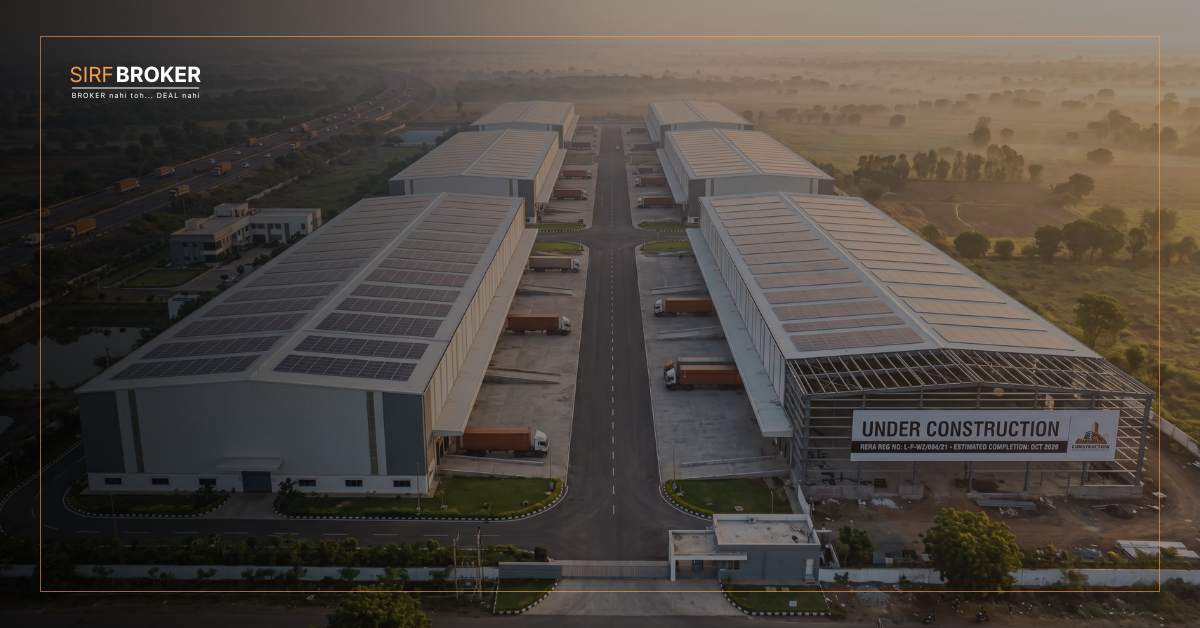
India’s industrial and warehousing sector recorded 11 million square feet of leasing in the first quarter of 2026 — the strongest single quarter in four years, representing 22% growth year on year, according to JLL India’s industrial market tracking. Full-year 2025 was itself a record: 72.5 million square feet leased, a 29% increase over 2024.
This is not a sector recovering from a slowdown. It is a sector that has moved structurally into a higher demand phase — and the developers who are positioned inside it are filling sheds before the paint is dry. The ones who are not positioned are watching from the outside, still building office or residential, and wondering why their vacancy numbers are moving in the wrong direction.
This article is the case for warehousing as a strategic asset class for Indian developers in 2026 — not as a peripheral play, but as the segment where long-term demand visibility now rivals or exceeds office and residential in many corridors.
| JLL India projects India’s industrial and warehousing stock to reach 850 million square feet by 2030 — up from 514 million sq ft today. That is a 65% increase in under five years, driven by three structural forces that are not going away: e-commerce fulfilment, manufacturing expansion under PLI schemes, and quick commerce urban logistics. Developers who are not building a warehousing thesis in 2026 are building a thesis for 2020. |
The Numbers Behind the Boom
India’s industrial and warehousing sector has outperformed office and residential absorption growth for two consecutive years. The Q1 2026 data from JLL India puts the headline number at 11 million square feet — but the composition matters as much as the total.
| Metric | Data Point | Source |
|---|---|---|
| Q1 2026 warehousing leasing | 11 million sq ft — 4-year quarterly high | JLL India Industrial Market Q1 2026 |
| YoY growth Q1 2026 | +22% vs Q1 2025 | JLL India Industrial Market Q1 2026 |
| Full-year 2025 leasing | 72.5 million sq ft — annual record | JLL India Industrial Market 2025 |
| YoY growth 2025 vs 2024 | +29% | JLL India Industrial Market 2025 |
| Current India stock | 514 million sq ft | JLL India Warehousing Report 2026 |
| Projected stock by 2030 | 850 million sq ft (11.4% CAGR) | JLL India Warehousing Report 2026 |
The 3PL (third-party logistics) surge within that number is notable. 3PL providers leased approximately 3.5 million square feet in Q1 2026 alone — an 80% increase compared to Q1 2025, according to JLL India’s industrial market data. Manufacturing companies accounted for 47% of total space leased in the quarter, bolstered by government PLI schemes and ‘Make in India’ production expansion.
Three Structural Forces Driving This — and Why None of Them Are Cyclical
Warehousing demand in India is not a one-year story. Three forces are driving it structurally, and each has a multi-year runway.
Force 1: E-commerce and 3PL expansion. India’s e-commerce market continues to demand fulfilment infrastructure at a pace that new supply is still catching up with. 3PL operators — the logistics companies that manage warehousing and distribution for multiple retail and manufacturing clients — are the fastest-growing occupier segment. The 80% surge in 3PL leasing in Q1 2026 reflects a maturation of the outsourced logistics model: companies that previously ran their own warehousing are contracting it out, concentrating demand into professional 3PL operators who in turn need high-quality, large-format industrial facilities.
Force 2: Manufacturing expansion under PLI schemes. The Production Linked Incentive schemes covering 14 manufacturing sectors have materially increased India’s industrial output ambitions. Manufacturing companies accounted for 47% of Q1 2026 warehousing demand. This is not speculative build — it is space being taken by companies with confirmed production mandates and multi-year operational commitments.
Force 3: Quick commerce — the new urban warehousing brief. This is the force most developers have not yet built a product strategy around. Quick commerce operators (Blinkit, Zepto, Swiggy Instamart) require hyperlocal fulfilment centres — called dark stores — positioned within 2 to 4 kilometres of dense residential catchments. These are warehouse-format spaces of 2,000 to 5,000 sq ft, positioned inside urban residential neighbourhoods, not at city periphery logistics parks. Every major quick commerce operator is aggressively expanding their dark store network in Tier 1 and Tier 2 cities — and the developer who has ground-floor commercial units in dense residential catchments with loading access is fielding these calls today.
Where Demand Is Moving — City and Corridor Analysis
| City / Corridor | Demand Driver | Status |
|---|---|---|
| Mumbai / MMR | 3PL, e-commerce, port-linked logistics (Nhava Sheva) | Largest market — constrained land, strong rents |
| Delhi NCR | Manufacturing (Noida, Greater Noida), 3PL, e-commerce | Second-largest — strong absorption on NH-8, NH-58 corridors |
| Bengaluru | E-commerce, manufacturing, quick commerce dark stores | Growing fast — supply constrained on Hosur Road / Tumkur corridors |
| Pune | Auto components, manufacturing, 3PL serving Western India | Maturing — Chakan / Ranjangaon corridor absorbing strongly |
| Chennai | Auto, electronics manufacturing, port logistics | Strong manufacturing base — NH-48 and NH-32 corridors |
| Tier 2 cities | E-commerce expansion, PLI manufacturing, 3PL regional hubs | Emerging — first-mover advantage significant, supply minimal |
Tier 2 city absorption is recording approximately 20% year-on-year growth, per Colliers India’s 2026 Industrial Outlook. Cities like Ahmedabad, Nagpur, Lucknow, and Coimbatore are seeing warehousing demand arrive ahead of formal supply — the same dynamic that produced outsize returns in Pune’s Chakan corridor a decade ago for developers who were early. The window in Tier 2 markets is open now. It will not stay open at current land prices once institutional developers consolidate the best corridors.
What Grade A Warehousing Actually Requires — The Developer Specification
| GRADE A WAREHOUSING: THE SPECIFICATION FILTER Clear height → Minimum 10–12 metres floor-to-underside-of-truss. Modern racking systems require it. A 7-metre clear height shed is Grade B at best and cannot serve 3PL operators using vertical storage. Floor loading → Minimum 5 tonnes per sq mt (50 kN/m²) for manufacturing and heavy logistics. E-commerce light goods can work at 3 tonnes. Underbuild here and your tenant base is limited from day one. Dock doors → One dock per 1,000 sq mt of warehouse area as a minimum. Covered truck courts minimum 35 metres deep. Automated dock levellers standard for 3PL tenants. Power supply → Minimum 1 kVA per sq mt for e-commerce/3PL. Higher for cold chain and food logistics. Full backup DG capacity for operations — not just security/lighting. Sustainability → IGBC Green certification is increasingly required by multinational 3PL operators and MNC manufacturing occupiers as a procurement standard. Solar rooftop provision is expected. Road access → Immediate connectivity to a national highway or state highway corridor that can handle 40-tonne trucks. Internal road width minimum 12 metres for two-lane truck movement. A warehouse that fails any one of these criteria cannot compete for Grade A 3PL, e-commerce, or manufacturing tenants — regardless of how competitive the rental is. |
The Old Assumptions vs the 2026 Warehousing Reality
| Old Developer Assumption | 2026 Reality |
|---|---|
| “Warehousing is low-yield, low-glamour — not worth the capital” | Grade A logistics assets are attracting institutional capital and REIT structures. Yield compression is happening. |
| “Any covered shed will find a tenant” | 3PL and e-commerce tenants apply a Grade A filter. Old stock with low clear heights and poor truck access is accumulating vacancy. |
| “City periphery land is too cheap to be strategic” | Highway corridors 30–60 km from city centres in Mumbai, Delhi, and Bengaluru have been the most actively absorbed industrial zones for three consecutive years. |
| “Tier 2 cities don’t have enough demand to justify a project” | Tier 2 city warehousing absorption is growing at ~20% YoY per Colliers India. Supply is minimal. First movers are leasing before completion. |
| “Office and residential are the real money” | Office absorption is quality-bifurcated. Residential is premium-led. Industrial is the only major segment recording volume growth across all cities. |
Sirf Broker POV
The warehousing sector’s story in India is the story of a market that arrived faster than the developer community was prepared for. Institutional players moved first and quickly into Grade A industrial. They understood the demand signal from the occupier side because their tenants were telling them what they needed.
Most mid-sized Indian developers heard the same signal and chose to wait. Some are still waiting.
The case for entering in 2026 is not that the market has just appeared. It is that the Tier 2 city opportunity is genuinely open, the dark store urban format is genuinely underdeveloped, and Grade A supply in key corridors is genuinely constrained relative to the absorption numbers JLL is recording. There are still first-mover positions available — just not in the cities that were obvious five years ago.
The risk in warehousing is not demand. Demand has been confirmed by three consecutive years of record absorption. The risk is specification: a developer who builds a 7-metre clear height shed in 2026 is building a legacy asset before it opens. Grade A is not a premium product in industrial real estate — it is the entry standard for the tenants driving this market. Build below it and you are competing for a tenant pool that institutional developers have already priced out.
The REIT structures now operating in Indian real estate — including industrial REITs — provide a new exit pathway for developers who build to institutional grade. That exit option did not exist five years ago. It changes the developer calculus significantly.
Conclusion
India’s warehousing market will be 850 million square feet by 2030, according to JLL India — up 65% from today. The question for developers is not whether to have a warehousing strategy. It is whether to have one now, while Tier 2 city land is still accessible and the specification bar is clear, or later, when institutional capital has consolidated the best corridors.
For developers tracking how institutional capital is flowing into industrial and other asset classes, the overview of how REITs are changing real estate investing in India explains the new exit and capital-raising options now available to developers building to institutional grade.
Frequently Asked Questions
1. How large is India’s warehousing and logistics real estate market in 2026?
India’s industrial and warehousing stock stands at 514 million square feet as of 2026, according to JLL India. The sector recorded 72.5 million square feet of leasing in full-year 2025 — a record — and 11 million square feet in Q1 2026 alone, the strongest single quarter in four years. JLL projects the stock to reach 850 million square feet by 2030, implying a CAGR of approximately 11.4%.
2. What is driving India’s warehousing demand boom in 2026?
Three structural forces: e-commerce and 3PL expansion (3PL leasing surged 80% year on year in Q1 2026 per JLL India); manufacturing expansion under PLI schemes (manufacturing occupiers accounted for 47% of Q1 2026 demand); and quick commerce growth, which is driving demand for hyperlocal dark store facilities within urban residential catchments — a property type that requires a fundamentally different development brief from traditional logistics parks.
3. Which Indian cities are leading warehousing absorption in 2026?
Mumbai/MMR and Delhi NCR remain the largest markets, followed by Bengaluru, Pune, and Chennai. Tier 2 cities including Ahmedabad, Nagpur, Lucknow, and Coimbatore are recording approximately 20% year-on-year absorption growth per Colliers India’s 2026 Industrial Outlook — representing significant first-mover opportunity for developers ahead of institutional consolidation.
4. What is Grade A warehousing and why does it matter for developers?
Grade A warehousing meets the specification standards required by institutional 3PL, e-commerce, and manufacturing tenants: minimum 10–12 metre clear heights, 5 tonne/sq mt floor loading, one dock door per 1,000 sq mt, full backup power, IGBC certification, and direct highway access. Buildings that do not meet these standards cannot compete for the tenants driving the majority of India’s warehousing absorption — regardless of rental competitiveness.
5. What is a dark store and why is it relevant to real estate developers?
A dark store is a small urban fulfilment centre — typically 2,000 to 5,000 sq ft — used by quick commerce operators (Blinkit, Zepto, Swiggy Instamart) to fulfil sub-30-minute deliveries. Unlike traditional logistics parks at city peripheries, dark stores need to be positioned within 2 to 4 km of dense residential areas, requiring ground-floor commercial units with loading access. Quick commerce operators are actively leasing these across Tier 1 and Tier 2 cities in 2026.
6. How are REITs changing the developer calculus for warehousing in India?
REIT structures in India — including those with industrial and logistics asset portfolios — provide developers with an institutionalised exit pathway that did not exist five years ago. Developers who build Grade A warehousing to institutional specification are now building product that qualifies for REIT acquisition or REIT-backed portfolio transactions, fundamentally changing the risk-reward equation for warehousing development.
7. What should developers check before committing to a warehousing project?
Six questions: confirmed highway connectivity for 40-tonne trucks; industrial/logistics land use zoning; ability to achieve minimum 10-metre clear heights within structural and planning constraints; adequate power infrastructure for the intended tenant profile; IGBC Green certification achievability; and confirmed or probable demand from 3PL or manufacturing occupiers in the micro-location.
Sources and References
- JLL India — Industrial and Warehousing Market Report Q1 2026 — 11 mn sq ft Q1 2026 leasing; +22% YoY; 3PL surge 80%; manufacturing 47% of demand. jll.co.in
- JLL India — Future of Logistics: Warehousing Market India 2026 — India stock at 514 mn sq ft; projection of 850 mn sq ft by 2030; 11.4% CAGR. jll.co.in
- JLL India — Industrial Market 2025 Annual Report — Full-year 2025 leasing 72.5 mn sq ft; +29% YoY.
- Colliers India — 2026 India Real Estate Outlook — Tier 2 city warehousing absorption ~20% YoY growth; decentralised logistics expansion. colliers.com/en-in
Disclaimer
| This article is published by Sirf Broker for educational and informational purposes only. It is not investment or development advice. Warehousing market performance varies significantly by city, micro-location, tenant profile, and asset specification. All data is sourced from publicly available reports cited above. Developers should conduct independent due diligence and consult qualified professionals before any land acquisition or development decision. |