

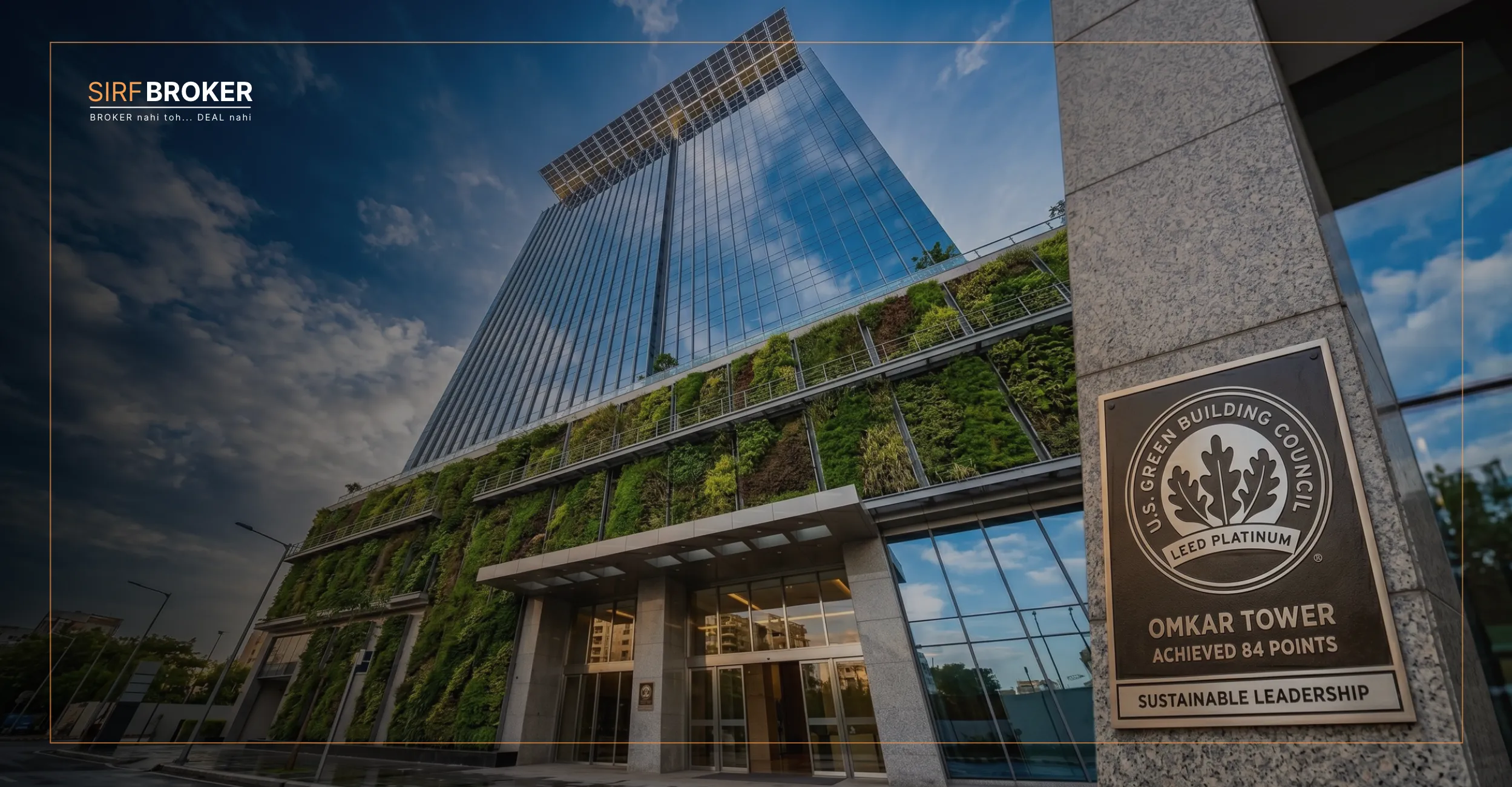
Green-certified conventional office spaces in India command 18 to 22% higher rentals than comparable non-certified buildings. Green-certified flexible workspaces command premiums of 47 to 50%. India’s total green-certified office inventory has crossed 700 million square feet, placing it third globally in LEED certifications — ahead of Hong Kong and South Korea.
Those are not projections or targets. They are current market data, and they describe a gap that most Indian developers have not yet built a strategy around. The typical framing in developer conversations is still: “LEED certification adds cost.” The data says something different: it adds rent, and the rent premium significantly outweighs the certification cost over a building’s operational life.
| In 2024 alone, 370 projects received LEED certification in India, covering 8.5 million gross square metres. India now holds 81% of its green-certified office inventory under LEED, with IGBC accounting for 9%. Bengaluru leads with 30% of India’s green office stock — and the correlation between green certification, GCC tenancy, and low vacancy is not coincidental. It is causal. |
The Numbers: What Green Certification Actually Does to Rent
| Building Type | Rent Premium vs Non-Certified | Source |
|---|---|---|
| Conventional Grade A office (LEED/IGBC certified) | +18–22% over non-certified Grade A | CBRE India / India Green Building Council |
| Green-certified flexible workspace | +47–50% over standard flex space | CBRE India |
| LEED Platinum vs LEED Gold | Marginal additional premium — but required for top-tier MNC procurement lists | India Green Building Council |
| Energy savings from green design | 30–50% reduction in energy consumption | India Green Building Council / CBRE India |
A developer building a 3 lakh sq ft Grade A office building in Bengaluru’s ORR corridor faces a choice: build to standard Grade A specification and achieve market rent, or invest in LEED Gold certification and command 18–22% above market. On a base rent of ₹80/sq ft/month, an 18% premium translates to approximately ₹14/sq ft/month additional revenue. Across 3 lakh sq ft, that is ₹4.2 crore in additional annual rental income — recurring, not one-time. Against a certification cost that typically runs at 1–3% of construction cost, the payback period is short.
Why GCCs Are the Reason This Premium Exists
The 18–22% rent premium for green buildings is not driven by Indian occupiers choosing to pay more out of environmental preference. It is driven by GCC procurement mandates — the global multinational policies that require their India operations to occupy sustainability-certified space.
When a BFSI multinational’s global real estate team approves an India office location, the building’s LEED Gold or Platinum status is a checklist item, not a preference. Without it, the building does not make the shortlist. This is why the rent premium and low vacancy in green buildings are directly correlated — the buildings without certification are competing for a smaller, domestic-occupier-led tenant pool.
| India’s green-certified office buildings are not premium products for environmentally conscious tenants. They are the minimum viable product for the tenant segment that dominates leasing. GCCs accounted for approximately half of all India office leasing in Q1 2026 per CBRE India. Almost all of them have sustainability certification as a procurement prerequisite. The developer who builds without LEED or IGBC certification is not saving on cost. They are excluding themselves from half the demand pool. |
Where India’s Green Office Stock Is Concentrated
| City | Share of India Green Office Stock | Implication |
|---|---|---|
| Bengaluru | 30% | Highest green density — GCC premium market well established |
| Mumbai | 15% | Strong BKC cluster; BFSI GCC demand |
| Hyderabad | 14% | Hitech City / Gachibowli corridor — fast-growing green stock |
| Pune | 12% | Growing GCC presence driving green certification demand |
| Gurugram | 11.5% | Cyber City / DLF Avenue leading; older stock lagging |
Source: India Green Building Council / CBRE India, 2025–26.
What LEED and IGBC Certification Actually Requires
| LEED VS IGBC: WHAT DEVELOPERS NEED TO KNOW LEED (Leadership in Energy and Environmental Design) → US Green Building Council standard. Globally recognised — required by most US, European, and Southeast Asian MNC procurement policies. India is 3rd globally in LEED certifications. Accounts for 81% of India’s green-certified office stock. IGBC (Indian Green Building Council) → Indian standard, administered by CII. Widely accepted by Indian corporates and a growing number of MNC procurement teams. 9% of India’s green stock. Simpler and lower-cost to certify than LEED — viable path for mid-tier developers. GRIHA (Green Rating for Integrated Habitat Assessment) → Government of India standard, primarily used for government buildings. Less relevant for commercial office market tenants. Certification cost → Typically 1–3% of total construction cost for LEED Gold. Higher for Platinum. Front-loaded investment — recovered through rent premium within 3–5 years on a stabilised building. Register early → LEED certification must be integrated from design stage. Retrofitting a building post-construction for LEED is significantly more expensive and not always achievable to the same rating level. |
Sirf Broker POV
The conversation about green buildings in Indian real estate is still being framed as a cost decision, when it is demonstrably a revenue decision. The 18–22% rent premium is not theoretical — it is being achieved by the buildings that hold it, in the markets where GCC and MNC tenants dominate leasing. The buildings without certification in those same markets are sitting at higher vacancy and lower rents, competing for a domestic occupier pool that is smaller and less rental-stable.
What we are seeing in 2026 is that the rent premium for green buildings is not narrowing. It is holding — because the demand driver (GCC procurement mandates) is structural, not cyclical. As long as India’s leasing market is dominated by MNCs applying global sustainability standards, the rent gap between certified and non-certified buildings will persist.
The developer question in 2026 is not “should I certify?” It is “which certification, and how do I get it into the design from day one rather than trying to bolt it on at shell stage?” LEED Gold is the market standard for premium commercial. IGBC is a viable path for developers who want the premium without full LEED process cost. Both need to be in the brief at the concept stage — not the construction stage. The developer who starts that conversation at shell and core has already spent money they can’t recover.
Conclusion
India’s green building market has crossed 700 million square feet. The rent premium is established, documented, and growing in the segments that matter most — GCC and MNC occupiers. For developers who have not yet built a sustainability certification strategy into their standard office development brief, 2026 is the year to change that. The cost of certification is a known number. The cost of not certifying — in rent foregone and vacancy risk — is becoming clearer every quarter.
For brokers, understanding the most common mistakes in commercial leasing includes failing to understand why a building’s certification status affects which tenant mandates it can compete for — a distinction that changes the conversation with corporate clients entirely.
Frequently Asked Questions
1. What rent premium do green-certified buildings command in India?
Green-certified conventional Grade A office spaces command 18–22% higher rents than comparable non-certified buildings, according to CBRE India and India Green Building Council data. Green-certified flexible workspaces attract even higher premiums of 47–50% compared to standard flex space. The premium reflects genuine tenant demand from MNC and GCC occupiers whose global procurement policies require sustainability certification.
2. How many green-certified office buildings does India have?
India’s total green-certified office inventory has crossed 700 million square feet, making India the third-largest LEED-certified market globally — ahead of Hong Kong and South Korea. In 2024 alone, 370 projects received LEED certification covering 8.5 million gross square metres. LEED accounts for 81% of India’s green stock, with IGBC at 9%.
3. Which Indian cities have the most green-certified office space?
Bengaluru leads with 30% of India’s total green office stock, followed by Mumbai at 15%, Hyderabad at 14%, Pune at 12%, and Gurugram at 11.5%, according to India Green Building Council and CBRE India data. Bengaluru’s dominance reflects its position as India’s leading GCC market — where sustainability certification is a procurement requirement, not a preference.
4. What is the difference between LEED and IGBC certification in India?
LEED (Leadership in Energy and Environmental Design) is the US Green Building Council’s global standard, required by most US, European, and international MNC procurement policies. IGBC (Indian Green Building Council) is the Indian standard administered by CII — widely accepted by Indian corporates and a growing number of MNC teams, with simpler certification processes and lower cost than LEED. Both deliver meaningful rent premiums. LEED is the standard required for the widest range of MNC tenant mandates.
5. How much does LEED certification cost for an Indian office building?
LEED certification typically costs 1–3% of total construction cost for LEED Gold, with higher costs for Platinum. The investment is front-loaded — but recovered through rent premium on a stabilised building within 3–5 years. Critically, LEED certification must be integrated from the design stage. Retrofitting post-construction is significantly more expensive and often achieves a lower rating level.
6. Why do GCC tenants specifically require green-certified buildings?
GCCs are extensions of their multinational parent companies’ global operations — and those parents apply global real estate standards, including ESG and sustainability procurement policies, to every facility worldwide. LEED Gold or Platinum certification is a shortlist prerequisite in most MNC global real estate playbooks — meaning a building without certification is excluded before site visits begin, regardless of rent competitiveness.
7. What should a developer do if their existing building is not green-certified?
Three options: retrofit for IGBC certification (more achievable than LEED retrofit for existing buildings and provides meaningful rent premium); reposition the building for domestic-occupier tenants who are less certification-sensitive and accept the lower rent range; or, for older buildings with structural limitations, consider the economics of redevelopment to a certified standard versus continuing to compete in the non-certified tier. The answer depends on the building’s age, location, and the capital available for upgrade.
Sources and References
- CBRE India — Green-certified conventional office rent premium 18–22%; green flex premium 47–50%. cbre.co.in
- India Green Building Council (IGBC) / GBCI India — India 3rd globally in LEED certifications; 700 mn sq ft green office stock; 370 LEED certifications in 2024; energy savings 30–50%; city-wise green stock distribution. gbci.org/india
Disclaimer
| This article is published by Sirf Broker for educational purposes only. It is not investment or development advice. Rent premiums vary by city, micro-location, building quality, and market conditions. Certification costs and processes are subject to change. Developers should obtain independent cost assessments and consult certified sustainability consultants before any development or certification decision. |