

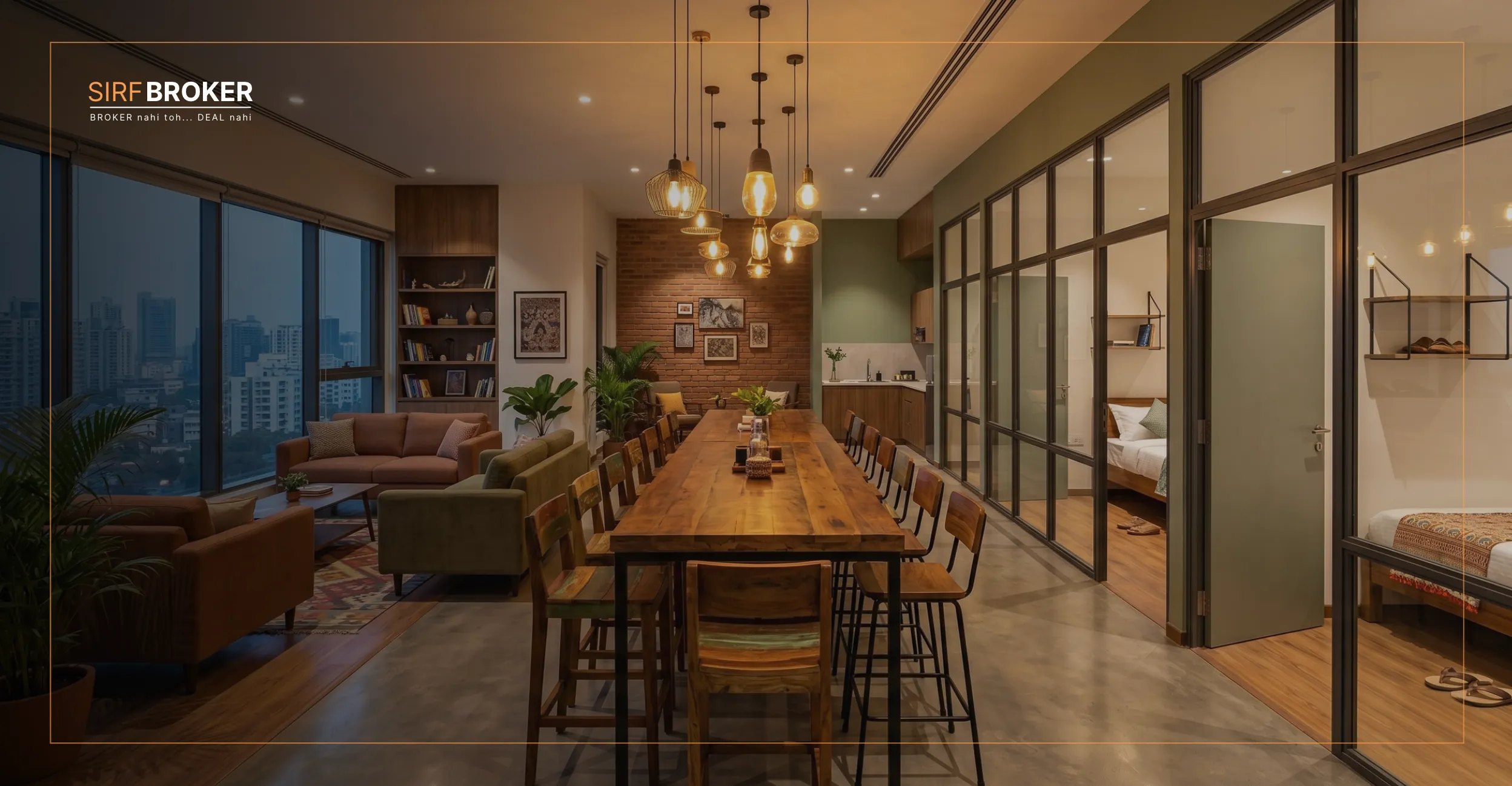
India’s higher education system accommodates approximately 4 million students in institutional housing. The demand for student accommodation is estimated at 12 million. That 8 million bed gap is not a social policy problem — it is a real estate opportunity that organised developers have barely started to address.
The co-living market in India — which includes both student-focused purpose-built accommodation and professional co-living for young urban workers — currently has an organised inventory of approximately 0.3 million beds, according to Colliers India. By 2030, Colliers projects that figure will reach 1 million beds. The growth trajectory is not a prediction. It is the arithmetic of demographic demand meeting the beginning of professional supply.
| Co-living in India offers a rental arbitrage of up to 35% against traditional 1BHK rentals for the same budget, according to market comparisons. Operators in the organised segment are achieving occupancy rates above 90% in established markets. For developers, this is a segment where demand is confirmed, institutional interest is growing, and the professional supply base is thin enough that first-mover positions still exist in most cities. |
The Demand Case — Three Numbers That Define the Opportunity
| Metric | Number | Source |
|---|---|---|
| Total student housing demand in India | ~12 million beds | All India Survey on Higher Education (AISHE) |
| Institutional accommodation supply | ~4 million (35–40% of demand) | AISHE survey data |
| Current organised co-living inventory | ~0.3 million beds | Colliers India |
| Projected organised inventory 2030 | ~1 million beds (3x current) | Colliers India |
| Rental arbitrage vs 1BHK | Up to 35% cheaper for equivalent budget | Market comparisons, Colive research |
| Organised market penetration | Currently ~5%; projected 8–10% by 2026–27 | Colliers India |
Two Distinct Product Types — Both With Developer Opportunity
The co-living real estate opportunity sits in two distinct product types, each with different development briefs, tenant profiles, and operational models.
Purpose-Built Student Accommodation (PBSA). Designed specifically for university and college students — proximity to educational institutions is the primary location criterion. En-suite or shared rooms, communal kitchens, study rooms, common areas. The PBSA model is well-established in the UK and Australia; India is in the early innings. At 12 million demand vs 4 million institutional supply, the unmet need is structural and not going away.
Professional co-living. Designed for young urban professionals — proximity to employment clusters (IT parks, commercial districts) is the primary criterion. Private rooms with shared amenities, flexible lease tenures, all-inclusive billing. The professional co-living market benefits from India’s ongoing urbanisation and the large population of young workers relocating for employment who find traditional housing unaffordable at entry-level salaries.
Where the Opportunity Is Strongest
| City / Market | Co-Living Driver | Developer Opportunity |
|---|---|---|
| Bengaluru | Largest IT/GCC workforce; high in-migration; premium rental market | Professional co-living near ORR, Whitefield; high-yield, high-occupancy established market |
| Pune | Large student population (Symbiosis, COEP, other institutions); IT employment | PBSA near Hinjewadi/Kharadi employment zones; strong student demand in Deccan, Baner |
| Hyderabad | GCC expansion driving professional in-migration; growing student base | Professional co-living near Hitech City; PBSA near Shamshabad / university clusters |
| Tier 2 cities | Jaipur, Coimbatore, Indore — rising student populations; limited organised supply | First-mover advantage strongest; franchise/revenue-share models viable for local developers |
Colliers India specifically identifies Tier 2 city expansion as the next wave of co-living growth — enabled by acquisition of unorganised players, new PBSA builds near educational clusters, and partnership models with institutions. For developers in these cities, the barrier to entry is lower and the first-mover advantage larger than in Bengaluru or Mumbai, where institutional operators have already established positions.
The Developer Business Model — How Co-Living Gets Built and Operated
| THREE MODELS FOR DEVELOPER PARTICIPATION Build and Lease to Operator → Developer builds to co-living specification and leases the entire building to an established operator (Colive, Stanza Living, OYO Life). Operator manages all hospitality and tenancy. Developer gets stable long-lease rental income. Lower yield than operating yourself; lower operational complexity. Build and Operate → Developer builds and manages the co-living product directly. Higher yield potential; requires operational capability in hospitality and property management. Best suited for developers with existing residential management platforms. Franchise / Revenue Share → Local developer or landlord provides the asset; established co-living operator provides brand, management, and tenancy. Revenue shared. Fastest entry model — especially viable in Tier 2 cities where operators are actively seeking local asset partners. Colliers India identifies this as the fastest-growing model in 2026. The franchise/revenue-share model allows entry without full development capital outlay — particularly relevant for developers who own suitable existing assets in locations with established student or professional demand. |
What the Development Brief Looks Like
Co-living is not a repurposed residential building. Done well, it is a purpose-designed product with specific spatial, service, and technology requirements that differ from standard residential.
- Room size: Private rooms of 120–200 sq ft with en-suite bathroom. Studio or twin configurations. Built-in storage critical — co-living residents are usually without furniture.
- Common areas: Minimum 20–25% of total floor area allocated to communal spaces — kitchen, dining, lounge, study/co-working, laundry. These spaces drive occupancy and premium.
- Amenities infrastructure: High-speed internet throughout (this is non-negotiable — a co-living building without strong WiFi is not sellable to operators), laundry, 24/7 security, CCTV.
- Technology layer: Smart access control, app-based management, digital billing. Operators expect this built-in, not added after.
- Location: Within 2 km of the target institution (PBSA) or employment cluster (professional). Transport connectivity matters more than neighbourhood prestige.
Sirf Broker POV
The co-living and student housing opportunity in India is not a niche. It is one of the largest unmet real estate demand gaps in the country — and most developers are not in the conversation because it does not look like a conventional real estate product.
That perception is changing. Institutional capital has started flowing into co-living platforms. CBRE India now covers student housing and co-living as a distinct asset class. Colliers projects a threefold increase in organised inventory by 2030. The question for developers in 2026 is not whether this is a real market — it clearly is. The question is whether to enter now, while operators are actively seeking asset partners and first-mover returns are available, or later, when the market has consolidated and entry requires competing against well-capitalised national platforms.
For developers in Tier 2 cities specifically, the revenue-share model lowers the financial bar to entry. You provide a well-located asset; an established operator provides tenants, management, and brand. The developer does not need to build operational hospitality expertise — they lease it. That model is viable today, in cities where the demand is present and organised supply is minimal. In three years, when more operators have moved into those cities, the negotiating dynamic will be different.
Conclusion
India’s 12 million bed student housing gap is not closing on its own. Institutional accommodation is not scaling to demand. Traditional residential housing is not priced accessibly for students or entry-level professionals. The organised co-living sector is growing — from 0.3 million beds to a projected 1 million by 2030 per Colliers India — but that still represents a fraction of the unmet demand. For developers who are looking for a segment with confirmed demand, growing institutional interest, and significant first-mover availability in Tier 2 cities, co-living is the strongest case available in 2026.
For developers tracking how new residential asset formats are being financed and exited, the overview of how REITs are reshaping real estate investing in India covers the institutional capital pathways now emerging for alternative residential formats.
Frequently Asked Questions
1. How large is India’s co-living and student housing market in 2026?
India’s organised co-living inventory stands at approximately 0.3 million beds as of 2026, according to Colliers India. Against a student housing demand of approximately 12 million beds (per the All India Survey on Higher Education), with institutional accommodation meeting only 35–40% of that demand, the gap is structural and large. Colliers projects organised co-living inventory growing to 1 million beds by 2030 — a threefold increase from today.
2. What is the rental advantage of co-living vs traditional housing in India?
Co-living in India offers a rental arbitrage of up to 35% compared to traditional 1BHK rentals for a similar monthly budget, when factoring in the all-inclusive nature of co-living pricing (utilities, internet, housekeeping, furniture included). This affordability advantage is the primary demand driver among students and young professionals for whom furnished, serviced accommodation in well-located urban zones is otherwise unaffordable.
3. What is Purpose-Built Student Accommodation (PBSA) and why does India need more of it?
PBSA is purpose-designed residential real estate for students — en-suite or shared rooms with communal kitchens, study spaces, and common areas, located near educational institutions. India’s PBSA market is in early innings compared to the UK and Australia, despite having one of the world’s largest student populations. With only 35–40% of student accommodation demand met by institutions, the gap for organised private PBSA operators and developers is substantial.
4. Which cities have the strongest co-living demand in India?
Bengaluru leads for professional co-living due to IT/GCC in-migration. Pune has both strong student demand (multiple universities) and professional demand. Hyderabad is growing rapidly on GCC expansion. Tier 2 cities including Jaipur, Coimbatore, and Indore are identified by Colliers India as the next wave — with first-mover advantage available to developers who enter before national operators consolidate these markets.
5. What are the three models for developer participation in co-living?
Build and lease to an established operator (stable rental income, low operational involvement); build and operate directly (higher yield potential, requires hospitality management capability); or franchise/revenue-share (developer provides the asset, operator provides brand, management, and tenants). The revenue-share model is identified by Colliers India as the fastest-growing entry model in 2026, particularly in Tier 2 cities where operators seek local asset partners.
6. What does a co-living building development brief look like?
Private rooms of 120–200 sq ft with en-suite bathrooms; communal spaces comprising 20–25% of total floor area (kitchen, dining, lounge, co-working, laundry); high-speed internet throughout as a non-negotiable infrastructure requirement; smart access control and app-based management systems built in (not retrofitted); and location within 2 km of the target institution or employment cluster, with strong public transport connectivity.
7. How is institutional investment flowing into India’s co-living sector?
Institutional interest in co-living as a distinct asset class has increased materially, with CBRE India now covering student housing and co-living separately in its alternative asset class research. Investment structures range from direct acquisition of co-living platforms to sale-and-leaseback arrangements and REIT-eligible portfolio structures as the market matures. Colliers India’s coverage of co-living as a formal real estate segment reflects the transition from niche to institutional-grade asset class.
Sources and References
- Colliers India — Co-Living Segment Report — Organised inventory ~0.3 mn beds; projected ~1 mn beds by 2030; organised market penetration 5% → 8–10%; franchise/revenue-share model growth; Tier 2 city expansion. colliers.com/en-in
- All India Survey on Higher Education (AISHE) — Institutional accommodation ~4 million students (35–40% of demand); total student housing demand ~12 million. Ministry of Education, Government of India.
- CBRE India — Student Housing and Co-Living Research — Asset class coverage; rental arbitrage data. cbre.co.in
Disclaimer
| This article is published by Sirf Broker for educational purposes only. It is not investment or development advice. Co-living market performance, occupancy rates, and returns vary significantly by city, location, product quality, and operator. Developers should conduct independent due diligence and consult qualified professionals before any investment or development decision in this sector. |