

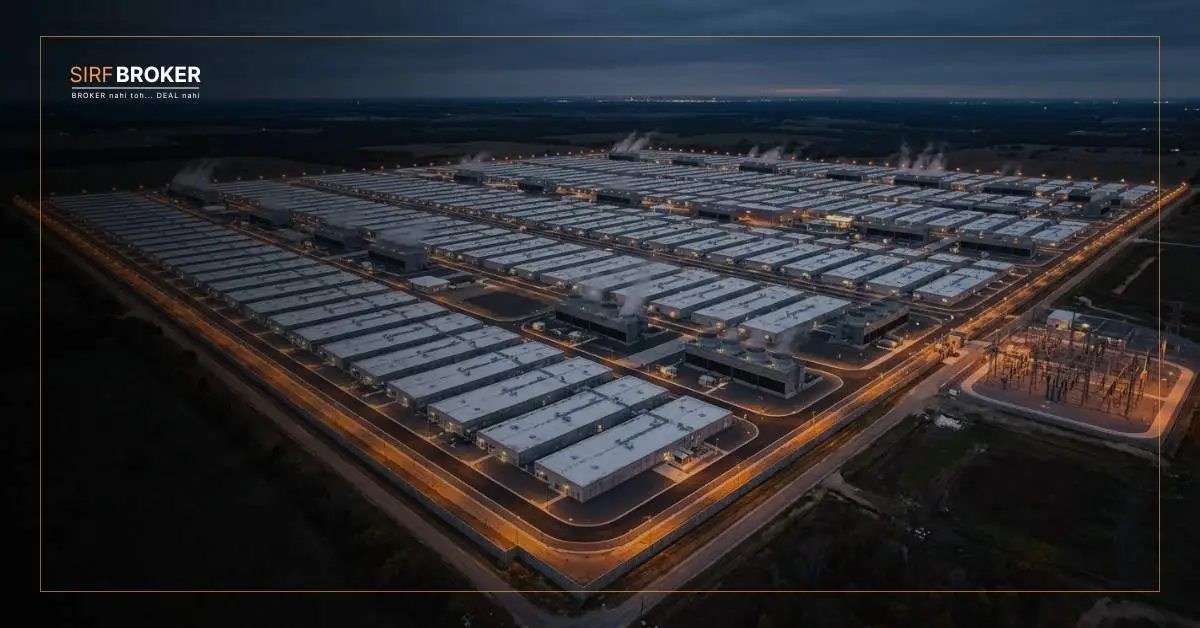
The most valuable land transaction in India right now is not happening in Bandra, Golf Course Road, or Whitefield. It is happening in industrial corridors outside Mumbai, Chennai, Hyderabad, and Pune — large-format plots near power substations, in low-flood-risk zones, with industrial zoning already in place.
The buyers are hyperscalers. The sellers, in many cases, are developers who do not yet know their asset has changed category.
India’s data centre sector drew cumulative investment commitments of $126 billion by the end of 2025. According to CBRE India’s 2026 Asia Pacific Data Centre Trends & Outlook, those commitments are projected to rise by approximately 45% year-on-year in 2026 — potentially crossing $180 billion. In 2025 alone, $56.4 billion in fresh commitments arrived. Microsoft has pledged $17.5 billion. Amazon has pledged $15 billion. Google has pledged $15 billion.
Five hundred megawatts of fresh data centre capacity is expected to come online in India through 2026. By 2028, India’s total data centre stock is projected to surpass 3 gigawatts. By 2030, the sector will require over 55 million square feet of real estate. CBRE has elevated India to a “Leading Market” in the APAC region — alongside Japan, Australia, South Korea, and Mainland China.
| This is not a technology story. It is a real estate story. The demand is for land — specific land, in specific locations, with specific infrastructure. The developers who understand what hyperscalers actually require, and who hold assets that match those requirements, are sitting on a category of value they may not have priced correctly. The ones who miss this window will watch someone else sell the same land at a multiple they did not anticipate. |
Why Data Centres Need So Much Real Estate — and Why It Has to Be Specific Land
A data centre is not an office building or a warehouse. The real estate requirements are precise, and they eliminate most available land from consideration immediately.
| Requirement | Why It Matters | What Disqualifies Land |
|---|---|---|
| Power availability | A hyperscale campus consumes 50–500 MW of power. The land must be within a defined distance of a high-capacity substation or have dedicated power infrastructure buildable on site. | Locations without 132KV or higher substation proximity are typically non-starters for large campuses |
| Large contiguous format | Hyperscale campuses require 25–100+ acres of contiguous land for phased build-out. Fragmented or small parcels cannot accommodate the full development programme. | Anything under 20 acres is typically only viable for smaller edge data centres |
| Industrial zoning | Data centres are classified as industrial/IT infrastructure in most Indian states. Residential or commercial zoning requires conversion — adding time and regulatory risk. | Non-industrial zoned land requires government conversion approval — typically 18–36 months |
| Low flood/natural disaster risk | Data centres hold critical infrastructure. Hyperscalers conduct detailed flood risk, seismic, and disaster risk assessments before committing to any site. | Coastal low-lying land, flood plain zones, seismically active zones are avoided |
| Fibre connectivity | Land must be on or near existing fibre backbone routes, or have viable fibre trenching routes to major internet exchange points. | Remote locations without fibre proximity add significant infrastructure cost |
| Water access | Cooling systems in large data centres consume significant water. Sites need either municipal water connection or viable groundwater access. | Water-stressed zones without viable cooling alternatives require expensive adiabatic or dry-cooled systems |
The Four Cities — Where India’s Data Centre Real Estate Is Concentrating
Data centre demand in India is not uniform. It is highly concentrated in four city clusters — each for different reasons related to power infrastructure, connectivity, and existing technology ecosystem density.
| THE FOUR DATA CENTRE CITIES AND WHAT THEY OFFER Mumbai → India’s largest and most established data centre market. Proximity to submarine cable landing stations at Versova and Seawoods makes it the primary international connectivity hub. Navi Mumbai, Panvel, and the Thane-Belapur industrial corridor are the primary development zones. Land premium is highest here — but so is tenant quality. Chennai → Second major submarine cable landing point in India. Growing rapidly as a hyperscale destination due to lower land cost vs Mumbai, strong state government support, and expanding power infrastructure. Sriperumbudur and Ambattur industrial zones are active. Hyderabad → India’s fastest-growing data centre market in 2025–26. Strong existing IT infrastructure, proactive state government, and large available land parcels in the Fab City and Patancheru industrial corridors. Lower land cost than Mumbai or Chennai with comparable power access. Pune → Emerging data centre market driven by overflow from Mumbai and strong GCC presence. Chakan, Ranjangaon, and Hinjewadi industrial corridors are seeing early data centre land acquisitions. Connectivity to Mumbai via existing fibre routes makes it viable for secondary and edge deployments. |
The Investment Numbers — What $180 Billion Committed Actually Means on the Ground
Investment commitments and ground-level land demand are different things. But the translation from one to the other in data centres is relatively direct: each megawatt of data centre capacity requires approximately 2,000 to 3,000 square feet of building footprint, and each large campus requires 25 to 100+ acres of land.
At 500 MW of fresh capacity arriving in 2026 and a projected build-out to 3 GW by 2028, India needs to absorb and develop approximately 2,300 MW of new capacity over the next two to three years. At conservative land requirements of 40 acres per 100 MW campus, that is approximately 920 acres of qualifying industrial land — in the four city clusters above — that will transact in the next 24 to 36 months.
| The Union Budget 2026-27 introduced a long-term tax holiday extending to 2047 for foreign cloud providers using India-based infrastructure — contingent on using an Indian reseller for service delivery. This policy signal has materially accelerated hyperscaler commitment timelines. The land pipeline is not speculative demand. It is capital already committed, waiting for qualifying sites to be identified and transacted. |
What Developers Holding Industrial Land Should Do
Three categories of developer asset qualify for serious data centre consideration:
Large industrial land parcels (20+ acres) in the four city corridors. If you hold land in Navi Mumbai, Panvel, Ambattur, Sriperumbudur, Patancheru, Fab City, Chakan, or Ranjangaon — check your power infrastructure proximity. If you are within 5 km of a 132KV substation, your land has almost certainly been identified in some hyperscaler’s site matrix already.
Industrial parks with existing power infrastructure. Developers who have already built IT/industrial parks with dedicated power infrastructure are in the strongest position — the build-ready option commands a significant premium over raw land because it removes the 18–24 month infrastructure development timeline.
Former large-format manufacturing land in the four corridors. Brownfield industrial land — disused manufacturing facilities on large plots — is actively sought because it typically comes with existing power connections, industrial zoning, and sometimes partial building infrastructure that can be adapted.
| What developers should not do: Transact data centre land without engaging a specialist advisor who understands hyperscaler requirements. A developer who sells 40 acres at standard industrial land rates in a location that qualifies for hyperscale development may be leaving 3–5x value on the table. The premium for data centre-qualifying land over standard industrial land in the four key corridors is material — and it is not yet fully priced into most developer balance sheets. |
For developers evaluating how data centre assets fit alongside office and residential in a diversified portfolio, the overview of how REITs are changing Indian real estate investment covers the institutional capital frameworks that are beginning to formalise data centre asset valuation alongside commercial office and warehousing.
Sirf Broker POV
India’s data centre boom is being covered as a technology story — AI, cloud computing, digital infrastructure. The real estate dimension is consistently underreported. But the on-the-ground dynamic is straightforward: hyperscalers need specific land in specific cities, they need it at scale, they need it now, and they are willing to pay a significant premium for sites that tick every box in their qualification matrix.
The developer community has not fully processed this. Industrial land in Mumbai’s peripheral corridors and Hyderabad’s Fab City zone is trading at prices that do not yet reflect the data centre premium — because most sellers are still using standard industrial land comps as their reference. That gap will close. The question is whether it closes before or after the developer has transacted.
The practical implication for developers in 2026 is this: if you hold large-format industrial land in the four active markets, get a site qualification assessment done now. It takes two to four weeks and tells you definitively whether your land meets hyperscaler criteria. If it does, you should be in conversation with data centre developers and operators — not waiting for them to call you. The hyperscaler land acquisition pipeline is moving faster than most developer timelines are built to accommodate.
By 2028, India will need to have absorbed most of the qualifying land it has in these corridors to hit the 3 GW target. That is a 24-month window. Developers who move in that window will establish positions that will be significantly harder and more expensive to replicate once the primary sites are transacted.
Conclusion
India’s data centre sector is the most capital-intensive real estate story of the decade — $180 billion committed, 500 MW arriving in 2026, 55 million square feet of real estate needed by 2030. The demand is real, the capital is committed, and the land requirement is specific. Developers holding qualifying assets in Mumbai, Chennai, Hyderabad, and Pune have a time-limited opportunity to position strategically in one of the highest-value real estate transactions currently active in the Indian market.
Frequently Asked Questions
1. What is a data centre and why does it require so much land in India?
A data centre is a facility housing the servers, networking equipment, and cooling systems that power cloud computing, AI workloads, and digital services. Hyperscale data centres — built by companies like Microsoft, Amazon, and Google — require 25 to 100+ acres of contiguous land per campus, with access to 50–500 MW of power, fibre connectivity, water access for cooling, and industrial zoning. India’s projection of 55 million sq ft of data centre real estate by 2030, per CBRE India data, reflects the aggregate land footprint of these facilities across the country’s four primary data centre markets.
2. Which Indian cities have the most data centre development activity in 2026?
Mumbai leads as India’s primary data centre market due to its submarine cable landing stations providing international connectivity. Chennai is the second major submarine cable hub and is growing rapidly with lower land costs. Hyderabad is India’s fastest-growing data centre market in 2025–26, driven by proactive state government support and large available land parcels. Pune is an emerging market driven by overflow from Mumbai. These four cities account for the majority of India’s current and projected data centre capacity, per CBRE India’s 2026 APAC Data Centre Outlook.
3. How much has been invested in India’s data centre sector?
Cumulative investment commitments in India’s data centre sector reached $126 billion by end-2025. CBRE India projects these to rise approximately 45% year-on-year in 2026, potentially exceeding $180 billion. Fresh commitments in 2025 alone were $56.4 billion. Major hyperscaler pledges include Microsoft ($17.5 billion), Amazon ($15 billion), and Google ($15 billion). India’s data centre capacity is projected to surpass 3 GW by 2028, from approximately 1,700 MW at end-2025.
4. What type of land qualifies for data centre development in India?
Qualifying land typically requires: 20+ acres of contiguous area (50–100+ acres for hyperscale); proximity to a 132KV or higher power substation; industrial zoning (or conversion-viable land); low flood and seismic risk profile; proximity to existing fibre backbone routes; and water access for cooling systems. Brownfield industrial land with existing power connections is particularly sought after because it eliminates infrastructure development time.
5. What is the Union Budget 2026-27 tax holiday for data centres?
The Union Budget 2026-27 introduced a long-term tax holiday extending to 2047 for foreign cloud providers utilising India-based infrastructure, contingent on the use of an Indian reseller for service delivery. This policy significantly accelerated hyperscaler commitment timelines for India, by reducing long-term operational tax uncertainty for international operators building in India for the first time.
6. How does data centre land value compare to standard industrial land in India?
Data centre-qualifying land — large format, near power infrastructure, industrial zoned, low risk profile, in the four primary markets — commands a significant premium over standard industrial land comparables. The premium reflects the scarcity of qualifying sites relative to hyperscaler demand, and the fact that data centre land is effectively being acquired as critical national infrastructure rather than standard commercial real estate. Developers transacting at standard industrial comps without a data centre qualification assessment may be significantly underpricing their assets.
7. What is CBRE’s “Leading Market” designation for India’s data centre sector?
CBRE’s 2026 Asia Pacific Data Centre Trends & Outlook elevated India to “Leading Market” status in the APAC region — placing it alongside Japan, Australia, South Korea, Mainland China, and Malaysia. This designation reflects India’s combination of large-scale hyperscaler commitments, policy support (including the 2047 tax holiday), growing domestic cloud demand from GCCs and digital-first businesses, and an expanding pool of qualifying land and power infrastructure in the four primary markets.
Sources and References
- CBRE India — 2026 Asia Pacific Data Centre Trends & Outlook — India “Leading Market” designation, $180B commitment projection, 45% YoY growth, 500 MW 2026 capacity. cbre.co.in
- Business World India — Data Centre Boom 2026 — 500 MW fresh capacity, $56.4B 2025 commitments, hyperscaler pledge data. businessworld.in
- MarkNtel Advisors / PR Newswire — India Data Centre Market 2026–32 — 3 GW by 2028 projection, 14.60% CAGR. prnewswire.com
- Union Budget 2026-27 — Long-term tax holiday to 2047 for foreign cloud providers. indiabudget.gov.in
- Realty N More — India Data Centre Capacity 2028 — 55 million sq ft real estate requirement by 2030. realtynmore.com
Disclaimer
| This article is published by Sirf Broker for educational and informational purposes only. It is not investment or development advice. Data centre development requirements, investment figures, and land qualification criteria vary significantly by operator, location, and market conditions. All data sourced from publicly available reports cited above. Developers should consult qualified real estate advisors and conduct independent feasibility assessment before any transaction decision. |