

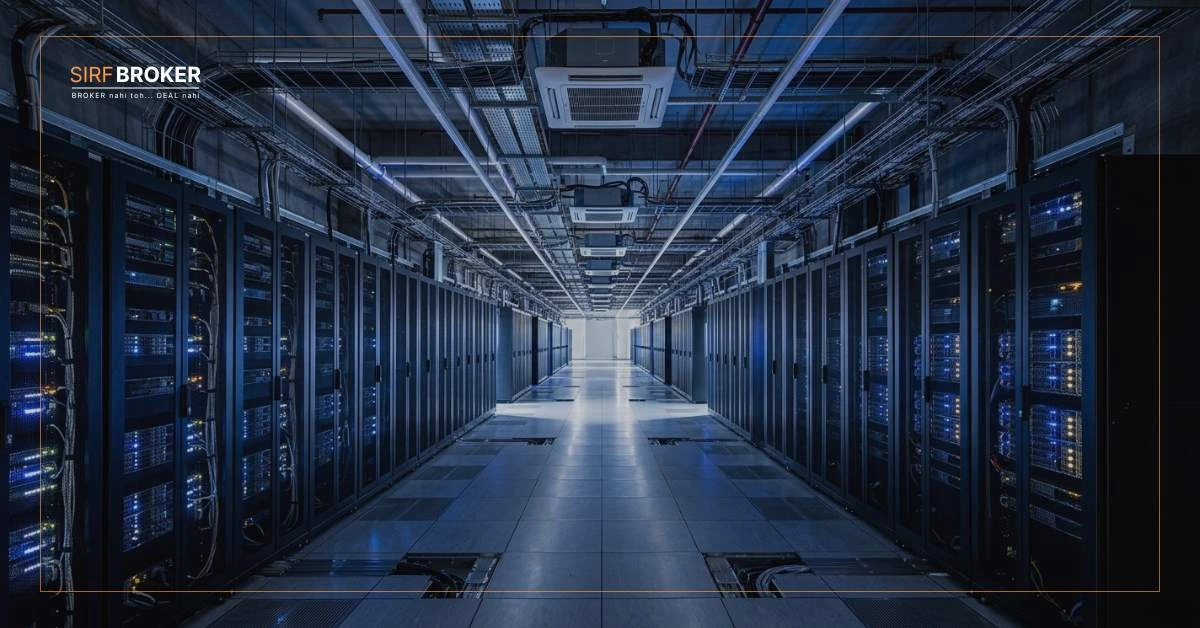
India’s data centre sector has crossed a threshold in 2026 that most real estate professionals have not fully registered: cumulative investment commitments have reached approximately $180 billion according to CBRE India, 500 MW of fresh capacity is expected this year alone, and the real estate demand generated by this infrastructure build-out is projected to hit 10 million square feet. According to JLL India’s data centre research, this sector is set to attract $5.7 billion in real estate investment by 2026.
This is not an IT sector story wearing a real estate costume. It is a property market story: purpose-built facilities on large land parcels, with specific power, cooling, and connectivity requirements, increasingly located outside traditional city centres, and commanding long-term leases with investment-grade tenants. Developers who understand the asset class early will be better positioned than those who discover it after the obvious sites are gone.
Why 2026 Is a Turning Point for Indian Data Centres
India’s data centre capacity is expected to grow by approximately 30 percent year-on-year in 2026, supported by 500 MW of new supply addition, according to CBRE India. The primary driver is artificial intelligence. America’s major technology firms have designated India as one of their largest global markets, and AI workloads require data infrastructure at a scale that the existing installed base cannot satisfy.
Three structural factors are converging simultaneously. First, India’s digital economy is scaling: UPI transactions, cloud adoption, streaming, and enterprise SaaS are all generating data that must be stored and processed locally. Second, data localisation requirements from RBI and SEBI for financial data are mandating Indian-soil storage for regulated industries. Third, India’s improving power infrastructure — particularly in states like Telangana, Maharashtra, and Tamil Nadu — is making hyperscale data centre development viable at a scale it could not support five years ago.
| Metric | 2026 Figure | Source |
|---|---|---|
| Real estate investment in data centres | $5.7 billion | JLL India |
| Real estate demand generated | 10 million sq ft | JLL India |
| Cumulative investment commitments | ~$180 billion | CBRE India |
| New capacity addition in 2026 | ~500 MW | CBRE India |
| Capacity growth YoY | ~30% | CBRE India |
Where the Data Centres Are Going — and Why Location Is Everything
The traditional data centre markets in India have been Mumbai (Navi Mumbai / Airoli corridor), Chennai, Bengaluru, Hyderabad, and Delhi-NCR. These five markets account for the bulk of installed capacity and continue to attract the largest hyperscale investments. However, the geography is expanding.
According to industry reports, cities including Ahmedabad, Visakhapatnam, Patna, and Bhopal are emerging as new data centre hubs, driven by three factors: 5G infrastructure rollout requiring edge computing nodes, growing demand for low-latency processing from local digital economies, and data localisation requirements pushing storage closer to end users. State governments in Telangana, Maharashtra, Andhra Pradesh, Tamil Nadu, and Uttar Pradesh are actively competing for data centre investment with power availability guarantees, infrastructure support, and policy frameworks.
For developers, the site selection calculus for a data centre is fundamentally different from a commercial office or residential project. The criteria are:
| Requirement | Standard | Why It Matters |
|---|---|---|
| Power availability | Uninterrupted, dedicated grid access + backup | Single biggest constraint in India |
| Land parcel size | 5–50+ acres depending on scale | Hyperscale requires large contiguous land |
| Floor load capacity | 1,000–2,000 kg/sqm minimum | Standard commercial construction does not qualify |
| Fibre connectivity | Multiple redundant fibre routes | Single-route connectivity is disqualifying |
| Cooling infrastructure | Water access or air cooling at scale | Climate and water stress affect viability |
| Seismic zone | Zone II or lower preferred | Risk tolerance for mission-critical infrastructure |
The Real Estate Investment Case for Data Centres
From an investment perspective, data centres offer a profile that differs from most other commercial real estate categories. Leases are typically long — 10 to 20 years — with hyperscale tenants (Amazon, Google, Microsoft, Meta, and their Indian equivalents) who have virtually no option to relocate once built-in infrastructure is in place. The cost of moving a data centre is prohibitive; once a tenant is in, they stay.
The yield profile for Indian data centre assets reflects this lease security. With tenants of global investment grade, long lease terms, and genuine barriers to exit, data centres command institutional investor interest that goes well beyond what conventional commercial office assets attract. The $5.7 billion in real estate investment projected by JLL India is being driven largely by global and domestic PE funds, REITs, and sovereign wealth vehicles — exactly the capital that is shifting away from foreign to domestic in Indian real estate more broadly.
For commercial brokers, data centre transactions are complex, high-value mandates that require understanding the technical requirements, not just the square footage. Brokers who invest in understanding the site selection criteria, power procurement process, and lease structure norms for data centres are positioning themselves for some of the highest-value commercial transactions in the market. The broader shift in how institutional tenants think about total occupancy costs applies here — data centre tenants are highly sophisticated about total cost of occupancy and will negotiate on every variable.
Risks and Constraints
The single largest constraint on data centre development in India remains power. Hyperscale data centres consume electricity at a scale comparable to small industrial towns. The availability of reliable, dedicated grid power at the required load is not universal across India’s geography, and grid infrastructure in newer markets — however promising from a land and connectivity perspective — may not yet meet hyperscale requirements.
A secondary constraint is water. Modern data centre cooling approaches increasingly use water-based cooling systems, which creates a dependency on water availability that is in tension with India’s water stress in several key regions. Developers and investors evaluating sites need to conduct water availability assessments with the same rigour as power assessments.
| SIRF BROKER POV Data centres are the most structurally interesting commercial real estate asset class in India in 2026 — and most of the broker and developer community is not paying attention to them yet. That will change. The land sites that are suitable for hyperscale data centre development have a very specific profile — large, in states with reliable power infrastructure, in low seismic zones, with fibre corridor access. These sites are not abundant. Developers who identify and control these sites now, before hyperscale operators complete their first-wave site acquisitions, will be in a fundamentally different negotiating position than those who arrive after the obvious locations are gone. Sirf Broker’s view: the data centre opportunity in India is real, large, and structurally supported by demand forces — AI adoption, data localisation, digital economy growth — that will not reverse on a quarterly sentiment cycle. It requires domain knowledge to access, which is why the brokers and developers who invest in understanding the asset class now will find it less competitive than it will be in 18 months. |
Conclusion
India’s data centre real estate market is generating $5.7 billion in investment and 10 million square feet of property demand in 2026, driven by AI adoption, data localisation mandates, and a digital economy that is growing faster than existing infrastructure can accommodate. For developers, this is a purpose-built asset class with specific technical requirements, long-lease tenants of investment grade, and institutional capital already committed at scale. The opportunity is real. The window to access the most attractive sites may be shorter than it appears.
For context on how institutional capital is moving across all commercial asset classes in India, read our analysis of how REITs and domestic PE are reshaping India’s real estate investment landscape — data centres are one of the next frontiers for listed vehicle acquisition.
Frequently Asked Questions
Q: How much real estate investment is India’s data centre boom generating in 2026?
A: India’s data centre boom is projected to drive $5.7 billion in real estate investment and create demand for 10 million square feet of property space by 2026, according to JLL India’s data centre research.
Q: What is driving India’s data centre real estate demand in 2026?
A: Three primary drivers: AI adoption by global technology firms that have designated India as a priority market; data localisation requirements from RBI and SEBI mandating Indian-soil storage for regulated financial data; and rapid growth in India’s digital economy — UPI, cloud, streaming, and enterprise SaaS.
Q: Which cities lead India’s data centre real estate market in 2026?
A: Traditional markets of Mumbai (Navi Mumbai/Airoli), Chennai, Bengaluru, Hyderabad, and Delhi-NCR lead in installed capacity. Emerging markets include Ahmedabad, Visakhapatnam, Patna, and Bhopal, driven by 5G rollout and data localisation demands.
Q: What are the land and infrastructure requirements for a data centre in India?
A: Key requirements include: 5–50+ acres of contiguous land; dedicated, reliable grid power with backup generation; floor load capacity of 1,000–2,000 kg/sqm; multiple redundant fibre routes; cooling infrastructure (air or water-based); and low seismic zone location. Standard commercial construction does not meet these specifications.
Q: How long are data centre leases in India?
A: Data centre leases are typically 10 to 20 years, with tenants of global investment grade (Amazon, Google, Microsoft, and equivalents) who face prohibitive relocation costs once infrastructure is installed. This makes data centres among the most secure long-term lease assets in commercial real estate.
Q: What is the biggest constraint on data centre development in India?
A: Power availability is the single largest constraint. Hyperscale data centres consume electricity comparable to small industrial towns, and reliable dedicated grid access is not uniformly available. Water availability for cooling systems is a secondary constraint in water-stressed regions.
Q: How much new data centre capacity is expected in India in 2026?
A: Approximately 500 MW of fresh capacity is expected to come online in India in 2026, representing approximately 30 percent year-on-year growth, according to CBRE India. Cumulative investment commitments across the sector have reached approximately $180 billion.
- JLL India — Data Centre Real Estate Demand and Investment Report 2026
- CBRE India — India Data Centre Market 2026: 500 MW Capacity, $180B Commitments
Disclaimer: This article is for informational and educational purposes only. All data is sourced from published institutional reports. Sirf Broker is a real estate education and media platform and does not provide investment advice.