

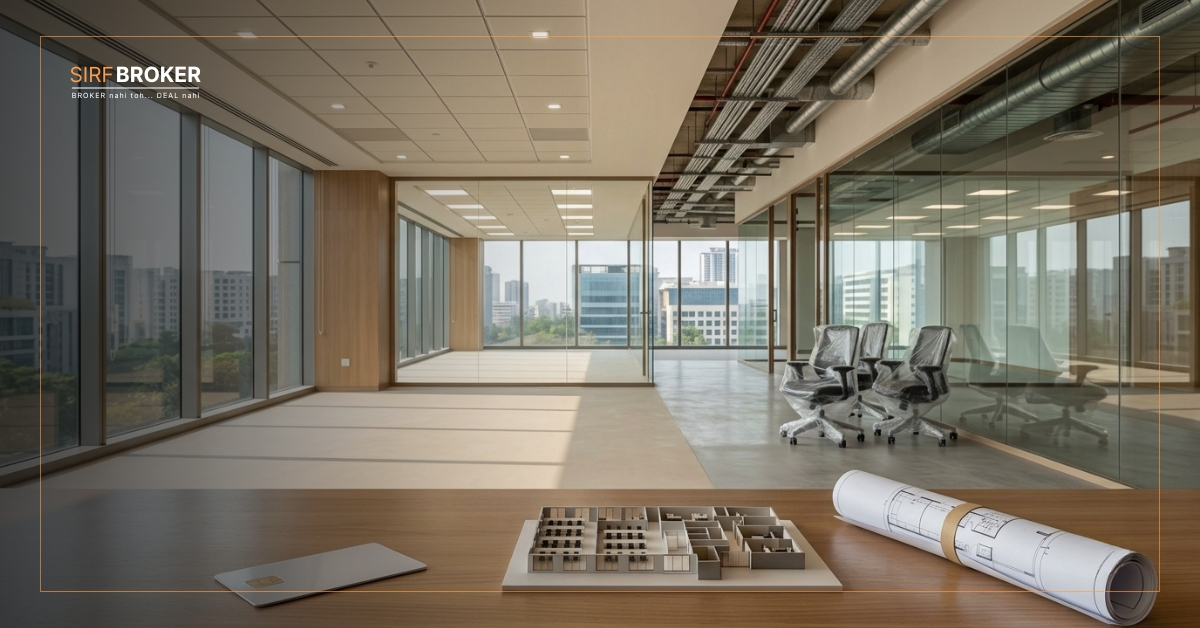
A tenant finds a beautiful office at an attractive rent. The broker says the deal is excellent. Then the fit-out estimate arrives: partitions, workstations, electrical points, AC changes, meeting rooms, internet infrastructure, security systems, furniture and downtime. Suddenly, the cheap office is not cheap anymore.
This is the most common and most expensive surprise in Indian commercial real estate. Rent gets all the attention. Fit-out, CAM, power load, IT setup, downtime and restoration quietly double the real cost of occupying an office.
This guide is for commercial real estate brokers, builders, developers, office landlords, tenants, startups and SMEs who want to understand what an office truly costs — from lease signing to the day employees walk in and start working.
| Rent is the visible cost. Fit-out is the hidden cost that decides whether an office is actually ready for business. |
Why Office Fit-Out Costs Matter More Than Ever in 2026
Globally, the cost of fitting out an office has been rising steadily. According to JLL’s Global Office Fit-Out Costs Guide 2026, which draws on cost data from 68 cities across 40 countries, global average office fit-out costs increased by approximately 2% to 6% across regions over the past year. The guide benchmarks a medium-quality corporate office fit-out at around US$2,150 per square metre (approximately US$205 per square foot) globally.
JLL’s APAC Office Fit-Out Cost Guide 2026, covering 27 cities across 14 countries in the Asia-Pacific region, highlights that fit-out costs in APAC markets vary considerably based on city, building grade, specification level and scope. India sits within this APAC range but has its own cost dynamics driven by labour, GST, material costs and landlord handover conditions.
Cushman & Wakefield’s India Office Fit-Out Costs and Market Insights 2026 notes that Mumbai is one of India’s highest-cost fit-out markets, with average costs around INR 6,567 per sq ft for collaborative hybrid workplace environments. Costs in other Indian cities vary depending on design quality, building grade, MEP scope and material specification.
JLL’s India Construction Cost Guide 2026 adds important context: new Labour Codes may increase labour costs by 5% to 12%, while GST 2.0 reforms may offer potential savings of 2% to 5% on construction costs. The net effect depends on project scope, vendor mix and timing.
The drivers behind rising fit-out costs in India include:
- Higher material and MEP costs post-pandemic
- Increasing demand for hybrid-ready, tech-enabled office layouts
- Better acoustic treatment, air quality and employee experience expectations
- Sustainability and green building compliance requirements
- Skilled labour shortages in interior fit-out trades
- Longer timelines for landlord approvals in older commercial buildings
What Is Office Fit-Out? A Simple Explanation
Before brokers, tenants and builders can have a productive conversation, everyone needs to agree on what these terms mean. Here is a practical guide:
Bare Shell Office
The builder hands over four walls, a floor slab and a ceiling with no finishes, no air conditioning, no flooring, no lighting, no washrooms fitted out and often no electrical points beyond the mains. This is the cheapest handover condition for the landlord and the most expensive starting point for the tenant. A bare shell office requires the highest fit-out investment.
Warm Shell Office
The builder has completed basic services: HVAC ducting, electrical risers, plumbing, sometimes false ceiling in common areas and fire suppression systems up to the floor level. The tenant still needs to complete interiors, partition walls, workstations, cabin fit-outs, IT infrastructure and branding. A warm shell reduces the fit-out scope versus a bare shell but remains a significant tenant investment.
Fitted-Out or Partially Fitted Office
Some landlords, especially in Grade A buildings, hand over offices with completed false ceilings, lighting, flooring, HVAC and even some partition work done. The tenant needs to add furniture, IT, branding and customisation. This is the middle ground and is increasingly popular in Indian Grade A commercial real estate.
Plug-and-Play or Turnkey Office
The office is fully furnished, wired, fitted and ready to occupy. Workstations, meeting rooms, reception, internet connectivity and basic IT infrastructure are in place. Common in managed office and co-working operators and in some pre-fitted landlord offerings. The rent is higher but the move-in cost is lower and the timeline is immediate.
Co-working Space
Fully managed, flexible, all-inclusive. No fit-out required. The operator absorbs the fit-out cost within the seat or desk pricing. Ideal for startups, early-stage businesses and teams needing speed and flexibility. Not suitable for large occupiers seeking branding control or long-term cost efficiency.
| Total Office Move-In Cost = Rent + CAM + Security Deposit + Fit-Out Cost + Furniture + MEP & Power + IT Setup + Downtime Cost An office is not affordable just because the rent looks attractive. It is affordable when the total move-in and operating cost makes sense. |
Complete Office Cost Breakdown — What Every Item Means and Who Should Clarify It
| Cost Item | What It Means | Who Should Clarify It |
|---|---|---|
| Rent (per sq ft/month) | The base monthly rental charge for the leasable area. May be quoted on carpet, built-up or super built-up area — always confirm which. | Broker must confirm area basis; tenant must understand net vs gross rent |
| CAM Charges | Common Area Maintenance charges for lifts, lobby, security, housekeeping, landscaping, DG power, fire safety. Can range from ₹15 to ₹80+ per sq ft/month depending on building grade and city. | Landlord must provide CAM breakdown; broker must highlight this as an operating cost |
| Security Deposit | Typically 3 to 12 months’ rent held by the landlord for the lease term. A large upfront cash outflow that ties up working capital. | Broker must negotiate deposit quantum and refund terms; tenant must budget upfront |
| Fit-Out Cost | Cost of partitions, ceilings, flooring, painting, carpentry, meeting rooms, reception, breakout areas, signage and branding. Varies significantly by handover condition, scope, city and quality. As noted by Cushman & Wakefield, Mumbai fit-out costs average around INR 6,567 per sq ft for collaborative hybrid environments. | Tenant must commission fit-out estimate; broker must flag handover condition |
| Furniture and Workstations | Desks, chairs, storage units, collaborative furniture, lounge seating, breakout furniture, boardroom furniture. Sometimes included in fit-out scope, sometimes separate. | Tenant to budget separately; broker can advise on furnished vs unfurnished options |
| MEP — Mechanical, Electrical, Plumbing | HVAC splits or ducted systems, electrical distribution boards, lighting, fire suppression, plumbing and washroom fitouts. Often the most expensive and time-consuming part of a fit-out, especially in bare shell handovers. | Landlord must confirm MEP capacity; broker must ask about handover state |
| IT and Technology Setup | Structured cabling, server room or IT closet, AV systems in meeting rooms, video conferencing, Wi-Fi access points, CCTV, access control, telephone systems. | IT team must scope separately; broker must confirm internet provider availability in building |
| Power Load / Sanctioned Load | The amount of electrical load available to the tenant. Often expressed in KVA. Insufficient load is a major operational problem for data-heavy or equipment-heavy occupiers. | Landlord must confirm sanctioned load; broker must ask this question before deal closes |
| Parking | Dedicated and visitor parking slots. Sometimes included in lease; sometimes charged separately at ₹2,000 to ₹10,000+ per slot per month in urban Grade A buildings. | Broker must confirm parking ratio and charges; tenant must align with headcount |
| Downtime Cost | Loss of productivity, delayed business operations and employee disruption during fit-out and moving. Often runs for 4 to 16 weeks and represents a real but invisible cost for occupiers. | Tenant must factor this into business planning; broker must negotiate rent-free period |
| Restoration Clause | A lease obligation requiring the tenant to restore the office to its original condition at lease end. This means demolishing the fit-out at exit — a significant cost that most tenants overlook at deal stage. | Broker must flag restoration clause; tenant’s lawyer must review and negotiate at lease stage |
| Lease Flexibility | Lock-in period, exit rights, expansion options, contraction rights, subletting rights and renewal terms. Inflexible leases trap tenants in space that no longer fits their business. | Broker must negotiate flexibility; tenant must think about 3-year and 5-year growth scenarios |
The Broker’s Role: Beyond Rent Per Square Foot
A broker who presents an office on the strength of rent alone is giving the client an incomplete picture. The best commercial brokers in India understand that their job is to help clients understand total occupancy cost, not just the per square foot monthly rate.
Here is what a serious commercial real estate broker must investigate and explain before recommending an office:
1. Handover Condition
Is the building handing over a bare shell, warm shell or fitted office? This single factor can change the tenant’s fit-out budget by ₹500 to ₹4,000+ per sq ft. A broker who does not ask this question before recommending an office is leaving the client exposed to a major financial shock.
2. Power Load and MEP Readiness
What is the sanctioned electrical load available to the tenant? Is HVAC included, excluded or partially done? Is the fire suppression system live? Are the washrooms fitted? Each of these affects the move-in cost and timeline significantly.
3. Fit-Out Approval Timeline
How long does the landlord take to approve the tenant’s fit-out drawings? In older buildings or complex multi-tenanted properties, approvals can take 4 to 12 weeks. Every week of delay is dead rent and dead productivity.
4. Rent-Free Period
Has the broker negotiated a rent-free period during fit-out? Standard commercial leases in India offer 1 to 6 months’ rent-free during fit-out, depending on lease term, landlord motivations and market conditions. This is real money and a skilled broker should always negotiate for it.
5. Floor Plate Efficiency
What is the usable carpet area as a percentage of the quoted area? Inefficient floor plates with large columns, awkward corners, deep floor plates or poor natural light result in more wasted space, higher per-employee cost and a poorer working environment.
6. Lock-In, Exit and Expansion Rights
Is there a lock-in period? Can the tenant exit early? Is there an option to expand to the adjacent space? If the business grows by 30% in year two, is there room in the building? These are strategic questions that directly affect the long-term cost and flexibility of the deal.
7. Restoration Clause
Many lease agreements include a restoration clause requiring the tenant to demolish all fit-out work and return the space to its original condition at the end of the lease. A broker who does not flag this clause leaves tenants facing an unexpected exit cost equal to a significant portion of the original fit-out investment.
| A broker’s value is not in finding the lowest rent. It is in helping the client understand the full cost of occupying a space — and finding the deal where total occupancy cost, lease flexibility and business fit are all aligned. |
The Builder and Landlord’s Role: Delivering Fit-Out-Ready Buildings
Indian office tenants — especially technology companies, BFSIs, professional services firms and growing SMEs — are becoming more demanding about building quality and handover conditions. Builders and landlords who understand this trend will lease faster, retain tenants longer and command premium rents.
Here is what tenants look for — and what landlords should provide:
Fit-Out-Ready Handover
Providing at minimum a warm shell — with HVAC ducting, electrical risers, fire suppression, and washrooms completed — dramatically reduces tenant fit-out cost and timeline. Landlords who go further and offer pre-fitted or plug-and-play units for small and mid-sized occupiers fill space faster.
Adequate Power Load
Technology, data and financial services occupiers have high power requirements. A building with inadequate sanctioned load or slow power upgrade timelines is a disqualifying factor for sophisticated tenants. Landlords should clearly communicate available KVA per floor and the process for applying for enhanced load.
Efficient Floor Plates
A building with a high carpet-to-built-up-area ratio, good natural light penetration, well-positioned core (lifts and washrooms) and minimal structural interruptions allows tenants to plan efficient, high-density workspaces. This translates directly to lower per-employee occupancy cost.
Internet and IT Infrastructure Readiness
Are multiple internet service providers available in the building? Is there dark fibre infrastructure? Is there a dedicated communication riser? Buildings without multi-provider internet access are a problem for any modern occupier.
Transparent CAM Structure
Tenants are increasingly asking for itemised CAM breakdowns before lease signing. Landlords who provide transparent, auditable CAM structures build trust and reduce lease negotiation time. Hidden CAM escalations are one of the biggest tenant grievances in Indian commercial real estate.
Fast Fit-Out Approvals
Every day a tenant waits for fit-out drawing approvals is a day closer to business disruption. Building management teams that process fit-out approvals within a defined, fast timeline (ideally 10 to 21 working days) are valued by tenants and their brokers.
The Tenant’s Budget: What to Prepare Before Signing a Lease
Tenants often walk into lease negotiations with a rent budget but not a move-in budget. These are very different numbers. A practical tenant moving into a medium-quality Grade A office in a major Indian city should budget for the following:
- Security deposit: 3 to 12 month’s rent depending on landlord, building and negotiation
- CAM charges: Monthly operating cost on top of rent — factor this into your monthly budget from Day 1
- Fit-out cost: Depends on handover condition, scope and quality. Can range widely by city, specification and building grade. Commission a professional estimate before signing.
- Furniture and workstations: Budget separately from fit-out. Employer brand and employee experience matter here.
- IT and technology infrastructure: Structured cabling, AV, video conferencing, Wi-Fi, CCTV, access control and telephone — often underbudgeted
- Branding and signage: Fascia signage, reception branding, wayfinding, lift lobby signage
- Legal and documentation costs: Lease registration, stamp duty, lawyer fees
- Moving and relocation cost: Physical movement of equipment, servers and furniture from the old office
- Downtime and transition cost: Double rent period if old lease overlaps with new fit-out, productivity losses during transition
- Compliance: Fire NOC, occupancy certificate alignment, local authority requirements
- Maintenance reserve: Budget for ongoing repairs and maintenance of fit-out post-handover
The key lesson: commission a fit-out estimate before you sign a lease, not after. The fit-out cost can easily be as large as — or larger than — one year’s rent. Knowing this before the lease is signed gives you negotiating power for rent-free periods, fit-out contributions and handover conditions.
The “Cheap Rent” Trap: Why Low Rent Can Be the Most Expensive Decision
The most dangerous phrase in Indian commercial real estate is: “Rent bahut attractive hai.”
Low rent can become the most expensive outcome when any of these conditions apply:
- Bare shell handover at low rent: The ₹20 per sq ft saving in rent is erased by ₹1,500 to ₹3,000 per sq ft in bare shell fit-out costs
- Inadequate power load: Upgrading sanctioned load involves significant cost, DISCOM procedures and months of delay
- Inefficient floor plate: A badly shaped floor with high loss factor means paying for area you cannot use
- Old building services: Old HVAC, dated electrical systems and poor IT infrastructure lead to ongoing operational problems and additional tenant investment
- Slow landlord approvals: A 3-month fit-out approval delay at ₹60 per sq ft rent on 5,000 sq ft costs ₹9 lakh in dead rent alone
- CAM surprise: A building advertising ₹60 rent with ₹45 CAM has a true occupancy cost of ₹105 — more expensive than a Grade A option at ₹85 rent and ₹15 CAM
- Restoration clause at exit: The cost of demolishing a well-fitted office and restoring to bare shell can range from ₹200 to ₹800 per sq ft depending on scope
The Broker Conversation: How to Talk About Real Occupancy Cost
| Don’t Say “Sir rent kam hai, office le lijiye.” Say This Instead “Sir rent attractive hai, but total cost — fit-out, CAM, power load, furniture, IT setup, parking, rent-free period, lock-in aur downtime — ke baad samajh aayega. Pehle total move-in cost calculate karte hain, tab decide karte hain ki yeh deal actually value for money hai ya nahin.” |
This is the difference between a transactional broker and a trusted advisor. The broker who explains total occupancy cost becomes the broker the client calls first — for this deal and every future deal.
Fit-Out Readiness Checklist for Brokers, Builders and Tenants
Before recommending an office or signing a lease, use this checklist to ensure everyone understands what is included, what is excluded and what needs to be budgeted:
Building and Handover
- What is the handover condition — bare shell, warm shell, fitted or plug-and-play?
- What MEP services are completed by the landlord at handover?
- What is the sanctioned electrical load available to this floor/unit?
- Is HVAC included or excluded from landlord’s scope?
- Are washrooms fitted out or tenant’s scope?
- Is fire suppression / sprinkler system live up to the floor level?
- What is the floor plate efficiency — carpet to built-up area ratio?
Lease and Financial Terms
- What is the monthly rent and on what area basis (carpet / built-up / super built-up)?
- What is the CAM charge — and what does it include? Is it itemised?
- How many months’ security deposit is required?
- Is there a rent-free period for fit-out? How many months?
- What is the lock-in period and exit penalty?
- Is there an expansion option for adjacent or upper/lower floors?
- What does the restoration clause require at lease end?
Technology and Connectivity
- Which internet service providers are available in the building?
- Is there a dedicated communication riser with dark fibre?
- Is there a building-level BMS (Building Management System)?
- Does the building have redundant power supply and DG backup?
Approvals and Timeline
- What is the landlord’s fit-out approval process and timeline?
- Which fit-out activities require prior written approval?
- What are the building’s fit-out working hours policy?
- Are there approved vendor lists for key trades?
Parking and Common Areas
- How many parking slots are allocated to this unit?
- Is parking included in rent or charged separately?
- Are visitor parking slots available?
- What are the common area facilities — lobby, cafeteria, gym, terrace, conference rooms?
Red Flags: When a Deal Needs a Second Look
These are warning signals that a deal may cost far more than it appears — and that a broker should investigate deeper before recommending:
- Rent suspiciously below market rate for the area and building grade
- Unclear or undocumented handover condition — “we’ll sort it out” is not an answer
- No clear power load figure provided or available from the landlord
- Weak HVAC infrastructure in an older building with no clear upgrade pathway
- No stated fit-out approval timeline from landlord or building management
- Suspiciously high CAM without an itemised breakdown
- No rent-free period offered despite a long lock-in term
- Restoration clause present but not discussed during deal negotiation
- Inefficient floor plate with high loss factor and poor layout
- Old building services with no maintenance records or building manager available
- No established internet service providers in the building
- Parking unclear or extremely limited relative to the headcount requirement
- No expansion option in a building with high occupancy — growth will force a costly relocation
The Sirf Broker View: What Separates a Good Commercial Broker from a Great One
The Indian commercial real estate market is maturing. Tenants are more informed. Landlords are more professional. And clients — whether a 20-person startup or a 2,000-person enterprise — expect their broker to be a trusted advisor, not a transaction facilitator.
The next-level commercial broker does not sell rent. They explain real occupancy cost. They understand fit-out, MEP, lease structures, CAM, power load, floor plate efficiency and total move-in budgets. They ask the right questions before recommending an office. They protect their clients from expensive surprises.
Global data from JLL and Cushman & Wakefield confirms that office fit-out costs are a material component of total occupancy spend. In India, with rapidly evolving Grade A supply, rising fit-out specifications and increasing tenant sophistication, brokers who only quote rent are leaving value — and trust — on the table.
| The broker who explains total occupancy cost — rent, CAM, fit-out, power, IT, downtime and restoration — becomes the broker that clients trust, refer and return to. That is the Sirf Broker standard. |
Frequently Asked Questions
1. What is the difference between office fit-out cost and office rent in India?
Rent is the recurring monthly charge for occupying the leased space. Fit-out cost is the one-time capital expenditure to make the space functional — covering partitions, ceilings, flooring, HVAC, electrical, IT infrastructure, furniture and branding. In India, fit-out costs can range from ₹800 per sq ft for a basic finish to ₹6,500+ per sq ft for a high-specification collaborative hybrid office, as indicated by Cushman & Wakefield’s 2026 India data for premium markets like Mumbai. Costs vary significantly by city, building grade and scope.
2. What is a warm shell office handover?
A warm shell office is one where the builder has completed base MEP services — HVAC ducting to the floor, electrical distribution boards, fire suppression risers and basic plumbing — but the tenant still needs to complete interior fit-out, including partitions, workstations, ceiling finishes, lighting and IT infrastructure. Warm shell handover reduces the tenant’s fit-out scope and cost compared to a bare shell.
3. What is a CAM charge in commercial office leasing?
CAM stands for Common Area Maintenance. It is a monthly charge paid by tenants to the landlord for the upkeep and operation of shared building areas and services — lifts, lobbies, security, housekeeping, landscaping, DG power, fire safety systems and building management. CAM charges are in addition to rent and can range from ₹15 to ₹80+ per sq ft per month depending on building grade, city and services included. Always ask for an itemised CAM breakdown before signing a lease.
4. What is a restoration clause in an office lease?
A restoration clause is a lease provision requiring the tenant to restore the office space to its original condition at the end of the lease term. This means the tenant must demolish the fit-out — remove partitions, flooring, ceilings, electrical work and furniture — and return the space to the landlord in its original state. This is an exit cost that tenants often overlook during deal negotiations and can be significant relative to the original fit-out investment.
5. How much does office fit-out cost in India?
Office fit-out costs in India vary considerably based on city, building grade, handover condition, design quality, material specification, MEP scope and landlord approvals. Cushman & Wakefield’s India Office Fit-Out Costs and Market Insights 2026 notes Mumbai as one of India’s highest-cost markets, with average fit-out costs around INR 6,567 per sq ft for collaborative hybrid workplace environments. Costs in other Indian cities and for different specification levels will differ. Always commission a professional estimate specific to your space and scope before finalising a budget.
6. Why is downtime important to factor into an office move?
Downtime refers to the period between lease commencement and the date employees can actually start working in the new office. This period — covering fit-out construction, furniture installation, IT commissioning and staff relocation — typically runs from 6 to 16 weeks for a medium-sized office. During this period, the business may be paying rent on the new space while also on the old space (if leases overlap), and productivity may be lower during the transition. Negotiating a rent-free period that covers the fit-out timeline is one of the most important financial protections a broker can secure for a tenant.
7. Should brokers discuss fit-out costs with clients even if they are not interior designers?
Yes — and emphatically so. A commercial broker does not need to be a fit-out specialist to explain the concept of handover condition, the difference between bare shell and warm shell, the importance of budgeting fit-out alongside rent and the value of a rent-free period during construction. Brokers who understand these concepts and explain them to clients build far stronger relationships and avoid the trust-destroying experience of a client discovering unexpected costs after signing a lease. For detailed fit-out estimates, brokers should refer clients to qualified interior designers and fit-out contractors.
Sources and References
- JLL Global Office Fit-Out Costs Guide 2026 — cost data from 68 cities and 40 countries; global benchmark for medium-quality corporate office fit-out approximately US$2,150 per sqm / US$205 per sq ft; global average fit-out costs increased approximately 2% to 6% across regions year-on-year
- JLL APAC Office Fit-Out Cost Guide 2026 — cost data from 27 cities and 14 countries across Asia-Pacific, including Indian market context
- Cushman & Wakefield India Office Fit-Out Costs and Market Insights 2026 — Mumbai as one of India’s highest-cost fit-out markets; average costs approximately INR 6,567 per sq ft for collaborative hybrid workplace environments
- JLL India Construction Cost Guide 2026 — new Labour Codes may increase labour costs by 5% to 12%; GST 2.0 reforms may offer potential savings of 2% to 5% on construction costs
- Additional market context referenced from CBRE, Colliers, Knight Frank and Savills India commercial market research (2025–2026)
Note: Specific data points referenced above are attributed to their respective published reports. No URLs included as per editorial policy. Readers are advised to access original reports directly from the respective firms for complete methodology and data context.
Disclaimer
This blog is educational content only. It is not legal, financial, leasing, construction or fit-out cost advice. Office fit-out costs vary by city, building condition, specification, scope, vendor, landlord approvals and lease terms. The data points referenced from JLL, Cushman & Wakefield and other firms are attributed to their published reports; readers should consult original sources for complete context. Tenants, brokers, builders and landlords should consult qualified commercial real estate professionals, legal advisors, MEP consultants, interior designers and fit-out specialists before making any leasing, construction or investment decisions. Sirf Broker is an education platform and does not provide brokerage, legal, financial or construction consultancy services.