

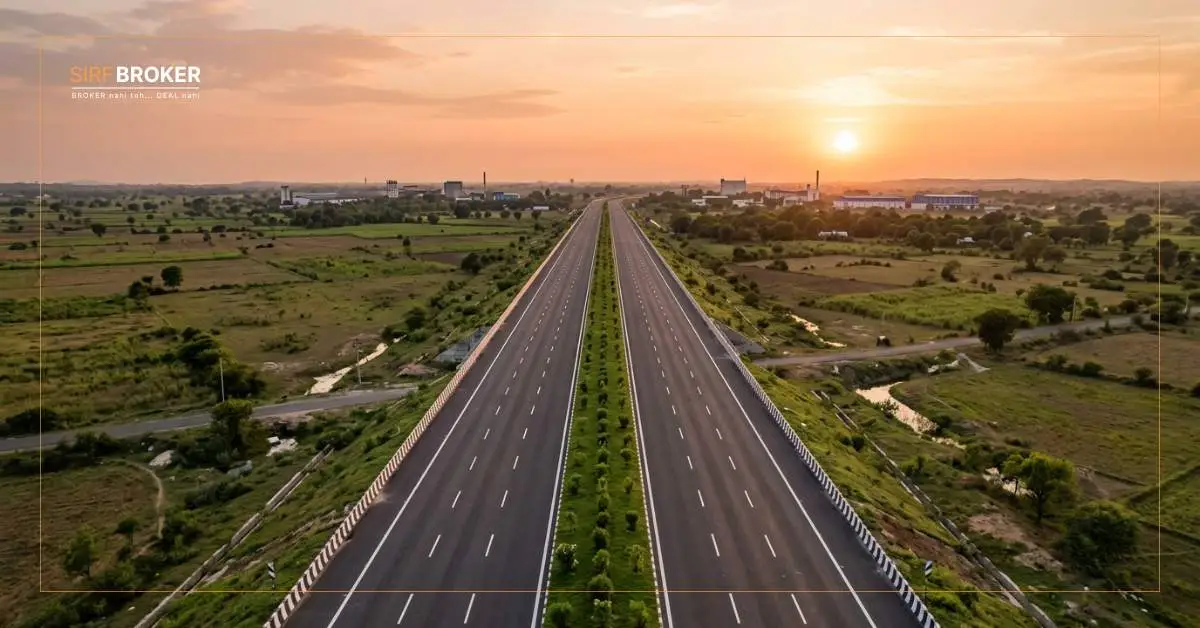
No force in Indian real estate has a more reliable, measurable, and repeatable impact on property values than infrastructure. Not sentiment cycles, not interest rate movements, not developer launches. When a metro line opens, land prices along its corridor move. When an expressway cuts travel time by 60%, property within its influence zone appreciates. This has happened consistently, across multiple cities, across multiple decades — and 2026 is no exception.
India is in the middle of its largest infrastructure investment cycle in history. Four projects in particular are reshaping residential and land markets right now: the Delhi–Dehradun Expressway (inaugurated April 2026), the Delhi–Mumbai Expressway (929 km operational as of mid-2026), the Dwarka Expressway in Gurugram (now mature enough to show a decade of appreciation data), and Bengaluru’s Namma Metro Phase 3 (currently under construction with pricing effects already visible in North Bengaluru). For brokers and developers, understanding how these corridors work — and what they do to property values — is not optional knowledge in 2026. It is core professional competency.
How Infrastructure Changes Property Value: The Mechanism
Infrastructure does not add value to real estate arbitrarily. It works through a specific mechanism: travel time reduction translates into location upgrade. When a new expressway cuts the commute from a peripheral town to a metro CBD from 90 minutes to 45 minutes, that town’s residential catchment for metro-employed buyers effectively doubles. The same physical location becomes closer, in functional terms, to employment, healthcare, education, and retail. Willingness to pay rises accordingly.
Research from JLL India and Knight Frank India on infrastructure-led markets consistently shows that the appreciation curve follows a predictable pattern: sharp early gains in anticipation of the project (often 2–3 years before opening), a consolidation period during construction, a second wave at inauguration, and sustained above-market appreciation in the years following as actual usage patterns confirm the commute benefit.
Three factors amplify the infrastructure effect in any specific corridor: (1) proximity to a major employment centre at one end, (2) availability of developable land in the catchment zone, and (3) quality of social infrastructure — schools, hospitals, malls — already in place or in development. Corridors that combine all three consistently outperform.
Delhi–Dehradun Expressway: The April 2026 Inauguration Effect
The 210-km Delhi–Dehradun Expressway, inaugurated in phases in April 2026, has reduced the Delhi–Dehradun journey time from the typical 5 to 7 hours to approximately 2.5 hours. The practical consequence for real estate is significant: Dehradun and the Mussoorie–Dehradun periphery has moved from a destination that Delhi-NCR residents visited occasionally to one within a 2.5-hour drive for weekend use and genuine second-home occupancy.
Dehradun’s established social infrastructure — DPS, Welham Boys’, GD Goenka, multiple private hospitals, a strong retail base — already makes it a credible relocation destination. The expressway removes the last major friction: journey time. Residential and plotted development in the Dehradun periphery and Haridwar–Rishikesh corridor has seen developer activity accelerate sharply since the inauguration.
For brokers: clients who are Delhi-NCR professionals with remote or hybrid work arrangements, who find Gurugram or Noida pricing prohibitive, are a natural second-home-as-primary buyer for well-priced developments in the Dehradun catchment. The corridor has opened a buyer category that did not previously exist at scale.
Delhi–Mumbai Expressway: Land Values Are Already Moving
The Delhi–Mumbai Expressway, with 929 km operational and full completion as of mid-2026, is India’s longest expressway and passes through Rajasthan, Madhya Pradesh, and Gujarat before entering Maharashtra. At this scale, the real estate impact is corridor-level — affecting industrial land, logistics parks, and residential development across multiple states.
According to JLL India’s research on infrastructure-led real estate development, land prices in key nodes along the corridor have seen substantial appreciation both ahead of and following the opening phases. The strongest effects are in industrial and logistics — the Delhi–Mumbai corridor is now India’s most important logistics spine, and warehousing facilities along key interchanges are in strong demand. For commercial and industrial land brokers, the Dausa–Vadodara–Surat stretch has seen the most significant activity.
For residential, the impact is most visible at the two ends: Bhiwadi–Alwar in the NCR catchment, and the Pune–Mumbai corridor in Maharashtra. Bhiwadi has long been an industrial town but is now attracting residential developer interest from NCR-based companies positioning for workforce housing along the corridor.
Dwarka Expressway: India’s Completed Case Study in Infrastructure-Led Appreciation
The Dwarka Expressway in Gurugram — now fully operational — is the most comprehensively documented case study in Indian real estate of infrastructure-driven appreciation. The corridor connects Delhi’s Dwarka sector to NH-48 and the Gurugram CBD, and took over a decade to complete. It delivered a residential appreciation story that is now well-established in transaction data.
According to Knight Frank India’s NCR residential research, Dwarka Expressway sub-markets have been among the strongest performers in NCR over the past five years. The combination of metro connectivity (Dwarka Sector 21 at one end), improved road access, and a large inventory of mid-market and premium residential stock created a market that outperformed Gurugram’s average. Sectors 99, 106, 108, 109, 110A have seen consistent demand from end-users and investors alike.
The Dwarka Expressway case teaches one important lesson: infrastructure-led appreciation requires patience. The corridor’s best returns came to buyers who entered during the construction phase — when uncertainty depressed prices — and held through to full operationalisation. Buyers who entered post-opening captured less appreciation but entered a more liquid, lower-risk market.
⚠️ Broker Note: Clients asking about infrastructure-corridor investments frequently confuse announcement effect with completion effect. The best entry points are typically 2–3 years before completion, when construction risk creates a price discount. Post-completion, the easy appreciation is already priced in. Help clients understand which phase each corridor is in before framing the investment case.
Bengaluru’s Namma Metro Phase 3: North Bengaluru’s Pricing Moment
Bengaluru’s Namma Metro Phase 3, currently under construction, is extending metro connectivity into North Bengaluru — the Hebbal–Sarjapur corridor and the Tumkur Road axis. North Bengaluru has historically traded at a discount to south and east Bengaluru due to connectivity perceptions. Phase 3 is changing that differential, and the market has begun to reflect it.
According to CBRE India’s Bengaluru residential research, North Bengaluru has seen residential price appreciation above the city average in recent quarters, with metro corridor expectations as a material driver alongside genuine office market growth — Manyata Tech Park, Embassy North, and expanding GCC campuses around Hebbal represent a large and growing employment base that previously suffered from connectivity constraints. The metro fundamentally reduces those constraints.
For developers: North Bengaluru’s land cost advantage relative to Whitefield or Electronic City remains significant. The combination of Phase 3 metro and existing employment density makes it one of the more defensible development entry points in Bengaluru in 2026.
What Brokers and Developers Should Do With This Data
Infrastructure analysis only helps if it translates into transaction decisions.
For brokers advising buyer-investors: Map the client’s investment horizon against the infrastructure completion timeline. A 5+ year holder should consider pre-completion entry on a corridor with verified government funding and construction progress. A client wanting 2–3 year liquidity is better served entering an already-operational corridor with established transactional volume.
For developers evaluating land acquisition: Use NHAI and state highway authority project timelines as the first filter on new land opportunities. Land within 15–20 km of a major expressway interchange or metro station opening within 3 years is the acquisition window. Already-operational corridor land is development-ready but priced accordingly.
For brokers advising residential buyers: Infrastructure corridor proximity should be weighted alongside job proximity — not instead of it. The strongest markets (Dwarka Expressway, Whitefield, Hinjewadi) all combine infrastructure with employment density. Corridors offering only commute time reduction to a distant CBD will perform more modestly.
Sirf Broker POV: Infrastructure Is the Most Honest Price Signal in Indian Real Estate
India’s real estate market has plenty of unreliable price signals — developer premiums, micro-market hype, floor-level negotiations that obscure true transaction prices. Infrastructure completion timelines are different. They are publicly documented, independently verifiable, and their effect on prices is consistently visible in transaction data across every market where they have been studied.
This makes infrastructure corridors one of the most honest investment frameworks available to Indian real estate buyers and developers. You are not betting on sentiment, developer reputation, or market timing. You are betting that a shorter commute is worth more than a longer one — which has been true in every urban property market in human history.
Our view at Sirf Broker: the three most significant opportunities in Indian real estate in H2 2026 are all infrastructure-linked. The Delhi–Dehradun corridor is in its early post-inauguration phase — the appreciation signal is visible but the full pricing adjustment has not yet occurred. North Bengaluru is in active pre-completion anticipation, historically the best risk-adjusted entry. The Delhi–Mumbai logistics corridor is a specialist play but represents multi-year industrial and warehousing demand that very few brokers are positioned to service. The common thread: infrastructure timelines are knowable. In a market that rewards patient, informed conviction, that knowability is a significant advantage.
Conclusion
India’s infrastructure investment cycle is creating property value across multiple corridors simultaneously. Understanding which phase each corridor is in, and what that means for entry and exit timing, is one of the most practical skills a broker or developer can develop in 2026.
Before purchasing any property in an infrastructure corridor, complete the foundational due diligence in our property verification guide — title clarity is as important as location. For guidance on how brokerage commissions work in high-appreciation markets, see our commission clarity guide. And if your client is considering a PMAY-linked unit in a new corridor development, our PMAY-U 2.0 broker guide covers the subsidy landscape that makes affordably priced corridor locations viable for first-time buyers.
Frequently Asked Questions
Q: Which expressway has had the biggest impact on Indian residential real estate?
A: The Dwarka Expressway in Gurugram is India’s best-documented case study in expressway-driven appreciation, with strong performance across the corridor per Knight Frank India NCR residential research. The Delhi–Mumbai Expressway is now the largest active story, affecting industrial land, logistics, and residential markets across multiple states.
Q: How does the Delhi–Dehradun Expressway affect real estate?
A: The 210-km expressway, inaugurated April 2026, cut the Delhi–Dehradun journey from 5–7 hours to ~2.5 hours. This has made the Dehradun corridor viable for second home buyers and remote-working professionals from Delhi-NCR, with developer activity in the Dehradun periphery accelerating since inauguration.
Q: What is happening to property prices in North Bengaluru?
A: North Bengaluru is seeing above-city-average price appreciation driven by Namma Metro Phase 3 (under construction) and the large GCC employment base at Manyata Tech Park and Hebbal corridor. CBRE India Bengaluru research cites metro connectivity expectations as a material pricing driver.
Q: When is the best time to buy in an infrastructure corridor?
A: Research consistently shows the best risk-adjusted entry is 2–3 years before infrastructure completion, when construction uncertainty creates a price discount. Post-inauguration entry is safer in certainty terms but captures less appreciation. Buyers with 5+ year horizons benefit most from pre-completion entry.
Q: Does all infrastructure create equal real estate impact?
A: No. Corridors perform best when connecting significant employment centres at both ends, with available developable land and improving social infrastructure. Infrastructure without an employment anchor produces more modest and less sustained appreciation.
Q: How should brokers use infrastructure data when advising buyers?
A: Map the client’s investment horizon against the infrastructure completion timeline. Pre-completion entry suits 5+ year holds. Operational corridors suit buyers wanting 2–3 year liquidity. Always weight infrastructure proximity alongside job proximity — the two together produce the strongest markets.
Q: What is the real estate impact of the Delhi–Mumbai Expressway?
A: With 929 km operational and full completion in mid-2026, the expressway is India’s largest logistics infrastructure project. Per JLL India research, the strongest effects are in industrial and logistics land. Residential effects are most visible at Bhiwadi–Alwar (NCR end) and the Pune–Mumbai stretch.