

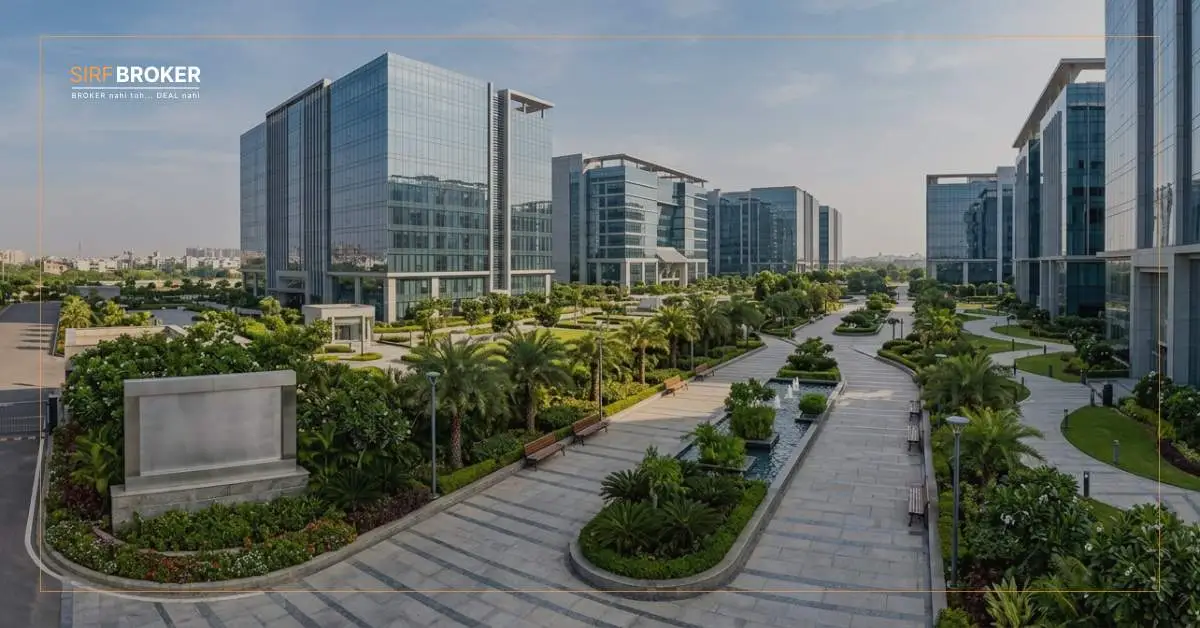
Ten years ago, Global Capability Centres in India were called “back offices.” The implication was clear: routine work, cost arbitrage, support functions. The description was always incomplete and is now simply wrong. India’s GCCs in 2026 are where global companies are building their AI capabilities, engineering their core products, running their risk and compliance functions, and housing some of their most strategically important talent. The language has changed because the reality changed first.
According to JLL India’s 2026 GCC Office Guide, India now hosts over 2,100 Global Capability Centres employing more than 2.3 million professionals and generating revenues exceeding $70 billion annually. More than 100 new GCCs are set to launch in 2026 alone, and 40 to 50% of Grade A office space demand across India’s top seven cities now comes from GCCs. That last figure is the one that every commercial real estate broker and developer needs to understand: close to half of all Grade A demand — from a single occupier category that did not exist at meaningful scale two decades ago.
If you are a commercial broker who does not understand how GCCs select locations, evaluate buildings, and structure leases, you are operating without knowledge of your largest single demand segment.
The Numbers Behind India’s GCC Boom
The GCC story in India has three phases. The first was cost arbitrage — companies set up Indian centres primarily to reduce labour costs. The second was capability building — GCCs expanded into engineering, analytics, and finance. The third phase, underway now, is strategic transformation. According to JLL India’s GCC research, approximately 80% of new GCCs launched in 2026 are prioritising AI and machine learning as their core mandate. These are not support functions — they are where global companies are building the tools they will use for the next decade.
| Metric | 2026 Figure |
|---|---|
| Total GCCs in India | 2,100+ (JLL India GCC Office Guide 2026) |
| Total GCC workforce | 2.3 million employees (JLL India GCC Office Guide 2026) |
| Annual GCC revenue from India | $70 billion+ (JLL India GCC Office Guide 2026) |
| New GCCs expected in 2026 | 100+ (JLL India GCC Office Guide 2026) |
| Share of Grade A office demand (top 7 cities) | 40–50% (JLL India GCC Office Guide 2026) |
| % of new GCCs focused on AI/ML | ~80% (JLL India GCC Office Guide 2026) |
Which Cities Are Winning the GCC Race — and Why
GCC location decisions follow specific criteria: talent depth, Grade A real estate availability, and operating environment. Bengaluru retains its position as India’s primary GCC destination with the deepest technology talent pool in the country. Hyderabad is the fastest-growing GCC city in 2026 — three major GCCs launched in the first two months of the year alone. Pune is strong for engineering and automotive GCCs. NCR (Gurugram and Noida) dominates for BFSI and corporate functions. Chennai is important for engineering and manufacturing.
What is new in 2026 is the emergence of Tier 2 cities. Ahmedabad (GIFT City regulatory framework), Coimbatore (manufacturing engineering talent), and Lucknow (finance and operations at lower cost) are all seeing GCC interest from companies expanding beyond the established metros. Most Tier 2 GCCs are in the 200–500 seat range, but the directional shift is clear and accelerating.
How GCCs Select Buildings: What Brokers Must Know
GCC real estate decisions differ from domestic enterprise leasing in three critical ways.
Lead time. A GCC works on a 12–18 month timeline from initial real estate search to operational headcount. The search begins at least 12 months before occupation — sometimes 18–24 months for large campuses. Brokers brought in only when a client is “ready to move” have missed the real advisory window.
Specification requirements. GCCs require Grade A buildings that support high-density occupation (70–90 sq ft per seat versus the 100–120 sq ft standard in conventional leasing), 24/7 building operations, and specific power and connectivity infrastructure. A building must be shortlisted against specification first, location second — a well-located building that cannot support technical requirements is not viable regardless of rent.
Transaction structure. GCCs often execute pre-lease agreements on build-to-suit campuses 18–24 months before occupation, or lease large blocks in established Grade A parks — Embassy, Manyata, RMZ, Prestige, DLF, Mindspace — with growth trajectory built into the lease. Understanding which parks have large-block availability and a track record of serving GCC occupiers is specialist knowledge that generalist brokers rarely possess.
⚠️ Broker Note: “Grade A” for a GCC means a building in a functioning IT/SEZ park with 24/7 operations, pre-certified power backup, and access to the relevant talent catchment. A standalone commercial building on a high street — even if physically Grade A — typically does not meet the operating environment requirement. Know the difference before presenting options.
The AI Pivot: What 80% AI-Focused GCCs Mean for Real Estate
AI-focused GCCs require more compute-adjacent infrastructure than conventional IT/BPO facilities: stronger data connectivity (low-latency fibre, fibre diversity), occasionally co-location proximity to data centres, and in some cases GPU cluster infrastructure. For commercial real estate, this means the connectivity specification of a building is becoming a screening criterion for GCC occupiers in a way it was not five years ago. Parks and landlords that have invested in connectivity infrastructure have a competitive advantage that will widen as AI workloads grow.
Tier 2 Cities: The Next GCC Wave
GCC expansion into Tier 2 cities creates a commercial real estate opportunity that most Tier 2 brokers are not yet positioned to service. Companies setting up in Ahmedabad, Coimbatore, or Lucknow for the first time need a broker who can identify Grade A supply, evaluate IT park options, advise on state government incentive frameworks, and navigate local regulatory requirements. In most Tier 2 cities, true Grade A supply is limited to one or two IT parks — a broker who maps this comprehensively will have very little competition. A 300-seat GCC is a 30,000–35,000 sq ft transaction with a creditworthy, long-term tenant. For a Tier 2 city, that is a major commercial deal.
Sirf Broker POV: GCCs Have Made Commercial Leasing a Specialist Market
The growth of GCCs as India’s dominant Grade A office demand driver has made commercial real estate leasing a more specialist activity than it was a decade ago. A broker serving GCC clients needs to understand pre-lease structures, build-to-suit economics, IT park selection criteria, and in 2026 — the AI infrastructure requirements that are beginning to differentiate buildings. None of this knowledge comes from general residential or commercial experience. It requires deliberate, sector-specific learning.
The opportunity in this specialisation is real and compounding. GCCs are long-term, creditworthy tenants with large footprints and repeat transaction needs. A company that establishes a 500-seat centre in Bengaluru in 2026 will likely expand to 1,000 seats by 2028 and 2,000 by 2030. The broker who serves them well in the first transaction owns the relationship for every expansion. That is a compounding advisory business, not a one-off commission.
Our view at Sirf Broker: the brokers who invest in understanding the GCC market now — its location criteria, building specifications, lease structures, and Tier 2 dynamics — will be the commercial leasing practitioners who matter most in India’s office market for the next decade. The demand is large, the clients sophisticated, and the supply of genuinely knowledgeable brokers thin. That combination is exactly where specialisation pays.
Conclusion
GCCs are not a trend in India’s commercial real estate market. They are the market. With 40–50% of Grade A office demand, 2,100+ centres, 2.3 million employees, and 100+ new launches in 2026, the GCC sector is the single most important demand driver in Indian commercial real estate. Brokers who understand it will command this decade’s most significant leasing mandates. Brokers who do not will watch those mandates go to specialists.
For a broader view of commercial real estate occupancy costs, read our guide on office fit-out costs and leasing — total occupancy cost understanding is critical for GCC advisory. For guidance on how REITs interact with commercial real estate ownership, see our REIT guide for brokers.
Frequently Asked Questions
Q: What percentage of India’s Grade A office demand do GCCs account for?
A: According to JLL India’s 2026 GCC Office Guide, GCCs account for 40 to 50% of Grade A office space demand across India’s top seven cities — making them the single largest demand driver in India’s commercial office market.
Q: How many GCCs are currently operating in India?
A: India hosts over 2,100 GCCs as of mid-2026, employing 2.3 million professionals and generating $70 billion+ in revenue annually, per JLL India’s 2026 GCC Office Guide. 100+ new GCCs are expected to launch in 2026 alone.
Q: Which Indian cities attract the most GCCs?
A: Bengaluru is India’s primary destination. Hyderabad is fastest-growing in 2026 with three major GCCs launching in the first two months. Pune leads for engineering/automotive. NCR dominates for BFSI. Ahmedabad, Coimbatore, and Lucknow are emerging Tier 2 markets.
Q: What office specification do GCCs require?
A: GCCs need Grade A buildings in IT/SEZ parks with 24/7 operations, power backup, 70–90 sq ft per seat density, strong fibre connectivity, and in 2026 increasingly — proximity to data centre infrastructure for AI-focused centres.
Q: What is the typical GCC lease term in India?
A: Typically 5 to 7 years with expansion options. Large campuses are often structured as pre-lease agreements on build-to-suit facilities executed 18–24 months before occupation.
Q: Why are 80% of new GCCs in India focused on AI?
A: GCCs have evolved from cost centres to strategic capability hubs. India’s engineering talent depth and operating environment make it the most viable location globally for large-scale AI capability development. Per JLL India 2026 GCC research, ~80% of new 2026 GCC launches list AI/ML as a core mandate.
Q: Is there a GCC opportunity for Tier 2 city commercial brokers?
A: Yes. Companies expanding to Ahmedabad, Coimbatore, or Lucknow need local brokers for Grade A supply identification, IT park evaluation, and incentive advisory. A 300-seat GCC is a 30,000–35,000 sq ft multi-year transaction with a creditworthy long-term tenant — a significant mandate in any Tier 2 market.