

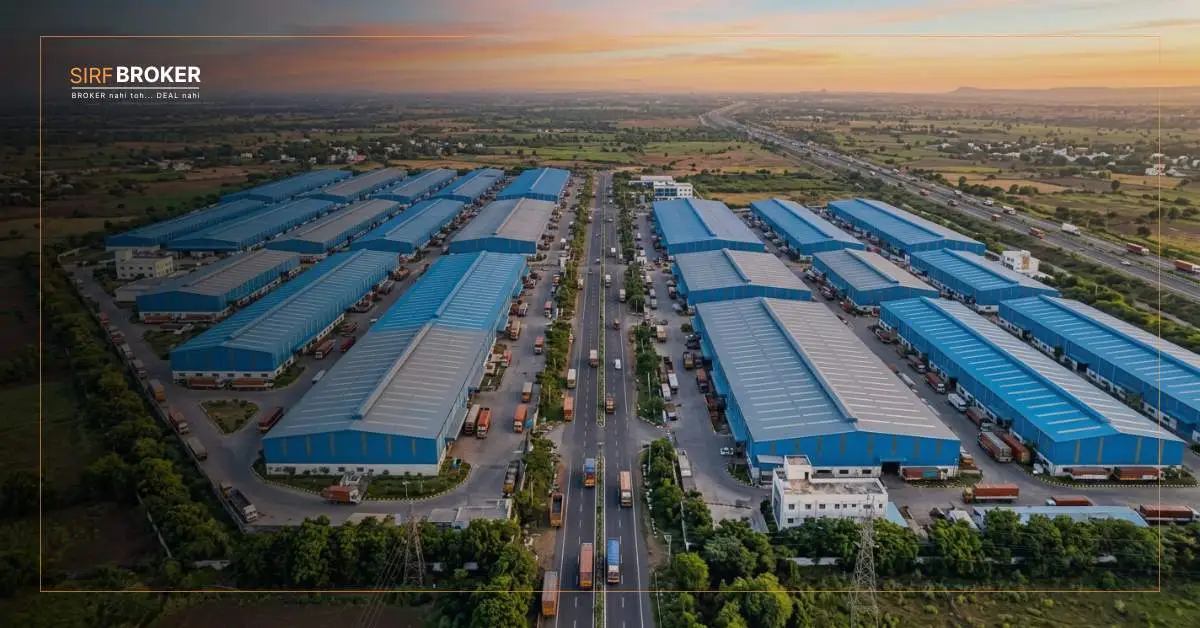
The US-China tariff war did not create India’s industrial real estate opportunity. It accelerated one that was already forming. When the United States imposed tariffs of up to 145% on Chinese manufactured goods in 2025, the economic calculus for any multinational manufacturing in or sourcing from China shifted dramatically overnight. Boards that had been discussing supply chain diversification for years were suddenly approving it. And the country that captured the largest share of that redirected attention — in electronics, pharmaceuticals, chemicals, auto components, and logistics — was India.
The real estate consequence is direct. Every new manufacturing line needs a plant. Every plant needs a supply chain. Every supply chain needs warehouses, cold storage, bonded logistics facilities, and last-mile infrastructure. India’s Grade A industrial leasing hit 11 million sq ft in Q1 2026 alone — a 22% year-on-year increase per Colliers India — and the annual demand outlook stands at 30 to 40 million sq ft. Colliers identified 30 high-potential industrial hotspots across the country, with Tier II and III cities increasingly appearing on shortlists that previously included only Pune, Chennai, and the NCR.
This is not a warehousing data story. It is a structural economic story that has a real estate consequence — and developers, brokers, and investors who understand the underlying supply chain logic will be better positioned than those who are simply tracking absorption numbers.
What China+1 Actually Means for Real Estate Demand
The China+1 strategy refers to the deliberate decision by global multinationals to establish at least one manufacturing or sourcing presence outside China — reducing concentration risk and tariff exposure simultaneously. India has become the primary beneficiary of this strategy across several categories.
In electronics, Apple’s supply chain expansion into India is the most visible example. Foxconn, Pegatron, and Tata Electronics are all ramping iPhone assembly in Tamil Nadu and Karnataka. The downstream effect: tooling suppliers, packaging manufacturers, component makers, and logistics providers are following the anchor tenant. Each anchor manufacturing plant of scale generates a multiplier of 3 to 5 times its own footprint in supporting industrial real estate demand within a 20 to 50 kilometre radius.
In pharmaceuticals, India was already the world’s largest supplier of generic drugs. The tariff war has accelerated API (active pharmaceutical ingredient) diversification by global buyers seeking non-China supply chains, with investment flowing into Hyderabad’s Genome Valley, Ahmedabad’s pharma clusters, and Visakhapatnam’s industrial corridors. In chemicals and specialty manufacturing, European and Japanese companies are establishing India production bases specifically to serve both the domestic market and as an export alternative to China-origin supply.
| Sector | Key India Corridor | Real Estate Demand Type |
|---|---|---|
| Electronics / Semiconductors | Sriperumbudur, Hosur, Noida | EMS plants, bonded warehouses |
| Pharmaceuticals / API | Hyderabad, Ahmedabad, Visakhapatnam | Regulated manufacturing, cold chain |
| Auto Components | Pune, Chennai, Gurugram, Hosur | Tier-1 supplier parks, JIT logistics |
| E-commerce / 3PL | Bhiwandi, Sohna, Chakan, Tauru | Grade A multi-user logistics parks |
| Chemicals / Specialty Mfg | Dahej (Gujarat), Cuddalore, Raigad | Chemical parks, industrial clusters |
The PLI Scheme: Why the Government Is a Demand Accelerator
India’s Production Linked Incentive scheme — covering 14 manufacturing sectors with approximately ₹1.97 lakh crore of committed incentives — is the policy backbone of the China+1 real estate story. PLI works by paying participating manufacturers a percentage of incremental sales over a base year. To earn PLI incentives, companies must establish production capacity on Indian soil. Capacity requires buildings.
The sectors with the most significant real estate implication include mobile and electronic components, pharmaceuticals, textiles, specialty steel, solar PV modules, food processing, and white goods. PLI-approved manufacturers typically need to be operational within 1 to 3 years of approval — creating a defined construction timeline for industrial developers. Build-to-suit industrial development in India has historically been the primary mode of Grade A industrial delivery, and PLI beneficiaries are among the most creditworthy tenants: their revenue is partially guaranteed by the central government.
India Industrial Real Estate — Key 2026 Metrics
| 11 MSF Grade A leasing Q1 2026 +22% YoY | 30–40 MSF Annual demand outlook | 30 New hotspot cities identified | ~⅓ 3PL share of demand |
Source: Colliers India Industrial & Warehousing Report 2026
The 30 New Industrial Hotspots: Beyond the Established Corridors
The established industrial real estate corridors — Pune’s Chakan and Talegaon, Chennai’s Sriperumbudur and Oragadam, NCR’s Kundli-Manesar-Palwal stretch, Bengaluru’s Bommasandra — will continue to absorb demand. But Colliers India’s 2026 research identified 30 high-potential industrial hotspots emerging as the next tier of opportunity, driven by the intersection of PLI sectoral clusters, infrastructure investment, and lower land and labour costs relative to saturated Tier-I corridors.
The micro-markets appearing most frequently: Hosur (Tamil Nadu) — now India’s fastest-growing electronics cluster; Coimbatore (precision engineering and auto); Nagpur (central India logistics hub with MIHAN international airport); Navi Mumbai’s Taloja and Khopoli (chemicals and pharma); Rajasthan’s Neemrana-Bhiwadi corridor (Japanese automotive supply chain); and Andhra Pradesh’s Krishnapatnam and Sricity industrial parks.
For developers, opportunity in emerging corridors requires a different risk framework than established markets. Land is typically cheaper, but infrastructure — power, water, road connectivity, skilled labour — needs independent verification before committing to speculative development. The sweet spot: build-to-suit for an anchor PLI tenant, followed by speculative multi-user logistics on adjacent land once the corridor’s viability is demonstrated.
3PL Demand: The Invisible Driver of Grade A Industrial Leasing
Third-party logistics operators account for approximately one-third of India’s Grade A industrial and warehousing demand per Colliers India — and this share is growing. 3PL growth is driven by two structural trends: e-commerce and quick commerce expansion requiring dense, strategically located warehouse networks; and manufacturing companies outsourcing logistics operations rather than owning facilities.
3PL operators typically want multi-user Grade A warehouses in established logistics parks close to major consumption centres, with standardised specification: minimum 10 metre clear height, dock-level loading, ESFR sprinklers, LED lighting, covered docks. Their average lease term is 5 to 7 years and expansion requirements are predictable. India’s largest 3PL operators have scaled to ₹500 crore-plus annual revenues with institutional backing — improving their covenant quality significantly over the last five years.
Sirf Broker POV: The Industrial Opportunity Is Real — But the Land Risk Is Often Hidden
India’s industrial real estate story is structurally sound. The demand drivers are genuine: trade war, PLI, e-commerce, 3PL growth, and a manufacturing policy environment actively trying to attract global capital. The 22% year-on-year growth in Q1 2026 Grade A leasing is not a spike — it is the early phase of a multi-year absorption story the data supports.
But the risk in industrial real estate is almost never the demand side. It is the land side. Industrial plots in India carry title risks, zoning risks, and environmental clearance risks that are materially different from — and often more complex than — residential or commercial property. A plot classified as agricultural in revenue records, adjacent to a waterbody or protected forest, or within 25 kilometres of a classified bio-reserve can have its industrial development approvals delayed by years — regardless of how strong the tenant is or how close the location is to a highway.
Developers and brokers advising industrial clients must verify: industrial land-use conversion status in revenue records, environmental clearance from the State Pollution Control Board, water source and quantity allocation, electrical load sanction from DISCOM, and right-of-way clearance on access roads. These are not standard residential due diligence items. The China+1 opportunity will be captured by those who execute this correctly — not by those who sign an LOI on land that looks right but isn’t cleared.
Conclusion
India’s industrial real estate market is at an inflection point driven by trade policy, manufacturing incentives, and logistics demand that is creating Grade A demand at a pace the market has not seen before. For brokers advising corporate tenants on industrial space requirements, understanding the common mistakes in commercial property leasing — particularly around industrial lease terms and specification requirements — is essential. For investors seeking access through listed vehicles, our guide to REITs and institutional real estate investment covers how industrial assets are being aggregated into investable structures.
Frequently Asked Questions
Q: What is the China+1 strategy and how does it affect India’s real estate market?
A: China+1 refers to multinationals establishing at least one manufacturing or sourcing base outside China to reduce tariff and concentration risk. With US tariffs on Chinese goods reaching up to 145% in 2025, companies in electronics, pharma, auto, and chemicals have accelerated India expansion. Each new manufacturing facility generates a multiplier of 3 to 5 times its own footprint in supporting industrial real estate demand within a 20 to 50 kilometre radius.
Q: How much Grade A industrial space did India lease in Q1 2026?
A: India’s Grade A industrial and warehousing sector recorded 11 million sq ft of leasing in Q1 2026 alone — a 22% year-on-year increase per Colliers India. The full-year demand outlook stands at 30 to 40 million sq ft, with Colliers identifying 30 high-potential new industrial hotspot markets beyond the established Pune-Chennai-NCR corridors.
Q: What is India’s PLI scheme and why does it matter for industrial real estate?
A: The Production Linked Incentive scheme covers 14 manufacturing sectors with approximately ₹1.97 lakh crore in government incentives. Companies must establish Indian production capacity to earn PLI payments — directly generating demand for industrial buildings. PLI beneficiaries are among the most creditworthy industrial tenants because part of their revenue is backed by the central government, making build-to-suit for PLI manufacturers particularly attractive for developers.
Q: Which Indian cities and corridors are the top industrial real estate destinations?
A: Established corridors include Pune (Chakan, Talegaon), Chennai (Sriperumbudur, Oragadam), NCR (Kundli-Manesar-Palwal), and Bengaluru (Bommasandra). Emerging markets per Colliers 2026 include Hosur (electronics), Nagpur (logistics), Neemrana-Bhiwadi (automotive), and Andhra Pradesh’s Krishnapatnam and Sricity industrial parks.
Q: What drives 3PL demand in India’s warehousing market?
A: Third-party logistics operators account for approximately one-third of Grade A industrial demand, driven by e-commerce and quick commerce expansion requiring dense warehouse networks, and by manufacturers outsourcing logistics rather than owning facilities. 3PL operators typically lease Grade A space on 5 to 7 year terms in established logistics parks close to consumption centres.
Q: What due diligence is essential before buying or leasing industrial land in India?
A: Verify: industrial land-use conversion status in revenue records, environmental clearance from the State Pollution Control Board, water source and quantity allocation, electrical load sanction from DISCOM, and right-of-way clearance on access roads. These differ materially from residential due diligence and require specialised industrial land assessment.
Q: How is India’s industrial real estate being accessed by institutional investors?
A: Through direct equity in Grade A warehouse parks, InvIT (Infrastructure Investment Trust) structures, and global real estate funds increasing India industrial allocation. The PLI-linked manufacturing demand and 3PL tenant base have significantly improved the income predictability and covenant quality of India’s Grade A industrial portfolio, making it more attractive to institutional capital.
Sources:
Colliers India — Industrial & Warehousing Report Q1 2026 (11 MSF; +22% YoY; 30–40 MSF annual demand; 30 new hotspots; 3PL ~⅓ of demand)
Ministry of Commerce and Industry, Government of India — PLI Scheme Overview (14 sectors; ₹1.97 lakh crore allocation)
JLL India — Industrial & Logistics Market Overview 2026
Cushman & Wakefield India — Supply Chain Real Estate Report 2026
Disclaimer: This article is for informational purposes only and does not constitute investment or legal advice. Industrial real estate involves specific regulatory requirements that vary by state and sector. Consult qualified advisors before making any investment or leasing decisions.