

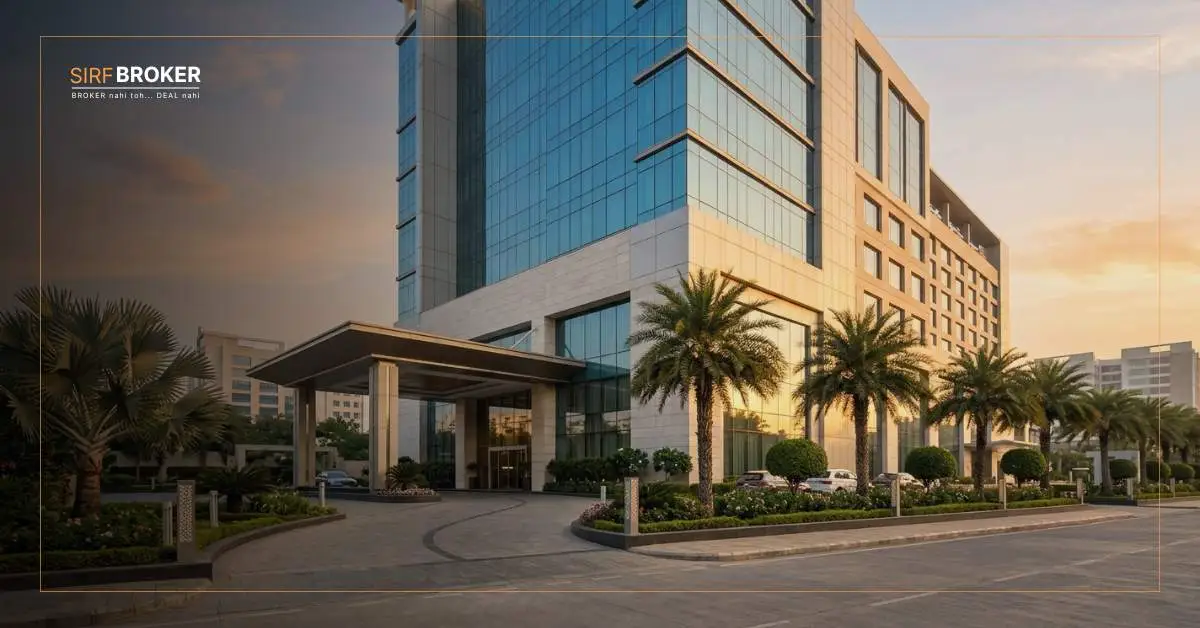
Most conversations about India’s institutional real estate market in H1 2026 have centred on two things: office and residential. The office story is about GCCs and record leasing volumes. The residential story is about ₹1 crore-plus units and premium inversion. What has been almost entirely absent from the conversation is the one sector that posted the most dramatic percentage growth of any asset class in H1 2026.
Hospitality. Hotels. A sector that institutional real estate capital largely ignored in India for the better part of a decade.
Hospitality real estate investment in India reached approximately $300 million in H1 2026 — a tripling year-on-year per Colliers India’s H1 2026 Investment Report. The growth is not attributable to a single large deal. It reflects a structural re-rating: institutional investors who previously categorised Indian hospitality as operationally complex and cyclically vulnerable are now treating it as an income-generating asset class with a demand story that is both domestic and global.
Driver 1: India’s Tourism Demand Has Permanently Reset
India’s domestic travel demand has undergone a structural shift that shows no sign of reverting. Domestic air passenger traffic crossed 150 million in FY2025 per the Ministry of Civil Aviation, and India is projected to become the world’s third-largest aviation market by 2030. The passenger is no longer the occasional business traveller saving for a once-a-year trip. The passenger is a 28 to 42 year old urban professional with discretionary income, a preference for branded accommodation, and a willingness to pay a meaningful premium for quality.
The implication for hotel real estate: average room rates in India’s top hotel markets have risen significantly since 2022. Mumbai’s premium hotel ARR reached ₹10,000 to ₹18,000 per night at top properties in FY2025. Bengaluru’s tech-corridor hotels, serving GCC employees and visiting executives, have sustained high occupancy through the year. Goa has re-established itself as a premium leisure destination with year-round premium occupancy rather than a 3-month seasonal peak.
Driver 2: The Brand Landscape Has Changed
Marriott International, Hyatt, IHG, AccorHotels, Hilton, and Wyndham all have significant India expansion pipelines. Domestic operators — Taj, Oberoi, Lemon Tree, Chalet Hotels — have scaled their management contract models such that developers can now deliver a hotel asset and hand it to a known operator under a structured fee arrangement.
This owner-operator separation model, standard in global hotel real estate investment, has become more established in India over the last five years. A branded management contract removes the biggest risk that historically deterred real estate capital from Indian hotels: dependence on a single owner-manager’s personal network and relationships. With a Marriott or Taj management contract, the hotel runs on the brand’s reservation system, loyalty programme, and operational SOPs — making the income stream more predictable and the exit more liquid.
| Hotel Segment | Key Markets | Investment Demand Driver |
|---|---|---|
| Upper Upscale / Luxury | Mumbai, Delhi, Bengaluru, Goa | UHNWI domestic and inbound tourism, corporate |
| Upper Midscale / Business | Hyderabad, Pune, Chennai, Noida | GCC employee travel, long-stay corporate |
| Mid-Market / Economy | Tier II cities, highway corridors | Domestic leisure, SME business travel |
| Branded Residences | Hyderabad, Bengaluru, Goa, Mumbai | UHNWI buyers, NRI investment |
| Leisure / Wellness Resorts | Goa, Kerala, Rajasthan, Himachal | Premium domestic leisure, international inbound |
Driver 3: Branded Residences Changed the Developer Math
A branded residence is a residential unit — apartment, villa, or penthouse — delivered and managed under a hotel brand’s name and standards. The buyer owns the residential asset; the hotel operator manages it as part of the hotel’s inventory when the owner is not in residence, generating rental income for the owner.
In Hyderabad, Bengaluru, Goa, and Mumbai, branded residence projects have recorded ₹8 crore to ₹25 crore per unit sales — among the highest residential ticket sizes in those markets. The premium a branded residence commands over conventional luxury residential in the same location is typically 25 to 40%, driven by brand association, managed maintenance, and rental income potential during non-occupation periods.
For developers, branded residences solve hotel development’s fundamental problem: upfront capital recovery. A conventional hotel requires 3 to 5 years of operations to begin returning capital. A mixed-use development with branded residences generates sales revenue in year 1 or 2, cross-subsidising the hotel component. This structure has opened hotel-anchored mixed-use development to a wider range of developers.
India Hospitality Real Estate — H1 2026 Snapshot
| 3× YoY growth in hospitality investment H1 2026 vs H1 2025 | ~$300M Total hospitality investment H1 2026 | 25–40% Branded residence price premium over conventional luxury |
Source: Colliers India H1 2026 Investment Report | Industry estimates
Where Institutional Capital Is Actually Deploying
The $300 million in H1 2026 hospitality investment is concentrating in three deal types: acquisition of stabilised, operating hotels with strong occupancy histories in gateway cities; forward funding of branded managed hotels being developed by credible operators on owned land; and investment in branded residence projects where residential sales revenue de-risks the equity return profile.
Bengaluru and Hyderabad — with the deepest corporate travel demand driven by GCC activity — attract the most consistent institutional interest in upper midscale and business hotel real estate. Goa has seen renewed institutional interest in the leisure and wellness resort category as premium occupancy and ARR data from the last two years has made the income model legible to institutional underwriters.
Sirf Broker POV: The Window Is Open, But Not for Long
Indian hospitality real estate is entering an institutional ownership phase. The tripling of investment in H1 2026 is not a blip — it is the first visible data point of a re-rating building since 2023. The combination of rising room rates, improved brand coverage, the branded residence structural innovation, and genuine domestic tourism demand growth has made the Indian hotel investment thesis coherent for institutional allocators who previously couldn’t underwrite it.
The window for developers and landowners in prime hotel locations is open now — before institutional capital has fully priced in the re-rating. Hotel-suitable land requires commercial hospitality zoning, minimum 1 to 2 acres in urban markets, good visibility and access, and proximity to business districts or leisure catchments. Landowners with such plots who are considering development partnerships should be evaluating hotel-anchored mixed-use seriously, because the branded residence revenue model means the capital stack works at ticket sizes not viable three years ago.
For brokers, hospitality represents a mandate category most residential or commercial brokers have never been approached for. That will change. As hotel development activity increases, demand for advisory on hotel transactions, hotel-anchored land, and branded residence brokerage will grow. Building familiarity now — the valuation methods, operator selection process, branded residence legal structures — is how a commercial broker captures this mandate before generalist hotel consultancies do.
Conclusion
India’s hospitality real estate sector tripled institutional investment in H1 2026 because three structural drivers converged: a permanently reset domestic tourism demand base, a mature branded management contract ecosystem, and the branded residence innovation that changed developer economics. For investors exploring structured access to this category, our guide to REITs and institutional real estate structures is a starting point. For commercial brokers expanding into hotel advisory, understanding common mistakes in commercial property deals — particularly around mixed-use development structures — will be essential preparation.
Frequently Asked Questions
Q: How much did India’s hospitality real estate investment grow in H1 2026?
A: Hospitality real estate investment in India reached approximately $300 million in H1 2026 — tripling year-on-year per Colliers India’s H1 2026 Investment Report. This was the strongest percentage growth of any real estate asset class in the period and represents a structural re-rating of Indian hospitality as an institutional asset class.
Q: Why is institutional capital now interested in Indian hotel real estate?
A: Three drivers converged: India’s domestic air travel crossed 150 million passengers in FY2025, resetting demand permanently; international hotel brands established mature management contract ecosystems in India that separate real estate ownership from operations; and branded residence structures changed developer economics by generating early sales revenue that cross-subsidises hotel development capital requirements.
Q: What is a branded residence and why does it matter for hotel real estate development?
A: A branded residence is a residential unit delivered and managed under a hotel brand. The buyer owns the asset; the operator manages it as hotel inventory when the owner is absent, generating rental income. Branded residences command a 25 to 40% premium over conventional luxury residential, and their upfront sales revenue cross-subsidises the hotel component — making hotel-anchored mixed-use development viable for a wider range of developers.
Q: Which Indian cities are the top hotel real estate investment markets in 2026?
A: Bengaluru and Hyderabad lead for business hotel investment, driven by GCC corporate travel demand. Goa leads the leisure and wellness resort category. Mumbai and Delhi remain gateway markets where trophy hotel assets trade at compressed yields. Emerging markets include Pune, Kochi, and Tier-II leisure destinations.
Q: What types of deals is institutional capital doing in Indian hospitality?
A: Three primary deal types: acquisition of stabilised operating hotels in gateway cities with strong occupancy histories; forward funding of branded managed hotels being developed by credible operators; and investment in branded residence projects where residential sales revenue de-risks the equity return profile.
Q: What makes hotel real estate different from office or residential investment in India?
A: Hotels are operationally intensive real assets — their income depends on daily occupancy and room rate, not a fixed lease. Institutional hotel investment in India typically works through management contracts with branded operators, separating real estate ownership from operations. The valuation methodology — capitalised EBITDA rather than per-sq-ft or rental yield — is also different, requiring sector-specific underwriting capability.
Q: What should landowners with prime hotel-suitable land know in 2026?
A: Hotel-suitable land requires commercial zoning permitting hospitality use, minimum 1 to 2 acres in urban markets, good visibility and access, and proximity to business districts or leisure catchments. The branded residence model means mixed-use hotel development is viable at ticket sizes that weren’t financially workable three years ago. Landowners with such parcels should evaluate hotel-anchored development partnerships with branded operators now, before the re-rating completes.
Sources:
Colliers India — H1 2026 Investment Report (hospitality ~$300M; tripled YoY)
Ministry of Civil Aviation, Government of India — Domestic Air Passenger Data FY2025 (150M passengers)
JLL India — Hotel & Hospitality Investment Advisory 2026
Cushman & Wakefield — India Branded Residences Market Report 2026
Disclaimer: This article is for informational purposes only and does not constitute investment advice. Hotel real estate involves sector-specific risks and valuation methodologies. Consult qualified hospitality real estate advisors before making investment decisions.