

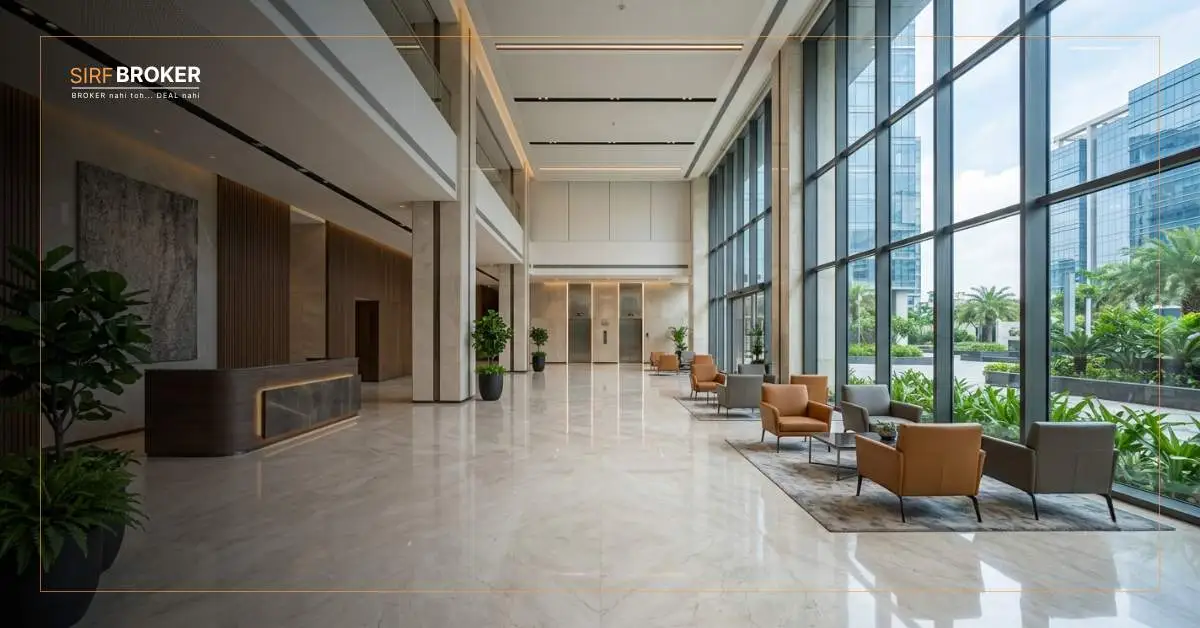
A Grade A commercial office building in Bengaluru with an anchor tenant on a 9-year lease and a net yield of 8% per annum used to be inaccessible to anyone without ₹5 crore or more to deploy as a direct investor — and the patience to manage a property, deal with tenant negotiations, and find a buyer when they wanted to exit.
That changed in March 2024, when SEBI notified the Small and Medium Real Estate Investment Trust (SM REIT) framework. As of 2025, SM REITs are operational, listed on stock exchanges, and offering retail investors access to institutional-grade commercial real estate from a minimum ticket size of ₹10 lakh.
Most Indian real estate investors — and most Indian brokers — have not yet understood what this means.
What Is an SM REIT?
An SM REIT is a SEBI-regulated investment structure that pools investor capital to own rent-generating commercial real estate assets valued between ₹50 crore and ₹500 crore. It is the smaller sibling of India’s full REITs — Embassy Office Parks, Mindspace, Brookfield, Nexus Malls — which hold assets valued in the thousands of crores and are accessible to investors at any price via stock exchange units.
The SM REIT framework was created specifically to regulate what the market already called “fractional ownership” — platforms like PropertyShare, hBits, Strata, and Myre Capital had been offering exactly this product since 2019, but through SPV and LLP structures that operated outside formal SEBI regulation. The SM REIT framework brings this activity under the regulatory umbrella with mandatory governance, disclosure, and investor protection requirements.
The key parameters: minimum asset size per SM REIT scheme is ₹50 crore. Maximum is ₹500 crore per scheme. Minimum investor ticket at issue: ₹10 lakh. 95% of net distributable cash flow must be distributed to unitholders every quarter. Units must be listed on NSE or BSE, providing secondary market liquidity that the old SPV/LLP structures could not offer.
PropertyShare became the first platform to receive a SEBI SM REIT license, with its PropShare Platina scheme listing on the exchange in 2024.
SM REIT vs Full REIT — What Is the Difference?
Full REITs in India — Embassy Office Parks, Mindspace, Brookfield Real Estate, Nexus Select Trust — hold portfolios of large institutional-grade assets: multi-tower office parks, Grade A shopping malls, business districts. These are assets that were already investable for large institutional funds. The REIT structure made them accessible to retail investors at any stock price.
SM REITs hold smaller assets in the ₹50-500 crore range — a premium standalone office building, a Grade A warehouse, a branded hotel. The market potential is significant. Industry estimates suggest over 500 million sq ft of commercial real estate in India is REIT-able stock — and the SM REIT-accessible segment is estimated at a market potential exceeding USD 75 billion.
| Feature | Full REIT | SM REIT | Pre-Regulation Fractional |
|---|---|---|---|
| SEBI regulated | Yes | Yes | No |
| Min ticket size | Any (listed price) | ₹10 lakh | ₹10–25 lakh (platform set) |
| Asset size | ₹1,000cr+ | ₹50–500cr | ₹10–500cr |
| Listed on exchange | Yes | Yes | No |
| Quarterly distribution | 90%+ | 95%+ | Platform discretion |
| Secondary liquidity | High | Moderate | Very limited |
What Asset Types Can SM REITs Hold?
The SEBI SM REIT framework permits SM REITs to hold income-generating real estate assets. In practice, the most common asset classes will be: Grade A commercial office buildings with creditworthy tenants, Grade A warehousing and logistics facilities, retail assets with anchor tenant leases, and hospitality assets under branded management contracts.
Underdeveloped land, residential projects under construction, and assets without a clear income stream are not SM REIT-eligible. The income yield — the regular quarterly distribution — is the product. Without stabilised rental income, there is no SM REIT case.
The Risks That Most Fractional Ownership Investors Ignore
The SEBI framework provides regulatory protection. It does not provide asset quality protection.
The single largest risk in any SM REIT investment is the quality of the underlying asset and the creditworthiness of the tenant. A ₹10 lakh investment in a well-located, fully-occupied Grade A office building with a 9-year anchor tenant lease is a fundamentally different risk than the same investment in a half-occupied, secondary-location building with short-term tenants and no anchor.
SEBI requires disclosure — but disclosure of a bad asset does not make it a good investment. Investors and brokers advising investors must read the asset-specific disclosures, understand the occupancy level, the tenant quality, the lease expiry profile, and the exit strategy before committing capital.
Secondary market liquidity, while structurally improved by the exchange listing, remains practically limited — the SM REIT market is young and trading volumes are thin. Investors should treat an SM REIT investment as a 5-7 year hold, not a liquid instrument.
Sirf Broker POV: What This Means for Brokers Advising Wealthy Clients
The SM REIT framework creates a new advisory responsibility for brokers who work with clients in the ₹50 lakh to ₹5 crore investable capital range.
This segment of client — the senior professional, the successful entrepreneur, the NRI returning with saved capital — has historically been steered toward two real estate options: buying another residential flat (low yield, high management effort) or a commercial shop or small office unit (illiquid, management-intensive). Neither option offered the professional management, the quarterly income stream, or the regulated governance that SM REITs now provide.
The broker who understands SM REITs — what they are, which platforms are SEBI-licensed, what asset types are available, how to read a scheme disclosure document — is in a position to genuinely help this client. The broker who does not understand them will watch this client either make an uninformed decision through a sales pitch from an unlicensed fractional platform, or leave real estate entirely and put the capital into mutual funds.
SM REITs are not a commission product for brokers — they are a knowledge product. The brokers who develop this knowledge will position themselves as the advisor of choice for the segment of Indian wealth that is growing fastest: high-income professionals who want real estate exposure without the operational headache of direct ownership.
Conclusion
The SM REIT framework is one of the most significant regulatory developments in Indian real estate since the full REIT framework was operationalised in 2019. For brokers and investors who want to understand the broader REIT landscape before exploring SM REITs, our guide to REITs and what Indian brokers must know is the starting point. For understanding common errors in commercial property transactions, our commercial leasing mistakes guide covers the patterns brokers must avoid.
Frequently Asked Questions
Q: What is an SM REIT in India?
A: An SM REIT (Small and Medium Real Estate Investment Trust) is a SEBI-regulated investment structure that pools retail and institutional investor capital to own income-generating commercial real estate assets valued between ₹50 crore and ₹500 crore. Introduced by SEBI in March 2024, units list on NSE or BSE and 95% of net cash flow must be distributed quarterly.
Q: What is the minimum investment in an SM REIT?
A: The minimum ticket size at issue is ₹10 lakh. Once listed on NSE or BSE, units can theoretically be traded at market price. However, given thin secondary trading volumes, investors should plan for a 5-7 year holding period.
Q: Who was the first platform to receive a SEBI SM REIT license?
A: PropertyShare (PropShare) became the first platform to receive a SEBI SM REIT license, with its PropShare Platina scheme listing on the stock exchange in 2024. Other fractional ownership platforms including hBits, Strata, and Myre Capital previously operated through SPV and LLP structures.
Q: What types of assets can an SM REIT hold?
A: SM REITs can hold income-generating commercial real estate — Grade A offices, warehousing and logistics facilities, retail assets with anchor tenant leases, and hospitality assets under branded management contracts. Undeveloped land and residential projects under construction are not eligible.
Q: What is the difference between an SM REIT and a full REIT?
A: Full REITs (Embassy, Mindspace, Brookfield, Nexus) hold large portfolios worth thousands of crores. SM REITs hold individual assets in the ₹50-500 crore range. Both are SEBI-regulated and exchange-listed; SM REITs require ₹10 lakh minimum at issue.
Q: What are the main risks of investing in an SM REIT?
A: Primary risk is asset quality — occupancy levels, tenant creditworthiness, lease expiry profiles, and exit strategy. SEBI regulation provides governance protection but not asset quality protection. Treat as a 5-7 year hold due to thin secondary trading volumes.
Q: How should a real estate broker explain SM REITs to clients?
A: Position SM REITs as regulated access to institutional-grade commercial real estate income — quarterly distributions from rental income, professional management, no operational burden, SEBI governance. Explain the minimum ₹10 lakh ticket, the 5-7 year hold expectation, and the importance of reading the asset-specific scheme disclosure document. Distinguish between SEBI-licensed SM REIT platforms and unregistered fractional ownership platforms still operating outside SEBI’s framework.