

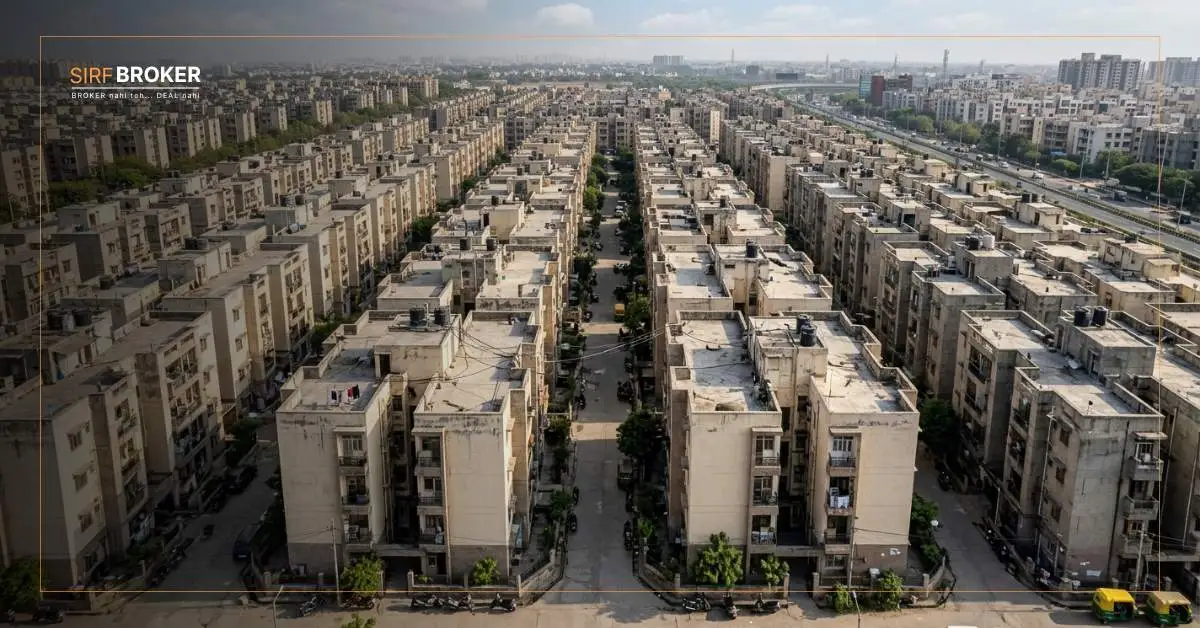
Affordable housing now accounts for just 6% of new residential launches in India. In 2018, it was 52%. That is not a market correction — it is a structural collapse that has been happening in plain sight, and almost nobody is talking about what it actually means for the 65 million people who work in construction and the hundreds of millions more who need a home they can afford.
The Q2 2026 data is unambiguous. New housing launches across India’s top cities rose 7% year-on-year to approximately 1.06 lakh units, according to data tracked by ANAROCK Research. Launch volumes look healthy on paper. But the composition of that supply has shifted so dramatically that the word “housing market” no longer means what most people think it means.
This is not a story about the luxury segment doing well. It is a story about the bottom of the market — homes priced below ₹40 lakh — being abandoned by developers, institutional capital, and policy alike. And the brokers, buyers, and city planners who haven’t noticed yet are about to.
| In Q2 2026, 96% of new launches in Bengaluru were above ₹80 lakh. In Delhi NCR, 61% were above ₹1.5 crore. Affordable supply — below ₹45 lakh — has gone from majority to near-invisible across India’s top residential markets. |
What the Q2 2026 Numbers Actually Show
The headline number — 1.06 lakh new units launched in Q2 2026 — sounds like a thriving market. Dig into the composition and the picture changes entirely.
In Bengaluru, 96% of new launches were concentrated in the premium and luxury segment — homes priced above ₹80 lakh — according to data reported by Business Standard in June 2026. In Delhi NCR, more than 61% of new launches were in the luxury tier above ₹1.5 crore. Even cities that historically served the first-time buyer — Pune, Hyderabad, Chennai — have seen the affordable segment shrink to near-negligible share.
Meanwhile, residential sales in Q1 2026 rose 8% year-on-year to 70,631 units, per JLL’s Q1 2026 Residential Dynamics Report. That’s a healthy absorption number. But that absorption is happening in the premium-and-above segment. Sales of homes priced below ₹40 lakh have been declining in volume terms for four consecutive quarters. The market is transacting — but in a band that excludes the majority of India’s urban workforce.
| City | Premium/Luxury Share of Q2 2026 Launches | Price Threshold |
|---|---|---|
| Bengaluru | 96% | Above ₹80 lakh |
| Delhi NCR | 61% | Above ₹1.5 crore |
| Mumbai MMR | Majority | Above ₹1 crore |
| National (All Cities) | 94% | Above ₹45 lakh |
Source: ANAROCK Research; Business Standard, June 2026; BusinessToday, July 2026.
Why Developers Have Exited the Affordable Segment
Developers are rational actors. The exit from affordable housing is not ideological — it is economic. Several forces have converged to make sub-₹45 lakh homes commercially unviable in metro and Tier-1 markets.
Land costs in metro cities now account for 60-63% of total project cost, according to industry estimates cited by The Week in July 2026. That ratio alone makes it nearly impossible to deliver a finished home below ₹45 lakh without either compressing margins to zero or locating the project so far from employment centres that buyers won’t purchase.
The financing structure compounds the problem. Commercial banks in India are prohibited from financing land acquisition, so developers rely on private credit for land purchases — and private credit for real estate carries interest rates of 18-20%. This cost is absorbed into the final sale price. No developer building on privately financed land at 20% interest can sell at ₹35 lakh and survive.
| —THE ECONOMICS THAT KILLED AFFORDABLE HOUSING Land cost → 60-63% of total project cost in metro markets. Cannot be financed by banks. Private credit → Fills the land financing gap at 18-20% interest rate. Absorbed into sale price. Result → Building below ₹45 lakh in a metro market means building at a loss. Developers have exited rationally. Institutional capital → PE funds and REITs only finance premium residential. Affordable segment cannot access this capital. |
Institutional capital has further amplified the shift. Private equity funds, REITs, and domestic family offices have concentrated almost entirely around Grade A commercial and premium residential assets where yields are defensible. The affordable segment — which requires thin margins, policy compliance under PMAY, and long gestation periods — does not compete for this capital. The market has drifted upmarket not because buyers have more money, but because the economics of affordable supply have broken.
What Happened to PMAY?
PMAY-Urban 2.0 — the government’s flagship housing-for-all scheme — was announced with significant ambition. The scheme targets 1 crore urban homes for the economically weaker and lower income sections by 2027. The on-ground reality is more complicated.
Execution under PMAY requires navigating state-level approvals, beneficiary identification, land allocation, and DBT-linked subsidy disbursements — each a source of delay. Developer interest in PMAY-linked projects has remained muted because the margin structure doesn’t pencil out without sustained policy subsidy and faster approval timelines at the state level.
Brokers who regularly handle transactions in the below-₹45 lakh segment report that PMAY-linked inventory in their micro-markets has either stalled mid-construction or been relaunched at higher price points once market conditions shifted. The pipeline that existed on paper in 2022 has not translated into delivered supply in 2026.
For a full breakdown of what PMAY-Urban 2.0 means for brokers advising first-time buyers, read: PMAY-Urban 2.0: What Real Estate Brokers Must Explain Before Promising a Subsidy.
The Downstream Effects Nobody Is Pricing In
The collapse of affordable housing is not just a buyer problem. It cascades through the economy in ways the market has not yet fully registered.
Construction employment is the most direct transmission channel. India’s construction sector employs more than 65 million workers — the second-largest employer in the country after agriculture. Affordable residential construction is the most labour-intensive segment of the real estate sector. The shift toward premium and luxury builds, which are more capital-intensive per square foot, means the jobs-per-rupee-invested ratio for the sector is falling.
| India’s construction sector supports 65 million workers and stimulates demand across 250+ ancillary industries — from cement and steel to plumbing and electrical. A ₹3 crore luxury apartment uses less cement per unit than five ₹60 lakh apartments. High transaction values do not compensate for supply volume compression. |
For urban migrants — the segment that constitutes the demand base for affordable housing — the response has been a retreat to the rental market. Urban rental demand in India’s top cities is tightening, with 2BHK rental rates in outer zones of Bengaluru, Hyderabad, and Pune rising 12-18% year-on-year over the last 18 months. The buyers priced out of ownership are inflating the rental market, creating a second affordability crisis downstream.
What Needs to Change
The correction needed in the affordable housing market requires action at multiple levels. Developers and industry associations — CREDAI and NAREDCO — have consistently pushed for a revision of the affordable housing definition, currently capped at ₹45 lakh, to ₹75-80 lakh in metro cities to reflect actual land cost reality.
Tax incentives under the Income Tax Act for affordable housing developers — deductions that existed under earlier PMAY structures — need to be reinstated and deepened. Land monetisation mechanisms that enable state governments to offer subsidised land to developers willing to build affordable supply need a policy framework that actually works at scale. Without these interventions, the Q2 2026 composition — 6% affordable, 94% premium — will not be a floor. It will continue to fall.
Sirf Broker POV
The affordable housing segment isn’t disappearing because buyers stopped wanting affordable homes. It’s disappearing because developers stopped building them — and they stopped for rational, economic reasons that policy hasn’t yet addressed.
What this means practically for brokers is being missed in most market commentary. Brokers who built their business around the sub-₹50 lakh buyer — the first-time homebuyer, the young salaried professional, the government employee — are operating in a shrinking inventory pool. New inventory in their price band is not coming. What exists is resale. And resale in the affordable segment has its own complications: ageing projects with pending OCs, RERA compliance gaps, deferred maintenance.
The brokers who adapt will pivot in one of two directions. First: move up-market and develop the client relationship skills, product knowledge, and financial literacy to operate in the ₹80 lakh to ₹2 crore band, where new supply is actually available. Second: become the specialists in affordable resale — the brokers who know the RERA status, the OC position, the maintenance dues, and the circle rate implications of every project in their micro-market better than anyone else.
Generalist brokers in the middle — vaguely serving the affordable new-launch buyer without deep knowledge of either product or regulation — are the most exposed. This is a structural shift in Indian housing, not a cycle. Waiting it out is not a strategy. The brokers who acknowledge this reality to their clients early will build the kind of trust that survives the market’s transformation. The ones who keep promising affordable new-launch inventory that doesn’t exist will lose clients to portals that at least show them what’s actually available.
Conclusion
The data from Q2 2026 makes it plain: India’s affordable housing market has collapsed as a share of new supply, and no single market force is going to reverse that without deliberate policy and structural change. For brokers, this is a client landscape reality that cannot be ignored. For developers, the question isn’t whether to exit affordable housing — most already have — it’s whether any policy environment will make re-entry viable. For buyers who needed an affordable home, the rental market is their only near-term option.
For brokers dealing with clients in the sub-₹50 lakh band, understanding how to protect your commission in lower-value transactions is essential: Don’t Lose Your Brokerage: The Commission Clarity Guide.
Frequently Asked Questions
1. What percentage of new housing launches in India are affordable in 2026?
Affordable housing — typically defined as homes priced below ₹45 lakh — accounted for just 6% of new residential launches in Q2 2026, down from approximately 52% in 2018, according to ANAROCK Research data. This represents one of the most dramatic structural shifts in India’s residential real estate market in recent years.
2. Why have developers stopped building affordable homes in India?
The primary reason is economics. In major Indian cities, land costs account for 60-63% of total project cost. Since banks cannot finance land acquisition, developers borrow from private lenders at 18-20% interest. These input costs make it commercially impossible to deliver a finished home below ₹45 lakh in a metro market without making a loss.
3. Does PMAY still support affordable housing buyers in 2026?
PMAY-Urban 2.0 is operational and targets 1 crore homes for EWS and LIG segments by 2027. However, on-ground delivery has been slower than projected due to state-level approval delays, beneficiary identification challenges, and limited developer participation. The subsidy structure exists; consistent supply delivery has been the gap.
4. How is the affordable housing shortage affecting rental prices in India?
Urban rental markets have tightened significantly. Buyers priced out of ownership have shifted to renting, pushing 2BHK rental rates up 12-18% year-on-year in outer zones of Bengaluru, Hyderabad, and Pune over the last 18 months. The ownership supply shortage is directly inflating the rental market downstream.
5. What is the definition of affordable housing in India, and should it be revised?
Under current PMAY guidelines, affordable housing is homes priced up to ₹45 lakh with carpet area up to 60 sq metres. CREDAI and NAREDCO have argued this cap no longer reflects land and construction realities in Tier-1 cities and have pushed for revision to ₹75-80 lakh in metro markets.
6. What should real estate brokers do given the collapse of affordable housing supply?
Brokers have two primary adaptation paths: move up-market and develop product knowledge for the ₹80 lakh–₹2 crore segment where new supply exists, or specialise in affordable resale — becoming the micro-market expert on RERA compliance, OC status, circle rates, and project history. Waiting for new affordable supply to return is not a viable business strategy.
Sources and References
- ANAROCK Research — Q2 2026 — Total new launches 1.06 lakh units, +7% YoY; affordable share 6%. anarock.com
- Business Standard — June 2026 — Bengaluru 96% premium launches, housing sales fall 6% in Q2; builders pivot to premium. business-standard.com
- BusinessToday — July 2026 — Bengaluru strongest housing market Q2, NCR leads price growth. businesstoday.in
- JLL India — Residential Dynamics Report Q1 2026 — Residential sales 70,631 units, +8% YoY; premium above ₹1 crore +30% YoY. jll.co.in
- The Week — July 7, 2026 — Silent slowdown in affordable housing; land costs 60-63% of project cost; private credit 18-20%. theweek.in
- CREDAI / NAREDCO — Push for ₹75-80 lakh affordable housing definition revision in metro markets. credai.org / naredco.in
Disclaimer
| This article is published by Sirf Broker for educational and informational purposes only. Market data and launch figures are sourced from publicly available third-party reports and are subject to revision. This is not investment or transaction advice. |