

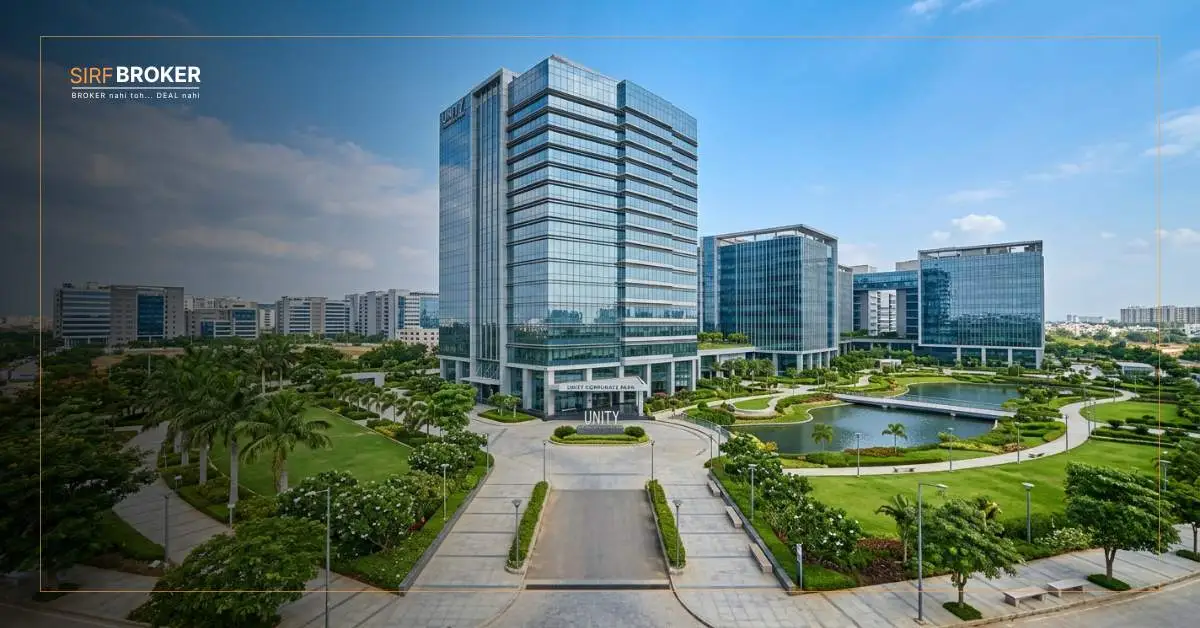
24.6 million sq ft. That is how much office space India’s top cities leased in Q2 2026 — the highest single quarter in the country’s commercial real estate history. The first half of 2026 closed at 45.5 million sq ft, up 9.6% year-on-year, making it the strongest H1 on record as well. According to CBRE’s Q2 2026 India Office Market Report, India’s office sector is not just recovering — it is resetting the ceiling on what demand looks like.
The number that explains the record is not the total. It is the GCC share. Global Capability Centres — the India-based operations of multinational corporations handling technology, analytics, finance, and operations — leased 10.3 million sq ft of office space in Q2 2026 alone, accounting for 42% of all office take-up in the quarter. For H1 2026, GCCs leased 16.5 MSF, a 38% year-on-year increase, per CBRE data reported by Business Standard on July 6, 2026.
This is not a general office market boom. It is a GCC-led, Grade A-concentrated, specific-city-dominant expansion that brokers and developers who are not positioned for it will largely miss. Understanding the composition of this record is more useful than celebrating the headline.
| Q2 2026: 24.6 MSF leased — all-time record. H1 2026: 45.5 MSF — strongest first half ever. GCCs: 42% of Q2 demand, 10.3 MSF in a single quarter. Source: CBRE India, Business Standard July 6, 2026. |
The City-by-City Breakdown
The record is not distributed evenly across India’s office markets. Bengaluru, Pune, Delhi NCR, and Mumbai together accounted for nearly 80% of total GCC leasing in H1 2026, per CBRE data. Each city is telling a different story within the broader record.
| City | GCC Leasing H1 2026 | Market Position |
|---|---|---|
| Bengaluru | 5.36 MSF | India’s largest GCC market — anchored by tech, AI, and engineering GCCs |
| Pune | 3.01 MSF | Rising fast — BFSI and engineering GCCs expanding in Hinjewadi, Kharadi |
| Delhi NCR | 2.37 MSF | Gurugram Cyber City and Noida Expressway driving corporate demand |
| Mumbai | 2.23 MSF | BFSI-led — BKC and Powai remain the preferred corridors |
Source: CBRE India Q2 2026 Office Market Report, Business Standard July 6, 2026; IANS Live July 4, 2026.
Bengaluru’s position as India’s largest GCC market is structural, not cyclical. The city has built an ecosystem — talent supply chains, educational institutions, vendor networks, and residential infrastructure for GCC professionals — that no other Indian city has fully replicated. When a global technology company expands its India GCC, Bengaluru is the default first consideration. Everything else is a secondary market.
What Sector Is Actually Driving the Demand
The sector composition of H1 2026 office leasing tells the occupier story precisely. IT-BPM remained the largest contributor with a 22% share of total leasing. BFSI (banking, financial services, and insurance) strengthened its position with 19% of demand. Engineering and manufacturing accounted for 16%, driven by the China+1 manufacturing thesis pushing global companies to establish India-based engineering operations.
| WHAT THE SECTOR MIX TELLS BROKERS IT-BPM (22%) → The original GCC base. Still the largest occupier group but its share is falling as BFSI and E&M expand. Brokers who only know tech GCC space requirements are operating with a narrowing client base. BFSI (19%) → The fastest-growing GCC category in India. BFSI GCCs have specific requirements: data centre adjacency, security infrastructure, regulatory compliance fit-outs. This is specialist territory. Engineering & Manufacturing (16%) → The new entrant. China+1 companies establishing India engineering centres. Typically require larger floor plates, uninterrupted power, and proximity to talent in Pune, Chennai, Hyderabad. |
The sector diversification matters for brokers because each sector has different space requirements. A BFSI GCC leasing 200,000 sq ft needs different infrastructure — trading floor configurations, data security specifications, backup power — than a technology GCC of the same size. Brokers who understand these requirements at the fit-out and specification level are advising at a level where portals cannot compete. For the full cost picture that occupiers need before committing to a lease, read: The Real Cost of Moving Offices: Why Rent Is Only Half the Story.
Flex Space Is the Other Driver
GCCs are not the only story in Q2 2026. Flex space operators — coworking platforms leasing large floors to offer managed workspace to enterprise clients — were the second major driver of office demand. Coworking operators leased a record 8.6 MSF in H1 2026, up 32% year-on-year.
| The convergence of GCC demand and flex demand is creating a new product category: the managed GCC. A multinational wanting a 500-seat India operation but not wanting to manage a direct lease is using flex operators as a turnkey solution. The flex operator takes the lease from the developer; the GCC takes a managed contract from the flex operator. This two-layer structure is absorbing a significant portion of the record leasing volume and changing how brokers need to structure relationships with both landlords and occupiers. |
What the Record Means for Vacancy and Rents
A record leasing quarter does not automatically mean zero vacancy. India’s office market has been adding Grade A supply simultaneously, and the quality bifurcation — Grade A filling while Grade B sits empty — is the nuance that the headline number obscures.
In Bengaluru’s established corridors — Whitefield, Sarjapur Road, Outer Ring Road — Grade A vacancy is tight and rents have moved up. In peripheral micro-markets and older stock buildings, vacancy is persistent. The record leasing number applies to the Grade A universe. Brokers pitching Grade B or older stock to GCC clients will not benefit from this demand environment — those clients will not lease what they are looking for in a building that does not meet their specifications.
For brokers handling commercial leasing transactions, understanding what constitutes Grade A specifications in each corridor — and which buildings genuinely qualify — is the knowledge that determines whether you are relevant to the GCC occupier conversation. For an overview of the common errors in commercial leasing that cost brokers mandates, read: Common Mistakes in Commercial Property Leasing Deals.
Sirf Broker POV
India’s office market record in Q2 2026 is the clearest data-point yet that the GCC thesis — which many brokers treated as a trend story two years ago — is now the structural foundation of the entire commercial office sector. 42% of all office demand in a record quarter came from one occupier type. That is not diversification. That is concentration.
For brokers, concentration is not a problem — it is a positioning opportunity. The brokers who have spent the last two years building relationships with GCC real estate heads, learning the specific space requirements of BFSI versus technology versus engineering GCCs, understanding which corridors have the power infrastructure and security specifications that GCC procurement teams require — those brokers are sitting inside the record. Everyone else is observing it from outside.
The mistake would be to read the record and assume the entire office market is buoyant. It is not. The record is a GCC record. Older stock, peripheral locations, and buildings that do not meet institutional specifications are not participating in it. A broker who positions themselves correctly — as a GCC-specialist or a managed workspace expert — is operating in the most active commercial real estate market in India’s history. A generalist broker waiting for any office enquiry will find that the record quarter produces nothing for their pipeline.
The second implication: sector diversification within GCC demand is accelerating. IT-BPM’s share is falling. BFSI and engineering are rising. Brokers who expanded their GCC knowledge beyond technology are already seeing the benefit. Brokers who didn’t are about to find their client roster narrowing even as the market expands.
Conclusion
India’s Q2 2026 office market record — 24.6 MSF in a single quarter, 45.5 MSF for H1 — is real, structural, and GCC-driven. The demand is concentrated in four cities, dominated by three sectors, and increasingly intermediated by flex operators offering managed solutions to GCC clients who don’t want to manage direct leases. For brokers and developers who are positioned correctly, this is the best market in India’s commercial real estate history. For those who are not, the record is a statistic rather than an opportunity.
To understand how India’s GCC expansion is reshaping office demand through 2030, read: REITs Are Changing Real Estate Investing: What Brokers Must Learn.
Frequently Asked Questions
1. How much office space did India lease in Q2 2026?
India’s office market leased 24.6 million sq ft in Q2 2026 — the highest single quarter on record, per CBRE’s Q2 2026 India Office Market Report. The first half of 2026 closed at 45.5 million sq ft, up 9.6% year-on-year, also the strongest H1 on record.
2. What is driving India’s record office leasing in 2026?
Global Capability Centres (GCCs) were the primary driver, accounting for 42% of Q2 2026 office demand — 10.3 MSF in a single quarter. For H1 2026, GCCs leased 16.5 MSF, up 38% year-on-year. Flex space operators were the second major driver, leasing a record 8.6 MSF in H1 2026, up 32% year-on-year.
3. Which Indian cities are leading office leasing in 2026?
Bengaluru leads India’s GCC office market with 5.36 MSF leased in H1 2026, followed by Pune (3.01 MSF), Delhi NCR (2.37 MSF), and Mumbai (2.23 MSF). Together, these four cities accounted for nearly 80% of total GCC leasing in H1 2026, per CBRE data.
4. What sectors are leasing the most office space in India in 2026?
IT-BPM led with 22% of H1 2026 leasing, followed by BFSI (banking, financial services, and insurance) at 19%, and engineering and manufacturing at 16%. BFSI and engineering are the fastest-growing categories, driven by global financial services GCC expansion and China+1 manufacturing thesis respectively.
5. What is a managed GCC and how does it affect office leasing?
A managed GCC is a structure where a flex space operator takes a direct lease from a building developer and then provides a turnkey managed workspace to a multinational’s India operation under a separate managed services contract. This two-layer structure allows GCCs to establish India operations without managing a direct property lease. It accounts for a growing share of office leasing volume and is changing how brokers must structure relationships with both landlords and GCC clients.
6. Does the record office leasing mean all office markets in India are performing well?
No. The record applies specifically to Grade A office supply in established corridors in Bengaluru, Pune, NCR, and Mumbai. Grade B office buildings, older stock, and peripheral locations are not participating in the demand surge. Vacancy in these segments remains elevated. The record is a Grade A, GCC-driven performance concentrated in specific micro-markets, not a broad market uplift.
Sources and References
- CBRE India — Q2 2026 India Office Market Report — Q2 gross leasing 24.6 MSF all-time high; GCC share 42%; H1 2026 45.5 MSF +9.6% YoY; sector breakdown IT-BPM 22%, BFSI 19%, E&M 16%. cbre.co.in
- Business Standard — July 6, 2026 — India’s office market posts record quarterly leasing on GCC, flex demand. business-standard.com
- ANI News — July 6, 2026 — India’s office leasing hits record 24.6 MSF in Q2; flex operators and GCCs drive demand. aninews.in
- IANS Live — July 4, 2026 — India office leasing surges 5% in H1 2026 as GCCs drive demand; Bengaluru 5.36 MSF, Pune 3.01 MSF, NCR 2.37 MSF, Mumbai 2.23 MSF. ianslive.in
- Bizzbuzz News — July 2026 — India office leasing rises 5% in H1 as GCC demand surges; coworking operators lease record 8.6 MSF H1 2026 +32% YoY. bizzbuzz.news
Disclaimer
| This article is published by Sirf Broker for educational and informational purposes only. Office leasing volumes, GCC demand figures, and sector data are sourced from publicly available third-party reports cited above and are subject to revision. This is not investment or transaction advice. |