

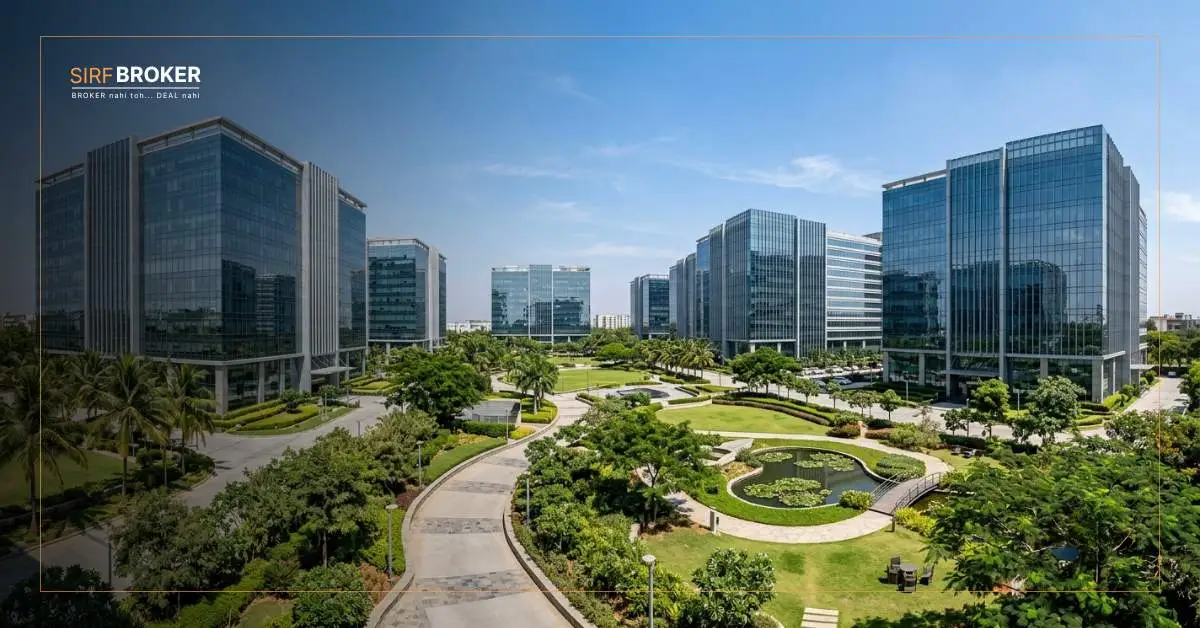
India’s office market absorbed 48 million square feet (msf) of Grade A space in H1 2026 — the second-best half-year performance on record, marginally lower than H1 2025 only because of an exceptionally high base, according to Knight Frank India’s H1 2026 report. The headline number is large. The composition behind it is more significant.
Global Capability Centres (GCCs) accounted for 43% of all office transactions in H1 2026, leasing 20.6 msf across India’s major cities. That share — 43% — is the highest recorded in any half-year period in India’s office market history. It means that in the first six months of 2026, nearly one in every two square feet of Grade A office space leased in India went to a GCC. The office market is not simply accommodating GCC demand. It is being shaped by it.
Total office stock in India crossed 1,054.6 msf after 27.1 msf of new completions were delivered in H1 2026. Vacancy continued to decline, falling to 14.6% — a figure that reflects occupier demand persistently outpacing fresh supply, a dynamic that typically supports rental growth in the near term.
| H1 2026 India office: 48 MSF total (2nd best H1 ever). GCC share: 43% = 20.6 MSF (all-time H1 record). Mumbai: 7.3 MSF (+33% YoY, all-time half-year high). Bengaluru: 14.1 MSF (market leader). Vacancy: 14.6% (declining). Total stock: 1,054.6 MSF. Source: Knight Frank India H1 2026; Business Standard. |
The GCC Dominance — What 43% Actually Means
GCCs have been the fastest-growing occupier category in India’s office market for several years. But the H1 2026 figure — 43% of all leasing — marks a structural threshold. At this share, GCCs are not simply the largest single occupier category. They are the market’s primary demand driver in a way that no single occupier type has been since IT-BPM companies dominated office absorption in the early 2000s.
| WHAT A 43% GCC SHARE MEANS FOR THE OFFICE MARKET Demand predictability → GCC leasing is driven by parent company mandates and multi-year India expansion plans that are resistant to short-term economic volatility. When a US technology company’s India GCC signs a 9-year lease, it is executing a board-approved strategy, not responding to a quarter’s P&L. This makes GCC demand more durable than enterprise or startup absorption — and gives developers building Grade A supply significantly better visibility on pre-lease demand than in any previous cycle. Specification inflation → GCCs require LEED-certified buildings, AI-capable power density (30-50 W/sq ft in advanced fit-outs), WELL certification consideration, and ESG data reporting from landlords. These requirements are not preferences — they are procurement filters. The Grade A stock that does not meet GCC specification requirements is increasingly competing for 57% of the market (non-GCC demand) while being excluded from the 43% with the best covenants and the longest leases. Concentration in four cities → GCC leasing is not geographically distributed. Bengaluru, Hyderabad, Pune, and Chennai absorb the overwhelming majority of GCC demand. Brokers building commercial practices in these cities have fundamentally better demand conditions than those in Tier 2 markets, regardless of individual skill. Geography is the first decision in commercial advisory — and the GCC map makes it easier than it has ever been to read. Rental floor effect → GCCs signing long leases at market rents establish a rental floor that protects the broader market during downturns. In 2020-21, it was GCC demand (from companies using the pandemic to accelerate India operations) that prevented the rental correction that many predicted. The same dynamic holds in 2026 — GCC willingness to pay Grade A rents for Grade A product is keeping market rents elevated and vacancy declining even as other occupier segments moderate. |
Mumbai’s Breakout — 7.3 MSF, +33% YoY, All-Time Half-Year Record
The city-level story of H1 2026 is Mumbai. The Mumbai Metropolitan Region leased 7.3 msf of Grade A office space in H1 2026 — a 33% year-on-year increase and the highest half-year leasing volume ever recorded in the city, per Knight Frank data. That is a significant development for a market that has historically underperformed relative to its economic weight in India.
Mumbai’s office market has been constrained for years by a specific combination of factors: high land cost limiting greenfield Grade A development, older stock that does not meet GCC specification requirements, and relatively high vacancy in legacy office precincts like Nariman Point and Lower Parel that masked genuine supply tightness in the newer, compliant micro-markets. BKC and Powai have been the reliable performers; Navi Mumbai is where the growth supply is arriving.
| Mumbai’s 7.3 msf H1 2026 performance reflects two converging forces: the arrival of new Grade A supply in Navi Mumbai’s Airoli-Ghansoli and Thane micro-markets at rents competitive with Bengaluru, and the BFSI-driven GCC wave that is landing disproportionately in Mumbai given the city’s finance and professional services concentration. BFSI GCCs — from JP Morgan, Goldman Sachs, HSBC, and their equivalents — are not choosing between Mumbai and Bengaluru. They are choosing Mumbai, and the half-year leasing record reflects that choice at scale. |
Bengaluru Holds — 14.1 MSF, Market Leadership Intact
Bengaluru retained its position as India’s largest office market with 14.1 msf of leasing in H1 2026. The city’s market leadership is structural — driven by the density of technology GCCs, the depth of engineering talent supply, and the volume of Grade A supply in corridors like Outer Ring Road, Whitefield, and Electronic City that has been consistently delivered against pre-committed demand.
| City | H1 2026 Leasing | Standout |
|---|---|---|
| Bengaluru | 14.1 MSF | Market leader; GCC and tech demand anchor |
| Mumbai | 7.3 MSF (+33% YoY) | All-time half-year record; BFSI GCC wave |
| Hyderabad | Record H1 per Deccan Chronicle | GCC demand anchoring HITEC City expansion |
| Pune | Highest-ever H1 | Engineering GCC and manufacturing sector demand |
Source: Knight Frank India H1 2026; Deccan Chronicle; Punekar News July 2026.
What Declining Vacancy to 14.6% Means for Rent
India’s Grade A office vacancy fell to 14.6% in H1 2026. That figure might not sound tight — 14.6% means roughly one in seven square feet of existing stock is available. But the number obscures a critical segmentation: vacancy in GCC-compliant, LEED-certified, well-located Grade A buildings in the primary GCC corridors is materially tighter than the headline figure. The vacancy that persists is concentrated in older, non-certified, or poorly-located stock that GCC procurement will not consider regardless of price.
This two-tier vacancy structure — functional undersupply in the GCC-compliant segment running simultaneously with structural oversupply in the non-compliant segment — is the dynamic that explains why rents in premium micro-markets continue to rise while headline vacancy numbers suggest the market should be soft. For brokers advising occupiers on this market, the critical advisory skill is understanding which micro-market and which building type genuinely has the vacancy that a specific client can use. For the full cost picture of moving into a premium office, read: The Real Cost of Moving Offices: Why Rent Is Only Half the Story.
What This Means for Brokers in Commercial Leasing
A market where GCCs account for 43% of leasing and the highest-value mandates require LEED certification, ESG reporting capability, and AI-capable power infrastructure is not a market that rewards generalist brokerage. The GCC mandate process — from parent company site brief to India RFP to shortlist to heads of terms — involves procurement, legal, facilities, HR, and local real estate advisory in a structured process that typically runs 6-18 months.
Brokers who understand that process — who know the decision criteria at each stage, who have relationships with the India real estate heads of the major GCC parent companies, and who can move faster than a competitor on the site identification step — are not competing with portal aggregators. They are competing with international property consultants, and they can win those mandates on local market depth and relationship capital that the large firms sometimes lack in specific micro-markets.
The common errors in commercial leasing mandates are consistent enough to learn from: read Common Mistakes in Commercial Property Leasing Deals for the full advisory framework.
Sirf Broker POV
The 43% GCC share of India’s H1 2026 office leasing is the most important commercial real estate data point published this year. Not because it confirms what the market has known for several years — that GCCs are the dominant force in Indian office demand — but because 43% crosses the threshold from dominance to structural dependency. At this share, India’s Grade A office market is a GCC market with other occupiers, not a broad-based market where GCCs are the largest segment.
The implications compound. Developer underwriting of new Grade A supply is increasingly calibrated to GCC specification — LEED, power density, ESG reporting. Rental pricing in premium micro-markets is sustained by GCC willingness to pay for compliant product. Vacancy data is becoming less meaningful as a market indicator because it aggregates GCC-compliant and non-compliant supply that serve fundamentally different demand pools.
For Indian commercial brokers, the adaptation required is not subtle. The GCC mandate process requires a different client acquisition approach (corporate parent relationships, not lead aggregation), a different advisory offering (procurement process navigation, not portal search), and a different fee negotiation (structured retainer or success fee, not pure commission). The brokers who have made this adaptation are sitting in one of the strongest demand environments in the history of Indian commercial real estate. The ones who have not are serving the 57% of the market that GCCs are not competing for.
Conclusion
India’s office market absorbed 48 msf in H1 2026 — the second best half-year ever, driven by GCCs at a record 43% share (20.6 msf). Mumbai delivered its highest-ever half-year leasing at 7.3 msf (+33% YoY). Bengaluru led at 14.1 msf. Hyderabad and Pune both hit half-year records. Vacancy fell to 14.6% and total stock crossed 1,054 msf. The market is not cyclically strong. It is structurally reshaping around a single dominant demand force — and the brokers, developers, and investors who have built their practices around that force are in the best position they have ever occupied.
Frequently Asked Questions
1. How much office space was leased in India in H1 2026?
India’s Grade A office market absorbed 48 million sq ft in H1 2026 — the second-best half-year performance on record, per Knight Frank India. The marginal -2% YoY decline reflects the exceptionally high base of H1 2025 rather than any demand weakness. GCCs accounted for 43% of this absorption (20.6 msf), the highest share ever recorded in any half-year period.
2. What is a GCC and why is it driving India’s office demand?
A Global Capability Centre (GCC) is an India-based unit of a multinational company that performs technology, analytics, finance, legal, or operational functions for the global enterprise. GCCs have expanded rapidly in India due to the combination of engineering talent, competitive costs, and time-zone coverage for global operations. GCCs typically sign 9-year leases for large, high-specification spaces — making them the most stable, highest-quality demand in India’s office market.
3. Which Indian city saw the biggest office leasing growth in H1 2026?
Mumbai recorded the strongest growth, with 7.3 msf leased in H1 2026 — a 33% year-on-year increase and the highest half-year volume ever recorded in the city. This was driven by BFSI-sector GCCs from global financial firms choosing Mumbai for their India operations. Bengaluru remained the largest market overall at 14.1 msf.
4. What is the current office vacancy rate in India?
India’s Grade A office vacancy fell to 14.6% in H1 2026, per Knight Frank. However, functional vacancy in GCC-compliant, LEED-certified Grade A space in primary corridors is materially tighter than the headline figure. The reported vacancy is concentrated in older, non-certified, or poorly-located stock that GCC procurement typically excludes. Premium micro-markets in Bengaluru, Hyderabad, and Mumbai are significantly tighter.
5. How does GCC leasing affect office rents in India?
GCC demand sustains a rental floor in premium micro-markets because GCCs pay for compliant product and sign long leases that lock in rent levels for 9+ years. Even when overall market sentiment moderates, GCC mandate execution continues at pre-planned levels, preventing the rental corrections that market headlines might suggest. This is why rents in GCC-heavy corridors (Bengaluru ORR, Hyderabad HITEC City, Pune Hinjewadi) have remained elevated despite broader economic uncertainty in 2026.
6. What do GCCs require in office space that standard occupiers do not?
GCCs typically require: LEED Gold or Platinum certification (or GRIHA equivalent), AI-capable power density (30-50 W/sq ft in advanced fit-outs vs 15-20 W/sq ft standard), ESG reporting capability from the landlord (energy, water, carbon data compatible with parent company sustainability frameworks), WELL certification consideration (for employee wellbeing mandates), and lease structures aligned with parent company global real estate policies. Buildings that do not meet these requirements are excluded before price comparison begins.
Sources and References
- Knight Frank India — H1 2026 India Real Estate Report — 48 MSF total; GCC 43% share (20.6 MSF); Mumbai 7.3 MSF +33% YoY; Bengaluru 14.1 MSF; vacancy 14.6%; stock 1,054.6 MSF. knightfrank.co.in
- Business Standard — July 9, 2026 — Office leasing slips 2% as housing sales remain steady in H1: Knight Frank. business-standard.com
- CBRE India — July 6, 2026 — India’s office market posts record quarterly leasing on GCC and flex demand. business-standard.com
- Deccan Chronicle — July 2026 — Hyderabad sees record office leasing in first half; GCCs lead demand. deccanchronicle.com
- Punekar News — July 2026 — Pune records highest-ever half-year office leasing in H1 2026. punekarnews.in
Disclaimer
| This article is published by Sirf Broker for educational and informational purposes only. Leasing volumes, market share data, and vacancy figures are sourced from publicly available third-party reports cited above and are subject to revision. This is not investment advice. |