

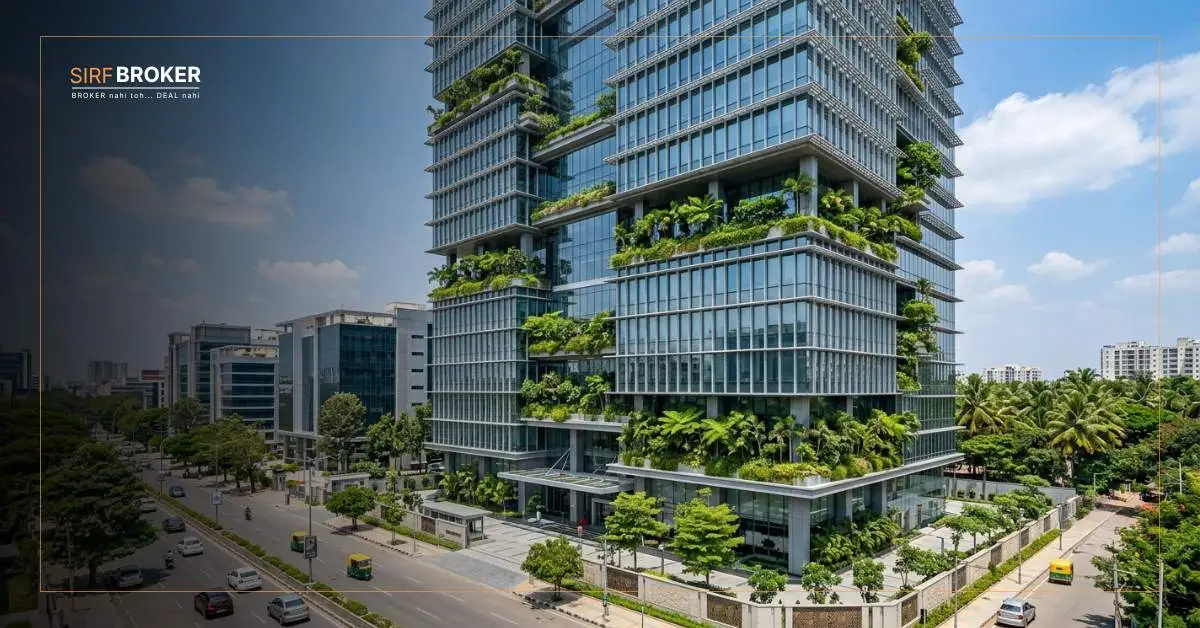
Three-quarters of every office building completed in India in Q2 2026 carries a green certification. Not a token eco-label — a formal third-party rating under LEED, IGBC, or GRIHA. And 73% of all office leasing in the same quarter happened inside green-certified buildings, according to CBRE’s India Office Figures Q2 2026.
That is no longer a market trend. That is the market.
If you are a broker advising a client on office space, or an occupier deciding between two buildings, understanding what these certifications actually mean — and what they don’t — is no longer optional. Green buildings command different lease terms, different service charges, and in some cases, different rental rates. Advising a client without knowing the difference between a LEED Gold and an IGBC Platinum building is advising from a gap.
| Green certification in India’s office market is no longer a differentiator for premium buildings — it is the baseline expectation. The question is no longer whether a building is certified, but what that certification actually covers. |
What Is a Green-Certified Building in India?
A green-certified building is one independently rated and verified against environmental performance standards — covering energy consumption, water use, materials, indoor air quality, and site sustainability. Three systems are active in India’s commercial office market:
LEED (Leadership in Energy and Environmental Design) is issued by the US Green Building Council and administered in India through the Indian Green Building Council (IGBC) under licence. It is the most internationally recognised system and the most commonly cited in Grade A commercial leasing. LEED ratings run Certified → Silver → Gold → Platinum.
IGBC has its own independent rating system, separate from LEED, administered by the Confederation of Indian Industry (CII). IGBC ratings are widely used in residential, industrial, and institutional buildings, and increasingly common in commercial projects. Ratings also run Certified → Silver → Gold → Platinum.
GRIHA (Green Rating for Integrated Habitat Assessment) is India’s national green building rating system, developed by TERI and adopted by the Government of India. GRIHA is the mandatory standard for all government buildings above a certain size. It is rated on a 1-star to 5-star scale.
In India’s premium commercial office market — Grade A buildings where MNCs, GCCs, and large Indian corporates lease — LEED certification dominates. When a developer says “LEED Gold building,” that is the certification a broker or occupier should be verifying, not assuming.
Why Three-Quarters of India’s New Office Supply Is Now Green
The shift to green-certified buildings did not happen because developers developed a conscience. It happened because institutional capital made it a requirement.
Global institutional investors — pension funds, REITs, sovereign wealth funds — have ESG mandates requiring their investable assets to carry green certifications. If a developer wants to attract institutional equity or sell a building to a REIT after completion, the building must be certified. That financial logic, more than any regulation, drove the green share of completions to 76% in a single quarter.
At the same time, MNCs and large Indian IT companies now routinely include green building requirements in their workplace policies — to meet their own sustainability targets or to comply with parent company mandates from the US or Europe. A GCC leasing 100,000 sq ft in Bengaluru is not negotiating without asking about the building’s certification level.
LEED, IGBC, and GRIHA — What Each Certification Actually Measures
All three systems rate buildings across similar categories, though weightings differ:
Energy performance is the heaviest-weighted category in all three systems. A LEED-certified building must outperform the baseline energy consumption benchmark by a meaningful margin. The higher the level (Gold vs Platinum), the larger the required savings.
Water efficiency covers indoor water use (low-flow fixtures, water recycling) and outdoor use (rainwater harvesting). In Indian cities where water scarcity is a real operational risk, this category has become more commercially significant.
Indoor environmental quality covers air quality, thermal comfort, daylighting, and acoustics. Buildings that score well here have better HVAC systems, better ventilation rates, and more natural light — factors with a documented impact on employee productivity and, increasingly, on occupier lease decisions.
Does Green Certification Mean Higher Rent? The Honest Answer
The relationship between green certification and rent in India is more nuanced than most assume.
At the top of the market — LEED Platinum or IGBC Platinum in premium micromarkets like BKC Mumbai, Cyber City Gurugram, or Whitefield Bengaluru — there is a measurable rent premium. These buildings attract tenants who will pay for quality, and developers price accordingly.
But at the Gold and Silver level, the premium is less consistent. In markets where green-certified supply is now the majority — which at 76% of completions is increasingly everywhere — the absence of certification is becoming a discount rather than the presence being a premium. Occupiers are no longer paying extra for green buildings. They are paying less for non-green ones.
The more commercially significant variable is energy cost. Green buildings with high energy performance scores deliver measurably lower electricity consumption per sq ft. For a large occupier, the difference between a high and low energy-performing building can run into crores annually. That operating cost difference, more than the headline rent, is what sophisticated occupiers are now calculating.
What Brokers and Occupiers Should Ask Before Signing a Lease in a Green Building
Green certification is not self-verifying. A building can claim LEED Gold and have a certificate that expired two years ago, or carry a design-phase certification never converted to an operational (post-occupancy) rating. Ask these specific questions:
1. Is the certification design-stage or operational? LEED certifies at the design stage and separately for operations post-occupancy. The operational certification is more meaningful — it reflects actual performance, not projected performance.
2. What is the exact certification level? Certified, Silver, Gold, and Platinum represent materially different performance levels. Ask to see the LEED scorecard, not just the certificate.
3. Is the certification current? LEED v4.1 certifications require periodic renewal. A Gold from 2019 may not reflect the building’s current performance.
4. What does the maintenance contract cover for green systems? HVAC systems in green buildings are more complex than in conventional buildings. A lease that does not specify maintenance responsibility for BMS (Building Management System) components can become a dispute.
Sirf Broker POV
The Indian real estate industry talks about green buildings as a feature. It is no longer a feature — it is a baseline, and brokers who have not updated their knowledge are now advising clients from a deficit.
Here is what we are actually seeing: occupiers are not walking into site visits asking about LEED levels. They are asking about electricity costs. They are asking who manages the HVAC. They are asking about 24-hour power backup integration. These are green building questions in disguise, and the brokers who can translate them into certification-level answers — who can point to a LEED scorecard rather than a developer brochure — are the ones closing leases in the current market.
The more important shift: as green supply becomes the norm, the broker opportunity is not in selling green buildings. It is in identifying which buildings have the operational certifications to match their labels. Design-stage LEED certifications are relatively easy to obtain and do not guarantee the building actually performs. Post-occupancy certifications are rarer and more meaningful. The occupier who signs a 5-year lease in a “LEED Gold” building and then finds electricity bills running 30% above developer projections has a problem. The broker who never asked the right questions has a bigger one.
Conclusion
India’s office market has crossed a threshold. At 76% green-certified completions in Q2 2026, the baseline expectation for any Grade A office building is now some level of environmental certification. For occupiers, the questions to ask are operational. For brokers, the knowledge to build is in the difference between certification types and levels — not the marketing headline.
If you are calculating your total office occupancy cost, read our guide on the real cost of moving offices before you sign.
Frequently Asked Questions
What does LEED certification mean for an office building in India?
LEED is a third-party green building certification issued by the US Green Building Council and administered in India by the Indian Green Building Council (IGBC). It rates buildings on energy efficiency, water conservation, indoor air quality, and materials. Ratings run Certified, Silver, Gold, and Platinum — with Platinum indicating the highest performance level.
Is a green-certified office building more expensive to rent?
In premium micromarkets, LEED Platinum and IGBC Platinum buildings can command a rental premium. However, as green supply now represents 76% of new completions (CBRE Q2 2026), the absence of certification is increasingly a discount rather than certification being a premium. Energy cost savings in high-rated green buildings often offset any rent differential for larger occupiers.
What is the difference between LEED and IGBC certification in India?
LEED is a US-origin system licenced to India through IGBC. IGBC also has its own separate rating system administered by the Confederation of Indian Industry (CII). Both use a Certified / Silver / Gold / Platinum scale. LEED is more internationally recognised and preferred by MNCs and global institutional investors.
What is GRIHA certification in Indian real estate?
GRIHA is India’s national green building rating system developed by TERI and endorsed by the Government of India. It uses a 1 to 5 star scale and is mandatory for government buildings above a certain size. It is less common in private commercial office development, where LEED and IGBC dominate.
What should an occupier check before renting a green-certified office building?
Check: (1) whether the certification is design-stage or post-occupancy, (2) the exact certification level, (3) the certification date and validity, (4) the building’s actual Energy Use Intensity rather than just the headline certificate, and (5) what the lease says about maintenance responsibility for green systems including BMS and HVAC.
Does green certification affect commercial lease terms in India?
Yes. Some green building leases include clauses requiring tenants to operate in ways that maintain the certification (e.g., no individual split ACs). The service charge may include BMS operating costs. Some leases now include energy benchmarking clauses requiring periodic reporting. Review the lease for these green-specific obligations before signing.