

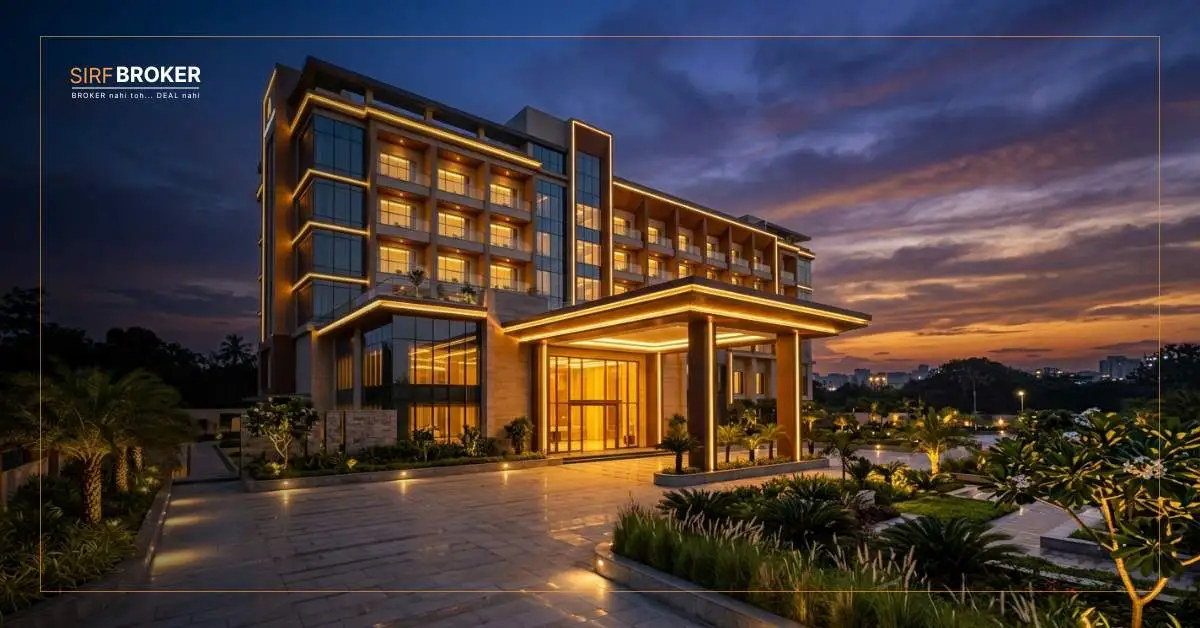
India’s hotel and hospitality real estate sector attracted $185 million in investment in Q1 2026 alone — a 58% increase year-on-year, according to JLL’s Hotels & Hospitality 2026 report. JLL projects full-year 2026 hotel transaction volumes could approach $1 billion — more than double the $567 million recorded in all of 2025, which itself was up 67% from 2024. In under three years, institutional investment in Indian hotel real estate has gone from a quiet backwater of the commercial property market to one of its fastest-growing segments.
Tier-1 cities contributed approximately 60% of Q1 2026 hotel investment, with Tier-2 and Tier-3 cities accounting for the remaining 40%. That 40% figure is the structural story beneath the headline: India’s hotel investment is not confined to Mumbai, Delhi, and Bengaluru. It is moving into Ayodhya, Varanasi, Amritsar, Coorg, Jim Corbett, and the emerging airport micro-markets that government infrastructure spending is creating. JLL specifically cites government land monetisation at locations like Yashobhoomi, Neopolis, Fintech City, and the Jewar Airport corridor as catalysts for new hotel investment pipelines.
For developers, commercial brokers, and institutional investors who have historically worked in office, residential, or industrial real estate, the hospitality asset class presents a different and increasingly compelling risk-return profile. Understanding why institutional capital is flowing in — and how hotel real estate transactions work — is now a necessary part of senior commercial real estate knowledge in India.
| India Hotel Real Estate — Investment Snapshot 2026 Q1 2026 investment: $185 million — up 58% YoY (JLL) · Full-year 2026 forecast: ~$1 billion · 2025 total: $567 million (up 67% from 2024) · Tier-1 city share: ~60% · Tier-2/Tier-3 share: 40% · Key catalysts: branded hotel expansion, PE fund entry, government land monetisation at Yashobhoomi, Jewar Airport, Neopolis Source: JLL Hotels & Hospitality 2026 Report; IBEF; Asian Hospitality; Travel Trade Journal. |
Why Hotel Investment Is Accelerating — The Three Structural Drivers
The 58% year-on-year jump in Q1 2026 hotel investment is not a single-event spike. It reflects three structural forces that are simultaneously strengthening India’s hospitality investment thesis.
The first is rising domestic travel demand. India’s domestic air passenger traffic has recovered fully from the 2020-2021 trough and is growing consistently — both business travel driven by India’s expanding corporate sector and leisure travel from a growing aspirational middle class with increased disposable income and travel appetite. Higher occupancy rates across branded hotels in Tier-1 cities are translating directly into stronger RevPAR — revenue per available room — which is the fundamental metric that institutional hotel investors track. When RevPAR improves, cap rates compress, asset values rise, and transaction activity increases.
The second driver is the branded hotel supply pipeline. India’s hotel market has long been underpenetrated by international and domestic branded hotel chains relative to comparable developing markets. The expansion of branded inventory — Marriott, Hyatt, IHG, Accor, and domestic brands like IHCL’s Taj, Lemon Tree, and OYO’s institutional formats — is creating investable assets. Branded hotels with long-term operator agreements from creditworthy international chains have a fundamentally different investor appeal than standalone independent hotels. They have predictable revenue management, global distribution systems, loyalty programme connectivity, and an operator covenant that institutional capital can underwrite.
The third driver is government infrastructure. The development of new airports — Jewar (Delhi NCR), Navi Mumbai, Mopa (Goa), Bhogapuram (Andhra Pradesh) — creates immediate demand for branded hotel capacity in surrounding micro-markets. Government-owned land monetisation programmes at integrated business districts and exhibition complexes are adding investable hotel real estate supply in locations that previously had no Grade A hospitality assets. JLL specifically identifies Yashobhoomi (Delhi’s new MICE complex in Dwarka Sector 25) as one of the most significant near-term catalysts for hotel investment in the NCR.
Tier-2 and Tier-3 Cities at 40%: The Structural Shift in Where Hotel Capital Goes
Tier-2 and Tier-3 cities accounting for 40% of India’s hotel investment in Q1 2026 is the data point that most directly challenges the conventional wisdom about where hospitality real estate investment happens in India.
The drivers of Tier-2/3 hotel investment are varied and location-specific. Religious tourism markets — Ayodhya, Varanasi, Tirupati, Amritsar, Shirdi — are experiencing branded hotel development at scale for the first time as government infrastructure investment upgrades road, airport, and railway access. Leisure destinations — Coorg, Jim Corbett, Goa’s secondary markets, Himachal Pradesh resort corridors — are attracting premium branded resort development from operators who see the aspirational leisure travel demand from Tier-1 and Tier-2 Indian consumers. And emerging industrial and manufacturing cities — Pune, Nashik, Ahmedabad, Surat, Coimbatore — are generating corporate travel demand from GCC employees and manufacturing sector executives that is creating sustainable hotel occupancy at midscale and upscale branded formats.
The investment mechanics in Tier-2/3 hotel markets differ from Tier-1. Land costs are a fraction of Mumbai or Delhi. The barriers to entry for developers are lower. But the operator agreement negotiations, the brand selection, and the positioning between luxury, upper-upscale, and midscale are more complex — there is no established comparable set to benchmark against in most Tier-2 markets. Developers entering Tier-2/3 hospitality for the first time frequently underestimate the complexity of the hotel development and management agreement structure.
| Market Type | Share of Q1 2026 Investment | Primary Demand Driver |
|---|---|---|
| Tier-1 Cities (Mumbai, Delhi, Bengaluru, Hyderabad, Chennai, Pune) | ~60% | Corporate travel, MICE, airport micro-market development; listed company capital recycling |
| Tier-2/3 Cities & Leisure Destinations | 40% | Religious tourism, aspirational leisure travel, manufacturing sector corporate travel, government land monetisation |
What Developers Need to Know Before Entering Hospitality Real Estate
Hotel real estate development has a fundamentally different economics from office or residential development. The capital expenditure is higher — typically ₹80–150 lakh per room key for upscale branded hotels depending on market and specification — and the revenue comes from hotel operations rather than rent or sale. This means the developer must either operate the hotel themselves, enter a hotel management agreement with a branded operator, or structure a franchise agreement. Each route has different risk, revenue share, and operational complexity implications.
Hotel management agreements are the most common institutional route. An international or domestic hotel brand agrees to manage the property on behalf of the owner in exchange for a base management fee (typically 2–3% of total revenues) plus an incentive fee (8–12% of gross operating profit). The operator brings the brand, the distribution system, the loyalty programme, and the management expertise. The owner provides the real estate, the fit-out capital, and bears the operating risk. Understanding which brand is right for which market, what the management agreement negotiation involves, and how to structure the hotel development project are specific capabilities that most commercial real estate developers do not have in-house.
For commercial brokers, hotel real estate transactions require different skills than office or residential deals. Hotel asset sales involve buyers who underwrite RevPAR, occupancy trends, EBITDA multiples, and operator agreement terms — not just cap rates on rental income. Brokers who want to participate in India’s hotel transaction market need to build knowledge of hospitality-specific valuation and transaction mechanics. For a foundation in how different commercial real estate asset classes are valued and what drives transaction dynamics, read: REITs Are Changing Real Estate Investing: What Brokers Must Learn.
Sirf Broker POV
The $1 billion hotel transaction forecast for 2026 is the kind of number that gets written about in the financial press and largely ignored by the commercial brokerage community — because most commercial brokers in India have no framework for hospitality real estate and have historically left these transactions to specialist hotel advisory firms.
That is changing. And the window where specialist knowledge is genuinely scarce in hotel real estate brokerage in India is open right now. The institutional capital flowing into hotel real estate — PE funds, listed hotel companies recycling capital, government land monetisation — is creating a volume of transactions that the handful of established hotel advisory specialists cannot handle alone. Generalist commercial brokers with genuine knowledge of hotel management agreements, branded hotel economics, and RevPAR-based valuation will find that hospitality mandates carry meaningfully better economics than comparable office transactions — and the competition is thinner.
The Tier-2/3 opportunity is particularly underserved. A commercial broker based in Coimbatore, Nashik, or Varanasi who builds specific knowledge of hotel development economics in their market — which brands are actively seeking to enter, what the land and construction cost assumptions look like, what RevPAR premiums branded properties command over independent hotels — is doing something that almost nobody else in that market is doing. India’s hotel investment boom is not a Delhi-Mumbai story alone. It is a national story, and its most interesting chapters are being written outside the metros.
Conclusion
India’s hotel and hospitality real estate sector attracted $185 million in Q1 2026 — up 58% year-on-year per JLL — with full-year 2026 investment forecast at approximately $1 billion. Tier-2 and Tier-3 cities are driving 40% of investment volume, reflecting structural demand from religious tourism, aspirational leisure travel, and manufacturing sector corporate demand. Government infrastructure at Jewar Airport, Yashobhoomi, and new airport micro-markets is creating hotel development pipelines that will sustain investment activity well into 2027–28.
For developers entering hospitality for the first time, the critical investment is in understanding hotel management agreement structures and branded operator economics before committing capital. For commercial brokers, building hospitality-specific transaction knowledge now — while the specialist competition is thin and the deal volume is growing — is one of the most defensible position-building moves available in India’s commercial real estate market in 2026. For more on how specialist knowledge translates into competitive advantage in commercial real estate brokerage, read: From Listings to Personal Brands: The New Broker Reality.
Frequently Asked Questions
How much investment did India’s hotel sector attract in 2026?
India’s hotel sector attracted $185 million in investment in Q1 2026 — a 58% year-on-year increase — according to JLL’s Hotels & Hospitality 2026 report. JLL projects full-year 2026 hotel transaction volumes could approach $1 billion, compared to $567 million in all of 2025 (which was itself up 67% from 2024).
Which cities are driving India’s hotel real estate investment in 2026?
Tier-1 cities (Mumbai, Delhi, Bengaluru, Hyderabad, Chennai, Pune) contributed approximately 60% of Q1 2026 hotel investment per JLL. Tier-2 and Tier-3 cities — including religious tourism destinations (Ayodhya, Varanasi), leisure markets (Coorg, Jim Corbett), and manufacturing corridor cities (Nashik, Coimbatore) — contributed 40% of investment, reflecting the breadth of branded hotel expansion beyond India’s metros.
What is driving the growth in India’s hospitality real estate investment?
Three structural forces are driving growth per JLL: rising domestic travel demand improving occupancy and RevPAR across branded hotels; the expansion of international and domestic branded hotel chains creating investable assets with operator covenants institutional investors can underwrite; and government infrastructure spending creating hotel development pipelines at new airport micro-markets (Jewar, Navi Mumbai) and MICE complexes (Yashobhoomi, Delhi).
How does hotel real estate differ from office or residential for developers?
Hotel development capital expenditure is typically ₹80–150 lakh per room key for upscale branded hotels — higher than comparable commercial office development. Revenue comes from hotel operations (RevPAR, occupancy, EBITDA) rather than lease income. Developers must structure hotel management agreements with branded operators who take 2–3% of revenues as base fees plus 8–12% of gross operating profit as incentive fees. The operator brings the brand, distribution, and management expertise; the developer bears operating risk.
What role is government infrastructure playing in India’s hotel investment boom?
JLL identifies government land monetisation and new infrastructure as catalysts for India’s 2026 hotel investment pipeline. Specifically: Yashobhoomi (Delhi’s new MICE complex in Dwarka), the Jewar Airport corridor (new hotel demand in Delhi-NCR’s western approach), Neopolis and Fintech City (emerging Tier-1 business district hotel demand), and new airport development across Tier-2 cities are all creating hotel development opportunities that did not previously exist.
Is hospitality real estate a viable opportunity for commercial brokers in India?
Yes — hotel real estate transactions require specialist knowledge of RevPAR-based valuation, hotel management agreement structures, EBITDA multiples, and branded operator economics that most commercial brokers do not currently have. The deal volume is growing rapidly and the specialist broker competition is thin. Brokers who build genuine hospitality transaction knowledge now — particularly in Tier-2/3 markets — are entering a segment with strong economics and limited specialist competition.