

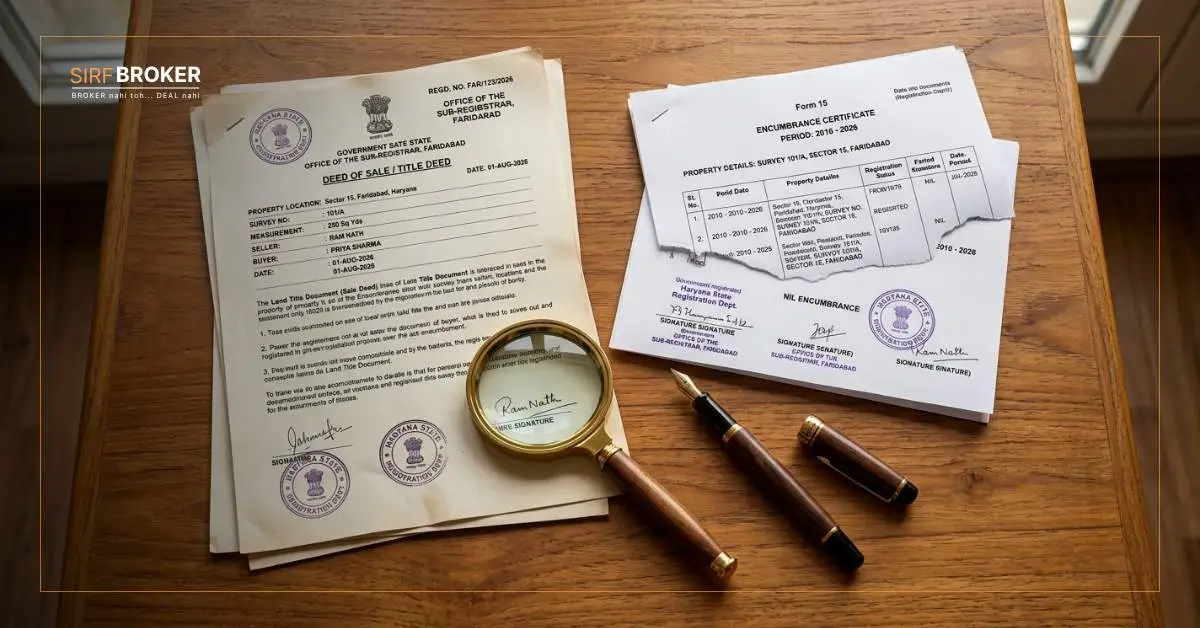
A disputed property title is one of the most catastrophic outcomes in any real estate transaction. The buyer loses money — sometimes crores. Legal battles stretch for years. And the broker who facilitated the deal without flagging the warning signs? Their phone stops ringing.
Title disputes in Indian real estate are more common than the industry publicly acknowledges. Encumbrances that were not discovered. Sellers who did not have clear ownership. Properties with pending litigation or government acquisition notices. Inherited properties with unresolved succession. Agricultural land converted for residential use without proper approvals. Each of these scenarios has ended transactions — and careers — that could have been protected by a structured due diligence process.
In 2026, RERA enforcement has intensified, land record digitisation has accelerated under the Bhu-Aadhaar (ULPIN) initiative, and Aadhaar-linked biometric registration has made property registration more traceable than ever before. The tools for due diligence are better than they have ever been. There is no excuse for skipping the process.
| Title Verification — Key Checkpoints Minimum ownership history to verify 30 years (legal standard) Primary document: clear title Encumbrance Certificate (EC) For new projects RERA registration + EC + approvals Digital land ID system Bhu-Aadhaar / ULPIN (14-digit ID) Registration mode (2026) Aadhaar-linked biometric mandatory Broker’s liability for title failure Potential RERA complaint + civil claim |
Why Property Title Disputes Are More Common Than You Think
India’s land records have historically been fragmented, paper-based, and maintained inconsistently across states. A property in a major urban centre might have a chain of ownership spanning three generations, with transfers registered through different systems across different decades — some as registered sale deeds, some as power of attorney transactions (which the Supreme Court ruled in 2011 do not confer ownership), and some through informal family succession with no formal documentation.
The categories of title risk that brokers encounter most frequently in practice are as follows. First, encumbered properties: properties that carry a mortgage, charge, or lien — often from a bank loan taken by the current or previous owner — that has not been discharged. If a bank has a registered charge on a property and the seller transfers it without obtaining a No Objection Certificate (NOC) from the lender, the buyer may be buying into a mortgage they did not know existed. Second, disputed inheritance: properties transferred through family succession, especially when no formal probate or succession certificate was obtained, frequently surface disputes years later when a previously unknown legal heir claims rights. Third, government acquisition or reservation: in rapidly developing urban markets, some parcels of land are under acquisition notifications by state or municipal authorities for road widening, public utilities, or other projects. A property under an acquisition notification may be legally untransferrable, and buyers who discover this post-purchase have very limited recourse.
The digitisation of land records under the National Land Record Modernisation Programme (NLRMP) and the Bhu-Aadhaar (ULPIN) initiative — which assigns a unique 14-digit identification number to every land parcel in India — is addressing some of this fragmentation. But implementation is uneven across states, and a clean digital record does not automatically mean a clean title. Brokers must still conduct physical document verification alongside digital checks.
The Encumbrance Certificate: India’s Most Important Title Document
The Encumbrance Certificate (EC) is the single most important document in any Indian property title check. It is an official record issued by the Sub-Registrar’s office that lists all registered transactions involving a property over a specified period — sales, mortgages, gifts, leases, and court orders. An EC is not issued by a private party; it comes from the government registration database and carries official weight.
A clean EC covering the relevant period means that no registered encumbrance (charge, mortgage, or lien) appears in the public record. It does not mean the property has no disputes — unregistered encumbrances (family disputes, pending litigation, government reservation orders) will not appear on an EC. But it is a necessary starting point.
How to obtain an EC: in most states, an Encumbrance Certificate can be applied for online through the state’s revenue department portal. In Karnataka, it is available through the Kaveri portal; in Tamil Nadu, through the TNREGINET portal; in Maharashtra, through the IGR Maharashtra portal. You will need the property’s Survey number or document number and the period for which you want the certificate. The standard practice is to obtain an EC for the past 15–30 years to cover the statutory limitation period for most property disputes.
Read the EC carefully: every entry on an EC represents a registered transaction. A mortgage entry that appears on the EC but has no corresponding “satisfaction of mortgage” entry means the loan may still be outstanding. Flag this to your client immediately. A legitimate seller will have an NOC from the lending institution confirming full repayment and release of the charge.
The Complete Due Diligence Checklist for Brokers
This checklist is not a substitute for a lawyer’s title opinion — particularly for high-value transactions. But it is what every broker should verify personally before presenting a property to a client as a viable purchase. If any item on this list cannot be verified, it must be flagged to the client before any money changes hands.
| Document / Check | What You Are Verifying | Red Flag |
| Encumbrance Certificate (30 years) | No registered mortgages, charges, or liens | Unsatisfied mortgage entry |
| Title Documents (chain of ownership) | Continuous, registered ownership chain to current seller | Gaps in chain; POA-based transfers |
| RERA Project Registration | Project is registered and registration is current | Expired or no RERA registration |
| Building Plan Approval | Structure built per approved plan; no unauthorised floors | Floors or extensions not in approved plan |
| Occupancy / Completion Certificate | Local authority has certified the building is habitable | No OC/CC for a completed building |
| Land Use / Zoning Certificate | Land is zoned for the proposed use (residential/commercial) | Agricultural land sold as residential plot |
| Property Tax Receipts | No outstanding municipal dues that transfer to buyer | Years of unpaid property tax |
| Society NOC (for apartments) | Seller has no outstanding dues to the housing society | Society refuses to issue NOC |
| Bhu-Aadhaar / ULPIN Check | Digital land parcel ID matches physical location and area | ID not available or mismatch with records |
New in 2026: Aadhaar Biometric Registration and Bhu-Aadhaar
Two significant changes have strengthened India’s property registration infrastructure in 2026 and created new verification tools for brokers.
Aadhaar-linked biometric registration is now mandatory for property registration in most states. At the time of executing the sale deed, both buyer and seller must authenticate their identity through Aadhaar-linked biometric verification at the Sub-Registrar’s office. This significantly reduces the scope for fraudulent registrations using forged identity documents — a problem that had been endemic in markets like Delhi-NCR, where fake power-of-attorney transfers were a documented source of title fraud. Brokers should inform clients that Aadhaar linkage will be required at registration and ensure both parties have their Aadhaar cards with updated mobile number linkage ready well in advance.
The Bhu-Aadhaar (ULPIN) system assigns every land parcel in India a unique 14-digit identification number, similar to how Aadhaar works for individuals. This ID is linked to the parcel’s shape, area, location coordinates, ownership record, and encumbrance history in the state’s digitised land record system. As states progressively implement ULPIN, it will become possible to conduct a significant portion of title verification online by searching this unique ID — dramatically reducing dependence on physical document searches. In states where ULPIN is implemented, verify that the property you are dealing with has a registered Bhu-Aadhaar number and that its details match the physical property and the documents presented by the seller.
Sirf Broker POV: Due Diligence Is Not Your Lawyer’s Job to Start. It Is Yours.
There is a widely held belief in the Indian brokerage community that title verification is the lawyer’s job. Send the client to an advocate, let them run the check, and the broker’s responsibility ends. We disagree with this framing — and we think it costs brokers credibility, client trust, and eventually referrals.
A property lawyer conducting a title search is doing a professional legal opinion — they are checking whether the title is legally defensible. That is essential for any significant transaction, and we are not suggesting brokers replace lawyers. But the broker is the first person who sees the property, meets the seller, reviews the documents that are initially presented, and determines whether to take the listing. By the time a lawyer is engaged, a broker has already made multiple implicit representations to the buyer: that this is a real property, that the seller appears to have legitimate ownership, and that the deal is worth serious consideration.
If you present a property to a buyer without having checked for obvious red flags — an EC with an unsatisfied mortgage, a missing OC, a conversion certificate for what was agricultural land — you have done your client a disservice. You do not need to be a legal expert. You need to ask the right questions and know what documents to request before the buyer gets excited about a property that cannot be safely purchased. That is the broker’s job. The ones who do it consistently are the ones whose clients refer everyone they know.
Conclusion
Property title verification is not optional due diligence for high-value deals. It is baseline professional practice for every transaction at every price point. The checklist above — EC, ownership chain, RERA registration, building approvals, OC, land use, property tax, society NOC, and Bhu-Aadhaar check — takes less than a day of effort but protects the buyer from years of potential litigation.
For more on the broker’s role in protecting clients at every deal stage, read our guide on what to verify before every site visit and our practical coverage of common mistakes in commercial property leasing.
Frequently Asked Questions
What is property title verification and why does it matter in India?
Property title verification is the process of confirming that a seller has clear, legal ownership of a property and that no encumbrances, disputes, or legal claims exist against it. In India, where land records have historically been fragmented and paper-based, title disputes are a material risk in every transaction. Verifying the title before completing a purchase protects the buyer from inheriting someone else’s legal problems — including mortgages, inheritance disputes, government acquisition notices, and zoning violations.
What is an Encumbrance Certificate and how do I get one?
An Encumbrance Certificate (EC) is an official government document that records all registered transactions (sales, mortgages, gifts, leases) involving a property over a specified period. It is the primary document for confirming that a property is free of registered financial charges. You can apply for an EC through your state’s online property registration portal (examples: Kaveri Online for Karnataka, IGR Maharashtra, TNREGINET for Tamil Nadu) using the property’s survey number or document number. Request an EC for at least 15–30 years to cover the standard limitation period for property disputes.
What is Bhu-Aadhaar (ULPIN) and how does it help in title verification?
Bhu-Aadhaar, also known as ULPIN (Unique Land Parcel Identification Number), is a 14-digit unique ID assigned to every land parcel in India as part of the government’s land record digitisation initiative. It links the parcel’s physical coordinates, area, ownership record, and encumbrance history in the state’s digital land record database. For states where ULPIN is active, this ID enables faster digital verification of land records and reduces dependence on physical document searches. Brokers should check whether the property has a registered Bhu-Aadhaar number and that it matches the seller’s documents.
Can a broker be held liable if a property title turns out to be disputed?
A broker’s liability for title defects depends on the facts and what representations were made. Under RERA, a broker who misrepresents the specifications or legal status of a property can face a complaint before the state RERA authority. In civil law, if a broker knowingly facilitated a transaction involving a disputed title without disclosing the risk, they may face claims of negligence or misrepresentation. The practical protection is clear: conduct and document your due diligence, flag all unresolved issues in writing to the buyer, and recommend legal counsel for every significant transaction.
What are the most common title risks in Indian real estate transactions?
The most frequent title risks are: unsatisfied mortgages not visible from physical inspection but appearing on the EC; power-of-attorney based transfers (which do not confer ownership); inheritance disputes where multiple legal heirs exist; land sold as residential or commercial that retains agricultural classification; properties under government acquisition or reservation notifications; and buildings constructed beyond approved plans without an Occupancy Certificate. All of these can be identified through the due diligence checklist — EC, ownership chain review, RERA check, land use certificate, and building approval verification.
What is the minimum ownership history a broker should verify in India?
Legal practice in India recommends verifying ownership history for a minimum of 30 years — the period that covers most statutory limitation periods for property-related claims. In practice, this means obtaining an Encumbrance Certificate for 30 years and requesting the original title documents (registered sale deeds or conveyance deeds) for each transfer in the chain during that period. For properties with complex inheritance histories, a lawyer should be engaged to trace the succession and confirm that all legal heirs have properly relinquished their rights or that succession has been formally established through probate or a succession certificate.