

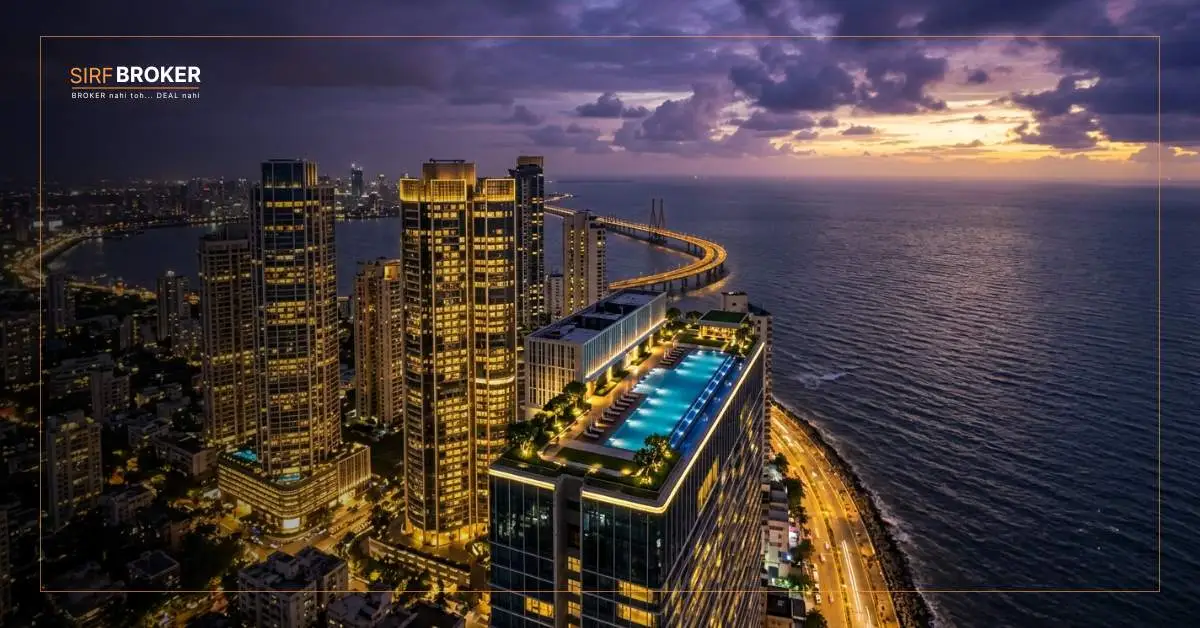
A bungalow on Bhagwan Das Road in Lutyens’ Delhi sold for ₹1,260 crore — one transaction, one property, one of India’s most valuable residential deals ever recorded. In Mumbai, ₹10 crore-plus homes generated ₹18,512 crore in sales in just the first six months of 2026. In Hyderabad, Bengaluru, and Chennai combined, 811 ultra-luxury transactions above ₹10 crore closed in FY26, worth ₹11,246 crore. India’s ultra-luxury residential market is no longer a footnote in the broader housing story. It has become one of the defining narratives of Indian real estate in 2026.
This article is a comprehensive look at the ultra-luxury market across India’s key cities — who is buying, what they are paying, which cities are growing fastest, what is driving the demand, and what brokers who want to operate in this segment need to understand before they approach their first ultra-luxury client.
Ultra-luxury in India is typically defined as residential property priced above ₹10 crore — a threshold that covers large-format luxury apartments, premium villas, heritage bungalows, and branded residences. The buyer profile is UHNWI (ultra-high-net-worth individual): industrialists, technology founders and early employees, senior corporate professionals, and increasingly, second-generation inheritors of family business wealth who are making their own independent real estate decisions. Understanding this buyer — their motivations, their decision process, and their expectations of the advisors who work with them — is the foundation of any serious ultra-luxury brokerage practice.
| India Ultra-Luxury Housing — Key Numbers 2026 Mumbai ₹10cr+ market value, H1 CY2026 ₹18,512 crore (+12% YoY) Mumbai ₹20–40cr segment growth (3 years) 136% (66 → 156 units, H1 CY’23 to H1 CY’26) Mumbai above ₹40cr transactions, H1 CY2026 41 transactions South India ultra-luxury sales (₹10cr+), FY26 811 units — ₹11,246 crore Hyderabad (South India leader), FY26 625 units — ₹8,562 crore Lutyens Delhi — single transaction record ₹1,260 crore (Bhagwan Das Road bungalow) |
Mumbai: India’s Ultra-Luxury Capital and What the ₹18,512 Crore Number Reveals
Mumbai’s ₹10 crore-plus residential market generated ₹18,512 crore in sales in the first half of CY2026 — a 12% year-on-year increase from ₹16,518 crore in H1 CY2025, according to research by India Sotheby’s International Realty and CRE Matrix. This figure makes Mumbai’s ultra-luxury segment one of the most consistently performing asset classes in Indian real estate — growing every half-year period for three consecutive years regardless of broader macroeconomic headwinds.
The data within the Mumbai number is as interesting as the headline. Homes priced between ₹10 crore and ₹20 crore continue to account for the largest volume share. But the fastest-growing sub-segment is ₹20 crore to ₹40 crore — which has grown 136% in three years, from 66 transactions in H1 CY2023 to 156 transactions in H1 CY2026. This is a category that barely existed as a meaningful market five years ago. The appetite for genuinely premium, large-format, amenity-rich urban residences at this price point has expanded faster than almost any other real estate sub-segment in India.
At the very top — above ₹40 crore — 41 transactions closed in H1 CY2026. Each of these represents a buyer committing more than what most Indians will earn in several lifetimes to a single residential purchase. The buyers in this category are making decisions based almost entirely on scarcity, privacy, and social signalling rather than investment return or price appreciation. The properties commanding these values are typically large-format apartments in ultra-premium buildings like Palais Royale or Lodha Malabar on Walkeshwar, rare sea-view penthouses, and bungalow plots in South Mumbai.
The geographic concentration of Mumbai’s ultra-luxury market tells its own story: South Mumbai — Lower Parel, Worli, Prabhadevi, Bandra — remains the dominant zone. The emergence of Bandra-Kurla Complex (BKC) as a luxury residential micro-market alongside its commercial identity is a relatively recent development, driven by senior professionals who want to live close to Mumbai’s primary commercial district and are willing to pay the premium for the convenience. Versova and Juhu are seeing a quiet but sustained demand from entertainment industry figures and media entrepreneurs for sea-proximity bungalows.
Hyderabad: India’s Surprise Ultra-Luxury Leader
If Mumbai’s ultra-luxury dominance is expected, Hyderabad’s emergence as India’s leading ultra-luxury market in South India is the more instructive story. According to data reported by Business Standard for FY26, South India’s three major cities — Hyderabad, Bengaluru, and Chennai — recorded 811 combined ultra-luxury sales (above ₹10 crore) worth ₹11,246 crore. Hyderabad alone contributed 625 of those units at a combined value of ₹8,562 crore — more than 76% of South India’s ultra-luxury transaction value.
This is a remarkable figure for a city that a decade ago was not in any serious conversation about ultra-luxury residential markets. The factors driving Hyderabad’s ultra-luxury emergence are specific and instructive: a large and wealthy technology founder community generated by the city’s decades of IT investment has matured to the point where liquidity events — startup acquisitions, ESOPs, secondary share sales — are creating new UHNWI buyers. The city also has a well-established pharma and manufacturing industrial base whose second and third generation is now at peak wealth accumulation age.
Hyderabad’s ultra-luxury market is concentrated in a small number of micro-markets: Banjara Hills (Road No. 12 area), Jubilee Hills, Kokapet, and the newer Tellapur/Narsingi corridor. These areas have seen aggressive launches of large-format luxury villas and gated villa communities by developers including Prestige, Lodha (through their Hyderabad entry), and large local developers like Ramky and Aparna. The villa format — independent or semi-independent housing with private garden or terrace space — has significantly outperformed apartment format at ultra-luxury price points in Hyderabad, reflecting the preferences of a buyer class whose primary frame of reference for premium living is the large independent house rather than the urban high-rise apartment.
Lutyens Delhi: The Market with 600 Properties and No Comparable
Lutyens’ Delhi — formally the Lutyens’ Bungalow Zone or LBZ — occupies 28 square kilometres of prime central Delhi. It contains approximately 3,000 bungalows, of which around 600 are privately owned. This is not a market. It is an archive. Every transaction that occurs in LBZ is a bespoke event — there is no standard comparable, no price-per-sq-ft benchmark that applies across the zone, and no public listing of available properties. Properties in Lutyens’ Delhi are transferred through private negotiations between parties who typically know each other or are connected through a very small network of advisors.
The ₹1,260 crore transaction on Bhagwan Das Road — one of the most significant residential deals in India’s documented history — illustrates the market’s characteristics. The property was acquired in 2015 for ₹304 crore and sold in 2026 for ₹1,260 crore: a 315% appreciation over 11 years, or approximately 13% compounded annually, with zero rental income during the ownership period (many Lutyens properties are not leased). The buyer’s motivation was not financial return — it was asset ownership in the most exclusive and supply-constrained residential address in the country, with the social and political adjacencies that come with it.
For brokers, Lutyens’ Delhi is not an addressable market in the conventional sense. Transactions happen through relationships that take years to build. The key insight for any broker thinking about this space: the first step is to become known to the advisors — CAs, bankers, and lawyers — who work with Delhi’s HNI and UHNWI families. The property transaction follows the relationship, not the other way around.
Who Is Buying Ultra-Luxury Real Estate in India in 2026
Understanding the ultra-luxury buyer profile is the prerequisite for serving them. The category is not monolithic — it contains several distinct buyer types with different motivations, time horizons, and expectations.
| Buyer Type | Primary Motivation | Typical Price Point | Decision Timeline |
| Technology founder / liquidity event | Lifestyle upgrade, wealth parking | ₹10–30 crore | 6–18 months post-liquidity |
| Industrial / family business heir | Social status, family legacy | ₹20–100 crore+ | Long — often 2–5 years |
| Senior corporate professional | Retirement home, asset preservation | ₹10–20 crore | 12–24 months |
| NRI returning or investing from abroad | India base, family home, investment | ₹10–40 crore | Often event-driven (return trip) |
| Institutional / family office investment | Capital preservation, yield through lease | ₹20 crore+ | Opportunistic — fast when right |
What Brokers Must Understand to Operate in Ultra-Luxury
The ultra-luxury segment rewards a completely different broker operating model than the mass market. Volume is not the strategy — depth is. A broker who closes two or three ultra-luxury transactions per year is generating more revenue than one who closes forty mid-market deals. The qualification to play in this space is not just market knowledge — it is the trust and discretion to be introduced to a buyer whose privacy is their primary concern.
Several specific things distinguish ultra-luxury brokerage from other segments. First, the transaction is never just about the property. Ultra-luxury buyers are buying a lifestyle, a social context, and a future optionality. The broker who can articulate why a particular building or locality has the right addressbook — who their neighbours would be, which schools are nearby, what the community’s reputation is — is adding value that price-per-sq-ft comparisons cannot. Second, confidentiality is absolute. In this market, the identity of the buyer and the terms of the transaction are private information. Brokers who discuss client details with third parties to demonstrate their access will be permanently excluded from the network. Third, patience is not optional. Ultra-luxury decisions take time. A buyer who expresses interest in January may close in October. The relationship must be nurtured without pressure — the moment a broker becomes transactional with an ultra-luxury client, the relationship is over.
Sirf Broker POV: Ultra-Luxury Is Not a Market You Enter. It Is a Market You Earn Access To.
The data is clear: India’s ultra-luxury residential market is growing, deepening, and spreading geographically — from Mumbai to Hyderabad, from South Mumbai to Lutyens Delhi and increasingly to Bengaluru and Chennai’s premium villa corridors. For brokers, the temptation is to look at the ₹18,512 crore Mumbai number and think: how do I get a piece of this?
The honest answer is: not quickly, and not by changing your pitch deck. Ultra-luxury brokerage in India is built on a very small number of deep relationships with advisors and families who are potential buyers or who know potential buyers. These relationships are built over years, through consistent professional conduct, demonstrated discretion, and a genuine track record of successful transactions. There are no shortcuts.
What brokers can do today is invest in the prerequisites: build genuine product knowledge of the ultra-luxury projects in your city, develop relationships with the lawyers and bankers who work with UHNWI clients, and ensure that your own professional presentation — your brand, your communication, your digital presence — is consistent with the standards your future ultra-luxury clients expect. A broker with a generic social media feed and no professional positioning cannot credibly service a client looking to spend ₹20 crore on a home. The market will not come to you. You need to build toward it.
The brokers who will dominate India’s ultra-luxury market in 2030 are making the right investments right now. That is the only timeline that matters.
Conclusion
India’s ultra-luxury housing market in 2026 is recording numbers that would have been unimaginable a decade ago. Mumbai at ₹18,512 crore, Hyderabad leading South India with 625 transactions above ₹10 crore, and individual bungalow transactions in Lutyens Delhi exceeding ₹1,000 crore — this is a market that has achieved genuine scale and depth. For brokers with the patience to build toward it, the opportunity is exceptional.
For any broker working in the premium segment today, ensure your fundamentals are in place: know how to verify a property before presenting it and understand how brokerage commission structures work at every price point.
Frequently Asked Questions
How big is India’s ultra-luxury housing market in 2026?
Mumbai’s ₹10 crore-plus residential market alone generated ₹18,512 crore in sales in H1 CY2026 — a 12% increase year-on-year, according to India Sotheby’s International Realty and CRE Matrix. South India’s three leading cities (Hyderabad, Bengaluru, Chennai) recorded 811 ultra-luxury transactions worth ₹11,246 crore in FY26. Including Delhi-NCR and other markets, India’s combined ultra-luxury residential transaction value in 2026 is among the highest ever recorded for the market.
Which city leads India’s ultra-luxury housing market?
Mumbai has the largest absolute transaction value for ultra-luxury residential (₹18,512 crore in H1 CY2026). However, Hyderabad has emerged as the dominant ultra-luxury market in South India, contributing 625 units worth ₹8,562 crore in FY26 — more than 76% of South India’s combined ultra-luxury value — driven by the wealth generated by the city’s mature technology and pharma ecosystem.
What is driving ultra-luxury home sales in India in 2026?
The primary drivers are: maturation of technology sector wealth with liquidity events (IPOs, secondary sales, acquisitions) creating new UHNWI buyers; second-generation family business wealth reaching peak purchasing age; returning NRI demand; and a shift in wealth preservation philosophy toward hard assets. The ultra-luxury segment is also driven by genuine scarcity — there are very few Grade A projects that can command ₹10 crore-plus pricing, which creates strong pricing power for well-located, well-amenitied developments.
What is the Lutyens’ Bungalow Zone and why are properties there so expensive?
The Lutyens’ Bungalow Zone (LBZ) is a 28-square-kilometre area of central New Delhi housing approximately 3,000 bungalows, of which around 600 are privately owned. The area was designed by Edwin Lutyens as part of New Delhi’s original planning in the early 20th century and contains many of Delhi’s most iconic residential addresses. Properties command extraordinary prices — typically ₹200 crore to well over ₹1,000 crore for large bungalows — due to absolute supply scarcity, strict development restrictions that prevent new construction, central location, and the social and political prestige associated with the address.
How is ultra-luxury brokerage different from standard residential brokerage?
Ultra-luxury brokerage requires a relationship-first approach rather than a transaction-first one. Buyers in this segment prioritise privacy, discretion, and the quality of their advisor’s judgment over price negotiation. Decisions take months or years. The broker’s value is in curating access to appropriate properties, understanding the buyer’s lifestyle requirements deeply, and maintaining absolute confidentiality. Professionally, ultra-luxury brokers typically operate through networks of UHNWI advisors — bankers, CAs, lawyers — rather than through digital portals or mass marketing.
What should a broker do to build a practice in India’s ultra-luxury segment?
The prerequisites are: deep product knowledge of the limited number of genuinely ultra-luxury projects in your city; professional brand consistency across all channels (social media, presentations, communication) that reflects the standards ultra-luxury clients expect; relationships with advisors who work with HNI and UHNWI families; and a track record of successful, discreet transactions in the premium (₹3–10 crore) range before attempting to move upward. Ultra-luxury access is earned through referrals from the network, not claimed through marketing. Building the network takes time — typically two to four years of consistent positioning.