

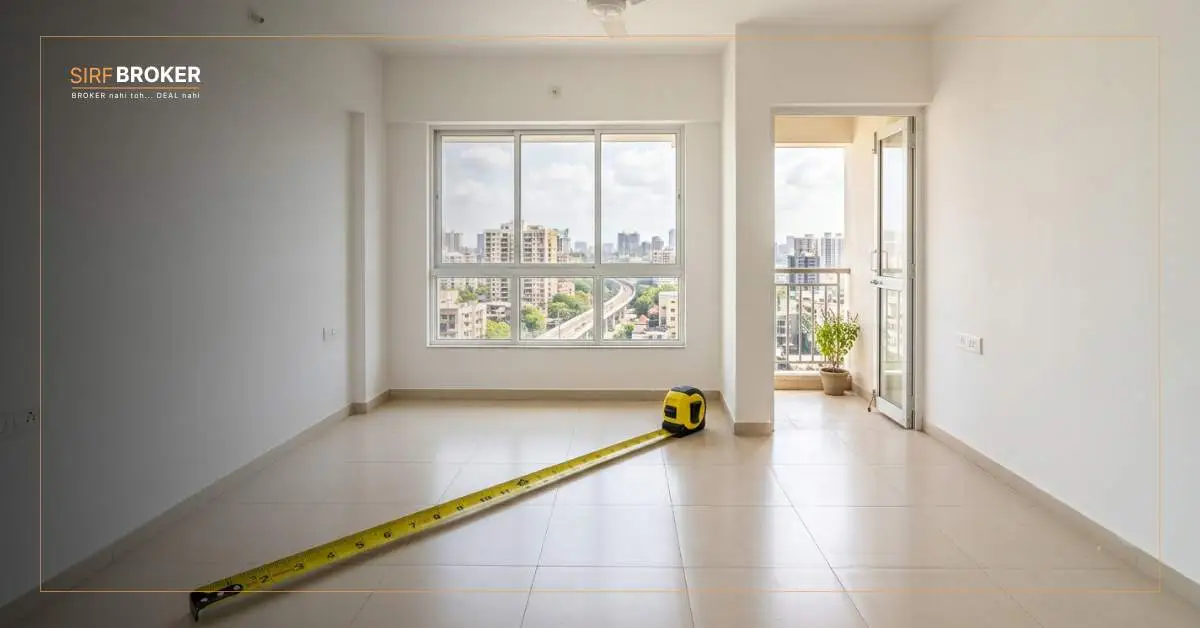
You see a flat advertised as 1,200 square feet. You visit it and it feels smaller than you expected. You move in and realise you are actually living in about 820 square feet. Nothing illegal happened. But nobody explained the difference between the three types of area measurements used in Indian real estate — and you paid the price for that confusion.
This is one of the most common misunderstandings in Indian home buying. The terms carpet area, built-up area, and super built-up area all refer to the same flat — but they measure very different things. Knowing what each one means, and which one you should be using when comparing two properties, can help you make a much smarter buying decision and avoid paying more than you should.
This guide explains all three terms in plain language, with examples. No jargon. No complicated formulas. Just what you need to know before you buy.
| Quick Reference — The Three Area Types Carpet Area The space you actually live in Built-Up Area Carpet area + your flat’s walls Super Built-Up Area Built-up area + shared spaces in the building |
What Is Carpet Area? (The One That Matters Most)
Carpet area is exactly what the name says — it is the area where you can actually lay a carpet. It is the floor space inside your flat, measured from the inside of one wall to the inside of the opposite wall. It includes your bedroom, living room, kitchen, bathrooms, and any internal store room or study. It does not include the thickness of your walls.
Think of it this way: if you were moving into a new flat and you bought a carpet to cover the floor, the area that carpet would need to cover is your carpet area. This is the space where your life actually happens — where your furniture goes, where your family spends time, where you cook and sleep and watch television.
Since 2017, RERA (Real Estate Regulatory Authority) has made it mandatory for all registered residential projects in India to quote prices based on carpet area. This was a major reform. Before RERA, builders were allowed to quote prices based on super built-up area, which made comparisons between projects very difficult and often misled buyers. RERA brought honesty to this process. If a builder is RERA-registered, the carpet area stated in your agreement is legally binding.
In most residential buildings in India, the carpet area of a flat is typically 65% to 70% of its super built-up area. So if a flat is advertised as 1,000 super built-up square feet, your actual living space is likely to be between 650 and 700 square feet.
What Is Built-Up Area? (Carpet Area Plus Your Walls)
Built-up area is carpet area plus the thickness of your flat’s walls. That is the only difference. Your flat has walls — those walls take up physical space. Built-up area measures the total footprint of your flat from the outer edge of one boundary wall to the outer edge of the opposite one, including the walls themselves.
Built-up area also includes things like your balcony (if it is enclosed) and any flower bed or utility ledge that is part of your flat but not technically inside the main living area. The walls of a typical apartment add about 10% to 15% to the carpet area. So if your carpet area is 700 square feet, your built-up area will be roughly 770 to 800 square feet.
Built-up area is a less commonly used term today because RERA has made carpet area the standard. But you will still see it in older buildings, resale properties, and in some builder communications. When comparing two properties, always convert both to carpet area before comparing — it is the only truly honest comparison.
What Is Super Built-Up Area? (The Number Builders Used to Advertise)
Super built-up area is the biggest of the three numbers — and historically the most misused. It takes your built-up area and adds your proportionate share of all the common spaces in the building. Common spaces include the entrance lobby, lifts, staircases, corridors on your floor, the gym, the clubhouse, the swimming pool area, the security cabin, and any other shared facility.
Here is the key point: you do not actually live in or use most of these spaces all day. You pass through the corridor. You use the lift a few times a day. You might visit the gym a few times a week. But the super built-up area calculation adds the full proportionate cost of all these spaces to your flat’s measurement — and then charges you per square foot on the resulting number.
The ratio of super built-up area to carpet area varies significantly from building to building. In a no-frills building with minimal common areas, the difference might be 20 to 25%. In a luxury building with a large lobby, multiple lifts, swimming pool, and extensive landscaping, the difference can be 35 to 40%. Two flats advertised at 1,200 super built-up square feet can have very different actual living spaces depending on how generous the builder has been with common amenities.
| Example Flat | Carpet Area | Built-Up Area | Super Built-Up Area |
| 2BHK in a standard building | 680 sq ft | 750 sq ft | 900 sq ft |
| 2BHK in a luxury complex | 680 sq ft | 750 sq ft | 1,050 sq ft |
| Same carpet area — different price | Same living space | 150 sq ft more charged |
Which Number Should You Use When Comparing Properties?
Always use carpet area when comparing two properties. This is the only number that tells you how much space you are actually getting to live in.
Here is a simple three-step process you can use for any property:
Step 1: Ask the builder or broker for the RERA carpet area of the flat. If the project is RERA-registered, this is a legal document number — it must be accurate.
Step 2: Calculate the price per square foot of carpet area by dividing the total price by the carpet area. For example: if a flat costs ₹60 lakh and has 680 sq ft carpet area, the price per carpet sq ft is ₹8,823. Do the same for every other property you are comparing.
Step 3: Now compare the price per carpet sq ft across all the properties you are considering. The property with the lowest number gives you the most living space per rupee spent — adjusted for location and quality.
This simple calculation is one of the most powerful tools a home buyer has. It cuts through all the marketing language and tells you what you are actually paying for the space you will live in.
Common Questions Home Buyers Ask About Area Measurements
One question that comes up often is: does RERA guarantee that the carpet area I was promised is what I will actually get? The answer is yes, with one exception. RERA allows a variation of up to 3% between the carpet area in your agreement and the actual carpet area at the time of possession. If the variation is more than 3%, you have the right to proportionate price adjustment. Always measure your flat at the time of possession and check it against your sale agreement.
Another common question: what about parking? Parking spaces are typically sold separately and are not included in any of the three area measurements. They are priced per slot, not per square foot, and should be treated as a separate purchase. Ask the builder specifically what is included in the parking price — covered versus open, assigned slot versus first-come basis, and whether the parking deed will be registered in your name.
Finally, for resale flats in older buildings — those built before RERA — you may not have a formal carpet area certificate. In these cases, you or your broker will need to physically measure the flat at the time of purchase and agree on the carpet area before finalising the price. Do not rely on the owner’s stated measurement without verification.
Sirf Broker POV: The Floor You Walk On Is the Only Number That Matters
We have seen buyers spend months comparing two properties and eventually choose the wrong one — because they compared super built-up area to super built-up area from two different builders, both of whom used different loading factors. The comparison was meaningless. The buyer chose the one that looked bigger on paper and ended up with a smaller flat.
This problem still exists in 2026 despite RERA’s carpet area mandate — because not all projects are RERA-registered, because older resale buildings predate RERA, and because some builders continue to lead their marketing with super built-up area even when required to disclose carpet area.
Our position is simple: the only number that matters is carpet area. It is the floor you walk on. It is the space your family lives in. It is what you are paying for. When you buy on any other basis — without converting everything to carpet area per rupee — you are making an incomplete comparison. A good broker will always present you with the carpet area price comparison. If they don’t, ask for it. It is your right as a buyer, and it is the most important number in your purchase decision.
Conclusion
Carpet area, built-up area, and super built-up area are three different ways to measure the same flat. Only carpet area tells you how much space you are actually getting to live in. Use it to compare every property you are considering — calculate the price per carpet sq ft, and let that number guide your decision.
Before you visit any property, read our guide on what to verify before a site visit and make sure you understand how brokerage commission works so there are no surprises.
Frequently Asked Questions
What is carpet area in simple terms?
Carpet area is the actual floor space inside your flat — the area where you can place furniture, walk around, and lay a carpet. It does not include the thickness of your walls. Since 2017, RERA requires all registered residential projects in India to state prices based on carpet area, making it the most honest measurement for home buyers to use.
What is the difference between built-up area and super built-up area?
Built-up area is carpet area plus the thickness of your flat’s boundary walls — typically 10 to 15% more than carpet area. Super built-up area is built-up area plus your proportionate share of all common spaces in the building (lobby, lifts, corridors, gym, pool) — typically 25 to 40% more than carpet area. The more amenities a building has, the larger the gap between carpet area and super built-up area.
Which area should I use when comparing two flats?
Always use carpet area. It is the only number that tells you how much living space you are actually getting. Divide the total price of each flat by its carpet area to get the price per carpet square foot. Then compare that number across properties. This strips away all differences in how builders calculate common area loading and gives you a true apples-to-apples comparison.
What is the loading factor in real estate?
The loading factor is the difference between the super built-up area and the carpet area, expressed as a percentage. A loading factor of 30% means that for every 100 sq ft of carpet area, you are paying for 130 sq ft of super built-up area — the extra 30 sq ft represents your share of common areas. Lower loading factor means more living space per rupee. Typical loading factors range from 20% for simple buildings to 40% for luxury complexes.
Is RERA carpet area accurate?
Yes — RERA carpet area in a registered project is a legally binding figure. However, RERA allows a variation of up to 3% at the time of possession. If the actual carpet area differs by more than 3% from what is stated in your agreement, you are entitled to a proportionate price adjustment. Always physically measure your flat at possession and compare it against your sale agreement carpet area.
How do I calculate the carpet area of a flat myself?
To calculate carpet area yourself, measure the floor area of each room from the inside of one wall to the inside of the opposite wall. Add up the floor area of all rooms — bedroom, living room, kitchen, bathrooms, store room, corridors inside the flat, and any internal areas. Do not include the balcony (it is counted separately under RERA). The total is your carpet area. For a rough estimate when visiting a property, pace out the rooms — an average adult step is about 2.5 feet.