

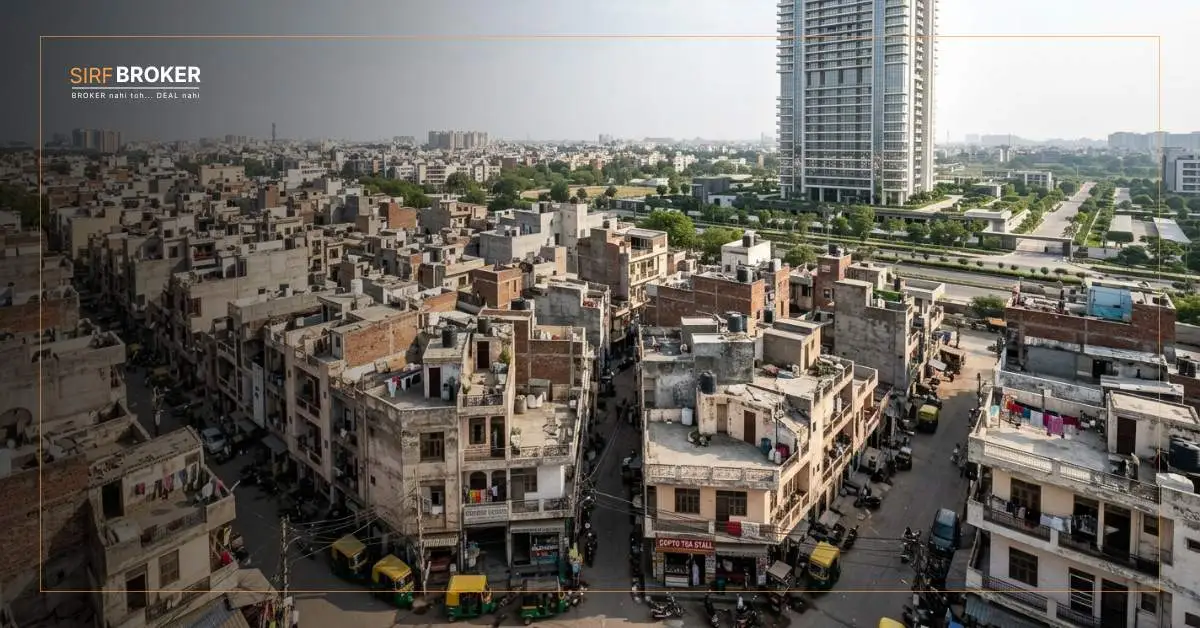
In 2018, affordable housing — residential units priced under ₹50 lakh — accounted for 52.4% of all new property launches across India’s eight major cities. Policy was aligned: PMAY-Urban was active, the government’s “Housing for All by 2022” target was in force, and developers were incentivised through tax exemptions and FSI bonuses to build for the mass market.
By Q2 2026, affordable housing accounted for 6% of new launches.
The collapse of affordable housing supply from more than half of all new inventory to a negligible sliver has happened gradually enough that it barely registered as a single news event — but cumulatively it represents one of the largest structural shifts in Indian residential real estate in the post-RERA era. It has changed who can buy a home in an Indian metro, which buyers are being priced into the rental market permanently, and why the headline sales numbers of 2024-2025 do not reflect the full picture of housing accessibility in India.
| Affordable housing (under ₹50 lakh) — share of new launches in major Indian cities: 52.4% in 2018 → 17.1% by June 2025 → 6% in Q2 2026. Sales of affordable homes declined 15% in H1 2026 to 32,063 units from 37,796 units a year earlier. Launches in the ₹80 lakh–₹2.5 crore range are now the primary developer focus. Source: ANAROCK; The Week, July 2026; BW Businessworld. |
Why Developers Stopped Building Affordable Homes
| THE FOUR FORCES KILLING AFFORDABLE HOUSING SUPPLY Land cost inflation → In every major metro, land cost per sq ft has risen 40-100% since 2019. At current land prices in Gurugram, Bengaluru, or Pune, it is mathematically impossible to deliver a viable 2BHK apartment for under ₹50 lakh unless the developer is working with pre-pandemic land inventory. Infrastructure investment driving connectivity also drives up surrounding land prices — benefiting developers with existing holdings while foreclosing new affordable supply. Construction cost escalation → Steel, cement, and labour costs have risen 25-40% since 2020. The cost to deliver a liveable, RERA-compliant apartment has increased substantially regardless of location. The margin on an affordable unit — already thin — has compressed to the point where many mid-size developers cannot sustain affordable launches without government-linked subsidy support. Premium demand signal → 2022-2025 produced the strongest demand ever seen in the ₹80 lakh–₹3 crore premium segment. Developers followed the money rationally. When premium projects are selling at 2-3x the margin of affordable projects and clearing faster, the capital allocation decision is obvious. The invisible hand pointed firmly away from affordable housing. PMAY policy gap → PMAY-Urban 2.0 has not delivered the supply-side incentives at the scale needed to offset developer economics. The subsidy available for affordable housing developers under current policy has not kept pace with land and construction cost escalation since 2019. The policy framework exists; the economics don’t yet stack for private developers at sufficient scale. |
Who Is Being Priced Out
The affordable housing collapse is not a story about luxury demand being strong. It is a story about who can no longer access formal homeownership in Indian metros.
A household earning ₹60,000-₹1,20,000 per month — which covers a large share of salaried India in tier-1 cities, including teachers, nurses, mid-level government employees, junior IT professionals, and small business owners — has home loan eligibility in the ₹25-55 lakh range at current interest rates of 8.5-9%. The available supply for that buyer in Mumbai, Delhi NCR, Bengaluru, or Pune at that price point has gone from abundant (2018) to negligible (2026).
| The practical outcome: affordable buyers in metro India are not disappearing — they are being permanently displaced into long-term renting, peripheral locations with 90-120 minute commutes, or tier-2 cities. This is a socioeconomic shift with implications for urban productivity, workforce retention, and long-term city competitiveness that extends well beyond the real estate sector. Source: The Week, July 7, 2026; BW Businessworld; Budget 2026-27 analysis, Keystone Real Estate Advisory. |
The Premium Housing Surge — What the Numbers Show
| Price Segment | Share of H1 2026 Sales | H1 2025 Share | Direction |
|---|---|---|---|
| Above ₹1 crore (premium) | 54% | 49% | ▲ Rising |
| ₹50 lakh – ₹1 crore (mid) | ~40% | ~43% | ▼ Declining |
| Under ₹50 lakh (affordable) | ~6% | ~8% | ▼▼ Sharply Declining |
Source: Knight Frank India H1 2026; ANAROCK Q2 2026; The Week July 2026.
What Would It Take to Reverse This
The structural economics of affordable housing in Indian metros cannot be fixed by developer goodwill or market sentiment. Three policy levers could, in combination, create the conditions for a supply revival:
Land subsidy and government land allocation. Providing land at below-market rates (or zero cost) for affordable housing projects — as some state governments have done through land pooling schemes — directly addresses the single largest cost barrier. Maharashtra’s MHADA and Delhi’s DDA land allocation models demonstrate the mechanism; the question is scale.
GST rationalisation for affordable housing. The GST rate on affordable homes (below ₹45 lakh) is effectively zero. Raising the price threshold for the zero-GST category to ₹65-75 lakh to reflect current market realities would expand the affordable segment’s commercial attractiveness without costing the government on already-affordable stock.
PMAY-Urban 2.0 implementation at speed. The scheme exists. The subsidy structure is in place. The pipeline has lagged because state-level implementation capacity varies enormously. The budget has allocated resources; the gap is execution. For the PMAY context: PMAY-Urban 2.0: What Real Estate Brokers Must Explain Before Promising a Subsidy.
What Brokers Must Navigate
For brokers serving buyers with budgets under ₹60 lakh in major metros, the inventory reality is stark: you are working a thin market. The advisory value you can add is geographic reframing (peripheral locations with improving connectivity), timing advice (ready-to-move affordable stock vs under-construction), and policy navigation (PMAY eligibility, stamp duty concessions for first-time buyers). Understanding that the affordable supply problem is structural — not cyclical — allows you to have an honest conversation with buyers about what is actually available and where, rather than promising availability that the market cannot currently deliver. Read: Before You Show the Property: The Verification Checklist Every Broker Should Follow.
Sirf Broker POV
India’s residential real estate market is running a dual story that rarely gets told in the same article: record sales, record investment, record prices at the top — and a structural collapse of affordable supply at the bottom. These are not contradictory. They are two sides of the same developer incentive structure.
The honest assessment: without significant policy intervention on land and construction cost economics, private developers have no financial reason to build affordable housing in tier-1 metros. The numbers are unambiguous. What they were building profitably in 2018 at ₹40 lakh they cannot build at that price in 2026 — not because they lack capability, but because inputs cost more and they have access to a margin-accretive alternative in the premium segment.
The policy conversation that India needs to have is not about adding more PMAY units to a presentation slide. It is about whether the land-cost, GST, FSI, and development charge structure in tier-1 metros can be restructured enough to make affordable housing commercially viable again for private developers at scale. That is a state-level political economy question as much as a housing policy question. Until it’s answered, the 6% share will keep declining — and a growing proportion of salaried metro India will pay rent for the rest of their careers.
Conclusion
Affordable housing’s share of new launches in India has collapsed from 52% in 2018 to 6% in Q2 2026 — driven by land cost inflation, construction cost escalation, premium demand dominance, and insufficient policy incentive to offset developer economics. Homes above ₹1 crore now represent 54% of all sales. The structural impact is a permanent displacement of lower-income salaried households from formal homeownership in metro India. Reversing this requires policy action on land, GST thresholds, and PMAY implementation — not just developer encouragement.
Frequently Asked Questions
1. What is affordable housing in India and how is it defined?
Affordable housing in India is typically defined as residential units priced under ₹45-50 lakh, targeting households with annual incomes under ₹6-18 lakh. Under GST rules, properties priced under ₹45 lakh with carpet area under 60 sqm (90 sqm in non-metros) qualify for zero GST. PMAY-Urban 2.0 targets beneficiaries in the EWS, LIG, and MIG income categories.
2. Why has affordable housing supply dropped so sharply in India?
Four forces: land cost inflation (40-100% rise in metro land prices since 2019 makes sub-₹50L development non-viable); construction cost escalation (25-40% rise in steel, cement, labour); premium demand signal (2022-2025 premium surge created a commercially superior alternative for developers); and PMAY policy gaps (subsidies haven’t kept pace with cost inflation). Source: ANAROCK; BW Businessworld.
3. What share of India’s housing sales are premium (above ₹1 crore) in 2026?
54% of total H1 2026 residential sales across India’s major cities were in units priced above ₹1 crore — up from 49% in H1 2025. This represents a structural shift, not a one-quarter anomaly, driven by both genuine premium demand and the absence of affordable supply alternatives. Source: Knight Frank India H1 2026.
4. Is PMAY-Urban 2.0 addressing the affordable housing gap?
PMAY-Urban 2.0 exists with a subsidy structure and budget allocation. The challenge is implementation pace, which varies significantly across states, and the fact that the subsidy quantum has not kept pace with land and construction cost inflation since the original PMAY framework was designed. The scheme is active — but its scale relative to the demand shortfall remains insufficient.
5. Which cities have the most affordable housing available in India in 2026?
Affordable supply is more available in tier-2 cities (Pune periphery, Ahmedabad, Jaipur, Lucknow) and in peripheral zones of tier-1 metros (Greater Noida, Navi Mumbai, Rajarhat in Kolkata). Within metro core areas, sub-₹50L inventory is now negligible in most major cities.
6. What does the affordable housing shortage mean for real estate brokers?
Brokers serving buyers under ₹60 lakh must reframe their geographic advisory — peripheral locations with improving metro/highway connectivity, ready-to-move resale properties in older buildings, and PMAY-eligible projects where the subsidy materially changes affordability. Understanding the structural supply constraint allows brokers to set accurate expectations rather than over-promising availability.