

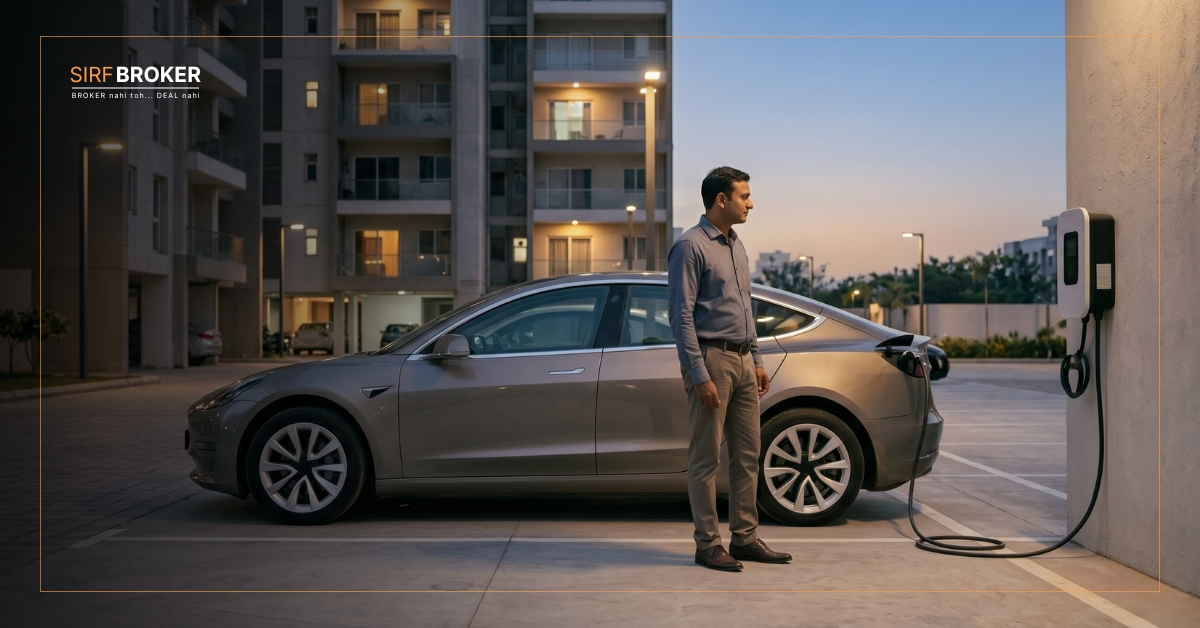
A few years ago, parking was a simple real estate question.
A buyer asked, “Parking milegi?”
A broker replied, “Yes sir, one covered parking included.”
That answer is no longer enough.
The new question is sharper:
“Can I charge my electric vehicle here?”
This one question is slowly changing how people judge residential societies, office buildings, malls, hotels, retail spaces, parking lots, warehouses and even commercial land.
EV charging is not only about cars. It is becoming a property infrastructure question.
| EV charging is becoming the new parking. Earlier, buyers checked whether a property had parking. Now, future-ready buyers will ask whether that parking can support charging safely, practically and legally. |
For real estate brokers, this is not a small trend. This is a new advisory opportunity.
The broker who understands EV charging will not only talk about parking. They will talk about electrical load, society permission, safe wiring, metering, billing, fire safety, future demand and building readiness.
That is the difference between a listing broker and a future-ready property advisor.
Why EV Charging Is Suddenly a Real Estate Topic
India’s EV market is no longer a niche conversation.
According to NITI Aayog, EV sales in India increased from around 50,000 units in 2016 to around 2.08 million units in 2024. India is also targeting a much larger EV share in total vehicle sales by 2030.
The government is supporting the charging ecosystem as well. PIB has reported that under the PM E-DRIVE scheme, the Government of India has allocated around ₹2,000 crore for public EV charging infrastructure. The scheme aims to support approximately 72,000 public EV charging stations across national highways, metro cities, toll plazas, railway stations, airports, fuel outlets and state highways.
The International Energy Agency’s Global EV Outlook 2025 notes that India may need to add around 50,000 public charging points annually through 2030 to meet projected charging requirements. It also states that PM E-DRIVE includes support for a targeted 22,100 EV chargers for electric four-wheelers through March 2026.
These numbers matter for real estate because charging infrastructure does not exist in the air. It has to be installed somewhere.
That “somewhere” is usually a property.
| The EV transition is not only a vehicle transition. It is a parking, power, safety, society-management and commercial-property transition. |
This is where Sirf Broker’s audience needs to pay attention.
The Real Estate Shift: Parking Is Becoming Infrastructure
Traditionally, parking was treated as dead space.
It was a slot. A number. A basement bay. A covered or open allocation. Buyers asked whether it was included or charged separately.
EVs change this logic.
Once a buyer owns an electric vehicle, parking is no longer just a place to keep the car. It becomes a charging point, a power connection, a billing issue, a safety concern and a future utility space.
This means parking is becoming active infrastructure.
For brokers, this is a major mindset shift.
Earlier, a broker could say:
“Sir parking included hai.”
Now, a better broker should ask:
- Is the parking dedicated or common?
- Can wiring reach this parking slot?
- Does the building have enough electrical load?
- Does the RWA allow private EV chargers?
- Will charging be metered separately?
- Is basement charging allowed under safety rules?
- Can the building support 10, 50 or 100 EVs in the future?
| A parking slot with no charging readiness may become less attractive to future EV-owning buyers. A parking slot with planned charging infrastructure becomes a stronger property feature. |
The EV-Ready Property Formula
EV readiness is not one feature. It is a combination of several property-level factors.
A building does not become EV-ready just because one charger has been installed near the gate. It becomes EV-ready when charging can happen safely, repeatedly and fairly without creating disputes or overloading the building.
| EV-Ready Property Score = Dedicated Parking + Electrical Load + Safe Wiring + Metering + Society Permission + Fire Safety + Future Scalability A property is truly EV-ready when charging can happen safely, legally, conveniently and repeatedly without creating conflict in the building. |
This framework is useful because it protects brokers from overpromising.
Instead of saying, “Charger lag jayega,” a broker can use this framework to check whether the building is actually ready.
Why Brokers Must Understand EV Charging Before Buyers Start Demanding It
Most brokers wait until buyers ask a question.
Better brokers raise the right question before the buyer does.
EV charging is one of those questions.
Today, not every buyer owns an EV. But many buyers are thinking about future usage. A family may buy a petrol car today and an EV in three years. A tenant may shift from a normal office to an EV-enabled office building. A commercial landlord may lose a premium tenant because the property cannot support charging.
That is why brokers need to understand EV charging before it becomes a common buyer demand.
| The best brokers do not only answer today’s buyer questions. They prepare clients for tomorrow’s property expectations. |
This is especially important for brokers working in:
- Premium residential apartments
- New gated societies
- Independent houses and villas
- Office buildings
- Malls and retail complexes
- Hotels and highway properties
- Commercial parking assets
- Warehouses and logistics hubs
EV readiness will not matter equally in every property. But where it matters, it can become a decision filter.
Residential Real Estate: The Real Issue Is Not the Charger, It Is the Society
For apartment buyers, EV charging often looks simple from the outside.
Buy a charger. Fix it near your parking. Plug in the car.
In reality, apartment EV charging can become complicated because the parking area is shared infrastructure.
The buyer may own the vehicle. The flat may have dedicated parking. But the wiring route, electrical load, basement safety, billing system and approval process involve the society, RWA, maintenance team or builder.
This is why society policy matters.
Residential buyers should ask:
- Does the society have an EV charging policy?
- Is personal charger installation allowed?
- Is the parking slot fixed and legally allotted?
- Can wiring safely reach the parking slot?
- Will the charger connect to the owner’s meter or a common meter?
- Is separate billing available?
- Is the electrical load sufficient?
- Has a qualified electrician or consultant reviewed the setup?
- Can basement charging be done safely?
- What happens when more residents buy EVs?
| For apartment societies, EV charging is not only a buyer convenience issue. It is a building-management issue. |
This is where a broker can add real value.
Instead of casually saying, “Society mein charger lag jayega,” the broker should verify if the society has already handled EV charger permissions or if the buyer will face resistance later.
The Society Conflict Problem: Why EV Charging Can Create Disputes
EV charging can create conflict when there is no clear policy.
One resident may install wiring from their meter. Another may object because the wiring passes through common areas. The RWA may ask who will pay for load upgrades. A third resident may ask why the electricity is being billed through common maintenance. Basement safety concerns may be raised. Parking allocation disputes may begin.
These conflicts are not theoretical. They are natural whenever a private vehicle need enters shared building infrastructure.
A good EV policy can prevent this.
A strong society EV policy should clarify:
- Who can install a charger?
- Where can chargers be installed?
- Who pays for wiring and installation?
- Who pays for load enhancement if needed?
- How will electricity consumption be metered?
- Which safety standards must be followed?
- Who maintains the charger?
- Whether common chargers will be installed?
- How future EV demand will be managed?
For brokers, this becomes a due-diligence point.
If a premium buyer owns an EV, the broker should not only show the flat. The broker should ask the society or builder about EV charging permissions.
Commercial Real Estate: EV Charging Can Change Footfall and Dwell Time
In commercial real estate, EV charging has a different meaning.
For homes, EV charging is a daily convenience.
For commercial properties, EV charging can become user engagement.
A mall with charging points can attract EV-owning customers who may spend time shopping or eating while the vehicle charges. A hotel with charging can attract road-trip travellers and business users. An office with charging can appeal to employees and corporate tenants. A retail plaza can use charging as an added reason for customers to stop.
This does not mean EV chargers automatically increase property value. That would be exaggerated.
But in the right location, with the right user base, EV charging can improve property utility.
| In commercial real estate, EV charging is useful when it matches user behaviour. It works best where people already park for meaningful time: offices, malls, hotels, hospitals, highways and large retail destinations. |
EV Charging and Different Property Types
EV charging will not affect every property in the same way.
Its importance depends on how people use the property and how long vehicles remain parked there.
| Property Type | Why EV Charging Matters | What Brokers Should Check |
|---|---|---|
| Apartment society | Residents park overnight, making home charging highly practical. | Dedicated parking, RWA approval, electrical load, metering and billing. |
| Independent house | Charging is usually easier because parking and power control are private. | Sanctioned load, earthing, charger location and safe installation. |
| Office building | Employees and tenants park for long hours during work. | Tenant demand, common parking policy, billing model and access control. |
| Mall or retail complex | Charging may increase dwell time and attract EV-owning customers. | Parking flow, charger operator tie-up, visibility and charging duration. |
| Hotel | Travellers and business guests value charging convenience. | Guest access, billing, charger type and safety process. |
| Highway property | Long-distance EV users need reliable charging stops. | Grid connection, transformer capacity, food/retail co-location and parking time. |
| Warehouse/logistics hub | Electric fleet adoption may create demand for depot or fleet charging. | Power load, fleet parking, charging schedule, yard movement and transformer capacity. |
The Warehouse and Fleet Charging Angle Brokers Should Not Ignore
Most people think EV charging is about private cars.
That is only one part of the story.
Commercial vehicles, delivery fleets, buses, logistics operators and warehouse-linked vehicles may also move toward electrification over time. When that happens, EV charging becomes a logistics real estate question.
A warehouse or logistics hub may need:
- Fleet parking zones
- High electrical load
- Charging schedule management
- Transformer capacity
- Safe battery charging areas
- Fire safety planning
- Driver rest areas during charging
- Separate movement paths for vehicles
This is different from installing one charger in a residential parking slot.
Fleet charging is operational infrastructure.
| For logistics and warehouse real estate, EV readiness may not mean one charging point. It may mean power planning, yard design, fleet movement, safety systems and operational scheduling. |
Industrial and warehouse brokers should start learning this now.
Future logistics tenants may not only ask about clear height, dock levelers and truck access. They may also ask about electrical load and fleet charging feasibility.
The Broker’s EV Charging Checklist
Brokers do not need to become electrical engineers.
But they do need to ask better questions.
| EV Check | Why It Matters | What Broker Should Ask |
|---|---|---|
| Dedicated parking | Charging is easier when the parking slot is fixed and identifiable. | Is parking fixed, allotted and close enough for wiring? |
| Electrical load | Insufficient load can make charging difficult or unsafe. | Does the building have capacity for EV charging now and later? |
| Wiring route | Long or unsafe wiring through common areas can create disputes. | Can wiring be done safely without disturbing common areas? |
| Society permission | RWAs and societies may have rules for charger installation. | Is EV charger installation already allowed or documented? |
| Metering and billing | Electricity cost must be tracked fairly. | Will charging be on personal meter, sub-meter or shared billing? |
| Fire and electrical safety | Charging must be installed professionally, especially in basement parking. | Has a qualified electrical/fire safety professional reviewed installation? |
| Future scalability | More residents or tenants may buy EVs later. | Can the building support multiple chargers in future? |
What Brokers Should Actually Say to Clients
This is where brokers can immediately improve their advisory language.
Do not overpromise.
Do not casually say charging can be installed without checking.
Use better language.
| Don’t say: “Sir parking hai, charger toh lag hi jayega.” Say instead: “Sir, EV charging ke liye sirf parking enough nahi hoti. Dedicated parking, electrical load, society permission, wiring route, metering, billing aur safety approval check karna padega. Pehle building ki EV readiness verify karte hain.” |
This is how a broker sounds professional.
The buyer may not know these questions. But if the broker raises them first, trust increases immediately.
The Hidden Risk: Charging Without Planning
EV charging sounds simple, but poor installation can create serious problems.
Buildings should not allow random wiring, extension cables, informal basement charging or unapproved electrical work.
Common mistakes include:
- Using temporary wiring for permanent charging.
- Installing chargers without load assessment.
- No separate metering or billing clarity.
- Parking disputes between residents.
- Basement charging without safety review.
- No policy from RWA or society management.
- Assuming one charger solution works for every building.
- Ignoring future demand when more residents buy EVs.
| EV charging should be planned like building infrastructure, not treated like a temporary appliance connection. |
This is especially important in older apartment societies where electrical load, parking design and wiring routes were never planned for EV charging.
Investor POV: Will EV-Ready Properties Get an Advantage?
EV charging alone will not make a bad property good.
This needs to be said clearly.
A poor-location property with weak demand does not become a strong investment because one EV charger is installed. But in the right market, with the right buyer profile, EV readiness can become a preference factor.
For residential investors, an EV-ready society may appeal to young professionals, premium tenants and future-focused families.
For commercial investors, EV charging can improve property positioning in offices, malls, hotels, retail complexes and parking assets.
For landlords, EV readiness can reduce future friction when more tenants start asking for charging access.
But investors should check demand before spending.
- Are EV users already present in the catchment?
- Is the property premium enough for buyers to care?
- Is charging demand residential, office, retail or highway-linked?
- Can the property recover charging-related investment?
- Is the charging setup scalable?
- Will EV readiness improve leaseability or only look good in marketing?
| EV readiness is not a magic appreciation tool. It is a future-readiness feature that can improve convenience, tenant appeal and long-term property relevance when the user demand is real. |
Buyer POV: What Should You Ask Before Buying?
If you already own an EV or plan to buy one in the next few years, do not leave charging as an afterthought.
Ask these questions before finalising the property:
- Is parking dedicated or open/common?
- Does the society allow personal EV charger installation?
- Is there a written EV charging policy?
- Is there enough electrical load?
- Will charging be billed separately?
- Who pays for wiring and charger installation?
- Can the charger be installed safely in basement or stilt parking?
- Are common chargers available?
- Can the building support more EVs in future?
This is not overthinking.
This is future-proofing your property decision.
Landlord and Society POV: EV Charging Needs Policy Before Conflict Begins
RWAs, apartment associations and commercial landlords should not wait for disputes to begin.
They need a clear EV charging policy.
A good EV charging policy should clarify:
- Who can install chargers?
- Where chargers can be installed?
- Who pays installation cost?
- Who pays for electrical load enhancement?
- How electricity usage will be billed?
- What safety standards must be followed?
- Who maintains the charger?
- Whether common chargers will be installed?
- How future demand will be managed?
Without policy, EV charging becomes a source of conflict.
With policy, it becomes a value-added facility.
Final Sirf Broker View
EV charging is no longer only a car conversation.
It is becoming a real estate conversation.
Homes, offices, malls, hotels, warehouses and parking spaces will increasingly be judged by whether they can support the mobility habits of the future.
But brokers must not oversell it.
A property is not future-ready just because the brochure says “EV charging provision.” Buyers and tenants must check parking, load, wiring, permissions, metering, billing, fire safety and scalability.
| The future broker will not only say “parking available.” They will say, “This property is EV-ready, and here is what we have verified.” |
For buyers, EV charging means daily convenience.
For tenants, it means property preference.
For landlords, it means future readiness.
For investors, it means long-term relevance.
For brokers, it means a new advisory edge.
Parking used to be enough. Now, charging readiness is becoming part of the property conversation.
Frequently Asked Questions (FAQs)
1. Is EV charging becoming important in Indian real estate?
Yes. As EV adoption grows, buyers and tenants are increasingly asking whether homes, offices, malls, hotels and parking spaces can support EV charging safely and practically.
2. Does every apartment society allow EV charger installation?
Not always. Some societies have clear EV charging policies, while others may require approval from the RWA or apartment association. Buyers should verify this before purchase.
3. Is parking enough for EV charging?
No. Parking is only the starting point. EV charging also needs electrical load, safe wiring, metering, billing clarity, society permission and safety compliance.
4. Can EV charging improve property value?
EV charging alone will not make a weak property valuable. But in future-ready markets, it can improve convenience, tenant appeal and long-term relevance.
5. What should brokers check before claiming a property is EV-ready?
Brokers should check dedicated parking, electrical capacity, society permissions, wiring route, metering, billing system, fire safety and future scalability.
6. Why does EV charging matter for commercial real estate?
Offices, malls, hotels and retail complexes can use EV charging as a customer or tenant convenience feature. It may also increase dwell time and improve user experience.
7. Why does EV charging matter for warehouses and logistics hubs?
As commercial fleets begin to electrify, some warehouses and logistics hubs may need fleet charging infrastructure, higher power load, charging schedules, safe battery zones and yard planning.
8. Should RWAs create EV charging policies?
Yes. A clear EV charging policy helps avoid disputes around installation cost, electricity billing, safety, parking allocation and future demand management.
Sources and References
- Press Information Bureau, Government of India: PM E-DRIVE allocation of ₹2,000 crore for public EV charging infrastructure and support for approximately 72,000 public EV charging stations.
- International Energy Agency, Global EV Outlook 2025: India EV charging infrastructure requirements, PM E-DRIVE support and projected annual public charging point additions through 2030.
- NITI Aayog: EV sales growth in India from around 50,000 units in 2016 to 2.08 million units in 2024, and India’s EV adoption roadmap.
- Bureau of Energy Efficiency: EV charging infrastructure guidelines and public charging station references.
- Ministry of Power: Charging Infrastructure for Electric Vehicles: Guidelines and Standards.
- e-AMRIT, NITI Aayog: EV charging standards, specifications and EV ecosystem references.
- Reuters: Reporting on India’s EV charging expansion and automaker charging network plans.
- CBRE, JLL, Colliers, Anarock and Cushman & Wakefield: Real estate, parking, commercial property and future-ready infrastructure references.
Disclaimer
This blog is published by Sirf Broker for educational and informational purposes only. It is not legal advice, electrical engineering advice, fire safety advice, financial advice or a property buying, selling or leasing recommendation. EV charging rules, permissions, safety standards, electrical load requirements and billing models may vary by state, city, building type, society rules and utility provider. Buyers, tenants, landlords and brokers should consult qualified electrical professionals, legal advisors, fire safety consultants, RWAs and relevant authorities before installing or relying on EV charging infrastructure.