

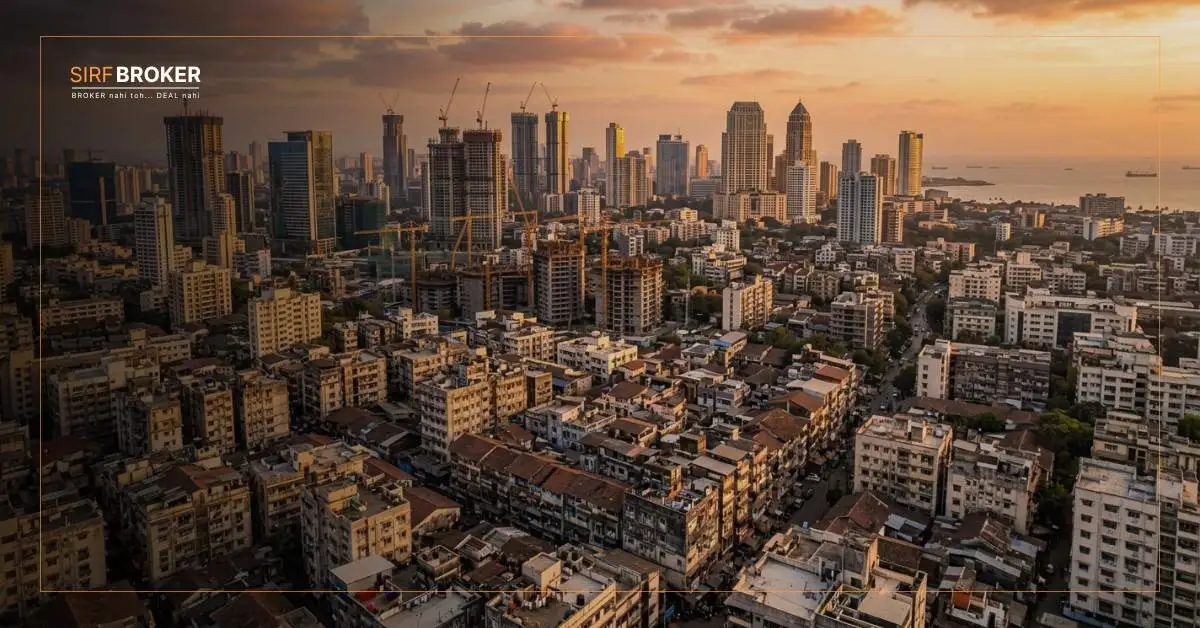
Mumbai has a housing problem that cannot be solved by building on the city’s periphery. The land is gone. Every viable greenfield plot within a practical commute of the city’s employment centres has been developed. The only way Mumbai gets new housing supply is by replacing what already exists — and that is exactly what is happening at a scale the city has not seen before.
According to Knight Frank India research published June 2026, Mumbai’s redevelopment pipeline could unlock approximately 59,000 new homes worth around ₹1.5 trillion by 2031. Developer agreements in Mumbai crossed the 1,094 mark — highest since 2020 — with societies collectively unlocking nearly 432 acres of prime urban land. In just the first quarter of 2026 alone, 70 new redevelopment deals were signed. And sitting above all of this is Dharavi — the 590-acre redevelopment that will, when completed, be one of the largest urban regeneration projects in the world.
For buyers, developers, and brokers in Mumbai, redevelopment is not a background story. It is the primary supply mechanism for the city’s housing market for the foreseeable future. Understanding how it works, which projects are credible, and what the risks look like is now a baseline professional requirement.
The Scale of Mumbai’s Redevelopment Pipeline
The numbers that Knight Frank India published in June 2026 reveal how fast Mumbai is recycling its land. A city generating 59,000 new homes from redevelopment by 2031 — at an estimated average value of approximately ₹2.5 crore per unit — represents a fundamental shift in how new housing supply is created in India’s most expensive real estate market.
| Project / Category | Scale | Status (Mid-2026) |
|---|---|---|
| Total societies under redevelopment | 1,094 (432 acres) | Active — 70 new deals in Q1 2026 |
| Dharavi Redevelopment | 590 acres; Adani Group (80%) + Maharashtra Govt (20%) | First handovers targeted December 2026 |
| Antop Hill (Wadala) | 450 acres; ~65,000 slum homes | Before High-Powered Committee |
| Behrambaug (Bandra East) | 140 acres; ~12,000 slum homes | Before High-Powered Committee |
| MSRDC Slum-Free Mumbai | 45 projects; 97.7 acres; 24,226 tenements | Active programme |
| Total pipeline homes by 2031 | ~59,000 units | Pipeline estimate — Knight Frank India, June 2026 |
| Estimated pipeline value | ~₹1.5 trillion | Knight Frank India, June 2026 |
The three major cluster projects — Dharavi, Antop Hill, and Behrambaug — together represent over 850 acres currently before Mumbai’s High-Powered Committee. These are not future plans. They are live regulatory processes, which means land unlocking is a matter of timeline, not probability.
Dharavi: The Project That Defines the Rest
Dharavi’s redevelopment has been discussed for decades. What changed in 2024–2026 is that it moved from political discussion to construction reality. Navbharat Mega Developers — the joint venture between Adani Group (80%) and the Maharashtra Government (20%) — is the executing entity, and first residential handovers are targeted for December 2026.
The 590-acre site straddles Sion, Mahim, and Matunga — some of the most central and strategically valuable land remaining in Mumbai. Dharavi sits within 3–5 km of the Bandra Kurla Complex (India’s highest-value commercial district), with direct access to Western and Central railway lines and imminent connectivity improvement from Mumbai Metro. The land itself, once redeveloped, will command among the highest residential and commercial values in the country.
The expectation effect is already working: residential values in Sion, Dharavi Road, and the Mahim-Matunga corridor have seen above-average appreciation as the redevelopment reality has firmed up, in advance of any physical transformation. For buyers and investors tracking adjacent micro-markets — this is the signal worth watching.
Society Redevelopment: Mumbai’s 1,094 Active Projects
While Dharavi commands attention, the real mass of Mumbai’s housing supply transformation is happening through its 1,094 active society redevelopment projects — older residential buildings across Borivali, Kandivali, Malad, Goregaon, Andheri, Bandra, Dadar, Prabhadevi, and dozens of other neighbourhoods, where residents have voted to redevelop and developers have signed agreements to build in their place.
The mechanics are consistent: residents of an old building agree to temporarily relocate (developer pays transit rent), the old structure is demolished, and a new taller building is constructed. Residents receive new apartments — typically larger than original units — and the developer’s return comes from additional floors (the “free-sale component”) sold in the open market.
The 70 new deals signed in Q1 2026 reflects three converging factors: Maharashtra’s streamlined consent processes for society redevelopment; residents’ growing awareness that redevelopment delivers significantly upgraded living standards; and developers’ increasing appetite for centrally-located land that does not otherwise exist at acquirable prices.
⚠️ Buyer Note — Redevelopment Project Due Diligence: Before purchasing in a redevelopment project — as original society member or free-sale buyer — verify: (1) developer’s track record on completing previous redevelopment projects on time; (2) IOD and CC from MCGM are in place; (3) RERA registration is active with clean QR code compliance record; (4) transit rent arrangement is documented and funded. Redevelopment projects carry higher complexity and risk than greenfield projects.
What Redevelopment Does to Surrounding Property Prices
Mumbai’s redevelopment pipeline has a well-documented, two-phase effect on surrounding property markets. In the short term (during construction), micro-markets near active redevelopment sites can see temporary disruption — noise, dust, displaced residents — which can create buying opportunities in neighbouring properties trading at a discount to post-redevelopment fair value.
In the medium term (1–3 years post-completion), the neighbourhood premium effect is real. New modern buildings raise the quality benchmark of a micro-market, attracting better retail and F&B tenants and improving average resident income profiles. Properties within 1–2 km of Dharavi, Antop Hill, and Behrambaug are positioned to benefit from this effect through the late 2020s — a specific, underresearched opportunity in most brokers’ advisory toolkits.
The Developer Opportunity in Mumbai’s Redevelopment Cycle
For developers, Mumbai’s 1,094 active society projects represent a pipeline more immediately accessible than greenfield development, where land acquisition at prevailing city prices makes most residential projects economically challenging. Society redevelopment flips this equation: land cost is effectively zero (residents’ consent replaces land payment), and return comes entirely from the free-sale component.
The model works in mid-to-premium micro-markets — Andheri, Bandra, Dadar, Borivali — where free-sale price per sq ft is high enough to cover construction and transit rent costs with adequate margin. Developers who have built specialist capabilities in Mumbai’s redevelopment regulatory environment — SRA, MHADA, MCGM approvals, High Court consent, RERA registration for redevelopment — have a genuine competitive advantage in a market where that knowledge is scarce.
Sirf Broker POV: Mumbai’s Redevelopment Pipeline Is the Most Consequential Supply Story in Indian Real Estate
Every few years, someone announces a “new Mumbai” — a Navi Mumbai expansion, a greenfield satellite city, a new township beyond Thane. These announcements generate headlines. They rarely generate the housing supply Mumbai actually needs, because the families who work in BKC, Nariman Point, Andheri East, and Lower Parel cannot practically live 60 km away, regardless of what is being built there.
Redevelopment is different. It adds supply where demand actually is. A new building in Dadar replaces an old one in Dadar. The location stays the same. The quality improves. The FSI unlocked by modern norms means the city is building upward rather than outward — the only model that can genuinely add housing supply to a city that has exhausted its horizontal growth options.
Our view at Sirf Broker: the 59,000-home pipeline by 2031 is the most significant residential supply story in Indian real estate. It will not solve Mumbai’s affordability problem — the free-sale component is priced at or above market rates, and truly affordable supply remains structurally absent. But it will add quality housing in locations buyers actually want to live in, from developers who have accepted the discipline of a rigorous regulatory process. In Mumbai’s housing market, that is progress worth paying close attention to.
Conclusion
Mumbai’s redevelopment pipeline — 1,094 active society projects, three mega-cluster redevelopments totalling 850+ acres, and Dharavi handovers targeted December 2026 — represents the most concentrated urban housing supply creation in India. Knight Frank India’s estimate of 59,000 homes worth ₹1.5 trillion by 2031 is data every Mumbai buyer, broker, and developer should have in their working knowledge of the market.
Before entering any redevelopment transaction, complete thorough due diligence. Our property verification guide covers steps critical in redevelopment contexts. For ownership transfer clarity, our mutation guide explains the process when old properties are replaced by new ones. For brokers navigating complex transactions, our transaction mistakes guide covers errors that recur most frequently in urban redevelopment deals.
Frequently Asked Questions
Q: How many homes will Mumbai’s redevelopment pipeline deliver by 2031?
A: According to Knight Frank India (June 2026), approximately 59,000 new homes worth around ₹1.5 trillion — from 1,094 active society redevelopment projects covering 432 acres, three major slum cluster projects (850+ acres combined), and the MSRDC Slum-Free Mumbai programme across 45 projects.
Q: What is the Dharavi redevelopment project and when will it complete?
A: A 590-acre project in central Mumbai led by Navbharat Mega Developers (Adani Group 80% + Maharashtra Govt 20%), located 3–5 km from the Bandra Kurla Complex. First residential handovers are targeted for December 2026, with the full redevelopment spanning several additional years.
Q: How does society redevelopment work in Mumbai?
A: Residents of an ageing building vote to redevelop, select a developer, temporarily relocate with developer-paid transit rent, and receive new — typically larger — apartments in the completed building. The developer’s return comes from additional free-sale floors sold in the open market. Mumbai had 1,094 active society redevelopment projects as of mid-2026, with 70 new deals signed in Q1 2026 alone.
Q: How does redevelopment affect property prices in surrounding areas?
A: Two phases: short-term — construction disruption can temporarily discount adjacent properties, creating buying opportunities. Medium-term (1–3 years post-completion) — the neighbourhood premium effect raises surrounding values as new buildings attract better retail and raise the average income of residents. Properties within 1–2 km of Dharavi, Antop Hill, and Behrambaug are positioned for above-average appreciation through the late 2020s.
Q: What due diligence should a buyer do before purchasing in a redevelopment project?
A: Verify: (1) developer’s redevelopment completion track record; (2) IOD and CC from MCGM are in place; (3) RERA registration is active with clean QR code compliance; (4) transit rent for existing residents is documented and funded; (5) the society’s formal consent process was completed correctly with no pending objections.
Q: What is the Antop Hill redevelopment project?
A: A 450-acre slum cluster in Wadala, Mumbai, covering approximately 65,000 slum homes — the single largest slum cluster by area in Mumbai’s current redevelopment pipeline. Currently before the High-Powered Committee for approvals. Wadala offers strong connectivity via Eastern Freeway, Monorail, and metro.
Q: Why is Mumbai relying on redevelopment rather than building new townships?
A: Mumbai has exhausted greenfield land within practical commute of major employment centres. Land acquisition at city prices makes conventional development economically unviable. Redevelopment provides supply without land acquisition — developers receive additional FSI rights in exchange for providing new housing to existing residents. This is the only scalable model for quality housing supply in Mumbai’s constrained geography.