

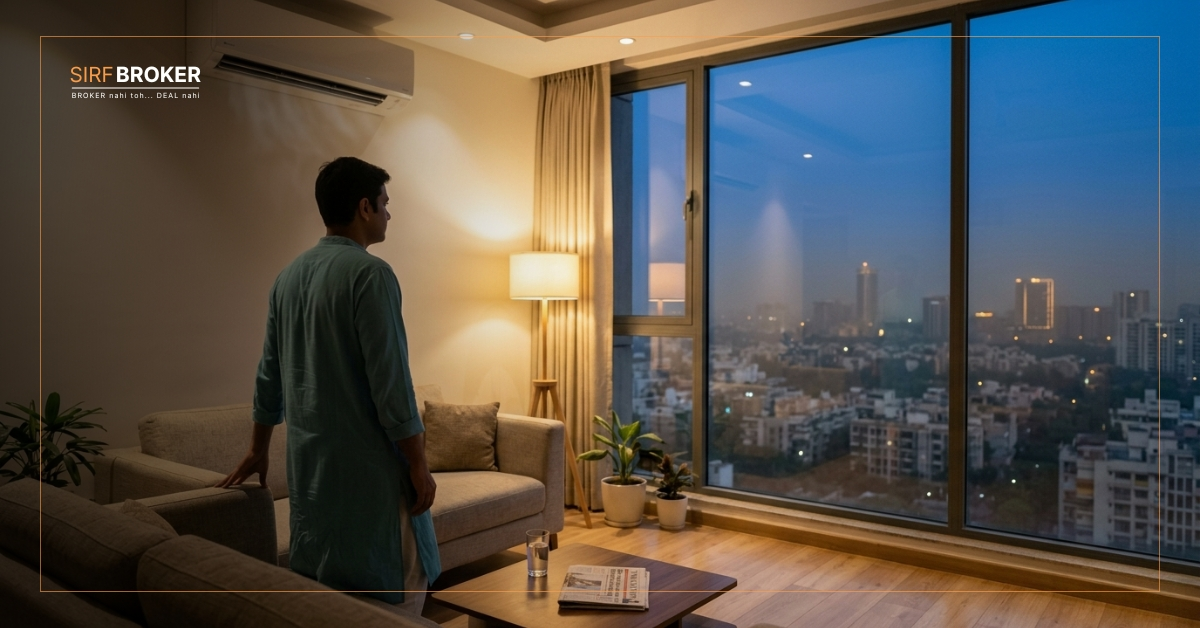
The flat looks premium. Italian marble in the lobby, a designer clubhouse, a glass-walled gym. The office has floor-to-ceiling windows and a sea-facing conference room. The warehouse has perfect highway access. Everything checks out on the site visit in pleasant weather. Then peak summer arrives. The grid groans, a power cut hits at 3 PM, the lifts stop, the ACs struggle on partial backup, the DG kicks in and the maintenance bill quietly balloons. That is the moment the real quality of a property is exposed — and most buyers discover it only after they’ve signed.
In May 2026, India gave brokers a loud reminder of why this matters: electricity demand smashed records as a brutal heatwave pushed the country’s grid to its limits.
| A property is not premium if the lifts stop, AC load fails, DG cost is unclear and tenants cannot rely on electricity during peak summer. Power reliability is quietly becoming a hidden real estate filter — and the broker who can read it sounds far more credible than the one who just says “backup hai”. |
Why Power Demand Is Suddenly a Real Estate Story
As reported by Reuters, Times of India, and the Economic Times, India’s peak electricity demand climbed to record levels through the 2026 summer, touching around 271 GW as heatwave conditions and surging air-conditioning use pushed the grid hard, with reports of power cuts in several regions. This builds on the Ministry of Power / PIB record of an all-time-high peak demand of 256.11 GW met on 25 April 2026 — surpassing the previous high of around 250 GW set in May 2024 — and electricity consumption growing roughly 8.9% in the April period compared with the previous year.
It’s local, too. Delhi’s peak power demand hit 7,776 MW on 19 May 2026 per State Load Dispatch Centre data, and the city crossed the 7,000 MW mark unusually early on 27 April — something that previously happened only in late May. Discom officials estimate that air-conditioning alone can account for 30–50% of domestic and commercial power consumption during peak summer.
For a broker, the takeaway is simple: as cooling demand keeps breaking records, the building that can reliably power its lifts, ACs, water pumps, and common areas through the worst week of summer is genuinely worth more than the one that can’t — regardless of marble and brochures.
The New Property Question: Not “Backup Hai?” But “Backup of What?”
Almost every broker says “100% power backup available.” It means almost nothing on its own. The real question — the one a sharp broker asks — is: what exactly does that backup cover? Does it run your in-flat AC points, or only the tube light and fan? Does it power all the lifts or just one? Does it cover the water pumps and common areas? And what does it cost you per unit when the DG is running? “Backup hai” is a brochure line. “Backup covers X, Y, Z at this cost” is due diligence.
The Sirf Broker Power-Ready Property Framework
| Power Reliability Score = Grid Stability + Sanctioned Load + Backup Coverage + DG Cost Clarity + Lift Support + AC Load Capacity + Future EV Readiness A property becomes power-ready when daily living, business continuity and future electricity needs are supported without hidden costs or frequent disruption. |
Score every property on these seven lenses before you call it premium. A glass tower with weak backup coverage and unclear DG costs scores low. A sensible building with full-load backup, clear billing, strong lift support, and EV-ready wiring scores high — even if its lobby is plainer.
Why Residential Buyers Should Care
For a family, power reliability is daily life, not a technical detail. When the grid fails on a 44°C afternoon, the things that matter are: do the lifts keep running (critical for elderly residents and young children), do the in-flat AC points stay powered, do the water pumps keep water flowing, do the security systems, cameras, and common-area lights stay on, and what does all of this add to the monthly maintenance bill through DG charges? For the growing number of people working from home, reliable power is no longer comfort — it is income. A flat where the AC dies and the Wi-Fi router goes dark every afternoon is a flat where work stops.
Why Brokers Should Care: Credibility
Here’s the broker reality: anyone can say “premium society.” The broker who can walk a client through sanctioned load, backup coverage, DG billing, lift support, and outage history sounds like an advisor, not a salesperson. And when a client’s lifts stop the first summer after moving in, they don’t blame the developer — they remember the broker who promised “tension nahi hai.” Verifying power reliability before you call something premium protects your reputation as much as your client’s comfort.
The Commercial Real Estate Angle
For offices, co-working spaces, malls, clinics, diagnostic centres, retail, and hotels, power is not comfort — it is business continuity. A power failure stops billing systems, freezes POS terminals, kills air-conditioning that customers and employees depend on, halts lifts and escalators, and in a clinic or diagnostic centre, can threaten equipment and patient safety. Grade-A commercial occupiers — especially multinational tenants and GCCs — treat power redundancy as a baseline requirement, which is why JLL, CBRE, and Colliers consistently note reliable power and backup infrastructure as core to Grade-A leasing decisions. A commercial broker who understands this advises far better than one quoting only the rent per square foot.
The Warehouse and Industrial Angle
In warehousing and industry, power reliability touches the bottom line directly. Cold storage depends on uninterrupted power — an outage can spoil an entire inventory. Machinery, dispatch and inventory systems, high-bay lighting, and increasingly EV fleet charging all need stable load. For these assets, sanctioned load, transformer capacity, backup redundancy, and grid stability in the industrial cluster are not nice-to-haves; they are deal fundamentals.
“Power Backup” Is Not One Single Thing
One of the biggest sources of buyer confusion — and broker overselling — is treating “backup” as a single feature. It is not. A serious broker distinguishes between:
- Common-area backup — only lobbies, corridors, stairwell lights
- Lift backup — all lifts, or only one in rotation?
- Flat (apartment) backup — a limited load (say a few lights and fans) vs full load
- AC backup — are in-flat AC points included? This is the big one in summer
- Full-load backup — the entire sanctioned load supported on DG
- DG (diesel generator) backup — with its own running cost passed to residents
- Inverter / UPS — individual or building-level, for short outages
- Solar / common-area renewable support — reduces common-area running cost
The Broker’s Power Due-Diligence Checklist
| Power Check | Why It Matters | What Broker Should Ask |
|---|---|---|
| Sanctioned load | Decides how many appliances and ACs you can run | What is the per-flat sanctioned load, and is it enough for your AC usage? |
| Backup coverage | “100% backup” can exclude AC points | Exactly what does backup cover — flat, AC, lifts, common areas? |
| DG cost | DG-run electricity is costlier and hits maintenance | How is DG power billed, and at what rate? (varies by building) |
| Lift backup | Critical for high-rises, elderly, children | Do all lifts run on backup, or only some? |
| AC support | The single biggest summer comfort factor | Are in-flat AC points supported on backup? |
| Transformer capacity | Overloaded transformers cause repeated trips | Is the building/cluster transformer adequately sized for full occupancy? |
| Water pump backup | No power can mean no water in summer | Are water pumps on backup supply? |
| Maintenance billing | DG and power costs flow into monthly charges | How are power and DG costs reflected in maintenance? |
| EV readiness | Future-proofing for EV charging load | Is there spare load and wiring provision for EV charging? |
| Outage history | The honest test of grid reliability in that area | How frequent and long are outages here in peak summer? (ask residents) |
Power Risk by Property Type
| Property Type | Power Risk | What to Check |
|---|---|---|
| High-rise apartment | High — lifts and water pumps depend entirely on power | Full lift backup, AC load support, transformer capacity |
| Old society | High — ageing wiring and undersized load | Wiring condition, sanctioned load, upgrade history |
| Premium society | Variable — depends on actual backup, not marketing | What backup covers, DG billing, EV readiness |
| Office space | High — affects business continuity | Redundancy, full-load DG, UPS for critical systems |
| Mall / retail | High — footfall, AC, billing, escalators | Backup for AC, escalators, POS and lighting |
| Clinic / diagnostic centre | Critical — equipment and patient safety | Uninterrupted power, redundant backup, UPS |
| Warehouse | Moderate–high — dispatch, lighting, EV fleet | Sanctioned load, transformer, cluster grid stability |
| Cold storage | Critical — outage can spoil entire inventory | Full redundancy, automatic DG switchover, fuel backup |
| Industrial shed | High — machinery and production depend on it | Load adequacy, voltage stability, backup capacity |
Upgrade Your Broker Conversation
| Client Question | Weak Broker Answer | Better Broker Answer |
|---|---|---|
| “Is there power backup?” | “Haan sir, 100% backup hai.” | “Yes — let’s confirm exactly what it covers: flat load, AC points, lifts, water pumps, and at what DG cost.” |
| “Will my AC run during a cut?” | “Bilkul chalega.” | “Depends on whether AC points are on backup. Let’s check the sanctioned backup load per flat in writing.” |
| “Is this a premium building?” | “Sabse premium society hai.” | “It looks premium — let’s verify power reliability too, because that’s what premium really means in summer.” |
| “How much is the DG cost?” | “Zyada nahi hota.” | “It varies by building. Let’s get the DG billing rate and recent maintenance bills to see the real cost.” |
| “Can I install an EV charger later?” | “Ho jayega.” | “Let’s check if there’s spare sanctioned load and wiring provision for EV charging — not every building has it yet.” |
The Broker Conversation That Builds Trust
| Don’t say: “Sir backup hai, tension nahi hai.” Say instead: “Sir backup hai, but kis cheez ka backup hai ye verify karna zaroori hai: lifts, common areas, flat load, AC points, water pumps, DG cost, billing model aur outage history. Premium property tabhi premium hai jab power reliability clear ho.” |
The Hidden Cost of Weak Power
Power problems rarely show up as one big bill — they leak out in many small ways. There are DG charges added to monthly maintenance. There is productivity lost when WFH professionals or businesses go dark. There is tenant dissatisfaction that raises vacancy and turnover for landlords. There is the inefficiency of ACs cycling on and off with unstable power. And increasingly, there is the constraint of not being able to add EV charging because the building has no spare load. None of these appear on the price tag — but all of them are part of the true cost of owning or leasing in a power-weak property.
Red Flags Brokers Should Watch
- A vague, unwritten “100% backup” claim with no specifics
- No written documentation of what backup actually covers
- AC points quietly excluded from backup
- DG charges and billing model left unclear
- A history of frequent or long outages in the area
- An overloaded or undersized transformer for the occupancy
- Old or strained wiring in a resale or older society
- No spare load or wiring provision for future EV charging
- Weak lift backup (only one lift, or none, on DG)
- Unclear or absent water-pump backup
The Final Sirf Broker View
For years, power backup was a single line on a brochure — “100% backup” — and nobody questioned it. That era is ending. With India’s peak demand smashing records past 256 GW in April 2026 and pushing toward 271 GW, with AC driving 30–50% of summer consumption, and with heatwaves arriving earlier and lasting longer, electricity reliability has quietly become part of serious property due diligence.
The broker who still says “backup hai, tension nahi” will keep closing easy deals — until the first summer power cut exposes the gap and the client’s trust evaporates. The broker who can explain the Power Reliability Score — grid stability, sanctioned load, backup coverage, DG cost clarity, lift support, AC load capacity, and future EV readiness — becomes the advisor that buyers, tenants, landlords, and businesses rely on.
A property’s marble and glass are visible on the site visit. Its power reliability is only visible to the broker who knows to look. Be that broker.
Frequently Asked Questions (FAQs)
1. Why is power reliability becoming important in real estate?
Because India’s electricity demand is hitting record highs — around 271 GW in the 2026 summer, after a 256.11 GW peak in April 2026 per the Ministry of Power — driven heavily by air-conditioning during longer, earlier heatwaves. A property that can’t reliably power lifts, ACs, water pumps, and common areas during peak summer is functionally weaker, regardless of how premium it looks.
2. What does “100% power backup” really mean?
It varies enormously by building, and that’s the problem. It might cover only common areas, only some lifts, or a limited per-flat load that excludes air-conditioning. A serious broker verifies exactly what the backup covers — flat load, AC points, lifts, water pumps — and at what DG running cost, rather than accepting the headline phrase.
3. What should a homebuyer check about power before buying?
Sanctioned load per flat, exactly what the backup covers (especially AC points), whether all lifts run on backup, water-pump backup, transformer capacity, the DG billing rate, how power costs flow into maintenance, EV-charging load provision, and the area’s real outage history in peak summer.
4. Why does power reliability matter so much for commercial property?
For offices, retail, malls, clinics, and hotels, power is business continuity. Outages stop billing systems, air-conditioning, lifts, and escalators, and can threaten equipment and safety in healthcare settings. Grade-A occupiers and multinational tenants treat power redundancy as a baseline requirement, which is why it directly affects leasing decisions and rental demand.
5. How does power reliability affect warehouses and cold storage?
Critically. Cold storage can lose an entire inventory in a sustained outage. Warehouses depend on stable power for machinery, dispatch systems, lighting, and increasingly EV fleet charging. Sanctioned load, transformer capacity, backup redundancy, and grid stability in the industrial cluster are core deal fundamentals, not extras.
6. Is DG (diesel generator) backup expensive?
DG-generated power generally costs more per unit than grid power, and this cost typically flows into society maintenance charges — but the exact rate and billing model vary by building and location. Brokers should help clients get the DG billing rate and recent maintenance bills to understand the real running cost rather than guessing.
7. Should buyers check EV charging readiness now?
Yes, increasingly. Even buyers without an EV today should check whether the building has spare sanctioned load and wiring provision for future EV charging, because retrofitting it into a building with no spare capacity can be difficult and expensive. EV readiness is becoming part of a property’s long-term power story.
Sources and References
- Reuters – India facing power cuts as heatwave pushed electricity demand to record levels above 270 GW (2026)
- Times of India – India’s power demand touching around 270.8 GW / 271 GW amid higher AC usage
- Economic Times – India’s peak power demand hitting 271 GW, breaking records on consecutive days
- Press Information Bureau (PIB) / Ministry of Power – All-time-high peak demand of 256.11 GW met on 25 April 2026 (surpassing the previous ~250 GW high of May 2024); electricity consumption growth of around 8.9% in the April 2026 period
- State Load Dispatch Centre (SLDC), Delhi – Delhi peak power demand of 7,776 MW on 19 May 2026; early crossing of 7,000 MW on 27 April 2026; discom estimate of AC contributing 30–50% of domestic and commercial consumption
- Central Electricity Authority / Grid Controller of India / National Power Portal – National power demand and grid data context
- India Meteorological Department (IMD), Ministry of Earth Sciences – 2026 heatwave conditions context
- Bureau of Energy Efficiency (BEE) / Ministry of Power – Building energy efficiency and demand-side context
- JLL India, CBRE, Colliers, Anarock, Knight Frank – Commercial real estate, Grade-A leasing, and building infrastructure references
Disclaimer
| This blog is published by Sirf Broker for educational and informational purposes only. It is not investment advice, legal advice, financial advice, or electrical-engineering advice. Power backup arrangements, sanctioned load, DG costs, transformer capacity, and electricity reliability vary significantly by project, building, and location, and change over time. All data points are referenced from publicly available sources cited above and reflect reporting available at the time of writing. Buyers, tenants, and investors should verify power reliability through official documents, society and maintenance teams, licensed electricians, qualified consultants, and the local power distribution authority before making any decision. Sirf Broker and the authors do not guarantee any specific power reliability, backup performance, cost, or property outcome based on this content. |