

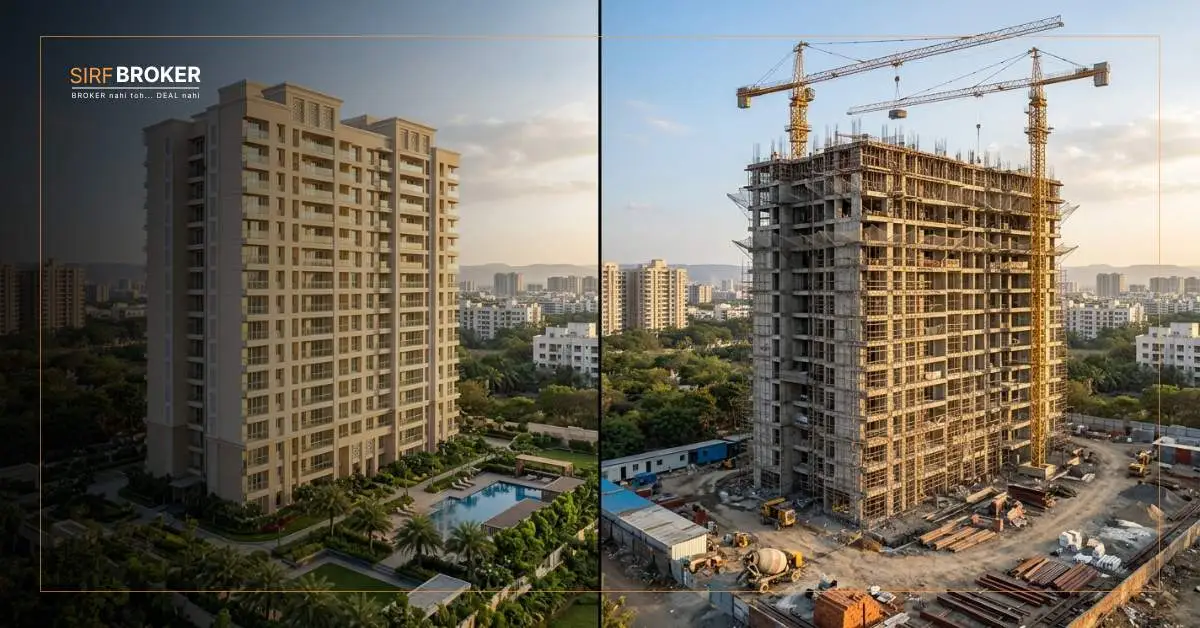
The most common mistake in Indian residential property buying is comparing a ready-to-move flat with an under-construction one purely on price per square foot. The buyer sees that the under-construction project is ₹800 per sq ft cheaper and concludes it is the better deal. Sometimes it is. Often it isn’t. The difference between the two is not just price — it is GST liability, delivery risk, financing structure, tax treatment, and the specific life circumstances of the buyer. Each of these variables can shift the decision independently.
This article lays out the full comparison — factually, without a predetermined conclusion — so that a buyer (or the broker advising them) can make the decision correctly for their specific situation rather than defaulting to the lower base price or the premium finish.
| The single most important regulatory difference: Ready-to-move (RTM) properties — those for which an Occupancy Certificate (OC) or Completion Certificate (CC) has been issued — attract zero GST. Under-construction (UC) properties attract 5% GST on the total consideration (1% for affordable housing below ₹45 lakh). On a ₹1 crore property, this is a ₹5 lakh difference — before any other factor is considered. Source: CGST Act 2017, Schedule III; GST Council; NoBroker Legal 2026. |
The Full Cost Comparison — What Ready-to-Move Actually Costs vs Under-Construction
| Factor | Ready-to-Move | Under-Construction |
|---|---|---|
| GST | Zero (OC/CC issued) | 5% of total consideration (1% affordable housing) |
| Base price | Typically 10-20% higher than comparable UC unit | Lower — often the most cited advantage |
| Delivery risk | Zero — property exists, OC issued | Real — delays of 1-5 years are common in India |
| What you see | Exact flat you’re buying | Show flat / brochure — actual delivery may differ |
| Rental income | Immediate on possession | Only after possession — 2-5 year wait for new UC |
| Tax deductions | Section 24 and 80C deductions from year 1 | Pre-possession interest deductible in 5 equal instalments post-possession only |
| Customisation | Limited — unit is built | Possible in early stages — floor, fixtures, layout modifications |
| Payment timeline | Typically lump sum or standard bank disbursement | Construction-linked — spread over 2-5 years |
Source: CGST Act 2017, Schedule III; NoBroker Legal GST Guide 2026; LegalAssure India; Brigade Group.
The GST Calculation — Why This One Factor Changes Everything
| HOW GST AFFECTS THE REAL COST GAP Example: ₹1 crore property → Under-construction at ₹1 crore attracts ₹5 lakh GST = effective cost ₹1.05 crore. Ready-to-move equivalent at ₹1.10 crore attracts zero GST = effective cost ₹1.10 crore. Real gap: ₹5 lakh, not ₹10 lakh. If you’ve been renting at ₹35,000/month for 18 months waiting for possession, add ₹6.3 lakh more. The “cheaper” under-construction unit is now more expensive in total outflow terms. What triggers GST → GST applies if the property is booked before the developer obtains an Occupancy Certificate (OC) or Completion Certificate (CC). A developer selling post-OC — even if the project was recently completed — is selling a ready-to-move property with zero GST. Always ask: has the OC been issued? The answer changes your tax liability immediately. Affordable housing exception → Under-construction properties priced below ₹45 lakh with carpet area below 60 sq m (90 sq m outside major metros) attract only 1% GST — not 5%. For buyers in this segment, the GST differential shrinks to ₹45,000 on a ₹45 lakh property, and the under-construction price advantage becomes more meaningful. Input tax credit (ITC) → The 5% GST rate for standard residential UC properties comes without ITC benefit for buyers — you pay 5% and receive no credit. Developers were previously able to pass through ITC benefits to buyers, but the simplified 5% rate post-2019 GST council revisions removed this. Source: GST Council 2019 revision; NoBroker 2026. |
The Home Loan and Tax Treatment Difference
Home loan interest deductions under Section 24(b) of the Income Tax Act (up to ₹2 lakh per year for self-occupied property) apply from the year of possession — not from the year of booking. If you borrow to buy an under-construction property in 2024 and take possession in 2027, you pay EMIs (or pre-EMI interest) for 3 years before you can deduct a single rupee of interest from your income tax.
The pre-possession interest is not lost — it can be deducted in 5 equal instalments starting from the year of possession, in addition to the current year’s interest deduction. But the timing difference is real cash flow impact. A buyer making ₹25 lakh per year in a higher income tax bracket who could have saved ₹62,500 per year in tax from Year 1 with a ready-to-move property — and instead has to wait 3 years — has a time value of money cost that doesn’t appear in any base price comparison.
| Important for new tax regime filers: If you have opted for the new income tax regime (which most salaried employees are now defaulting into), Section 24(b) interest deduction on self-occupied property is NOT available. Only interest on let-out property is deductible under the new regime. This effectively eliminates one of the traditional advantages of buying property with a home loan — make sure your tax filing situation is clear before building the Section 24 benefit into your purchase rationale. Source: Income Tax Act 1961; Budget 2023-26 amendments; ClearTax 2026. |
The Delivery Risk — What Actually Happens When a Project Delays
India’s residential real estate has a documented history of project delays. RERA was created precisely because delivery failure was endemic before 2016. Post-RERA, the situation has improved materially — RERA-registered projects with credible developers have far better delivery records than pre-RERA projects. But delays still occur, and the financial consequences of a delay in an under-construction purchase are not trivial.
A buyer who is renting while waiting for possession — paying ₹30,000-50,000 per month in metropolitan areas — incurs significant additional cost for every month of delay beyond the expected possession date. Under RERA Section 18, the buyer is entitled to interest at MCLR+2% from the developer for every month of delay, and can exit the project with a full refund plus interest. But claiming this requires active follow-up through RERA tribunals, which is a time and energy cost even when the legal outcome is clear.
For ready-to-move: the property exists, the OC is issued, and the risk of non-delivery is zero. The premium you pay over under-construction is partly a delivery risk premium — and whether it’s worth paying depends on how much you value certainty. Read: Before You Show the Property: The Verification Checklist Every Broker Should Follow to understand what to verify before committing to either type.
Who Should Buy Ready-to-Move — And Who Should Buy Under-Construction
| Buyer Profile | Better Fit | Why |
|---|---|---|
| Currently paying high rent, needs to move within 6 months | Ready-to-move | Rental savings offset RTM price premium |
| Investor with 3-5 year horizon, wants price appreciation | Under-construction (early stage) | Lower entry price; capital appreciation over construction period |
| First-time buyer, limited cash, needs construction-linked payment | Under-construction | CLP spreads payments; lower upfront cash requirement |
| Buying for immediate rental income | Ready-to-move | Rental income begins immediately; no waiting period |
| Needs specific floor/customisation | Under-construction (early stage) | Early buyers have more selection; modifications possible before finishing |
| Risk-averse, high income tax bracket, old tax regime | Ready-to-move | Zero GST + immediate Section 24 deductions maximise after-tax advantage |
Sirf Broker POV
The ready-to-move vs under-construction decision is one of the most frequently oversimplified in Indian residential real estate. Most buyers compare base price per sq ft and stop there. Most brokers follow the buyer’s framing rather than reorienting it. The result is purchase decisions that look right on the brochure and look different two years later when the possession delay has added ₹8 lakh in additional rent and the GST liability wasn’t budgeted for.
The correct framework for this decision has five inputs: total effective cost (base price + GST + stamp duty + registration + TDS + rent during waiting period), delivery risk profile (developer track record, RERA compliance, construction stage), tax regime (old regime buyers benefit more from RTM; new regime reduces this advantage), income need (rental income required immediately → RTM; can wait → UC), and cash flow capacity (large upfront payment or CLP preference). These five inputs produce a different answer for each buyer. The broker who helps a client work through all five is doing advisory work. The broker who shows a client the price comparison is doing portal work.
Conclusion
Ready-to-move properties attract zero GST, carry zero delivery risk, and allow immediate Section 24 tax deductions and rental income — but typically cost 10-20% more at the base price level. Under-construction properties offer lower entry prices and construction-linked payment flexibility, but attract 5% GST, carry delivery risk, and defer tax benefits and rental income. The correct decision depends on the buyer’s timeline, cash flow, tax regime, rental situation, and risk tolerance — not just the sq ft price comparison. Brokers who map all five inputs for each buyer convert the decision into advisory work rather than a brochure comparison.
Frequently Asked Questions
1. Does GST apply to ready-to-move properties in India?
No. Ready-to-move properties — those for which an Occupancy Certificate (OC) or Completion Certificate (CC) has been issued by the relevant authority — are fully exempt from GST. The sale of completed immovable property is excluded from the definition of “supply” under Schedule III of the CGST Act, 2017. Only under-construction properties attract GST.
2. What is the GST rate on under-construction property in India in 2026?
5% of total consideration for standard residential properties. 1% for affordable housing — units priced below ₹45 lakh with carpet area below 60 sq m in major cities (90 sq m in non-metros). No input tax credit (ITC) benefit for buyers. GST is payable on all payments made before the OC is issued, including down payments and construction-linked instalments.
3. Is under-construction property always cheaper than ready-to-move in India?
Not necessarily, when total cost is considered. An under-construction unit may be 10-20% cheaper at base price — but once you add 5% GST, rental payments during the waiting period (typically 2-4 years), and the deferred tax deduction benefit, the effective cost gap narrows significantly. For buyers paying ₹40,000/month rent over 30 months, that’s ₹12 lakh of additional cost to consider.
4. Can I claim tax deduction on a home loan for an under-construction property?
Yes, but deferred. Section 24(b) interest deduction (up to ₹2 lakh/year for self-occupied) only applies from the year of possession — not from the year of booking or loan disbursement. Pre-possession interest can be claimed in 5 equal instalments starting from the possession year, in addition to that year’s interest. Note: Section 24(b) is not available under the new income tax regime for self-occupied property.
5. What is a Completion Certificate (CC) and how is it different from an OC?
A Completion Certificate (CC) confirms that construction is complete as per approved plans. An Occupancy Certificate (OC) confirms that the building is safe for occupation and complies with building bye-laws. In most states, both together confirm that the property is a ready-to-move unit for GST purposes. Always verify: ask the developer for the OC/CC copy before confirming zero GST status of the property.
6. Which is better for a first-time buyer — ready-to-move or under-construction?
Depends on their situation. If they are currently paying high rent and need to move within 6-12 months, ready-to-move eliminates rental cost during the wait and provides immediate certainty. If they have a stable housing situation, 3-5 year time horizon, and want to spread payments through a construction-linked plan, under-construction with a credible RERA-registered developer can offer better value. The right answer is specific to the buyer, not generic.