

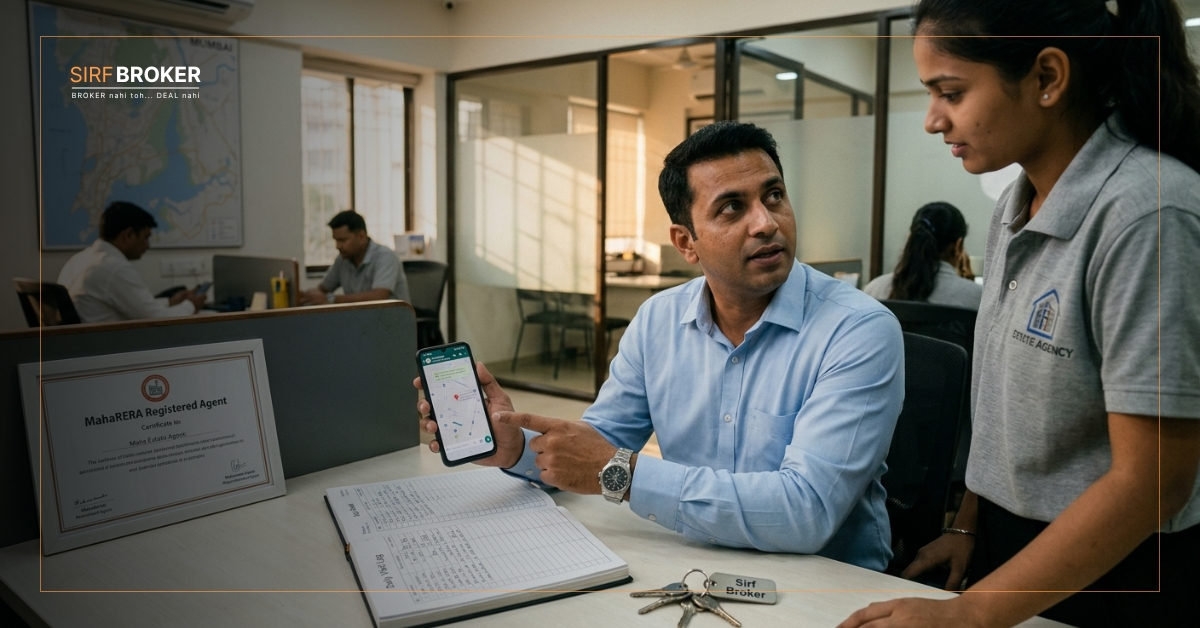
From the outside, a broker’s day looks simple: phone calls, site visits, property keys, negotiations, and commission discussions. But behind every deal is real-world movement — meeting unknown clients, entering empty properties, taking late calls, handling money expectations, navigating landlord-tenant friction, and protecting one’s own reputation. The broker who treats safety and professionalism as part of the job, not an afterthought, is the one who lasts in this business.
This is not a fear article. It is a professional practice article. Because the brokers who build long, respected careers are the ones who work with systems — not jugaad.
| Broker safety is not fear. It is process. A professional broker does not depend only on instinct; they work with verification, documentation, timing discipline and communication clarity. |
Why This Topic Matters Right Now
As reported by Times of India, Charkop Police in Mumbai registered an FIR after a real estate agent was allegedly assaulted following a street dispute in the Kandivli West area. We won’t dwell on the incident — it is one local case, and this article is not about it. But it is a useful reminder of a simple truth that every broker knows quietly: real estate work involves real-world movement, unknown people, and pressure situations, and that is exactly why professional boundaries and safety systems matter.
The takeaway is not “be scared.” The takeaway is “be professional.” A broker who follows a clear process for verification, site visits, documentation, and communication protects their safety, their time, their commission, and their reputation — all at once.
Why Broker Safety Is a Real Estate Issue, Not a Side Topic
Brokerage is one of the most high-touch, high-trust, high-pressure professions there is. A broker meets strangers based on a single phone call. They enter vacant flats and unfamiliar buildings. They discuss large sums of money with people they have just met. They sit between buyers and sellers, landlords and tenants — parties who are often emotional, anxious, or in conflict. And they do much of this alone, on the move, across a city.
In that context, safety is not an “extra.” It is built into doing the job well. The same systems that keep a broker safe also make them look more professional, more trustworthy, and more worth their fee.
The Sirf Broker Safety Framework
| Professional Broker Safety Score = Client Verification + Site Visit Protocol + Document Trail + Commission Clarity + Meeting Boundaries + Location Sharing + Dispute Handling A broker becomes safer and more professional when every visit, payment discussion and client interaction has a clear process. |
Score yourself honestly on these seven lenses. Most brokers are strong on closing and weak on process. The professionals are strong on both.
Site Visit Safety
The site visit is where a broker is most exposed — a new person, a new location, often alone. A few simple habits change everything:
- Verify the client before committing to a serious visit (more on this below)
- Prefer daylight for first visits, and avoid isolated late-night visits with unknown clients
- Share your live location with a colleague, family member, or your office
- Keep your office or team informed of where you are and who you are meeting
- Don’t carry unnecessary cash, valuables, or jewellery on visits
- Be cautious about entering unknown empty properties alone if something feels off — take a colleague or involve building security
- Keep the owner or society security informed that a visit is happening
- Document the visit timing — a simple WhatsApp note of “showing X property at Y time” creates a record
Client Verification
Most safety and time problems start with skipping verification. Before a serious site visit, a professional broker gathers basic, reasonable details — politely and as standard practice:
- Full name and phone number
- Basic requirement (BHK, rent vs buy, area preference)
- Budget range
- Purpose of the visit (end-use, investment, rental)
- Who will join the visit
- A simple WhatsApp confirmation of the appointment
- Owner or property permission to show the unit
This is not interrogation — it is the same basic professionalism any service business follows. A genuine client provides these easily. A client who refuses all of it is itself useful information.
Commission Clarity
A surprising number of broker disputes — some of which turn ugly — come down to one avoidable thing: brokerage terms were never made clear. Protect yourself with simple discipline:
- Discuss brokerage early, not after the deal is emotionally “done”
- Put the terms in writing on WhatsApp or email
- Clarify who pays — buyer, seller, tenant, landlord, or split
- Clarify when it is payable — on agreement, on token, on registration
- Avoid vague promises and “baad mein dekh lenge”
- Never rely on verbal assurance alone for your fee
Communication Boundaries
Professional communication is a safety tool in itself. Keep a steady, professional tone even when clients are emotional. Avoid late-night arguments and heated back-and-forth, especially one-on-one. Steer clear of personal comments and informal, risky meeting setups. If a conversation turns aggressive, don’t continue it alone in a charged setting — pause it, move it to writing, and involve your office if needed. Written confirmations protect both your safety and your credibility.
Meeting Location Strategy
Where you meet matters as much as who you meet. For first meetings with new clients, choose your office, a society gate, a café, or another known, public, well-lit place. Avoid unknown, isolated locations for initial meetings. Take a colleague along when a situation calls for it. And whenever possible, prefer properties that have security or an access log, so there is a record of who came and went.
The Documentation Trail
Every serious interaction should leave a simple record. This protects you in disputes and makes you look professional. A good documentation habit captures: the property shown, the date and time, the client’s name, owner permission, the brokerage terms, any token or payment discussion, and a short negotiation summary. A two-line WhatsApp message after each visit is enough — it costs nothing and protects everything.
The Broker Safety Checklist
| Risk Area | What Can Go Wrong | Professional Safety Step |
|---|---|---|
| Unknown client | Time wasted, or an unsafe meeting | Verify name, number, requirement and confirm on WhatsApp first |
| Late site visit | Isolation and reduced visibility | Prefer daylight; share live location; inform your team |
| Vacant property | Being alone with an unknown person | Involve security/owner; take a colleague if it feels off |
| Commission discussion | Disputes from unclear terms | Agree terms early, in writing — who pays, how much, when |
| Owner permission | Showing a unit without authorisation | Confirm permission to show before any visit |
| Payment / token | Cash handling risk and disputes | Avoid carrying cash; insist on receipts and traceable payments |
| Dispute | Escalation into conflict | Stay calm, move it to writing, involve your office, never confront |
Weak vs Professional Broker Behaviour
| Broker Situation | Weak Broker Behaviour | Better Broker Behaviour |
|---|---|---|
| Client wants an urgent visit | Rushes out alone, no verification, no record | Confirms details on WhatsApp, shares location, schedules in daylight |
| Brokerage not discussed | Assumes it will “work out later” | Sends clear written brokerage terms before the deal progresses |
| Client gets aggressive | Argues back, escalates on the spot | Stays calm, pauses, moves it to writing, involves the office |
| Vacant flat visit | Goes alone, tells no one | Informs team, involves security, keeps live location on |
| Owner gives keys casually | Holds keys loosely, no record | Logs key handover, returns promptly, documents the arrangement |
The Broker Conversation That Builds Trust
| Don’t say: “Sir aap aa jao, site dikha deta hoon, baaki baad mein dekh lenge.” Say instead: “Sir site visit se pehle requirement, timing, location, brokerage terms aur owner permission clear kar lete hain. Main visit details WhatsApp par confirm kar raha hoon so that everything stays professional and transparent.” |
Notice that the professional version isn’t unfriendly — it is simply organised. Good clients respect it. And it quietly screens out the ones who don’t.
For Agency Owners: Protecting Your Team
If you run a brokerage, your team’s safety and professionalism are your responsibility — and your reputation. Build simple systems so individual brokers aren’t relying on luck.
| Agency Safety Process | Why It Matters | How to Implement |
|---|---|---|
| Visit logs | Creates a record of who is where | A shared sheet or group with property, client, time |
| Staff check-in system | Ensures someone notices if a broker is out of touch | A simple “reached / done / leaving” message routine |
| Shared calendars | Visibility of all visits and meetings | A team calendar updated before each visit |
| Emergency contact | Fast help if something goes wrong | A known point of contact and saved emergency numbers |
| Standard brokerage message | Prevents commission disputes | A pre-written, agency-approved terms template |
| Client verification process | Filters time-wasters and reduces risk | A standard set of details collected before every serious visit |
| Property key handling rules | Avoids loss, misuse, and disputes | A key register with handover and return logging |
Red Flags Every Broker Should Notice
- A client refuses to share even basic details
- Insistence on a late-night visit to an isolated location
- A request for the broker to carry cash or documents around
- Avoidance of any written terms
- Repeatedly changing the meeting location at the last minute
- An aggressive or pressuring tone from the start
- Commission-dispute language before the work has even begun
- A visible, ongoing conflict between owner and client
- A request to access an unknown property with no security or record
None of these alone proves bad intent — but each is a cue to slow down, add a colleague, move things to writing, and stick to your process.
What a Professional Broker Should Never Do
- Threaten or intimidate a client
- Argue or escalate at the site
- Hold anyone’s documents illegally as “leverage”
- Enter into any physical confrontation
- Make false promises about price, possession, or returns
- Take cash without issuing a proper receipt
- Skip documentation to “save time”
- Show a property without the owner’s permission
Professionalism and safety are the same discipline viewed from two angles. The broker who avoids these behaviours protects both their client relationships and themselves.
Why Registration and Professional Identity Matter
Working with a clear professional identity also strengthens safety and credibility. Under the Real Estate (Regulation and Development) Act, 2016, real estate agents dealing in RERA-registered projects are expected to follow formal registration and accountability norms — for example, MahaRERA agent registration in Maharashtra. A registered, identifiable, accountable broker is taken more seriously by clients, owners, and authorities alike, which itself reduces the room for disputes and unprofessional behaviour. (This is general information, not legal advice — check the requirements applicable to your state and situation.)
The Final Sirf Broker View
The best brokers are not just good closers. They are good operators. They verify before they visit, they document as they go, they make their terms clear in writing, they keep their communication professional, and they never let a deal pull them into an unsafe or undignified situation.
Broker safety is not paranoia, and it is not about distrusting clients. It is about running your practice like a professional — with systems that protect your safety, your time, your commission, and your reputation, all at the same time. The market respects the broker who works with process. So does every good client.
Safety is not extra. It is part of professional brokerage.
Frequently Asked Questions (FAQs)
1. What is broker safety in real estate?
Broker safety is the set of professional practices that protect a broker during their work — including client verification, site visit protocols, location sharing, clear commission terms, professional communication, documentation, and dispute handling. It is about working with process, not fear.
2. What should a broker check before a site visit?
Verify the client’s name, number, requirement, budget, and purpose; confirm the appointment on WhatsApp; get owner permission to show the property; prefer daylight for first visits; share live location with a colleague or family member; and keep the office informed of where you are.
3. How can brokers avoid commission disputes?
Discuss brokerage early, put the terms in writing on WhatsApp or email, clarify who pays and when it is payable, and avoid relying on verbal assurances. Many broker conflicts come simply from terms never being made clear.
4. Is it safe to do site visits alone?
Many routine visits are fine, but brokers should use judgment. Prefer daylight, verify the client first, share live location, keep the team informed, involve building security or the owner, and take a colleague when a situation feels uncertain or isolated.
5. How should a broker handle an aggressive client?
Stay calm and professional, avoid arguing or escalating on the spot, pause the conversation, move it to written communication, and involve your office. Never enter a physical confrontation. If you feel genuinely unsafe, remove yourself from the situation and contact the police or emergency services.
6. Why does documentation matter for broker safety?
A simple record of each interaction — property shown, date and time, client name, owner permission, brokerage terms, and any payment discussion — protects you in disputes and makes you look more professional. A two-line WhatsApp note after each visit is usually enough.
7. How can a real estate agency keep its team safe?
By building simple systems: visit logs, a staff check-in routine, shared calendars, a known emergency contact, a standard written brokerage message, a client verification process, and clear property-key handling rules. Systems protect individual brokers from relying on luck.
Sources and References
- Times of India – Report on an FIR registered by Charkop Police after an alleged assault on a real estate agent in the Kandivli West area, Mumbai (used as a contextual reference only)
- MahaRERA (Maharashtra Real Estate Regulatory Authority) – Real estate agent registration and professional accountability framework
- Real Estate (Regulation and Development) Act, 2016 – Agent registration and professional norms for RERA-registered projects (general reference)
- Indian Contract Act, 1872 – General context for clarity of agreements and terms (general reference, not legal advice)
- Local police and emergency-services guidance – General personal-safety and incident-reporting practices
Disclaimer
| This blog is published by Sirf Broker for educational and informational purposes only. It is not legal advice, law-enforcement advice, personal-safety training, financial advice, or a property-dealing recommendation. Safety situations vary, and no checklist can guarantee safety. Brokers should follow applicable local laws and regulations, consult qualified legal professionals where needed, comply with RERA and other registration requirements relevant to their state and work, and contact the police or emergency services immediately in any unsafe situation. Sirf Broker and the authors do not accept liability for any outcome arising from reliance on this content. |