

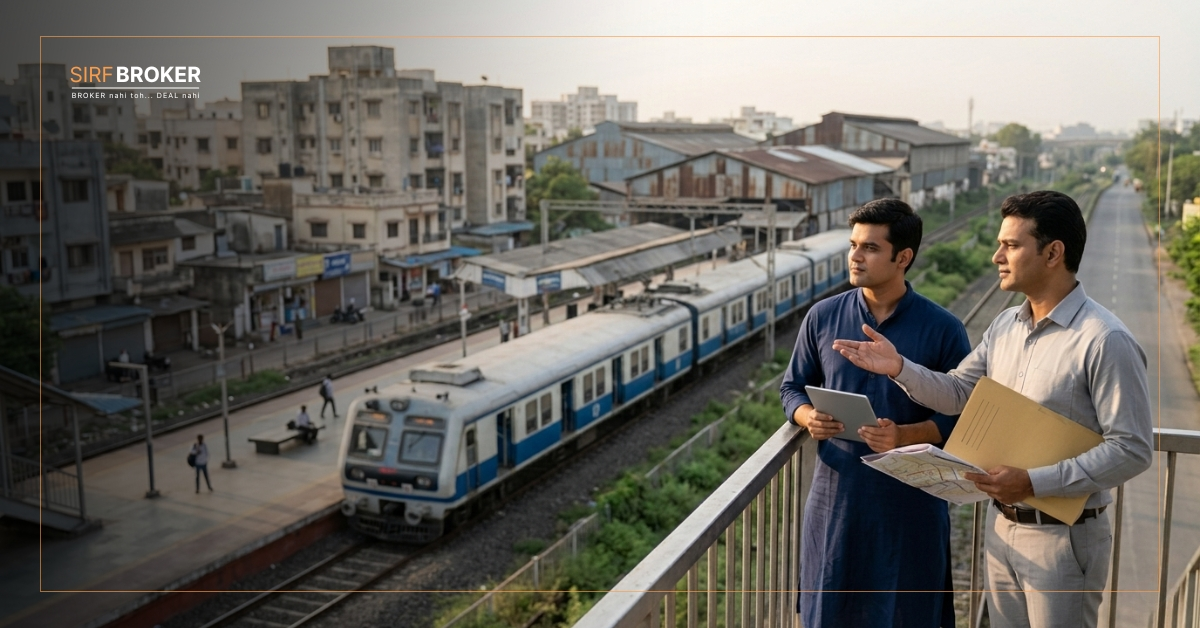
A homebuyer walks in asking about the nearest metro line. An industrial tenant in the same week asks how easily trucks can move goods out of his unit. A factory worker asks how long the train takes to reach his job. A landlord wonders why rental enquiries near an old railway station have suddenly picked up. Four very different people, four very different questions — and they may all point to the same quiet force: suburban rail.
Metro projects get the headlines, the glossy renders, and the broker excitement. But suburban rail often carries the real daily movement of workers, students, industrial employees, and middle-income families in the outer city. In May 2026, a new project gave brokers a fresh reason to pay attention.
| Suburban rail does not create real estate value because tracks exist. It matters when trains become reliable, stations become accessible, and people or goods actually move better — and the broker who can read that difference advises far better than the one shouting “rates badhenge”. |
Why This Topic Is Trending
As reported by PIB and the Ministry of Railways, Indian Railways has approved the Arakkonam–Chengalpattu Doubling Project under Southern Railway — a 68 km doubling at a cost of around ₹993 crore. The section forms part of the important Chennai suburban circular rail network connecting Chennai Beach, Tambaram, Chengalpattu, and Arakkonam.
According to the Ministry, the project is expected to ease congestion on a busy corridor, improve punctuality, increase the frequency of suburban services, and strengthen both passenger and freight movement — benefiting the transport of key commodities including cement, automobiles, food grains, iron, and steel. The existing single-line section is reported to be operating at a high level of capacity utilisation, with traffic expected to rise further.
As The Times of India noted, the corridor passes through major industrial and economic hubs, including Mahindra World City, Sriperumbudur, Oragadam, and Irungattukottai, and the proposed Parandur Airport near Kancheepuram lies close to the alignment — adding to the route’s strategic importance.
Here is the single most important word for a broker to internalise: the project is approved, not operational. That distinction is the entire difference between a real signal and a sales gimmick.
Why Suburban Rail Is Different from Metro
Brokers often lump all rail together, but metro and suburban rail play very different roles — and neither is “better.”
Metro is about dense, intra-city movement, moving large volumes of people short distances within a crowded urban core, usually elevated or underground, with high frequency and premium positioning. Suburban rail is about outer-city and regional movement — connecting towns, industrial belts, affordable housing catchments, and job hubs across longer distances, carrying daily workers, students, and often freight on the same network.
In real estate terms, metro tends to lift dense urban and premium micro-markets. Suburban rail tends to support affordable housing, rental demand, worker mobility, and industrial-logistics corridors in the outer city. A broker who understands this explains outer-city growth far more credibly than one who treats every rail line the same.
The Real Estate Chain (And Why It Isn’t Automatic)
The link between a rail project and property demand is a chain, and every link must hold:
Rail improvement → better train frequency and reliability → stronger accessibility → improved housing, rental, and industrial confidence → stronger local demand.
If the project is approved but stalls, the chain breaks at link one. If trains run but the station is 8 km from the housing pocket with no last-mile transport, it breaks at link three. A smart broker tracks the whole chain — not just the press release at the start.
The Sirf Broker Rail Connectivity Framework
| Rail-Linked Real Estate Strength = Train Frequency + Station Access + Last-Mile Connectivity + Job Hub Linkage + Industrial Movement + Affordable Housing Demand + Execution Timeline Rail-linked property becomes stronger when the corridor actually improves daily movement, not just when a project is announced. |
Score every rail-linked opportunity on these seven lenses. A station next to a housing pocket but with two trains a day scores low. A frequent, well-connected line linking affordable homes to real job hubs scores high. The framework — not the headline — is what you advise on.
Why Brokers Should Care
Anyone can say “station pass hai.” The broker who can explain whether the line is operational, how frequent the trains are, how accessible the station actually is, and which job hubs it connects — that broker sounds like an advisor, not a flyer-distributor. And when a client buys near an “upcoming” line that takes years to operationalise, they remember who oversold it. Reading mobility honestly protects your credibility as much as your client’s money.
Residential Impact
Suburban rail’s biggest residential effect is on affordability and access. When a corridor genuinely improves, middle-income buyers and renters can consider outer pockets they previously avoided because the commute becomes viable. This supports affordable and mid-segment housing demand, strengthens rental housing near accessible stations (especially for working professionals and students), and can gently expand a city’s liveable radius. The keyword is genuinely — the demand follows reliable trains and easy station access, not a track on a map.
Industrial and Warehouse Impact
This is where suburban rail’s freight role becomes a real estate factor. The Arakkonam–Chengalpattu corridor is explicitly meant to strengthen the movement of cement, automobiles, food grains, iron, and steel, and it serves industrial hubs like Mahindra World City, Sriperumbudur, Oragadam, and Irungattukottai. Better freight movement and worker access along such a corridor can strengthen industrial land demand, warehouse and logistics catchments, and the rental housing that industrial workers need nearby. For industrial and land brokers, freight connectivity is a genuine value driver — not a footnote.
The Airport-Linked Angle (Without the Hype)
The proposed Parandur Airport near Kancheepuram lies close to the corridor alignment, which adds long-term strategic context. But here is where brokers must stay disciplined: a proposed airport is a long-horizon, execution-dependent project. Airport-linked land demand can strengthen if and when execution and connectivity actually align — but “airport aa raha hai” is exactly the kind of speculative pitch that burns clients when timelines slip. Treat the airport as long-term context, never as a guaranteed near-term trigger.
A Station Nearby Is Not Enough
The most common broker mistake is treating “station distance” as the whole story. It isn’t. What actually decides usage is: how far the station really is on foot or by feeder transport, the train frequency, the safety and quality of the approach road and footpaths, parking and feeder transport availability, and the actual door-to-destination travel time. A station 1 km away with good last-mile beats a station 500 m away across an unsafe, unconnected stretch. Real estate value follows usable access, not map proximity.
The Broker’s Rail Due-Diligence Checklist
| Rail Factor | Why It Matters | What Broker Should Ask |
|---|---|---|
| Project status | Approved, under construction, and operational are very different | Is the line operational today, or only approved? |
| Train frequency | Frequency, not tracks, drives daily usability | How many services run, and will doubling improve frequency? |
| Station access | Real walking/feeder distance decides who uses it | How far is the station from the property in real travel time? |
| Last-mile transport | A station is useless without onward connectivity | Are autos, buses, or feeder transport available at the station? |
| Industrial linkage | Job hubs drive worker housing and rental demand | Which industrial hubs does the corridor connect? |
| Freight relevance | Freight movement supports industrial and warehouse demand | Is this corridor passenger-focused, freight-focused, or both? |
| Nearby job hubs | Employment proximity sustains housing demand | What employment centres are within commuting range? |
| Airport linkage | Long-term context, not a near-term guarantee | Is any airport plan real and time-bound, or just proposed? |
| Execution timeline | Approved does not mean finished | What is the realistic completion timeline? |
| Current vs future demand | Buying on “future” demand carries timing risk | Is there real demand today, or only a promise of it later? |
Rail Impact by Property Type
| Property Type | Rail Impact | What to Check |
|---|---|---|
| Affordable housing | High — viable commute expands buyer pool | Station access, train frequency, last-mile transport |
| Rental housing | High — worker and student demand near stations | Job hub proximity, tenant catchment, real travel time |
| Plotted land | Variable — depends on execution and timeline | Project status, holding horizon, genuine demand drivers |
| High-street retail | Moderate — footfall near active stations | Passenger volume, station catchment, accessibility |
| Warehouses | High — freight movement and logistics efficiency | Freight relevance, road-rail linkage, industrial cluster |
| Industrial sheds | High — worker access and goods movement | Hub linkage, worker housing nearby, freight capacity |
| Offices | Moderate — depends on employee commute patterns | Frequency, last-mile, distance to employment node |
| Airport-linked land | Speculative — long-horizon and execution-dependent | Whether the airport is approved, funded, and time-bound |
Upgrade Your Broker Conversation
| Client Question | Weak Broker Answer | Better Broker Answer |
|---|---|---|
| “A rail project is coming — will rates rise?” | “Haan sir, pakka badhega.” | “It can help, but only after execution and better frequency. Let’s check the timeline and real access first.” |
| “Should I buy now near the line?” | “Abhi lo, baad mein mehenga ho jayega.” | “Depends on the project status and your horizon. Approved is not operational — let’s match it to your goals.” |
| “Is the station close enough?” | “Bilkul paas hai.” | “Let’s check real travel time and last-mile transport, not just the distance on the map.” |
| “Will the airport boost this land?” | “Airport aayega, zameen udegi.” | “The airport is proposed and long-term. It’s context, not a guaranteed near-term trigger. Buy on today’s fundamentals.” |
| “Is this good for a warehouse?” | “Rail hai toh badhiya hai.” | “For warehousing, freight relevance and road-rail linkage matter most. Let’s verify the corridor’s freight role and cluster.” |
The Broker Conversation That Builds Trust
| Don’t say: “Sir rail project aa gaya, rates pakka badhenge.” Say instead: “Sir rail connectivity positive signal hai, but impact tab aayega jab project execute ho, train frequency improve ho, station access easy ho, last-mile transport ho aur nearby jobs/industrial demand real ho. Sirf announcement pe decision lena risky hai.” |
The Trap: An Announcement Is Not Investment Advice
| Approval → construction → operational services → actual usage are four different stages, often years apart. A project being approved tells you intent and funding. It does not tell you that trains are running, that frequency has improved, or that your client’s micro-market will actually benefit. Turning every rail announcement into a “buy now” pitch is exactly how brokers lose long-term trust. |
Red Flags Brokers Should Watch
- The station is too far for practical daily use
- Poor or non-existent last-mile connectivity from the station
- Low train frequency, even after the project completes
- No safe approach road or footpath to the station
- No real job-hub or industrial linkage along the corridor
- Hype built around a future airport that is only proposed
- An unclear or open-ended execution timeline
- Property already overpriced on “future connectivity” expectations
- Any broker promising guaranteed appreciation from the rail project
The Final Sirf Broker View
Metro will always get the spotlight, but suburban rail quietly moves the workers, students, families, and goods that keep outer-city real estate alive. The ₹993 crore Arakkonam–Chengalpattu doubling is a genuine signal — it strengthens a congested, high-utilisation corridor linking real industrial hubs and a proposed airport. But it is a signal, not a guarantee, and right now it is approved, not operational.
The broker who shouts “rail aa gaya, rates badhenge” will close a few quick deals and lose trust when reality moves slower than the headline. The broker who reads the Rail Connectivity Framework — frequency, station access, last-mile, job-hub linkage, industrial movement, affordable housing demand, and execution timeline — becomes the advisor that buyers, investors, and industrial clients rely on.
Suburban rail becomes a real estate signal only when it improves real movement. Learn to read mobility, not just maps.
Frequently Asked Questions (FAQs)
1. Does suburban rail increase property prices?
Not automatically. Suburban rail can support property demand when it genuinely improves movement — better train frequency, accessible stations, good last-mile connectivity, and linkage to real job hubs. Property value follows usable access and actual usage, not the mere existence of tracks or an announcement.
2. What is the Arakkonam–Chengalpattu Doubling Project?
As reported by PIB and the Ministry of Railways, it is a 68 km railway doubling project under Southern Railway, approved at a cost of around ₹993 crore. It forms part of the Chennai suburban circular rail network (Chennai Beach, Tambaram, Chengalpattu, Arakkonam) and aims to ease congestion, improve punctuality and frequency, and strengthen both passenger and freight movement.
3. How is suburban rail different from metro for real estate?
Metro supports dense, intra-city movement and often lifts urban and premium micro-markets. Suburban rail supports outer-city, regional, worker, student, and freight movement, and tends to support affordable housing, rental demand, and industrial-logistics corridors. Neither is “better” — they serve different roles.
4. Should a buyer purchase property just because a rail project is approved?
No. Approved is not operational. Buyers should check the project’s realistic execution timeline, expected train frequency, real station access and travel time, last-mile transport, and genuine job or industrial demand in the micro-market before deciding. An announcement is context, not a buy trigger by itself.
5. How does suburban rail affect industrial and warehouse property?
Significantly, through freight. The Arakkonam–Chengalpattu corridor is meant to strengthen movement of cement, automobiles, food grains, iron, and steel, and serves industrial hubs like Mahindra World City, Sriperumbudur, Oragadam, and Irungattukottai. Better freight movement and worker access can strengthen industrial land, warehouse catchments, and nearby worker housing demand.
6. How important is the proposed Parandur Airport to this corridor?
It adds long-term strategic context, since the proposed airport near Kancheepuram lies close to the alignment. But a proposed airport is execution-dependent and long-horizon. Brokers should treat it as future context, not a guaranteed near-term price trigger, and avoid speculative “airport aa raha hai” pitches.
7. What should a broker check before recommending rail-linked property?
Use the Rail Connectivity Framework: train frequency, station access, last-mile connectivity, job-hub linkage, industrial movement, affordable housing demand, and execution timeline. Also confirm whether the line is operational or only approved, and whether there is real demand today versus only a future promise.
Sources and References
- Press Information Bureau (PIB) / Ministry of Railways – Approval of the Arakkonam–Chengalpattu Doubling Project (68 km, ~₹993 crore) under Southern Railway; statements by Union Railway Minister Ashwini Vaishnaw on congestion, punctuality, frequency, and passenger/freight movement (May 2026)
- Times of India – Reporting on the Arakkonam–Chengalpattu line, industrial hubs (Mahindra World City, Sriperumbudur, Oragadam, Irungattukottai) and proximity to the proposed Parandur Airport
- Southern Railway / Indian Railways – Chennai suburban circular rail network context (Chennai Beach, Tambaram, Chengalpattu, Arakkonam)
- Ministry of Railways – Rail infrastructure modernisation and capacity-enhancement context
- Knight Frank India, JLL, CBRE, Colliers, Anarock – Connectivity, industrial corridor, warehousing, and city-expansion real estate references
- Economic Times / Business Standard / Mint / Moneycontrol – Rail infrastructure and real estate market commentary
Disclaimer
| This blog is published by Sirf Broker for educational and informational purposes only. It is not investment advice, legal advice, or financial advice. Rail infrastructure announcements and approvals do not guarantee property appreciation, and project timelines, train frequency, and connectivity outcomes are subject to execution and change. All data points are referenced from publicly available sources cited above and reflect reporting available at the time of writing. Real estate decisions require independent due diligence, project execution checks, micro-market analysis, and consultation with RERA-registered brokers, qualified financial advisors, and legal professionals. Sirf Broker and the authors do not guarantee any specific connectivity outcome, timeline, price movement, appreciation, or financial result based on this content. |