

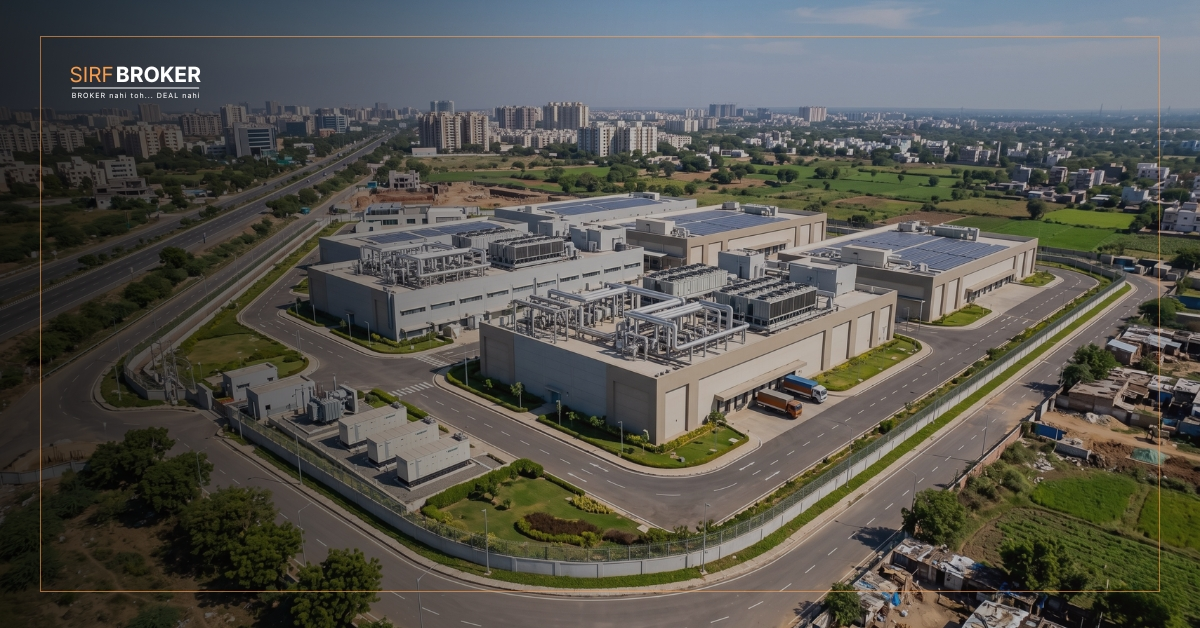
A commercial office tenant can leave when the lease ends. A data centre cannot. Once the power infrastructure, cooling systems, fibre connectivity, and physical security of a data centre are commissioned into a building, that building is committed to that purpose for fifteen to thirty years. The economics of relocation are prohibitive.
This is not a technology story. It is a real estate story — and India’s Union Budget 2026-27 just made it significantly larger.
What India’s Budget 2026 Actually Did for Data Centres
The Union Budget 2026-27 introduced a tax holiday until 2047 for foreign cloud service providers operating through Indian data centres. This is not a marginal incentive. A 21-year tax holiday fundamentally changes the long-term investment calculus for hyperscalers — Amazon Web Services, Microsoft Azure, Google Cloud — and for the domestic and international colocation operators who host them.
For real estate, the consequence is direct: when the government guarantees favourable tax treatment for over two decades, data centre operators plan their land acquisition and infrastructure buildout accordingly. Sites under evaluation are being committed. Sites already committed are being fast-tracked. The Budget effectively front-loaded a wave of data centre real estate demand that might have spread over the next decade into the next three to four years.
According to Colliers India’s 2026 market outlook, the AI market in India is projected to reach USD 17 billion by 2030, with data centre infrastructure as a core enabler. The demand for high-performance data centre capacity tied to machine learning workloads, cloud storage, and enterprise AI is separate from — and additive to — existing corporate IT infrastructure demand.
Where Data Centres Are Going in India — and Why Location Matters
Data centres are not location-agnostic. They go where power is available, reliable, and affordable. They go where fibre connectivity is dense. They go where land is accessible without being in city centres where the power-to-cost ratio becomes unworkable. And they go where government policy makes the regulatory environment predictable.
The four primary data centre corridors in India are Hyderabad, Pune, Chennai, and Navi Mumbai. Hyderabad offers government incentives and available land; Pune has proximity to Mumbai’s financial infrastructure with lower land cost; Chennai has dense undersea cable connectivity through its port; Navi Mumbai has large-format land parcels within infrastructure-rich proximity to the financial capital.
Secondary corridors are emerging in Noida and the Greater Noida expressway belt, driven by Delhi NCR’s enterprise demand and available large-format land parcels at viable cost structures.
For developers and landowners in these corridors, data centre demand is categorically different from office or residential demand. Data centre operators commit to long-term ground leases or outright purchases. They do not negotiate for short-term flexibility. They arrive with engineering requirements — floor load specifications, power draw capacity, cooling infrastructure — and the developer who meets those specifications wins the deal.
The GCC–Data Centre Convergence — a New Demand Profile Developers Must Understand
GCCs — Global Capability Centres — are not just office tenants anymore. The most sophisticated GCC operations now require data infrastructure within or adjacent to their campus. AI teams running machine learning workloads need low-latency access to compute infrastructure. Security requirements for banking and financial services GCCs mean on-premise or dedicated colocation rather than shared public cloud.
According to BusinessToday’s analysis of Budget 2026, GCCs are increasingly seeking campuses that combine office space, data infrastructure, and employee amenities in a single location. The implication for developers is significant: a Grade A office park that cannot accommodate data centre infrastructure within the campus is increasingly a second-tier proposition for the most valuable GCC occupiers. For a fuller picture of what the office leasing side of this GCC demand looks like, read The Real Cost of Moving Offices: Why Rent Is Only Half the Story.
What This Means for Brokers Handling Commercial Mandates
Most commercial brokers are not equipped to handle data centre briefs. The vocabulary is different — power density, raised floor load, PUE ratios, Tier III versus Tier IV certification, fibre redundancy. The decision-makers are infrastructure and CTO teams, not real estate heads. Deal timelines are longer than standard office leases.
But brokers who work in commercial real estate in Hyderabad, Pune, Chennai, or Navi Mumbai will encounter data centre briefs more frequently over the next 24 months. The brokers who invest in understanding the technical vocabulary and the supply landscape in their city will earn mandates that most generalist commercial brokers cannot compete for.
At a minimum, every commercial broker in these markets should know which large-format land parcels in their city have the power connectivity and zoning required for data centre development, and which existing buildings have the infrastructure specifications to host colocation facilities. Review Common Mistakes in Commercial Property Leasing Deals for a solid foundation before engaging with specialist briefs.
Sirf Broker POV
The data centre real estate story in India is being told almost entirely in technology media — as a story about AI, cloud computing, hyperscaler competition. Real estate media is treating it as a footnote. That is a mistake, and it will cost developers and brokers who are not paying attention.
Here is what the technology coverage is missing: data centres are one of the most financially durable real estate assets ever created. An office tenant who vacates leaves a landlord with a shell that can be re-leased. A data centre operator who decommissions a facility leaves behind raised floors, specialised power infrastructure, cooling systems, and a fibre-dense shell that has very limited alternative uses. This illiquidity means data centre leases are extremely long and extremely sticky — making them among the most attractive assets for real estate investors.
For Indian developers with land in the right corridors, the question is not whether to engage with data centre demand. It is whether they have the technical capability — or the right partners — to build to data centre specifications. Joint ventures with specialist data centre developers are an underexplored path worth pursuing before the prime land parcels in Hyderabad, Navi Mumbai, and Pune are committed.
The Budget 2026 tax holiday has a 21-year horizon. Land committed in 2026 will still be data centre land in 2047. Plan accordingly.
Conclusion
India’s data centre real estate market is moving from emerging opportunity to active demand in a single budget cycle. The combination of a 21-year tax holiday, AI-driven compute demand, and GCC campus integration requirements is creating a new asset class that developers and commercial brokers need to understand now — not in two years when the land is gone.
To understand the institutional capital flows that follow infrastructure buildout of this scale, read REITs Are Changing Real Estate Investing: What Brokers Must Learn.
═══════════════════════════════════════════
Frequently Asked Questions
What did India’s Budget 2026 do for data centres?
The Union Budget 2026-27 introduced a tax holiday until 2047 for foreign cloud service providers operating through Indian data centres. This 21-year incentive is designed to attract hyperscalers like Amazon Web Services, Microsoft Azure, and Google Cloud to commit long-term infrastructure investment in India.
Which cities in India are the top data centre real estate markets?
The four primary data centre corridors in India are Hyderabad, Pune, Chennai, and Navi Mumbai. Secondary markets are emerging in Noida and Greater Noida. Each offers a different combination of power availability, fibre connectivity, land accessibility, and government incentives.
How is AI demand affecting real estate in India?
AI-driven compute requirements are increasing demand for data centre infrastructure, which drives demand for large-format, power-ready land in India’s key corridors. The Indian AI market is projected to reach USD 17 billion by 2030, according to Colliers India, with data centre capacity as a core enabler.
What is the difference between a data centre lease and an office lease?
Data centre leases typically run 15 to 30 years because the cost of commissioning and decommissioning specialised infrastructure makes relocation prohibitively expensive. Data centre operators also have specific technical requirements — power density, floor load, cooling specifications — that must be met before they commit to a site.
What do GCCs have to do with data centres?
The most sophisticated Global Capability Centres now require data infrastructure within or adjacent to their campus, particularly AI and financial services teams that need low-latency access to compute capacity. A campus without power-ready data infrastructure is increasingly a second-tier proposition for premium GCC occupiers.
How can commercial brokers get involved in the data centre market?
Brokers in Hyderabad, Pune, Chennai, and Navi Mumbai should learn the technical vocabulary of data centre procurement — power density, Tier III/IV certification, PUE ratios — and map the large-format, power-connected land parcels in their markets. Brokers who build this knowledge will access mandates that generalist competitors cannot compete for.