

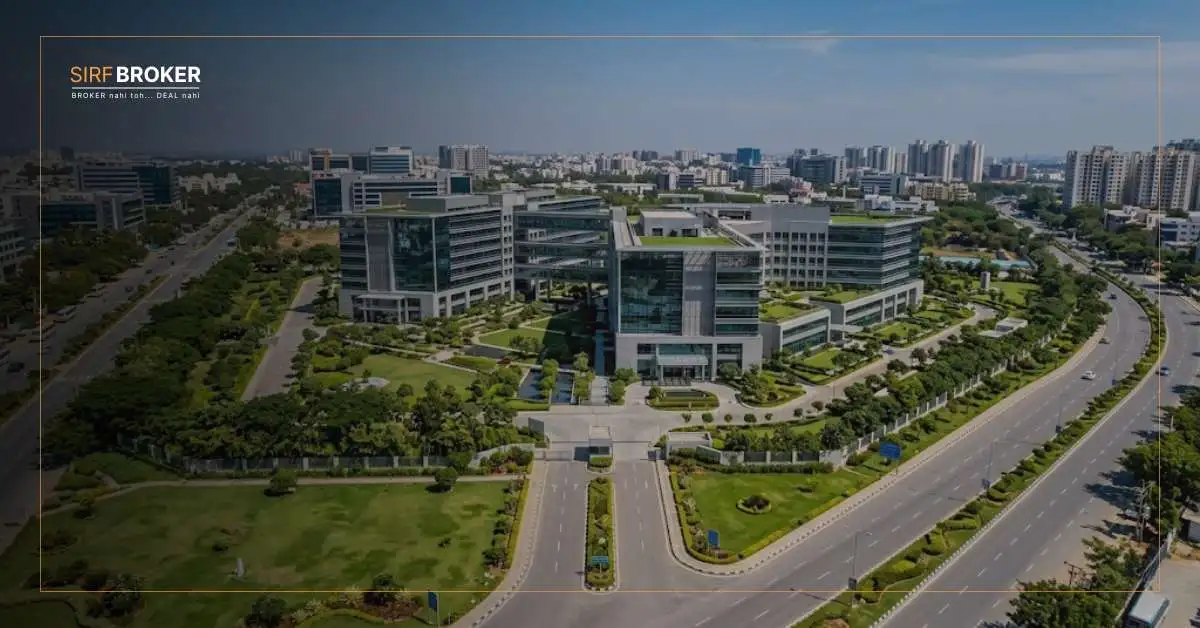
Nearly half of all commercial office space leased in India right now is going to one category of tenant that most brokers still cannot explain to their clients.
In Q1 2026, Global Capability Centres accounted for 45.5% of India’s total office demand — 10 million sq ft in a single quarter, a 43% jump year-on-year, according to JLL’s Q1 2026 India Office Market report. The quarter itself set a record: 21.5 million sq ft of gross leasing across the top cities, making it the highest single quarter India’s office market has ever recorded.
GCCs are no longer a niche category. They are the market. And a broker who cannot speak to one fluently — who doesn’t know what they need, how they decide, or why their deals work differently from domestic tenants — is invisible to the single biggest source of commercial leasing demand in the country.
This article is the briefing every commercial office broker in India needs.
What Is a Global Capability Centre (GCC)?
A Global Capability Centre — also called a GCC — is an in-house office set up by a foreign multinational corporation in India to handle strategic functions for the global business. This is not a call centre or a back-office outsourcing unit. Modern GCCs own product development, AI research, financial analytics, cybersecurity, and legal operations for their parent companies worldwide.
India hosts more than 2,000 GCCs employing over 1.9 million professionals, according to the Zinnov-NASSCOM India GCC Landscape Report 2026. That includes operations from 506 Forbes Global 2000 companies — organisations like JPMorgan, Goldman Sachs, Microsoft, Walmart, and Airbus, all of whom have significant India footprints.
The distinction that matters for brokers: a GCC is not a tenant that rents space for cost reasons alone. GCCs sign long leases, demand Grade A+ specifications, and make decisions through a procurement chain that looks nothing like a domestic company’s. Understanding the difference is the gap between winning a mandate and watching it go to someone else.
Why GCCs Are Now the Most Important Client in Indian Commercial Real Estate
India’s office market closed 2025 with 83.3 million sq ft of gross leasing — its highest annual total, according to JLL’s India office market annual data. GCCs drove 38% of that, or 31.3 million sq ft, which is itself a record for a single occupier category in a single year.
By Q1 2026, that share had grown to 45.5%. Pan-India vacancy dropped to a five-year low of 14.7%, with net absorption hitting 13.7 million sq ft in just three months.
Colliers India projects GCC leasing will grow another 15–20% over the next two years, driven by three factors: more global companies choosing India for strategic (not just operational) functions; existing GCCs expanding as they take on broader mandates from their parent companies; and the entry of mid-market and PE-backed multinationals who are setting up India centres for the first time.
This is not a cyclical wave. The Zinnov-NASSCOM 2026 report documents that 92% of GCC leaders now report their India centres contribute value beyond cost savings. GCCs are becoming the place where global companies build their AI capability, run their product roadmaps, and house their senior leadership for Asia-Pacific. That structural shift does not reverse.
Where GCCs Are Concentrating — and Where They’re Moving Next
Bengaluru remains India’s GCC capital, home to approximately 900 GCC units and 34–39% of all GCC leasing activity. Hyderabad holds a 20–23% market share and overtook Bengaluru as the top city for new GCC launches between January and November 2025, adding over 41 new centres to Bengaluru’s 30, according to JLL data. Southern cities — Bengaluru, Hyderabad, and Chennai combined — captured 64% of all GCC leasing in Q1 2025.
Pune, Delhi NCR, and Mumbai make up the remaining demand, with Pune emerging as a preferred location for BFSI and analytics GCCs that want proximity to Mumbai’s financial sector without metro-level real estate costs.
The expansion story for the next two years is Tier 2 cities. Colliers India’s 2026 outlook specifically flags decentralised work models and cost arbitrage as forces pushing GCC real estate requirement into Tier 2 and Tier 3 cities. Cities like Ahmedabad, Coimbatore, and Nagpur are seeing early-stage hiring demand from tech and GCC functions — the real estate mandates follow 12 to 18 months later.
For a broker operating in a non-metro market, this is a window. The brokers who understand GCC requirements before the first mandate arrives will own the relationship. The ones who try to learn on the job during a live requirement will lose it to someone from Bengaluru who already speaks the language.
What GCCs Actually Look For in an Office Space
GCC real estate requirements are distinct from domestic commercial tenants in almost every dimension that matters to a broker. Here is what drives their decisions.
Floor Plate Size
GCCs prefer large, contiguous floor plates — typically 30,000 sq ft and above per floor, often seeking 50,000–100,000+ sq ft across two or three connected floors or a dedicated building. Fragmented space across multiple buildings or poorly connected floors is rarely acceptable. The operational model requires teams to work in proximity; a GCC that has to split its 800-person engineering team across two unconnected buildings will move it to a campus where that isn’t necessary.
Space Per Person
GCCs allocate more square footage per employee than comparable domestic companies — typically 100–130 sq ft per person, versus 80–110 sq ft for Indian firms. This reflects parent company workspace standards, the need for amenities to attract global-calibre talent, and the inclusion of specialised rooms for training, video conferencing with global teams, and quiet focus work.
Building Specification
Grade A is a minimum, not a differentiator. GCCs look for LEED Platinum or Gold certification, 24/7 power backup, redundant internet infrastructure, high floor-to-ceiling heights, and modern HVAC systems that can be subdivided by zone.
A broker who shows a GCC a non-LEED-certified building — regardless of how good the rent looks — will not close the deal. Before presenting a building to a GCC Tenant Representative, run through the property verification checklist every broker should follow — GCC procurement teams will ask for documentation you need to have in hand before the first meeting.
Location
GCCs prioritise proximity to talent pools over everything else. This means tech corridors, established IT parks, and areas with strong metro or road connectivity to residential catchments. Whitefield and Outer Ring Road in Bengaluru, Hitech City and Gachibowli in Hyderabad, Hinjewadi in Pune. Location for a GCC is about employee access, not just prestige address.
Lease Tenure
GCCs sign longer leases than domestic tenants — typically 5 to 9 years, with lock-in periods of 5 years standard in most agreements. This reflects the capital they invest in fit-out: a GCC that spends ₹1,500–2,500 per sq ft fitting out a 50,000 sq ft office is not going to accept a 3-year lease.
How GCC Leasing Decisions Work — and Why Brokers Lose Them
GCC leasing is a procurement process, not a property search. Understanding this distinction is the single most important thing a broker needs to know before approaching a GCC mandate.
A domestic company searching for office space typically involves a founder, a CFO, and a facility manager. The decision cycle is 2–6 months. The broker shows options; the client decides; the deal closes.
A GCC leasing decision involves a global real estate team at headquarters, a local APAC real estate lead, the GCC head or CEO in India, an internal finance team, an external Tenant Representative — typically a global commercial real estate firm such as JLL, CBRE, or Cushman & Wakefield — and in some cases, a sustainability or workplace strategy committee.
The decision cycle is 6–18 months. The first RFP is sent to buildings; buildings respond with term sheets; shortlisted buildings go through due diligence; preferred buildings are presented to HQ for approval; lease negotiations run for 2–4 months after shortlisting.
The implication for brokers: if you are approaching a GCC with an off-market listing or a property you think is “a great fit,” you are not in the process. The process started before you got there.
The way to enter GCC mandates is not to chase active requirements — it is to build relationships with the Tenant Representatives who manage these requirements before they go to RFP, and to know your city’s Grade A inventory better than anyone at the table.
Brokers entering a live GCC requirement late aren’t just missing a deal; they’re repeating one of the most common mistakes in commercial property leasing.
For commercial brokers in cities where GCCs are expanding, the question is not “how do I find a GCC tenant?” The question is “which global real estate firm is running the Tenant Representative process in my city, and do they know who I am?”
Sirf Broker POV
The commercial real estate brokerage model in India was built around domestic tenants. A company needs space; a broker shows space; the deal happens in weeks. GCCs have changed the equation structurally, and most brokers have not caught up with what that actually means for their business.
Here is what it means: the knowledge gap between a generalist commercial broker and a GCC-specialist broker is now measured in deal size, not deal count.
A GCC taking 80,000 sq ft on a 7-year lease at ₹90 per sq ft in Bengaluru represents a brokerage opportunity that a dozen domestic office deals cannot match. But that opportunity goes entirely to brokers who can hold a credible conversation about LEED certification requirements, global workplace standards, Tenant Representative protocols, and what a parent company’s real estate committee looks for before approving a shortlist.
The counterintuitive point: GCCs do not necessarily want to deal with the biggest broker in the city. They want to deal with the broker who knows the most about their specific sub-market.
The broker who can walk a Hyderabad GCC head through every vacant 50,000+ sq ft floor in Hitech City — lease-by-lease, building-by-building, with data on why three of them changed hands in the last 12 months — is more useful than a broker with 30 listings and no depth.
This market is not getting smaller. Colliers projects 15–20% growth in GCC leasing in the next two years. The brokers who build sub-market expertise now, who develop relationships with global Tenant Representatives, and who learn the procurement language will have a structural advantage that compounds.
The ones who keep treating GCCs as a slightly larger version of domestic office mandates will keep not understanding why they aren’t in the room.
Conclusion
GCCs now account for nearly half of India’s commercial office leasing. That number is growing. The tenant category that built India’s office market in the early 2000s — large domestic IT firms and BPOs — has been replaced at the top of the demand table by multinationals running their global operations from Indian campuses.
Brokers who understand what a GCC is, what they look for, how they decide, and who manages their mandates are entering the most consequential segment of commercial real estate in India.
Those who don’t will continue to watch the largest deals in their cities close without them.
Read about the hidden costs GCC occupiers — and their brokers — often miss in office leasing: The Real Cost of Moving Offices: Why Rent Is Only Half the Story.
Sources
- JLL India Office Market Dynamics Q1 2026
- JLL India Office Market Q1 2026 Leasing Update
- Zinnov-NASSCOM India GCC Landscape Report 2026
- Colliers India GCCs in India: Driving Innovation & Office Demand
Data and market insights referenced in this article are derived from publicly available industry research published by JLL, Colliers, NASSCOM, and Zinnov.
Frequently Asked Questions
What is a GCC in real estate?
A GCC — Global Capability Centre — is an in-house office set up by a foreign multinational in India to run strategic functions for the global business. Unlike outsourced vendors, GCCs are wholly owned by the parent company. In real estate terms, GCCs are now the largest single category of office space demand in India, accounting for 45.5% of gross leasing in Q1 2026, according to JLL.
Which Indian cities have the most GCCs?
Bengaluru leads with approximately 900 GCC units and 34–39% of all GCC leasing activity. Hyderabad is second with 20–23% of the market and overtook Bengaluru for new GCC launches in 2025. Together with Chennai, South India captures 64% of GCC office leasing. Pune, Delhi NCR, and Mumbai account for most of the remaining demand, with Tier 2 cities like Ahmedabad and Coimbatore beginning to attract early GCC activity.
How much office space do GCCs typically take?
GCCs prefer large, contiguous floor plates — generally 30,000 sq ft per floor at minimum, with many requirements running to 50,000–100,000+ sq ft across connected floors or dedicated campuses. They also allocate more space per employee than domestic firms, typically 100–130 sq ft per person versus 80–110 sq ft for Indian companies.
What building specifications do GCCs require?
GCCs look for Grade A or Grade A+ buildings with LEED Gold or Platinum certification, 24/7 power backup, redundant internet infrastructure, floor-to-ceiling heights of at least 10 feet, and modern HVAC systems. Green building certification has become a near-mandatory requirement for GCCs whose parent companies have global ESG commitments. Non-certified buildings are rarely shortlisted regardless of rent.
How do GCC lease tenures differ from domestic office tenants?
GCCs sign significantly longer leases than domestic tenants — typically 5 to 9 years, with 5-year lock-in periods standard. This reflects the high cost of fit-out: a GCC investing ₹1,500–2,500 per sq ft in interior build-out requires lease security before committing that capital. Shorter leases or unfavourable break-clause terms are a common reason buildings are eliminated early in the GCC shortlisting process.
How does a broker win a GCC office mandate?
GCC leasing runs through a formal procurement process, typically managed by a global Tenant Representative firm such as JLL, CBRE, Cushman & Wakefield, or Colliers. Brokers who want to participate in GCC mandates need to build relationships with the Tenant Representatives active in their city, maintain detailed sub-market data on large Grade A floor availability, and be able to brief a global real estate team credibly. Showing up with an off-market listing after a requirement goes live is too late.