

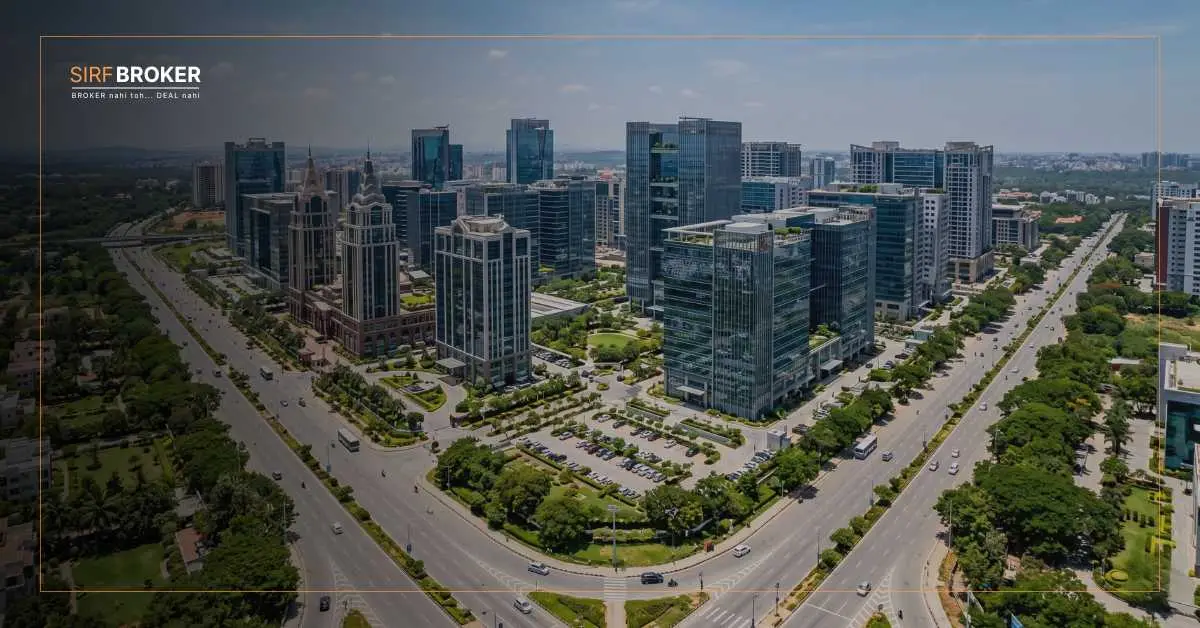
Office landlords in London, New York, and Frankfurt are discounting rents and offering free fit-out periods to fill towers that have been half-empty since 2020. Office landlords in Bengaluru, Hyderabad, and Gurugram are doing the opposite — holding firm on pricing, tightening lease terms, and watching vacancy numbers fall to their lowest levels since before the pandemic.
This divergence is not noise. It is structural. And for brokers and developers working in Indian commercial real estate, it changes almost everything about how you price, pitch, and position your deals.
What India’s Office Vacancy Numbers Actually Show
Office vacancy across India’s top eight cities fell below 14% in Q1 2026 for the first time since the pandemic — a threshold that matters because it signals a shift in negotiating power from tenants to landlords, according to data from Colliers India’s 2026 outlook.
The driver is not speculative demand. Global Capability Centres — the Indian operations of multinational corporations that manage technology, finance, and analytics functions — leased a record 9.1 million sq ft in Q1 2026 alone, the highest quarterly absorption ever recorded. That represents 45.5% of all commercial leasing activity in a single quarter. GCCs expanded their total footprint by 43% year-on-year to 10 million sq ft across the quarter.
To put that in context: nearly half of every square foot leased in India’s commercial market right now is going to a GCC. This is no longer a segment of the market. It is the market.
Total projected leasing demand for 2026 sits at 70–75 million sq ft, with GCCs expected to account for 30–35 million sq ft of that — roughly 40–50% of all Grade A office demand — according to Colliers India.
Why Western Office Markets Are Struggling — and Why India Is Structurally Different
The Western office market is not going through a bad quarter. It is going through a structural correction that will take years to resolve.
Hybrid work has permanently reduced average daily office attendance in most American and European firms. Building owners who borrowed heavily to develop or acquire office assets before 2022 are now refinancing at rates that make carrying costs painful. Vacancy in major US cities is running at 18–22% in secondary corridors, with older Grade B and C stock effectively unleasable without demolition-level repositioning.
India does not have these problems. Hybrid work has not taken hold here the way it has in the West — most Indian corporations, GCCs, and technology firms still expect full-time office attendance as a baseline. India also had a demand correction during COVID, but it cleared faster and was followed by the largest GCC expansion cycle ever seen in the country.
The structural advantage is talent. India offers the largest pool of English-speaking engineering, finance, and technology talent in the world at cost structures that make Indian offices economically rational for multinationals even at current exchange rates.
What This Means for Office Rental Rates
When vacancy tightens and demand remains strong, rents firm up. Colliers India projects rental appreciation of 5–10% across Grade A corridors in 2026 compared to 2024 levels.
The cities most likely to see the steepest appreciation are those where new Grade A supply cannot keep pace with GCC demand: Bengaluru’s Whitefield and Outer Ring Road corridors, Hyderabad’s Hitech City and Nanakramguda, and Pune’s Hinjewadi.
The gap between Grade A and Grade B stock is also widening. GCCs want LEED-certified, campus-format buildings with 24/7 infrastructure. Grade B and older stock that cannot meet these specifications will see higher vacancy even as overall market vacancy tightens. For a full picture of what commercial occupiers factor into their total cost, read The Real Cost of Moving Offices: Why Rent Is Only Half the Story.
What Brokers and Developers Should Be Doing With This Data
For developers, the signal is clear: prioritise Grade A delivery. The market is not asking for more supply in general — it is asking for more supply at the right specification, in the right locations, delivered on schedule.
For brokers working the commercial side, vacancy data is one of the most useful client conversation tools available. When a corporate occupier asks for a lower rent, the correct response is to show them what the vacancy numbers look like in their preferred corridor and explain that the window to lock in favourable terms may be six months, not two years.
The brokers who understand vacancy microdata — not city-level averages, but corridor-level and building-class-level data — will close more commercial mandates. For a clear guide on what to verify before a commercial deal, see Common Mistakes in Commercial Property Leasing Deals.
Sirf Broker POV
The India-versus-West office divergence is real data. But there is a narrative risk in how the Indian market is using it.
When brokers and developers say “India is different,” they are correct — but the reasons matter more than the conclusion. India’s office tightening is driven by one dominant force: GCC demand. If that force slows — because a global recession reduces multinational expansion budgets, or because AI makes some GCC functions automatable — India’s vacancy numbers will move quickly. The structural advantage is real, but it is not invincible.
Developers banking on GCC demand to absorb whatever they build should look carefully at their micromarket. Hyderabad’s Financial District is in a different market from its older Hitech City buildings. Bengaluru’s Outer Ring Road is not the same as Whitefield in terms of GCC appetite right now.
Brokers serving commercial occupiers should use the vacancy data aggressively — but with precision. “Vacancy in Bengaluru is at 12%” is a useless fact. “Grade A vacancy in the Outer Ring Road corridor is under 9%, and the three buildings that fit your brief have no options above the 4th floor” is a closing argument.
The market is tightening. Use the data like you know what it means.
Conclusion
India’s office market is at its tightest point since before the pandemic, driven by the largest GCC expansion cycle in the country’s history. For developers, quality supply in the right locations will not struggle for takers. For brokers, the vacancy data is your single strongest negotiation tool in a market that has shifted toward landlords.
For a deeper look at how institutional capital is following this tightening, read REITs Are Changing Real Estate Investing: What Brokers Must Learn.
Frequently Asked Questions
What is the current office vacancy rate in India’s top cities?
Office vacancy across India’s top eight cities fell below 14% in Q1 2026 for the first time since the pandemic, according to Colliers India. This is the tightest the market has been in four years and reflects sustained demand from GCCs and technology firms.
Why is India’s office market tightening when Western markets are struggling?
India’s office demand is driven primarily by Global Capability Centres which leased a record 9.1 million sq ft in Q1 2026 alone. Unlike Western markets, India has not seen significant hybrid work adoption at the enterprise level, and its talent cost advantage continues to attract global demand.
What are GCCs and why do they matter for Indian office leasing?
GCCs — Global Capability Centres — are the Indian offices of multinational companies managing technology, finance, analytics, and operations functions. They accounted for 45.5% of all commercial leasing activity in India in Q1 2026, making them the single largest occupier category in the market.
Which Indian cities are seeing the most office demand in 2026?
Bengaluru, Hyderabad, Pune, and Delhi NCR (particularly Gurugram) are the highest-demand markets. Bengaluru’s Outer Ring Road, Hyderabad’s Financial District and Nanakramguda, and Pune’s Hinjewadi are seeing the tightest vacancy and strongest rental appreciation.
Are office rents going up in India in 2026?
Yes. Colliers India projects rental appreciation of 5–10% across Grade A corridors in 2026 compared to 2024 levels, driven by tightening vacancy and sustained GCC demand. Grade A buildings in prime corridors are likely to see the strongest appreciation.
How should brokers use office vacancy data in client conversations?
Brokers should use corridor-level and building-class-level vacancy data rather than city averages. Showing a corporate occupier that Grade A vacancy in their preferred corridor is under 10% — with limited alternative options — is a stronger negotiating position than citing a headline market average.