

The most expensive mistake a broker can make is recommending an under-construction project that goes wrong. Not for the broker financially — though that matters — but for the client. A family that books a flat worth ₹80 lakh based on a broker’s recommendation, waits three years past the promised possession date, and ultimately receives a unit without an Occupancy Certificate, has had their life disrupted in a way that no commission refund can fix.
The broker who made that recommendation will not be forgiven. And in the era of Google reviews, WhatsApp groups, and housing forums where buyer complaints circulate for years, they should expect their reputation to carry that story.
Developer due diligence is not optional extra work. It is the minimum standard of care that a professional broker owes to every client who asks “which project should I buy?” Here is the 8-point process. Do it for every project you actively recommend — not just the ones that feel uncertain.
Point 1: Verify RERA Registration and Project Details
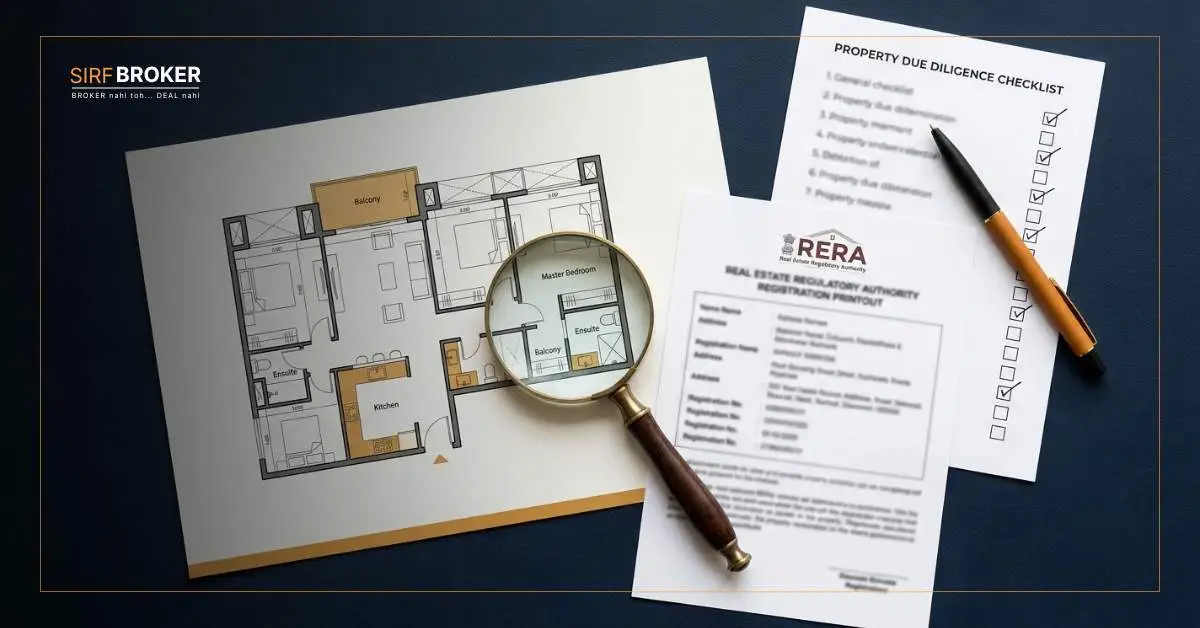
Every under-construction real estate project in India must be registered with the state RERA authority. Visiting the state RERA portal — MahaRERA for Maharashtra, RERA Karnataka, UP RERA, TNRERA, and so on — and searching for the project gives you the developer’s declaration of the project’s approved plan, schedule, and completion date.
What to check on RERA: the project’s RERA registration number and its validity status (active vs expired). The registered completion date — compare it against the possession date being told to buyers. Approved floor plans and unit configurations — verify that what is being sold matches what is approved. The developer’s declared escrow account details — every RERA-registered project must maintain 70% of buyer collections in a separate escrow account used only for project construction.
Red Flag: RERA Registration Missing or Expired
If a project above 500 sq metres or 8 units is being marketed without RERA registration, the developer is operating in violation of RERA. Selling or recommending an unregistered project — even unknowingly — exposes both the buyer and the broker to legal risk. Do not recommend it.
Point 2: Check the Developer’s Completed Project Track Record
A developer’s past delivery record is the single most reliable predictor of future delivery performance. Research the developer’s last three to five completed projects: the promised possession date, the actual possession date, and whether Occupancy Certificates were obtained.
Sources for this research: the RERA portal (completed projects are listed), housing forums like Housing.com and MagicBricks buyer review sections, local broker networks who have dealt with this developer before, and Google reviews of the developer’s past projects. The question is not “has the developer ever been late?” — almost every developer has delayed at least one project. The question is: how late, how often, and how did they communicate with buyers during the delay?
Point 3: Verify RERA Escrow Compliance
Section 4(2)(l)(D) of RERA requires developers to maintain 70% of buyer collections in a separate designated bank account, used exclusively for construction of that project. In practice, not all developers comply, and not all state RERA authorities actively audit it.
On the RERA portal, check whether the developer has declared their escrow account. For larger projects, the developer must submit quarterly construction progress reports and financial disclosures. Check the most recent submission date — if a developer has not filed a quarterly update in over a year, they may be in RERA non-compliance. A developer diverting buyer funds to other projects and not maintaining the designated construction account is the highest-risk scenario in Indian under-construction real estate.
Point 4: Search for Litigation and RERA Complaints
RERA complaint records are public in most states. The state RERA portal typically has a “complaints” or “orders” section where you can search by developer or project name and see what complaints have been filed and what orders have been passed. A handful of complaints on a large project with thousands of buyers is normal. A pattern of complaints about the same issues — delayed possession, quality defects, refusal to provide OC, failure to give possession despite full payment — across multiple projects is a disqualifying red flag.
Beyond RERA, search for the developer’s name in consumer court databases. National Consumer Disputes Redressal Commission (NCDRC) orders are publicly available and searchable. Google the developer’s name with terms like “complaint,” “delay,” “OC,” and “possession” to surface buyer experience reports across platforms.
| Check Point | Where to Look | Green Signal | Red Flag |
|---|---|---|---|
| RERA Registration | State RERA portal | Active registration; delivery date matches marketing | Missing, expired, or dates inconsistent |
| Past delivery record | RERA completed projects, buyer reviews | Consistent delivery within 6–12 months of schedule | 2+ projects with 3+ year delays |
| RERA quarterly filings | RERA portal progress reports | Regular filings; escrow account declared | No filings in 12+ months |
| RERA complaints | RERA complaints/orders section | Zero or isolated complaints | Pattern of same issues across projects |
| Land title | Encumbrance certificate, local registrar | Clear title; no undischarged mortgage on plot | Mortgage not discharged; disputed title |
| Approvals status | Local municipal authority records | Building plan approved; environment clearance in hand | Only in-principle approval at point of sale |
| Financial health | Listed developer filings, news, credit rating | Healthy debt levels; positive operating cash flow | High debt; NPA reports; restructuring |
| Builder-buyer agreement | Review the actual agreement before recommending | RERA-compliant clauses; committed possession date | Blanket developer discretion on delays |
Point 5: Verify Land Title and Construction Plot Encumbrances
The land on which a project is being built must have a clear, unencumbered title. An encumbrance certificate (EC) from the sub-registrar’s office shows all registered charges, mortgages, and liens on a property for a specified period. If the construction plot has a mortgage registered against it that has not been discharged, the lender has a charge on the land — and in the event of developer default, that charge takes priority over buyer interests.
The practical check: ask the developer for the land title documents and encumbrance certificate. Any reputable developer should provide these on request. Reluctance to share land title documentation is itself a red flag. The presence of a known bank’s construction loan is a partial — not absolute — comfort signal, since the bank will have conducted its own diligence before extending finance.
Point 6: Verify Approvals — Not Just Claims That Approvals Are “In Process”
Many projects in India are launched and sold before all approvals are in hand, typically disclosed with phrases like “all approvals in process” or “RERA registered pending certain approvals.” Brokers who treat this as a standard qualifier — rather than a risk to be explicitly disclosed to their buyers — are not serving their clients.
Minimum approvals that should be in hand before recommending a project: building plan approval from the local municipal authority, and environment clearance (if required). Approvals acceptable to be in process at launch: individual floor NOCs, lift NOC, completion certificate. Approvals that should not still be “in process” once 20% of units are sold: the fundamental building plan and environmental clearance.
Point 7: Assess the Developer’s Financial Health
For listed developers — Godrej Properties, Prestige, Brigade, Sobha, DLF, Mahindra Lifespace — quarterly investor presentations and annual reports give you balance sheet visibility. Look specifically for: net debt to equity (above 1x warrants attention), any debt restructuring or NPA classification at lender banks, and whether the company is generating positive operating cash flow from existing projects.
For unlisted developers, financial health assessment is harder but not impossible: check news for any lender action, check whether other projects are progressing on schedule, and speak to brokers who have recently closed deals with this developer about payment and process reliability. An unlisted developer who has consistently paid brokerage on time, responds quickly to queries, and has active construction progress across projects is a different risk profile than one who pays late, is difficult to reach, and has construction work that appears stalled.
Point 8: Read the Builder-Buyer Agreement Before Recommending
The builder-buyer agreement (BBA) is the contract that defines the buyer’s legal position. Most brokers never read it. Specific clauses to review:
Force majeure clause: A RERA-compliant BBA allows force majeure only for genuinely unforeseeable events. A BBA that includes “market conditions,” “regulatory changes,” or “material availability” in its force majeure definition gives the developer near-unlimited cover to delay with impunity.
Possession date commitment: RERA requires a committed possession date with compensation for delay. If the BBA says “tentative possession” or includes no delay compensation clause, the buyer has weaker legal standing than RERA mandates.
Unilateral variation clause: Some BBAs allow the developer to make changes to layout, specifications, or amenities without buyer consent. This is not RERA-compliant. Flag it and advise your buyer to seek legal review before signing.
Sirf Broker POV: Developer Due Diligence Is the Work That Separates Professionals from Salespeople
The easiest version of being a broker is acting as a price transmitter: the developer tells you the project, the price, and the commission; you tell the buyer. You show the site office, walk the model flat, and close. That is not brokerage. That is reselling — with no independent value added.
The valuable version of being a broker is acting as an informed filter: you have done the RERA check, the track record review, the complaints research, and the BBA review before you walk your client into that site office. When your client asks “can I trust this developer?” you have a real answer — not a marketing pitch. And when your client’s possession date is met, their OC is obtained, and their purchase goes smoothly, they know exactly who to call — and who to refer — for the next property decision.
Developer due diligence is not the developer’s responsibility to handle. It is not the buyer’s responsibility to perform. It is the broker’s responsibility to deliver. The brokers who understand this are building practices. The ones who don’t are building transactions — until one of them goes wrong.
Conclusion
Developer due diligence — RERA verification, past track record, escrow compliance, complaints history, land title, approvals status, financial health, and BBA review — is the 8-point process that separates a professional recommendation from a commission-driven sales pitch. For the broader property verification framework that applies before any site visit, our property verification checklist is the starting point. For understanding common errors that cost brokers deals and credibility, our commercial leasing mistakes guide covers the recurring patterns. And for protecting brokerage commission through the deal process, our commission clarity guide explains how to structure your terms before the work begins.
Frequently Asked Questions
Q: Why must brokers do developer due diligence before recommending an under-construction project?
A: Brokers who recommend under-construction projects carry a reputational obligation — and in some cases a legal one — to their clients. If a project they recommended is delayed by three years, delivers without an Occupancy Certificate, or collapses due to developer financial distress, the client will hold the broker accountable. Developer due diligence is the minimum standard of professional care that distinguishes a professional broker from a commission-driven salesperson.
Q: How do I check a developer’s RERA registration status?
A: Go to your state’s RERA portal (MahaRERA for Maharashtra, RERA Karnataka, UP RERA, TNRERA, etc.) and search by project name or developer name. Verify that the registration is active — not expired — that the registered completion date matches what is being told to buyers, and that the developer has been filing quarterly construction and financial progress reports.
Q: How can a broker check a developer’s past project delivery record?
A: Check the RERA portal for the developer’s completed projects and their registered vs actual completion dates. Cross-reference with buyer reviews on Housing.com, MagicBricks, and housing forums. Speak to other brokers in your network who have closed deals with this developer. Google the developer’s name with “delay,” “possession,” “complaint,” and “OC” to surface buyer experience reports.
Q: What is RERA escrow compliance and why does it matter?
A: Section 4(2)(l)(D) of RERA requires developers to deposit 70% of all buyer collections in a designated bank account used only for construction of that project. This protects against developers diverting buyer funds to other projects. On the RERA portal, verify that the developer has declared their escrow account and that quarterly reports are being filed. Absence of recent filings is a serious compliance red flag.
Q: What should I look for in a builder-buyer agreement before recommending a project?
A: Three things: the force majeure clause (avoid BBAs that include “market conditions” or “regulatory changes” as force majeure — these give the developer open-ended delay cover); the possession date (it must be a committed date with RERA-compliant delay compensation, not a “tentative” estimate); and unilateral variation rights (the developer should not be able to change floor plans, specifications, or amenities without buyer consent).
Q: What land title checks should a broker do for an under-construction project?
A: Request the encumbrance certificate (EC) for the construction plot from the sub-registrar’s office. This shows all registered charges, mortgages, and liens on the land. If the plot has a mortgage that has not been discharged, the lender’s charge takes priority over buyer interests in a developer default scenario. Any reputable developer should provide land title documentation on request — reluctance to do so is a red flag.
Q: How do I assess a developer’s financial health before recommending their project?
A: For listed developers, review quarterly reports for net debt to equity (above 1x warrants attention) and operating cash flow. For unlisted developers, check news for lender action or NPA reports, assess whether their other active projects are progressing on schedule, and speak to brokers who have recently dealt with them about payment reliability and construction progress.