

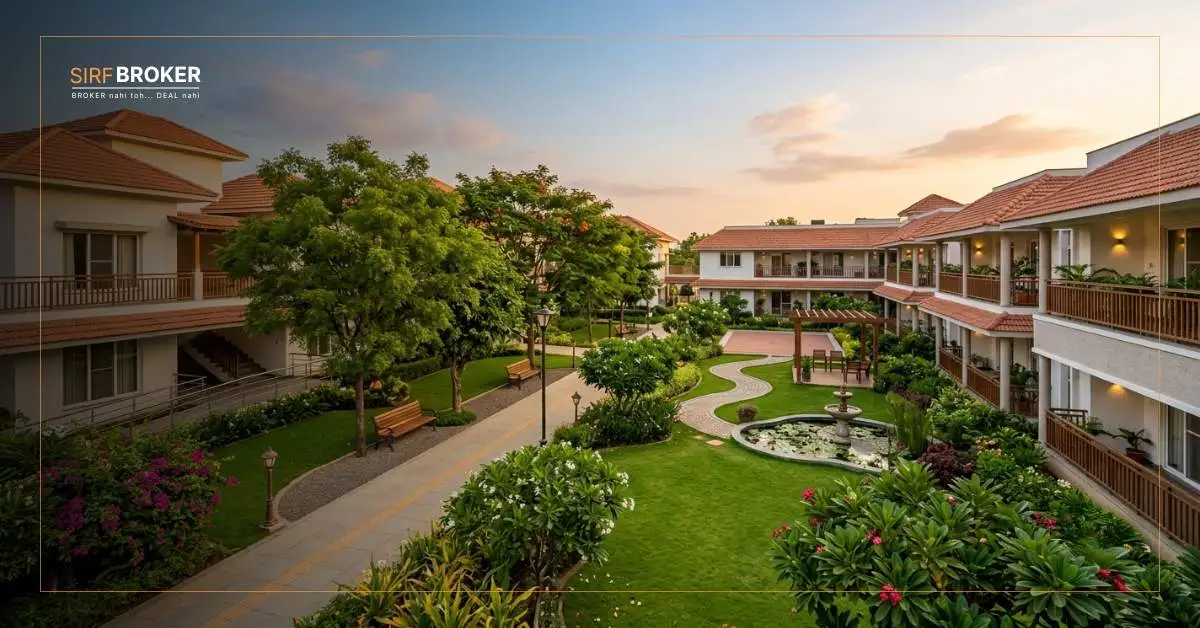
India’s residential real estate conversation is almost entirely about the young: millennials buying their first home, GCC employees upgrading to premium apartments, NRIs investing in Bengaluru or Hyderabad. The 140 million Indians who are currently over 60 years of age — a figure projected to cross 200 million by 2050 per United Nations Population Fund data — are almost entirely absent from that conversation. So is the real estate sector they will eventually need.
India’s organised senior living sector — purpose-built retirement communities, assisted living facilities, and senior-friendly residential developments managed by operators with defined service standards — has fewer than 20,000 units in total inventory across the country. Against a population of 140 million senior citizens, this represents an organised housing coverage of approximately 0.014%. Even if you expand the definition generously to include unregistered senior accommodations and old-age homes, the gap between demand and supply is not a market inefficiency. It is a structural absence.
Understanding this gap — its causes, its current state, and the emerging developer and investor response — is increasingly important for real estate practitioners watching the global “living sector” emerge as an institutional asset class. In India, senior living is the largest undeveloped segment within that category.
The Demographic Reality: Who Are India’s Senior Citizens in 2026?
India’s population over 60 is currently approximately 140 million — roughly the combined population of France and the United Kingdom. It is a heterogeneous group: in health status, from independently mobile to requiring full assisted care; in financial profile, from HNI retirees with significant savings to those entirely dependent on family support; and in family structure, from those living in multi-generational households to those whose children have migrated to other cities or countries.
The most relevant segment for organised senior living real estate is the financially independent senior: a retired government or private sector employee with a pension or retirement corpus, or the parent of a GCC or IT professional who has migrated to a different city. This segment is estimated at 10 to 15 million households — large enough to support a significant organised sector, but historically served almost entirely by informal family arrangements rather than purpose-built facilities.
Three structural shifts are changing this. First, nuclear family formation in India’s urban middle class has accelerated — the adult child who would traditionally have lived with and cared for ageing parents now lives in a different city or country. Second, life expectancy in India’s urban middle class has extended significantly — a 60-year-old in 2026 can expect 20 to 25 more years of life, many in good health, requiring a quality-of-life environment rather than a medical facility. Third, the mental shift from “old-age home” (stigmatised) to “senior living community” (an active, service-rich lifestyle choice) is happening in India, driven by NRI family experience and changing generational attitudes.
| Senior Living Category | Description | Target Resident | India Status |
|---|---|---|---|
| Independent Senior Living | Age-restricted community with amenities, no medical care | Healthy, active senior (60–75) | Very limited supply |
| Assisted Living | Residential with personal care support (meals, housekeeping, mobility) | Senior needing daily support (70+) | Nascent — few organised operators |
| Memory Care | Specialised for dementia and Alzheimer’s patients | Senior with cognitive decline | Extremely limited |
| Continuing Care Retirement | Full spectrum from independent to nursing care in one campus | All senior cohorts | Virtually absent |
| Senior-Friendly Residential | Standard apartments with age-friendly design, no managed services | Active independent senior | Growing but unorganised |
The Current Operator Landscape: Who Is Building Senior Living in India?
India’s organised senior living sector is being built by a handful of operators whose combined inventory accounts for the bulk of the country’s institutional senior housing supply. The sector’s development has been driven more by conviction than by capital efficiency — margins are tighter than conventional residential, and operational complexity is significantly higher.
Antara Senior Living — a subsidiary of Max India, which has deep healthcare experience through Max Healthcare — operates premium senior living communities in Dehradun and Noida, combining residential ownership with a service ecosystem covering healthcare, wellness, concierge, and community programmes.
Columbia Pacific Communities, backed by US-based Columbia Pacific Advisors, operates multiple communities in Bengaluru, Chennai, Pune, and Kolkata. Ashiana Housing, a listed developer, has developed senior housing in multiple cities including Jaipur, Bhiwadi, and Chennai under their Ashiana Utsav brand. Covai Care operates in South India.
Common characteristics of successful operators: proximity to quality healthcare infrastructure (a hospital within 2 to 5 kilometres is considered essential by prospective residents and their families), established brand for trust, a mixed ownership-and-rental model to accommodate different financial capacities, and a service staff team with specific senior care training.
India Senior Living — Demand vs Supply Reality
| 140M+ Indians over 60 in 2026 Source: UNFPA / Census data | <20,000 Organised senior living units in India | 200M+ Projected population over 60 by 2050 |
Source: UNFPA India Ageing Report 2023 | Census of India projections | Industry operator data
Note: Organised unit count is an industry estimate. No regulatory body currently requires mandatory aggregated reporting of senior living facilities in India.
What the Developer Opportunity Actually Looks Like
The senior living developer opportunity in India is real but structurally different from conventional residential development.
Land requirements: Senior living communities require horizontal space — typically 5 to 15 acres minimum for a viable community — and cannot be efficiently delivered in high-rise format. This restricts feasibility to peripheral urban locations and Tier-II cities where land costs are manageable. Attempting senior living in prime urban micro-markets where land costs exceed ₹10 crore per acre makes unit economics unworkable at price points senior residents can afford.
Capital recovery timeline: Senior living is slower to fill than conventional residential. A 200-unit community typically requires 3 to 5 years to reach stabilised occupancy — because the decision cycle is long and emotionally complex, often involving multiple family members and a meaningful shift in lifestyle identity.
Operating company requirement: Organised senior living requires a staffed operating entity — for reception, security, housekeeping, medical support, activities coordination, and community management — running in perpetuity. Developers who build the infrastructure without the service layer have built a building, not a senior living community.
Pricing and tenure structure: Successful operators use a mixed model: outright purchase, long-term lease, and monthly rental — serving different financial profiles within the senior cohort. Monthly maintenance and service fees typically range from ₹15,000 to ₹60,000 per month depending on location, operator quality, and services included. Pure purchase-only models limit absorption because many seniors are asset-rich but cash-flow constrained.
Sirf Broker POV: Senior Living Will Be India’s Most Underestimated Real Estate Category of the Next Decade
The co-living boom in India happened because a large and financially active cohort — urban young professionals — had a housing need that conventional residential did not serve. The sector attracted developer attention, institutional capital, and operator scale within five years. Senior living is the same structural story for a different cohort — but the demographic numbers are larger, the financial capacity of the target market is more substantial, and the supply gap is proportionally wider.
The reason it has not happened yet is not demand — it is product complexity. Senior living requires a developer, an operator, a healthcare partner, and a community design philosophy to work simultaneously. That is more coordination than launching residential units with a standard specification. But developers willing to do that coordination work — or partner with established operators like Antara, Columbia Pacific, or Ashiana — are entering a market with almost no quality competition.
For brokers, senior living represents a mandate category almost never mentioned in broker-developer conversations. That will change as the sector scales. Understanding what drives a senior living purchase decision — proximity to healthcare, community quality, service standards, operator reputation — is entirely different from what drives an apartment sale. Build that understanding now. The mandates will follow.
Conclusion
India’s senior living real estate sector has a demand story backed by 140 million people and a supply story built on fewer than 20,000 organised units. The gap will not close without significant developer participation over the next decade — and developers who enter early do so before institutional capital has discovered and priced the opportunity. For understanding how the broader living sector is being structured as an investment category, our guide to REITs and institutional investment structures is relevant context. For current government housing policy that may eventually be extended to senior housing, our PMAY-Urban 2.0 broker guide covers the policy landscape.
Frequently Asked Questions
Q: How big is India’s senior population and why does it matter for real estate?
A: India has approximately 140 million people over 60 in 2026, projected to exceed 200 million by 2050 per UNFPA data. This creates structural demand for age-appropriate housing — senior living communities, assisted living facilities, and senior-friendly residential developments — that India’s organised housing market has almost entirely failed to supply.
Q: How much organised senior living supply exists in India?
A: India’s organised senior living sector — purpose-built communities managed by operators with defined service standards — has fewer than 20,000 units in total inventory as of 2026. Against a population of 140 million senior citizens, this represents coverage of under 0.02%. The gap is a structural absence, not a market inefficiency.
Q: Who are the main senior living operators in India?
A: The organised sector is served primarily by Antara Senior Living (Max India subsidiary; Dehradun and Noida), Columbia Pacific Communities (Bengaluru, Chennai, Pune, Kolkata), Ashiana Housing’s Utsav brand (Jaipur, Bhiwadi, Chennai), and Covai Care in South India. No operator has yet scaled to more than a few hundred units.
Q: What land and location requirements does senior living development need?
A: Senior living requires a minimum 5 to 15 acres in horizontal format, proximity to quality healthcare infrastructure (hospital within 2 to 5 kilometres), and is most viable at peripheral urban locations or Tier-II cities where land costs are manageable. High-rise delivery is not operationally practical for this product type.
Q: Why is senior living harder to develop than conventional residential?
A: Three factors: slower absorption (3 to 5 years to stabilised occupancy vs months for conventional residential); the requirement for a perpetual operating company running community services; and a complex multi-stakeholder purchase decision involving the senior and their adult children. Developers expecting residential-style velocity and a build-and-exit model will find senior living fundamentally different.
Q: What is the pricing structure of senior living in India?
A: Successful operators use a mixed model: outright purchase, long-term lease, and monthly rental. Monthly maintenance and service fees typically range from ₹15,000 to ₹60,000 per month depending on location and services included. Pure purchase-only models limit absorption because many seniors are asset-rich but cash-flow constrained.
Q: Is senior living in India an institutional investment opportunity?
A: Emerging but not yet at institutional scale. Global senior housing funds have expressed interest in India. Barriers remain: operational complexity, lack of a distinct regulatory framework for senior living as an asset class, and insufficient track record data for institutional underwriting. Operators building track records now are creating the product that will attract institutional capital in the next 5 to 7 years.
Sources:
United Nations Population Fund (UNFPA) — India Ageing Report 2023 (140M over 60; 200M projection by 2050)
Census of India — Elderly population projections
JLL India — Senior Living and Living Sector Report 2026
CBRE India — Alternative Real Estate: Senior Living Market Overview 2026
Operator data: Antara Senior Living, Columbia Pacific Communities, Ashiana Housing annual reports
Note: The figure of under 20,000 organised senior living units is an industry estimate based on operator-reported figures. No regulatory body in India currently requires mandatory registration or reporting of senior living facilities as a distinct category, so a definitive verified total is not publicly available as of 2026.
Disclaimer: This article is for informational purposes only and does not constitute investment advice. Market size estimates are based on industry data and may differ from official figures. Consult qualified advisors before making real estate development or investment decisions.