

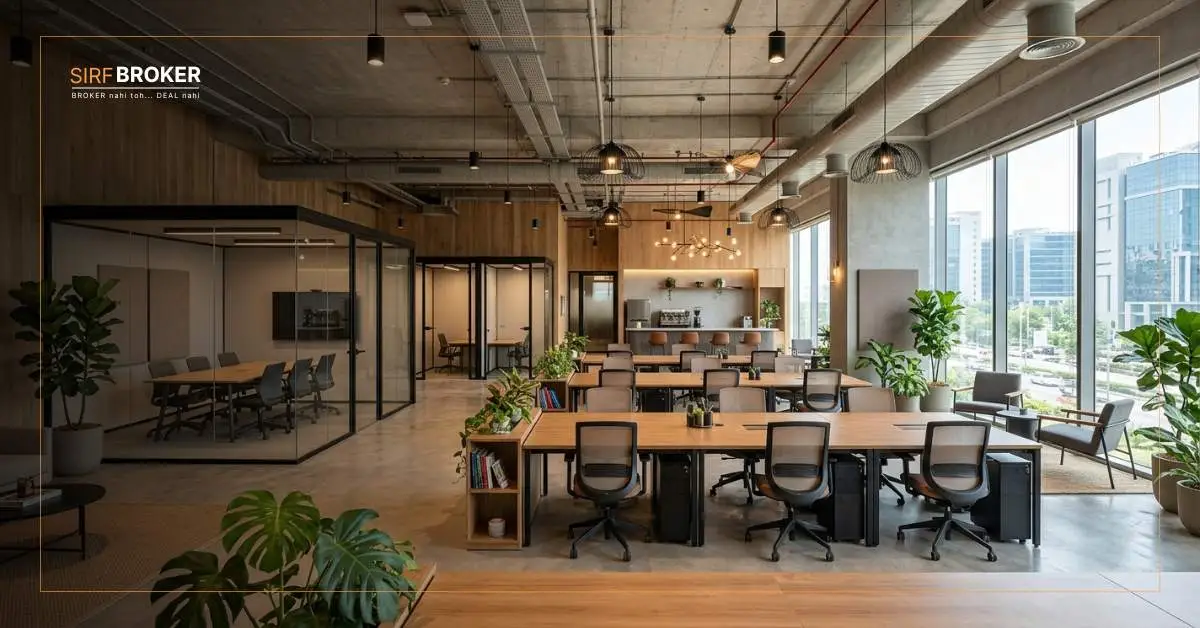
Delhi-NCR has never been India’s most dynamic office leasing market. Bengaluru has had that title for years. Hyderabad has been the new-supply story. Mumbai holds the BFSI premium anchor. Delhi-NCR’s commercial market has always been substantial — but it was not the one generating the most-watched data points.
Q2 2026 changed that, at least for one quarter.
Delhi-NCR recorded its highest-ever quarterly flexible office space absorption in Q2 2026 — with flex operators accounting for 45% of the region’s total leasing of approximately 3.6 million sq ft, according to CBRE India’s Q2 2026 Office Market Report. That 45% flex share is not just a record for Delhi-NCR. It is one of the highest flex-to-total ratios recorded in any major Indian city in a single quarter.
The number tells a story about how occupiers in Delhi-NCR are rethinking their office portfolio strategy — and what brokers in the region need to understand about the market they are now working in.
The Delhi-NCR Q2 2026 Numbers
Total office leasing in Delhi-NCR in Q2 2026: approximately 3.6 million sq ft. Flex operator share: 45% — approximately 1.6 MSF. This is the highest quarterly flex take-up ever recorded for the region. Fresh office supply added to Delhi-NCR in Q2 2026: approximately 2.0 MSF.
By occupier type beyond flex: research, consulting, and analytics firms accounted for 17% of the region’s leasing volume. Technology enterprises secured a 12% share. The sector distribution reflects Delhi-NCR’s growing role as a hub for consulting-led business — the Big 4, strategy consultancies, analytics captives — alongside its established base of technology and BFSI occupiers.
| Occupier Segment | Share of Q2 2026 Delhi-NCR Leasing |
|---|---|
| Flex operators | 45% (~1.6 MSF) |
| Research, consulting & analytics | 17% |
| Technology enterprises | 12% |
| Other segments (BFSI, manufacturing, others) | 26% |
Source: CBRE India Q2 2026 Office Market Report
What Is the Core + Flex Model and Why Is It Reshaping Delhi-NCR?
The core + flex model is the enterprise office portfolio strategy that has driven the flex operator surge. It works like this: a company leases a smaller, stable “core” office on a traditional 5-9 year lease — large enough to anchor their brand, host leadership, and run core operations. For the rest of their space needs — overflow capacity, project-based teams, new employee onboarding before core capacity expands, a Delhi presence while their primary office is in Mumbai — they use managed flexible space.
The advantages for the occupier are significant: capital efficiency (no large fit-out spend on space used irregularly), flexibility (scale up or down within the flex contract), and speed (move in within days rather than the 6-18 months required for a new core office buildout).
Delhi-NCR’s corporate base — heavy in consulting, BFSI, large Indian conglomerates with divisional operations, and government-adjacent entities — has historically leased office space on traditional long-term bases. The 45% flex share in Q2 2026 signals that this corporate base has now adopted the core + flex model at scale. The shift did not happen overnight — it reflects a strategic decision by occupiers who tested flex in 2022-2023 and are now expanding their flex footprint as the model proves out.
Where in Delhi-NCR Is Flex Demand Concentrating?
Gurugram — specifically Cyber City, Golf Course Road, and the emerging Dwarka Expressway corridor — is the primary anchor for flex operator deployments in Delhi-NCR. The concentration of multinational occupiers, financial services firms, and technology enterprises in Gurugram creates a natural demand base for managed flexible spaces that cater to these corporate profiles.
Noida — particularly Sector 62, Sector 132, and the Expressway stretch — is the secondary flex market, driven by technology companies, IT services firms, and the growing GCC presence in the eastern corridor. Noida’s lower rental base relative to Gurugram has also attracted cost-conscious flex operators building inventory for the SME and startup segments.
South Delhi’s commercial markets — Nehru Place, Okhla, Saket — serve a different occupier profile: smaller professional services firms, legal and compliance functions, and government-adjacent businesses. Flex penetration in South Delhi is lower than in Gurugram and Noida but growing.
What This Means for Brokers Working in Delhi-NCR Commercial
The 45% flex share has a direct implication for how commercial brokers in Delhi-NCR work. When nearly half of office leasing in a quarter goes to flex operators rather than direct occupiers, the transaction dynamics shift.
A traditional office lease — direct between landlord and occupier — involves one set of negotiations, one lease document, one set of stamp duty and registration costs. A flex operator lease involves the operator taking a large block from the landlord, then subletting individual suites and hot desks to end-users. The broker’s role, the fee structure, and the transaction timeline are different depending on which end of the deal they are working.
Broker Advisory Note — Flex vs Direct Leasing
When an occupier client says they want office space in Gurugram, the first question is: do they want a direct lease or are they open to a managed flex arrangement? The answer changes which landlords, which products, which fee structures, and which timelines apply. Knowing the client’s preference before starting the search saves everyone’s time and positions the broker as a genuine advisor rather than a space-finder.
Sirf Broker POV: Flex Is Not a Threat to Commercial Brokers. Ignorance of It Is.
The narrative in parts of the broking community is that flex operators are competitors — they take space, manage it, and deliver it to end-users directly, cutting the traditional broker out of the transaction. This narrative confuses the operator’s role with the broker’s role.
Flex operators are landlords of a different kind. They acquire space, fit it out, and operate it. What they are not is a space-finding advisor for the corporate occupier trying to decide between a flex arrangement and a direct lease, between Gurugram and Noida, between three operator options in the same building district. That advisory function belongs to the broker.
The commercial broker in Delhi-NCR in 2026 who understands flex — who knows which operators have inventory where, what the flex pricing model looks like versus a direct lease total cost of occupancy, and how to advise a client on the core + flex balance for their specific headcount and growth trajectory — is adding value that cannot be replicated by walking into a WeWork or Awfis directly. The corporate occupier making a ₹2-5 crore annual occupancy decision wants an advisor, not a tour guide. Flex market knowledge is what separates the two.
Conclusion
Delhi-NCR’s record flex quarter is a lagging indicator of a decision that large occupiers made 12-24 months ago — to make flex a structural part of their office portfolio, not an emergency accommodation. For the broader national office market context from which this Delhi-NCR data comes, our guide to the real cost of office leasing covers what occupiers actually pay when they go direct. For avoiding the mistakes that derail commercial deals, our commercial leasing mistakes guide is required reading before any large transaction.
Frequently Asked Questions
Q: What was Delhi-NCR’s office leasing performance in Q2 2026?
A: Delhi-NCR leased approximately 3.6 million sq ft of office space in Q2 2026, recording its highest-ever quarterly flexible office space take-up. Flex operators accounted for 45% of the region’s total leasing — an all-time record for the region. Source: CBRE India Q2 2026 Office Market Report.
Q: What is the core + flex model in office leasing?
A: Core + flex is a portfolio strategy where a company maintains a smaller, stable long-leased “core” office for their primary operations while using managed flexible office space for overflow capacity, project teams, and new-city presence. It allows companies to avoid committing 100% of their space needs to long-term leases while maintaining an anchored physical presence.
Q: Which occupier segments drove Delhi-NCR office leasing in Q2 2026?
A: Flex operators led at 45% of the region’s leasing. Research, consulting, and analytics firms accounted for 17%, and technology enterprises for 12%. BFSI and other segments made up the remaining 26%.
Q: Which micro-markets in Delhi-NCR have the most flex office space?
A: Gurugram — specifically Cyber City, Golf Course Road, and Dwarka Expressway — is the primary flex market, driven by multinational, financial services, and technology occupiers. Noida (Sector 62, Sector 132, Expressway) is the secondary flex market. South Delhi (Nehru Place, Okhla, Saket) has a smaller but growing flex presence serving professional services and government-adjacent occupiers.
Q: How should a broker advise a client choosing between direct lease and flex?
A: The choice depends on headcount stability, growth trajectory, budget, and timeline. Direct leases suit occupiers with stable or growing headcounts wanting brand identity and lower long-term cost. Flex suits occupiers with variable headcounts, short decision timelines, or those wanting a presence in a new city without a long-term capital commitment. Total cost of occupancy — including fit-out, brokerage, stamp duty, and rent — should be compared across both models.
Q: How large is the flex office market in India overall in 2026?
A: Flex operators took a significant share of India’s record 24.6 MSF Q2 2026 absorption nationally. Delhi-NCR’s 45% flex share was the regional record; other cities including Bengaluru and Mumbai also saw substantial flex demand as part of India’s national office market hitting its all-time quarterly high.
Q: Do flex office operators compete with commercial real estate brokers?
A: No — they serve different functions. Flex operators are a type of landlord. Commercial brokers advise occupier clients on space strategy — comparing flex vs direct lease, selecting micro-markets, negotiating terms, and managing the transaction. A corporate occupier choosing between a WeWork in Cyber City and a direct lease in the same building needs an advisor, not another flex operator pitch. The broker’s value is in the advisory function, not space delivery.