

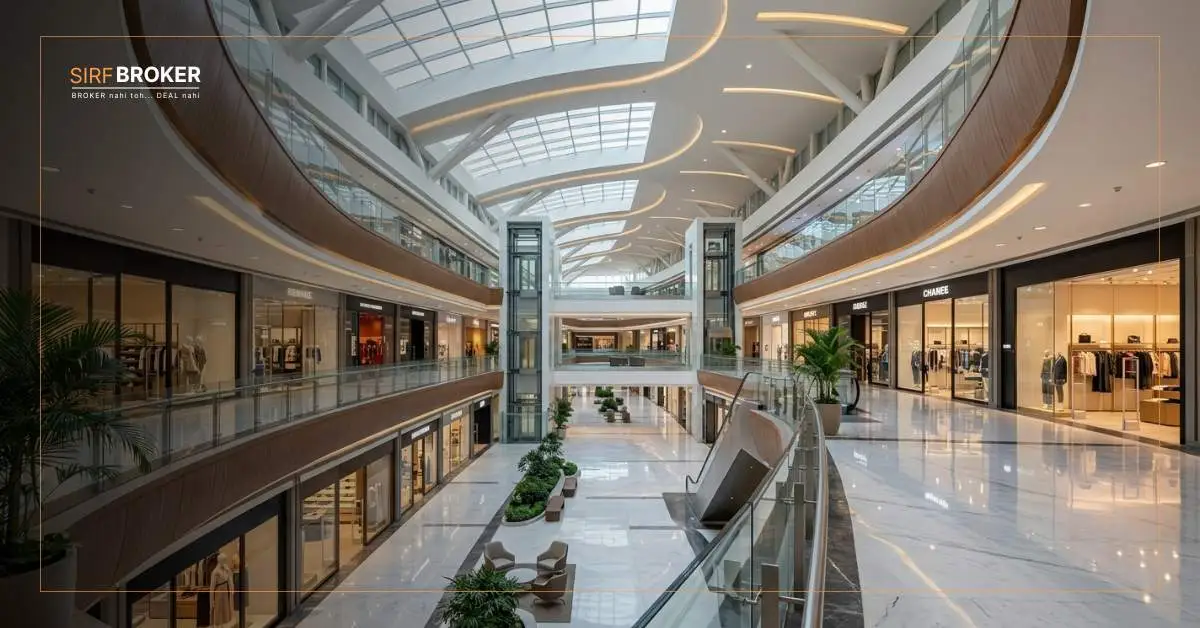
When demand grows 17.6% and supply adds zero, rents move in one direction. India’s retail real estate market in Q2 2026 is sitting in exactly that position — and the implications for developers, retailers, and brokers are sharper than most people reading the headline number have grasped.
According to Cushman & Wakefield’s Q2 2026 India Retail Leasing Report, gross leasing volume across India’s top eight cities reached 2.4 million sq ft in the quarter — up 17.6% year-on-year and 23.2% quarter-on-quarter. Simultaneously, no new Grade A mall supply was added in Q2 2026 — the second consecutive quarter of zero Grade A supply addition. Two forces pulling in opposite directions create one outcome: tighter vacancy, upward rental pressure, and negotiating leverage shifting from landlord-neutral to landlord-favourable.
This matters differently depending on which side of the transaction you’re on. For developers, it’s a green light backed by real data. For retailers looking to lease, it’s a market increasingly unforgiving of slow decision-making. For brokers, it is a market where knowing which Grade A mall or high-street location still has vacant units — and what the landlord’s realistic ask is — is worth real money.
| 2.4 MSF retail leased. +17.6% YoY. Zero new Grade A malls added — for the second consecutive quarter. 12.7 MSF of new supply coming 2026-2028. The question is whether retailer demand will sustain through the delivery cycle. |
The Q2 2026 Retail Leasing Numbers in Detail
The 2.4 MSF of gross retail leasing in Q2 2026 breaks down in ways that reveal the market’s structure clearly, per Cushman & Wakefield’s data.
Malls accounted for 51.3% of total leasing — approximately 1.23 MSF — registering 33.4% quarter-on-quarter growth and 21.9% year-on-year growth. Main streets (high streets) accounted for the remaining 48.7%, or approximately 1.17 MSF, growing 14% sequentially and 13.3% from the prior year.
| Format | Q2 2026 Volume | Share | YoY Growth | QoQ Growth |
|---|---|---|---|---|
| Malls | ~1.23 MSF | 51.3% | +21.9% | +33.4% |
| Main Streets / High Streets | ~1.17 MSF | 48.7% | +13.3% | +14.0% |
| Total | 2.4 MSF | 100% | +17.6% | +23.2% |
Source: Cushman & Wakefield Q2 2026 India Retail Leasing Report, reported by Business Standard, July 1, 2026.
The occupier composition is the most telling data point: domestic retailers drove 82.4% of total leasing — approximately 1.98 MSF — with around 54% of their activity concentrated in main streets. International brands accounted for just 17.6% of leasing (0.42 MSF), with 76% of their transactions in malls. This split says something important: domestic brands — now more sophisticated, better capitalised, and expanding faster than ever — are comfortable with high-street formats and their economics. International brands still need the controlled environment and footfall aggregation that Grade A malls provide.
Why There Is No New Grade A Mall Supply
Two consecutive quarters of zero Grade A retail supply addition is not an accident of timing. It reflects a structural reality in India’s retail real estate development pipeline.
Grade A retail development — integrated malls with modern specifications, anchor tenants, F&B, entertainment, and professional mall management — requires large land parcels, development capital in the range of ₹1,500-2,500 crore, and a three-to-five year gestation from land acquisition to completion. The pipeline that was conceived in 2021-2022 is still under construction. The zero-supply quarters of 2026 are the delivery gap of a pipeline that slowed during the pandemic and hasn’t fully caught up.
| Looking forward, Cushman & Wakefield’s data shows 12.7 MSF of new retail supply scheduled for delivery between 2026 and 2028. That pipeline will substantially change the supply picture. The question is whether demand sustains through the delivery cycle without occupancy softening — as it did in the 2012-2015 oversupply period. |
The difference this cycle: retailers are in genuine expansion mode. Domestic fashion, quick-service restaurants, experiential entertainment, and health and wellness brands are actively seeking new space. The absorption risk in the 2026-2028 pipeline is materially lower than in prior cycles — but it is not zero, and developers building to lower specifications will not benefit from the demand environment that Grade A is attracting.
High Streets Are the Underappreciated Story
The bifurcation between mall and high-street retail is sharpening in ways that matter for micro-market strategy. Malls offer controlled footfall but come with high CAM (Common Area Maintenance) charges, revenue-sharing clauses, and lease structures that can disadvantage smaller brands. High streets — the Linking Roads, Connaught Places, 100-Foot Roads, and local market corridors of India — offer visibility, lower occupancy costs, and flexibility.
The fact that domestic retailers are doing 54% of their leasing on main streets, and growing that share, reflects a market reality: Indian brands now understand their customer well enough to take main-street bets. The footfall aggregation that a Grade A mall guaranteed is less critical when you have strong brand loyalty, digital pre-traffic, and unit economics that work at lower volumes.
| — MALL VS HIGH STREET: WHAT THE Q2 2026 DATA REVEALS — Domestic retailers → 82.4% of all leasing. 54% on high streets. Expanding with discipline — brand loyalty reduces footfall dependency on malls. International retailers → 17.6% of leasing. 76% in malls. Still dependent on managed environments, premium positioning, and guaranteed footfall aggregation. Broker implication → Know both formats. A domestic QSR expanding on Bengaluru’s 100-Foot Road has different lease needs than a European fashion brand entering Phoenix Palassio. The advisory conversation is completely different. |
For brokers handling retail clients, this bifurcation creates a clear advisory opportunity. Understanding CAM structures, revenue-sharing clauses, and exit mechanisms in both formats is what separates a retail leasing specialist from a generalist who handles opportunistic referrals.
For a broader view on how commercial lease structures can create problems if not handled carefully, read: Common Mistakes in Commercial Property Leasing Deals.
What the 2026-2028 Pipeline Means for Developers
The 12.7 MSF of retail supply scheduled between 2026 and 2028 is the clearest opportunity in India’s retail real estate development calendar. But it comes with a critical qualifier: Grade A specification is not optional.
Every data point from Q2 2026 confirms that the supply tightness is specifically in Grade A retail. Secondary malls and underspecified developments are not in short supply. What the market is short of is space that international brands, premium domestic retailers, and high-spending consumers want. Developers who build to lower specifications to cut development cost will not benefit from the current demand environment.
The other implication for developers is anchor tenant strategy. The two formats absorbing most reliably are F&B and experiential — cinemas, gaming, family entertainment — alongside fashion. Pure retail without F&B and experiential anchoring is a weaker proposition than it was five years ago. Any new mall project in the 2026-2028 window should be stress-tested for what happens to occupancy when fashion alone doesn’t fill the floor plate. Retailers and developers interested in the REIT exit option for retail assets should also understand how India’s REIT framework is reshaping commercial real estate ownership.
Sirf Broker POV
India’s retail real estate story in Q2 2026 is not primarily about the 17.6% leasing growth number. It’s about what the demand composition reveals: domestic retail is the engine, high streets are gaining share, and the international brand count that was supposed to surge post-COVID is still a modest 17.6% of the market.
The implication that is being missed in most market commentary: India’s retail real estate is increasingly insulated from global retail headwinds. When international brands consolidate, cut footprint, or exit emerging markets — as several fashion and F&B chains did between 2023 and 2025 — the gap gets absorbed by domestic brands within a quarter or two. That resilience is structural, not cyclical. It comes from the same underlying force driving premium residential demand: a domestic consumer class with disposable income, brand consciousness, and appetite for experience.
For brokers in the retail leasing segment, the watch item for the next 18 months is the 2026-2028 supply pipeline and which developers are executing on schedule. Retail brands in expansion mode will commit to pre-leasing if the developer has a track record. Pre-leasing advisory — helping a retailer evaluate a pipeline project before it’s built — is a higher-margin conversation than reactive vacancy matching. The brokers who move into that pre-leasing advisory space before the supply wave arrives will write the best deals of the cycle. The ones waiting for vacancy to appear will be negotiating from the wrong position in a market that is about to swing from tight to buyer-competitive.
Conclusion
India’s retail real estate is in a demand-supply imbalance that favours landlords and disciplined developers in the near term. Zero supply quarters will not persist — 12.7 MSF is coming — but the demand side is structurally sound enough to absorb it if Grade A specifications are maintained and anchor tenant strategy is thoughtful. The key insight from Q2 2026: the market is moving, and the window for pre-leasing and early positioning closes when the supply arrives.
For the full cost picture that retail occupiers and developers need to understand before committing to a lease, read: The Real Cost of Moving Offices: Why Rent Is Only Half the Story.
Frequently Asked Questions
1. How much did India’s retail leasing grow in Q2 2026?
India’s gross retail leasing volume reached 2.4 million sq ft in Q2 2026 across the top eight cities, registering 17.6% year-on-year growth and 23.2% quarter-on-quarter growth, according to Cushman & Wakefield’s Q2 2026 India Retail Leasing Report.
2. Why is there no new Grade A mall supply in India in 2026?
Grade A mall development requires large land parcels, ₹1,500-2,500 crore in development capital, and a 3-5 year gestation period. The delivery gap in 2026 reflects a slowdown in new mall project launches during 2020-2022. A pipeline of 12.7 MSF is scheduled for delivery between 2026 and 2028.
3. What is the difference between mall leasing and high-street leasing in India?
Mall leasing refers to space within a managed retail complex — controlled environment, shared footfall, CAM charges, and revenue-sharing structures. High-street (main street) leasing is street-facing shop space on established retail corridors with lower occupancy costs and greater flexibility. In Q2 2026, malls took 51.3% of retail leasing and main streets 48.7% per Cushman & Wakefield.
4. Which type of retailer is driving India’s retail leasing demand in 2026?
Domestic retailers drove 82.4% of total retail leasing in Q2 2026 (approximately 1.98 MSF), with 54% of their activity on main streets. International brands accounted for 17.6% of leasing, with 76% of their transactions in malls. India’s domestic retail sector — not global brands — is the primary demand engine.
5. What is the retail real estate supply pipeline in India for 2026-2028?
Cushman & Wakefield data shows 12.7 MSF of new retail supply — predominantly Grade A malls — scheduled for delivery between 2026 and 2028. If demand sustains its current trajectory and developers maintain Grade A specifications with strong F&B and experiential anchor strategies, the market has capacity to absorb this supply.
6. How should brokers approach retail leasing in India in 2026?
Specialise by format (mall vs. high street), build relationships with domestic brand expansion teams, and position for pre-leasing advisory on pipeline projects before they’re built. Understanding CAM structures, revenue-sharing clauses, and anchor-to-vanilla tenant mix ratios is the specialist knowledge that separates high-margin retail leasing brokers from generalists.
Sources and References
- Cushman & Wakefield — Q2 2026 India Retail Leasing Report — 2.4 MSF gross leasing +17.6% YoY; malls 51.3%; main streets 48.7%; domestic retailers 82.4%; zero Grade A supply Q2; pipeline 12.7 MSF 2026-28. cushmanwakefield.com
- Business Standard — July 1, 2026 — India’s Q2 2026 retail leasing grows 17.6% YoY amid sustained demand. business-standard.com
- Realty NXT / NewKerala — July 2, 2026 — India retail leasing rises 18% to 2.4 MSF Q2 2026; Delhi NCR leads with 30% share. realtynxt.com
Disclaimer
| This article is published by Sirf Broker for educational and informational purposes only. Retail leasing volumes and supply pipeline data are sourced from publicly available third-party reports cited above and are subject to revision. This is not investment or transaction advice. |