

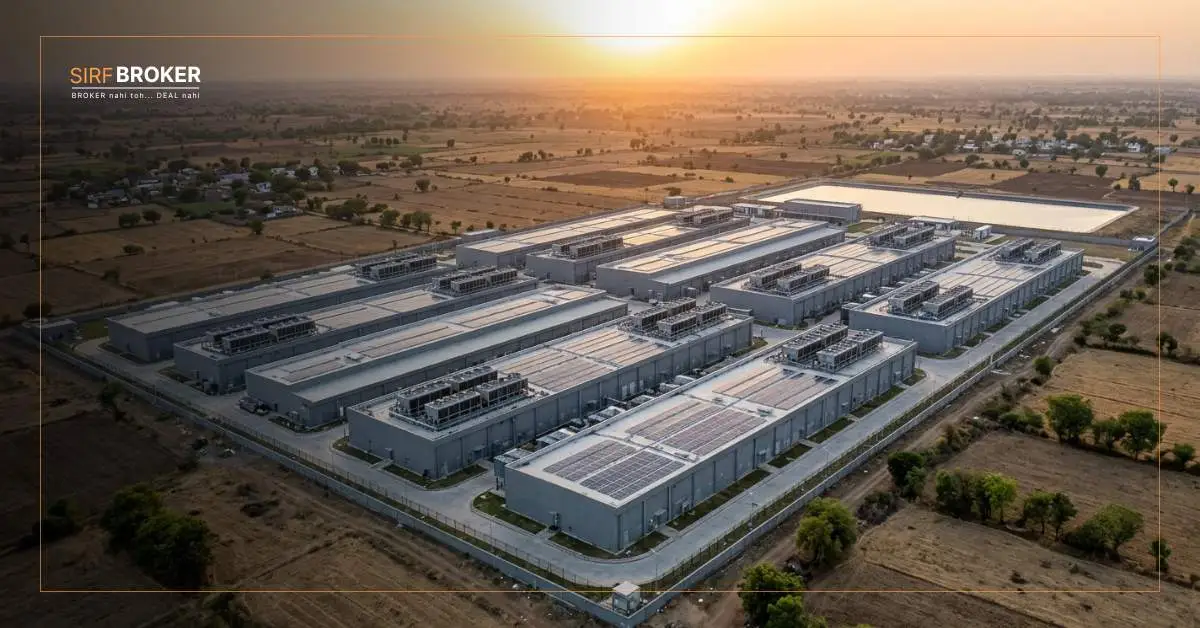
India’s data centre sector is undergoing a capital deployment event that has no precedent in the country’s real estate history. Total investment commitments are projected to exceed USD 180 billion in 2026. Data centre capacity is expected to grow 30% year-on-year. Mumbai alone is expected to cross the 1 GW installed capacity milestone. AirTrunk has committed USD 30 billion to India. Blackstone is executing a proposed ₹10,000 crore digital infrastructure hub. The Reliance-Meta partnership is building infrastructure to support AI and cloud demand across the subcontinent. In Q2 2026, data centres overtook office to become the single largest destination for private equity real estate flows in India — capturing 38% of institutional inflows for the quarter.
The capital is real. The demand is real. The constraint is not regulatory or demand-side. It is electricity.
| India data centre 2026 snapshot: USD 180B+ investment commitments. 30% capacity growth projected. Mumbai: 41% national market share, expected to cross 1GW in 2026. Grid India projection: current 1.2GW data centre load to rise to 8-10GW by 2030. Electricity: 40-60% of daily data centre operating costs. Transmission infrastructure gap: solar/wind plants built in 18-24 months; transmission lines take 36-60 months. Source: CBRE India; IEEFA; GRI Hub; The Star, May 2026. |
Why Power Is Now the Primary Real Estate Variable for Data Centres
A traditional commercial real estate decision is driven by location, floor plate, amenities, and price per sq ft. A data centre real estate decision is driven by one thing above all others: assured, reliable, cost-competitive power at scale.
Data centres consume electricity at a rate that industrial and commercial buildings cannot approach. Electricity represents 40-60% of a data centre’s daily operational expenditure — more than labour, more than maintenance, more than connectivity. A hyperscale data centre requires upwards of 100 MW of continuous power supply. Multiple such facilities — the kind AirTrunk, Microsoft, and Google are building in India — require power at grid-destabilising scale if not planned for systematically.
| INDIA’S POWER GRID AND DATA CENTRES: THE NUMBERS Mumbai’s grid history → Mumbai has a historically isolated grid — physically disconnected from the national grid for decades. It failed in 2020 and 2022. The Kharghar-Vikhroli 400KV line (late 2023) added ~1,000 MW import capacity; the Mumbai Urja Marg inter-state line (2024) added ~2,000 MW more. These additions matter, but Mumbai’s grid must now absorb data centre loads that could individually run to 1 GW. By 2030, data centres could consume a third of the electricity produced in the city. Source: IEEFA; The Star, May 2026. The transmission gap → A solar or wind project in India is built in 18-24 months. The transmission line to carry its power to an urban load centre takes 36-60 months. Build-out has run at approximately 80% of target, leaving renewable plants built but idle, waiting for grid connections. For a data centre developer with committed capital and an occupier ready to move in, a 36-60 month transmission timeline is not a footnote — it is a project constraint of the highest order. Source: IEEFA; Grid India; GRI Hub. 2030 projection → Grid India estimates that India’s current data centre load of 1.2 GW could rise to 8-10 GW by 2030. This is a 7-8x increase in less than four years. The national grid, renewable generation capacity, and transmission infrastructure are not currently calibrated for this trajectory — creating both a bottleneck and an investment opportunity in power infrastructure itself. Source: Grid India; GRI Hub India Data Centres report, 2026. |
The Real Estate Implications — Where Data Centres Are and Aren’t Going
Power availability — not land price, not connectivity, not government incentives — is increasingly the determinant of where large-scale data centres can be built in India. This is creating a market geography that diverges significantly from traditional commercial real estate:
| Location | Data Centre Status | Power Position | Constraint |
|---|---|---|---|
| Mumbai | 41% national share; approaching 1GW | Grid upgraded but strained; submarine cable landing advantage | Grid capacity ceiling approaching; cost highest in India |
| Delhi NCR | Major hub; 15-18% national share | Stronger national grid interconnection | Land cost in Noida/Greater Noida rising as data centre demand grows |
| Chennai | Tier-1 hub; submarine cable advantage | Renewable energy access via Tamil Nadu wind/solar | Water scarcity for cooling in summer months |
| Bengaluru | Growing | Karnataka renewable surplus creating opportunity | Inland location limits submarine cable advantage |
Source: CBRE India Data Centre Report 2026; IEEFA India; GRI Hub Data Centres report.
Policy — What the Government Is Doing to Unlock Power for Data Centres
| The Government of India has announced: long-term tax holidays until 2047 for foreign cloud providers using India-based infrastructure; 15% safe harbour margin for domestic data centres to ease transfer pricing; capital support of 25-35% for green technology investments in data centres. These are demand-enabling measures. The missing piece is supply-side infrastructure: a transmission build-out programme that matches the speed of data centre deployment. Source: CBRE India; Ministry of Electronics and Information Technology 2026. |
What This Means for Real Estate Brokers and Developers
Data centre real estate is not a sector where brokers operate in the same way as residential or even mainstream commercial. The clients are global hyperscalers, domestic carriers, and specialised data centre operators — not individual buyers or standard corporate occupiers. Transactions are measured in acres and megawatts, not square feet and fit-out budgets.
But the ripple effects are squarely within mainstream real estate practice. Data centre hubs create secondary demand: corporate offices for operations and engineering teams near the facilities, industrial sheds for hardware logistics and staging, and residential demand from the employment base. The data centre campuses being built near Navi Mumbai, Greater Noida, and the outer periphery of Bengaluru are generating the same kind of micro-market development that IT parks generated in the 2000s — and that is entirely within a broker’s practical purview.
For understanding the commercial office demand driven by these employment clusters: The Real Cost of Moving Offices: Why Rent Is Only Half the Story. For investment products that provide exposure to these assets: REITs Are Changing Real Estate Investing: What Brokers Must Learn.
Sirf Broker POV
The data centre boom is the most significant new real estate asset class to emerge in India since IT parks in the 1990s. The capital numbers are staggering, the demand fundamentals are real, and the government policy support is genuine. But the AI infrastructure sprint is running ahead of the infrastructure reality in one critical dimension: power.
India cannot build data centres at $180 billion of investment commitment without simultaneously building the transmission infrastructure to power them. The 36-60 month gap between renewable energy generation and transmission line connectivity is not a solvable problem within a single project’s development timeline — it is a national infrastructure planning problem. Mumbai’s grid, already at the edge of its capacity and historically prone to failure, is being asked to absorb a load trajectory that could reach a third of the city’s total electricity consumption by 2030.
The developers and investors who will outperform in this cycle are not those who are first to commit capital to land near data centre hubs. They are those who are first to solve the power question — through captive renewable energy, private grid connections, or co-location with power infrastructure rather than the other way around. Power is the new location in data centre real estate. The premium address is the one with guaranteed megawatts.
Conclusion
India’s data centre sector has attracted over USD 180 billion in investment commitments and is on track for 30% capacity growth in 2026. Data centres overtook office in Q2 2026 PE flows, accounting for 38% of institutional inflows. The binding constraint is power: electricity represents 40-60% of operational costs, Mumbai’s grid is approaching capacity limits, and transmission build-out lags data centre construction by 36-60 months. The developers who solve the power problem first — through captive renewables, grid co-investment, or strategic site selection near power infrastructure — will define the next decade of this asset class in India.
Frequently Asked Questions
1. Why are data centres considered real estate assets in India?
Data centres are capital-intensive physical infrastructure assets — they require land, purpose-built buildings, power infrastructure, and cooling systems. They are bought, sold, leased, and valued using real estate frameworks (cap rates, yield on cost, long-term occupier leases). Institutional investors including REITs, private equity funds, and pension capital treat them as an alternative real estate asset class alongside office, industrial, and retail.
2. How much is being invested in India’s data centre sector in 2026?
Total cumulative investment commitments are projected to exceed USD 180 billion in 2026, according to CBRE India. Key transactions include AirTrunk’s USD 30 billion commitment, Blackstone’s proposed ₹10,000 crore hub, and the Reliance-Meta partnership. Data centres captured 38% of total PE real estate inflows in Q2 2026, overtaking office for the first time.
3. Why is power the biggest challenge for India’s data centre growth?
Electricity accounts for 40-60% of a data centre’s daily operational costs. Mumbai’s grid is strained and has failed in 2020 and 2022. Transmission lines take 36-60 months to build — much longer than the 18-24 months for renewable generation. Grid India projects data centre load to rise from current 1.2 GW to 8-10 GW by 2030 — a 7-8x increase requiring massive transmission investment. Source: IEEFA; Grid India; GRI Hub 2026.
4. Which Indian cities are the biggest data centre markets?
Mumbai holds 41% of national data centre market share and is expected to cross 1 GW in 2026. Delhi NCR holds approximately 15-18%. Chennai benefits from submarine cable landing stations and Tamil Nadu’s renewable energy surplus. Bengaluru is growing, leveraging Karnataka’s renewable surplus. Together these four cities account for nearly 90% of India’s tier-1 data centre capacity.
5. What policy support is India providing for data centre growth?
Tax holidays until 2047 for foreign cloud providers using India-based infrastructure; 15% safe harbour margin for domestic data centres on transfer pricing; 25-35% capital support for green technology investments. The policy framework is supportive — the gap is transmission infrastructure build-out matching the speed of data centre deployment.
6. How does the data centre boom affect mainstream real estate brokers?
Data centre campuses create secondary demand: corporate office space for engineering and operations teams, industrial sheds for hardware logistics, and residential demand from employment clusters. These are identical to the micro-market development patterns that IT parks created in the 2000s — and are squarely within a mainstream broker’s commercial and residential practice scope.