

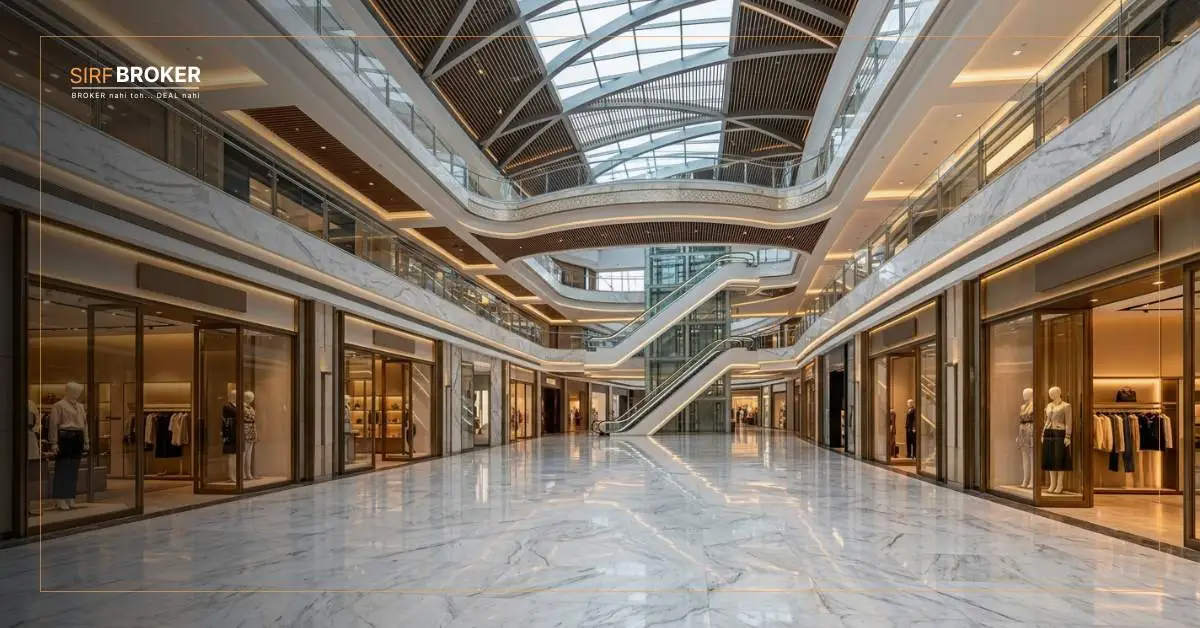
Retail space leasing across Delhi-NCR’s malls and high streets reached 1.3 million sq ft in the first half of 2026 — a 78% increase year-on-year, according to Cushman & Wakefield’s H1 2026 retail market report published on July 25, 2026. Fashion brands led the charge, accounting for 28% of total retail leasing. Food and beverage operators followed at 16%, and department stores at 12%. The result is a retail leasing environment where demand is outpacing available supply, Grade A+ mall vacancy has compressed to approximately 1%, and landlords are firming rents for the first time in several years.
The 78% growth figure deserves immediate context: it is building on a relatively moderate H1 2025 base, and it reflects a genuine structural shift in which categories are expanding aggressively in organised retail real estate, not a one-off demand spike. Fashion and F&B together drive nearly half of all Delhi-NCR retail absorption. Both categories are structurally growing — not recovering. Understanding why they are growing, where they are going, and what they require from retail landlords is the practical knowledge that separates a retail real estate specialist from a generalist in this market.
| Delhi-NCR Retail — H1 2026 at a glance · Total leasing H1 2026: 1.3 MSF — up 78% YoY · Fashion: 28% of total absorption (largest segment) · F&B: 16% · Department stores: 12% · Gurugram: 54% of Q1 market share · Delhi: 26% · Noida: 20% · Mall leasing: 64% of Q1 activity · Grade A mall vacancy: 7.9% · Grade A+ mall vacancy: ~1% Source: Cushman & Wakefield H1 2026 Retail Report; Business Standard, July 25, 2026. |
Why Fashion Is Leading — and What It Requires
Fashion brands accounting for 28% of Delhi-NCR retail leasing in H1 2026 is not an accident of timing. It reflects the convergence of three structural forces: the expansion of international fashion brands that accelerated India market entry post-pandemic and are now scaling their store networks, the emergence of a large aspirational consumer class in Gurugram and Noida’s GCC-employment corridors who spend meaningfully on branded apparel and footwear, and the replacement cycle happening in older mall formats as brands that signed decade-old leases renegotiate and upgrade to Grade A locations.
Fashion tenants are not interchangeable from a landlord or broker perspective. International fashion brands — particularly those in the ₹3,000–15,000 per unit price range that targets the GCC professional demographic — have specific requirements: minimum 2,000–5,000 sq ft per unit, anchor co-tenancy with other premium fashion and lifestyle brands, specific frontage-to-depth ratios, high natural footfall micro-locations within the mall, and landlord willingness to contribute fit-out incentives for long-term leases. Securing these tenants requires the kind of retail real estate specialist knowledge that goes well beyond property listings.
The high-street component of the Delhi-NCR retail story is also worth noting. F&B operators — cafes, casual dining, quick service restaurants — are driving high-street leasing in established neighbourhoods: Connaught Place, Khan Market, South Extension in Delhi; Golf Course Road, Sector 29 in Gurugram; Sector 18 in Noida. High-street F&B requirements differ significantly from mall requirements: footfall data, visibility from arterial roads, proximity to residential density, and parking access matter more than mall anchor composition.
The Vacancy Picture: Grade A+ at Near-Zero
The most operationally significant retail data point in Delhi-NCR right now is not the leasing volume — it is the vacancy rate. Grade A+ malls in Delhi-NCR have vacancy compressed to approximately 1%, per Cushman & Wakefield’s Q1 2026 data. Grade A malls carry a 7.9% vacancy rate.
These numbers have a direct consequence for how retail brokers operate in this market. A brand looking to enter or expand in Delhi-NCR’s premium mall environment — a DLF Mall of India, an Ambience Mall, a Worldmark Aerocity — is not shopping among multiple vacant options. They are on waiting lists, competing for spaces that will become available on natural lease expiry. The broker who knows which tenants are approaching lease end in which mall, in which category, and with what renewal appetite has an intelligence advantage that is not derivable from any public source.
For developers with retail assets in Delhi-NCR, near-zero Grade A+ vacancy is a rent-growth signal. Cushman & Wakefield notes that tighter vacancies are translating into firmer rentals and stronger landlord negotiating positions. Developers planning new retail supply — particularly in Gurugram’s emerging corridors around the Dwarka Expressway and the upcoming diplomatic enclave retail districts — are entering a market where demand is structurally ahead of supply. That is the most favourable supply window for new retail development in Delhi-NCR since the pre-2015 mall expansion cycle.
| Sub-Market | Q1 2026 Share | Primary Demand Driver |
|---|---|---|
| Gurugram | 54% of Delhi-NCR retail leasing | GCC professional consumer base; premium fashion and F&B expansion |
| Delhi (South, CP, Khan Market) | 26% | Legacy premium high-street; F&B, lifestyle, and specialty retail |
| Noida (Sector 18, Expressway) | 20% | Volume-driven fashion and anchor retail; GCC workforce proximity |
What This Means for Retail Real Estate Brokers
Delhi-NCR’s retail leasing rebound creates a specific opportunity for brokers who have maintained active mall and high-street relationships through the 2020–2023 slowdown. The retailers expanding in H1 2026 — fashion brands in the ₹3,000–15,000 aspirational range, quick-service and casual dining F&B operators, and specialty lifestyle brands — are actively seeking brokers who know the micro-vacancy situation in specific malls, the landlord appetite for new category tenants, and the negotiation mechanics of retail leases (revenue share versus minimum guarantee, fit-out contribution, lock-in period structures).
Retail leases are structurally different from office leases. The commercial terms — minimum guarantee rents, revenue share arrangements, fit-out contribution expectations, anchor co-tenancy clauses — require specific knowledge that most commercial office brokers do not have. Brokers who have built retail-specific knowledge are operating in a market where supply is scarce, demand is strong, and tenant-side advisory is genuinely valuable. For an understanding of how commercial lease structures differ and where most mistakes are made, read: Common Mistakes in Commercial Property Leasing Deals.
Sirf Broker POV
The 78% growth in Delhi-NCR retail leasing is striking. What is more striking is where it is concentrated: Gurugram, at 54% of the market, is the demand engine. And Gurugram’s retail demand is being driven by the same force that is driving its office market — the GCC workforce. A senior technology engineer or a BFSI GCC professional earning ₹30–60 lakh annually is a retail consumer of a fundamentally different character from the aspirational shopper who drove the first wave of Indian mall expansion in the 2000s. They spend differently, they brand differently, and they congregate in different locations within the city.
The retail brands that understand this — and are signing leases in DLF Cybercity-adjacent retail, in Sector 29’s restaurant corridor, in the premium high-streets growing around Golf Course Extension Road — are not making location decisions randomly. They are following demographic concentration. The retail broker who maps GCC employment geography onto retail catchment area analysis is doing something almost nobody in the Indian retail real estate market is systematically doing. That broker has a genuine, demonstrable edge in advising both retail tenants on where to locate and developers on what categories to attract to which asset.
Grade A+ mall vacancy at 1% is not a curiosity statistic. It is the clearest signal that premium organised retail in Delhi-NCR has fundamentally tipped from a landlord-seeking-tenant dynamic to a tenant-seeking-location dynamic. The brokers who built the right landlord relationships over the last three years are now on speed dial for every fashion and F&B brand entering or expanding in the NCR. The ones who didn’t are watching the deals get done without them.
Conclusion
Delhi-NCR retail leasing reached 1.3 million sq ft in H1 2026 — a 78% year-on-year increase per Cushman & Wakefield. Fashion led at 28% of absorption, F&B at 16%. Gurugram drove 54% of all leasing. Grade A+ mall vacancy compressed to approximately 1%. Demand is structurally ahead of supply and Cushman & Wakefield projects demand will outpace availability in the near term, supporting rental growth across premium retail assets.
For retail brokers in Delhi-NCR, this is the most active market in several years — and it is rewarding specialist knowledge over generalist relationships. Brokers who know the micro-vacancy situation in specific malls, the tenant mix strategies of key developers, and the commercial lease mechanics of retail tenancy agreements are the ones capturing mandates in a supply-constrained market. For the full commercial cost picture when advising expanding retailers, read: The Real Cost of Moving Offices: Why Rent Is Only Half the Story.
Frequently Asked Questions
How much retail space was leased in Delhi-NCR in H1 2026?
Retail space leasing in Delhi-NCR reached 1.3 million sq ft in H1 2026 — an increase of 78% year-on-year, according to Cushman & Wakefield’s H1 2026 retail market report published on July 25, 2026. This includes both mall and high-street leasing across Gurugram, Delhi, and Noida.
Which categories are driving Delhi-NCR retail leasing in 2026?
Fashion brands led Delhi-NCR retail leasing in H1 2026 with a 28% share, followed by food and beverage (F&B) operators at 16% and department stores at 12%, per Cushman & Wakefield. Fashion and department store segments recorded the highest absolute increase in leasing volume in H1 2026 compared to H1 2025.
What is the vacancy rate in Delhi-NCR’s premium malls in 2026?
Grade A malls in Delhi-NCR carry a vacancy rate of approximately 7.9%, while Grade A+ malls have compressed to approximately 1% vacancy, per Cushman & Wakefield Q1 2026 data. Near-zero vacancy in premium assets is translating into firmer rents and stronger landlord negotiating positions across the Delhi-NCR retail market.
Which sub-market leads Delhi-NCR retail leasing in 2026?
Gurugram dominated Delhi-NCR retail leasing in Q1 2026 with a 54% market share, followed by Delhi at 26% and Noida at 20%, per Cushman & Wakefield. Gurugram’s dominance reflects its dense GCC professional workforce base, which drives consumption of premium fashion, F&B, and lifestyle retail.
What type of retail space is most in demand in Delhi-NCR in 2026?
Mall-based leasing accounted for 64% of Q1 2026 retail activity in Delhi-NCR, per Cushman & Wakefield. Within malls, Grade A+ assets with low vacancy are in highest demand from fashion and F&B occupiers. High-street leasing is also growing, particularly for F&B operators targeting established residential and office corridors in Gurugram and South Delhi.
What does the Delhi-NCR retail leasing data mean for brokers?
A 78% leasing increase in a supply-constrained market — Grade A+ vacancy near 1% — creates strong demand for brokers with genuine specialist knowledge: micro-vacancy intelligence in specific malls, retail lease commercial structures (revenue share, minimum guarantee, fit-out contributions), and tenant-mix advisory capability. Generalist brokers without retail-specific knowledge will find the best mandates in this market going to specialists who have maintained active mall and high-street relationships.